
Articles | Volume 8, issue 2
https://doi.org/10.5194/gchron-8-255-2026
© Author(s) 2026. This work is distributed under
the Creative Commons Attribution 4.0 License.
the Creative Commons Attribution 4.0 License.
https://doi.org/10.5194/gchron-8-255-2026
© Author(s) 2026. This work is distributed under
the Creative Commons Attribution 4.0 License.
the Creative Commons Attribution 4.0 License.
Research article
| 
05 May 2026
Research article |
| 05 May 2026
| 05 May 2026
Paired 14C–10Be exposure ages from Mount Murphy, West Antarctica: Implications for accurate and precise deglacial chronologies
Jonathan R. Adams
CORRESPONDING AUTHOR

Department of Earth Science & Engineering, Imperial College London, Exhibition Road, London, SW7 2AZ, UK
British Antarctic Survey, High Cross, Madingley Road, Cambridge, CB3 0ET, UK
Dylan H. Rood
Department of Earth Science & Engineering, Imperial College London, Exhibition Road, London, SW7 2AZ, UK
Klaus Wilcken
Australian Nuclear Science and Technology Organization, Lucas Heights, NSW 2234, Australia
Stephen J. Roberts
British Antarctic Survey, High Cross, Madingley Road, Cambridge, CB3 0ET, UK
Joanne S. Johnson
British Antarctic Survey, High Cross, Madingley Road, Cambridge, CB3 0ET, UK
Related authors
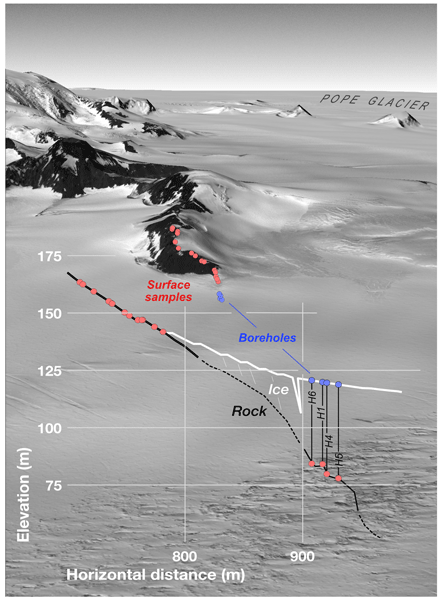
Greg Balco, Nathan Brown, Keir Nichols, Ryan A. Venturelli, Jonathan Adams, Scott Braddock, Seth Campbell, Brent Goehring, Joanne S. Johnson, Dylan H. Rood, Klaus Wilcken, Brenda Hall, and John Woodward
The Cryosphere, 17, 1787–1801, https://doi.org/10.5194/tc-17-1787-2023, https://doi.org/10.5194/tc-17-1787-2023, 2023
Short summary
Short summary
Samples of bedrock recovered from below the West Antarctic Ice Sheet show that part of the ice sheet was thinner several thousand years ago than it is now and subsequently thickened. This is important because of concern that present ice thinning in this region may lead to rapid, irreversible sea level rise. The past episode of thinning at this site that took place in a similar, although not identical, climate was not irreversible; however, reversal required at least 3000 years to complete.

Jonathan R. Adams, Joanne S. Johnson, Stephen J. Roberts, Philippa J. Mason, Keir A. Nichols, Ryan A. Venturelli, Klaus Wilcken, Greg Balco, Brent Goehring, Brenda Hall, John Woodward, and Dylan H. Rood
The Cryosphere, 16, 4887–4905, https://doi.org/10.5194/tc-16-4887-2022, https://doi.org/10.5194/tc-16-4887-2022, 2022
Short summary
Short summary
Glaciers in West Antarctica are experiencing significant ice loss. Geological data provide historical context for ongoing ice loss in West Antarctica, including constraints on likely future ice sheet behaviour in response to climatic warming. We present evidence from rare isotopes measured in rocks collected from an outcrop next to Pope Glacier. These data suggest that Pope Glacier thinned faster and sooner after the last ice age than previously thought.
Megan Thayne, Nicolas Bakken-French, Sam Pappas, Andrew Kicinski, Emmett Elsom, Nikolau Knepper, Dylan H. Rood, and Anders E. Carlson
EGUsphere, https://doi.org/10.5194/egusphere-2026-4076, https://doi.org/10.5194/egusphere-2026-4076, 2026
This preprint is open for discussion and under review for The Cryosphere (TC).
Short summary
Short summary
Field mapping and remote sensing documents the 2023 extent of glaciers on 5 volcanos in the Oregon central Cascades. These glaciers lost ~20 % of their area in the last 3–5 years at 3.2–11.3 % per year, which are 4.5–6.1 times faster than prior retreat. These rates are some of the fastest in western North America and rival rates in the Austrian Alps. Smaller glaciers are losing area faster. Summer warming of ~ 0.7 °C since ~1990 to ~ 1.5 °C since ~1980 is driving this rapid glacier area loss.
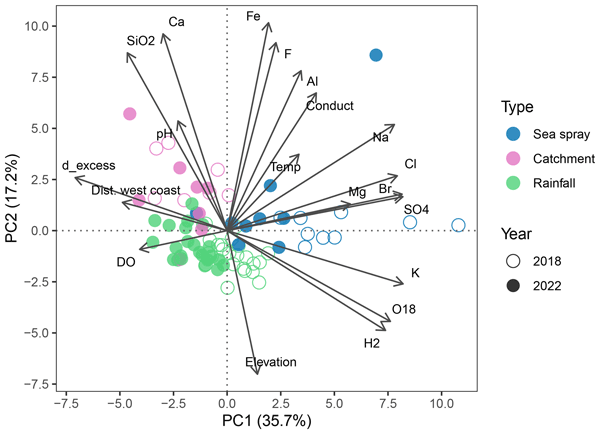
Caitlin A. Selfe, Karina Meredith, Liza McDonough, Justine Shaw, Stephen J. Roberts, and Krystyna M. Saunders
Biogeosciences, 23, 3807–3827, https://doi.org/10.5194/bg-23-3807-2026, https://doi.org/10.5194/bg-23-3807-2026, 2026
Short summary
Short summary
This study presents an updated diatom–conductivity model to reconstruct past Southern Hemisphere westerly wind strength from lake sediments on sub-Antarctic Macquarie Island. We analysed diatom–environment relationships using seasonal and multi-year water chemistry and isotope data. Diatoms respond strongly to changes in lake water conductivity driven by wind-blown sea spray. The model provides a reliable tool for tracking long-term wind patterns and understanding past and future climate change.
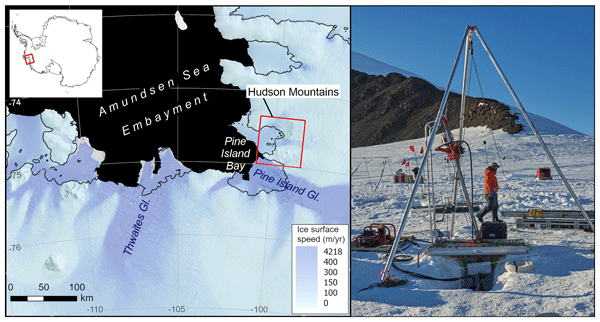
Joanne S. Johnson, John Woodward, Ian Nesbitt, Kate Winter, Seth Campbell, Keir A. Nichols, Ryan A. Venturelli, Scott Braddock, Brent M. Goehring, Brenda Hall, Dylan H. Rood, and Greg Balco
The Cryosphere, 19, 303–324, https://doi.org/10.5194/tc-19-303-2025, https://doi.org/10.5194/tc-19-303-2025, 2025
Short summary
Short summary
Determining where and when the Antarctic ice sheet was smaller than present requires recovery and exposure dating of subglacial bedrock. Here we use ice sheet model outputs and field data (geological and glaciological observations, bedrock samples, and ground-penetrating radar) to assess the suitability for subglacial drilling of sites in the Hudson Mountains, West Antarctica. We find that no sites are perfect, but two are feasible, with the most suitable being Winkie Nunatak (74.86°S, 99.77°W).
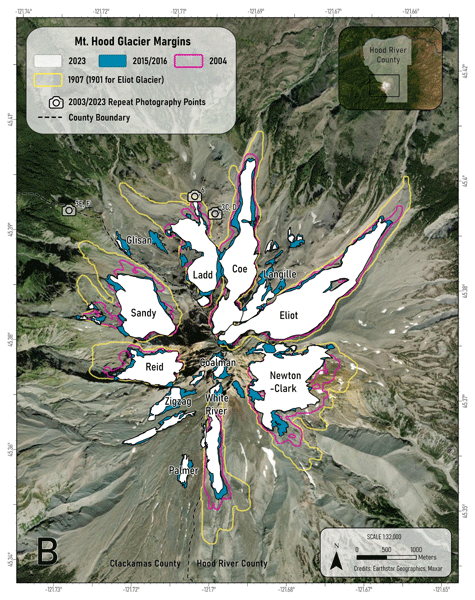
Nicolas Bakken-French, Stephen J. Boyer, B. Clay Southworth, Megan Thayne, Dylan H. Rood, and Anders E. Carlson
The Cryosphere, 18, 4517–4530, https://doi.org/10.5194/tc-18-4517-2024, https://doi.org/10.5194/tc-18-4517-2024, 2024
Short summary
Short summary
Repeat photography, field mapping, and remote sensing find that glaciers on Mt. Hood, Oregon, have lost about 25 % of their area in the first 2 decades of the 21st century and 17 % of their area in the last 7–8 years. The 21st century recession rate is more than 3 times faster than the 20th century average and 1.9 times faster than the fastest period of retreat within the 20th century. This unprecedented retreat corresponds to regional summer warming of 1.7–1.8°C relative to the early 1900s.
Jacob T. H. Anderson, Toshiyuki Fujioka, David Fink, Alan J. Hidy, Gary S. Wilson, Klaus Wilcken, Andrey Abramov, and Nikita Demidov
The Cryosphere, 17, 4917–4936, https://doi.org/10.5194/tc-17-4917-2023, https://doi.org/10.5194/tc-17-4917-2023, 2023
Short summary
Short summary
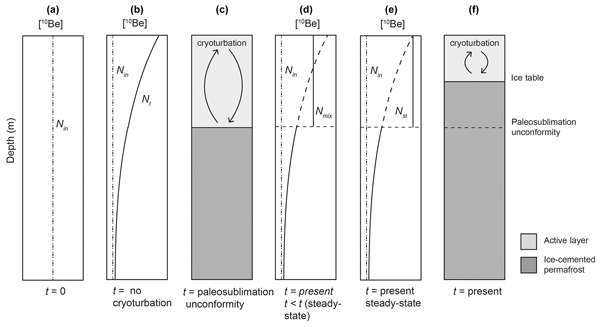
Antarctic permafrost processes are not widely studied or understood in the McMurdo Dry Valleys. Our data show that near-surface permafrost sediments were deposited ~180 000 years ago in Pearse Valley, while in lower Wright Valley sediments are either vertically mixed after deposition or were deposited < 25 000 years ago. Our data also record Taylor Glacier retreat from Pearse Valley ~65 000–74 000 years ago and support antiphase dynamics between alpine glaciers and sea ice in the Ross Sea.
Jennifer R. Shadrick, Dylan H. Rood, Martin D. Hurst, Matthew D. Piggott, Klaus M. Wilcken, and Alexander J. Seal
Earth Surf. Dynam., 11, 429–450, https://doi.org/10.5194/esurf-11-429-2023, https://doi.org/10.5194/esurf-11-429-2023, 2023
Short summary
Short summary
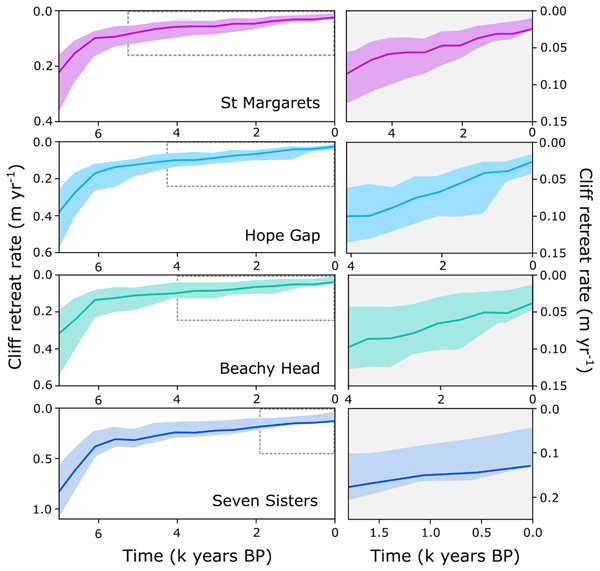
This study uses a coastal evolution model to interpret cosmogenic beryllium-10 concentrations and topographic data and, in turn, quantify long-term cliff retreat rates for four chalk sites on the south coast of England. By using a process-based model, clear distinctions between intertidal weathering rates have been recognised between chalk and sandstone rock coast sites, advocating the use of process-based models to interpret the long-term behaviour of rock coasts.
Greg Balco, Nathan Brown, Keir Nichols, Ryan A. Venturelli, Jonathan Adams, Scott Braddock, Seth Campbell, Brent Goehring, Joanne S. Johnson, Dylan H. Rood, Klaus Wilcken, Brenda Hall, and John Woodward
The Cryosphere, 17, 1787–1801, https://doi.org/10.5194/tc-17-1787-2023, https://doi.org/10.5194/tc-17-1787-2023, 2023
Short summary
Short summary
Samples of bedrock recovered from below the West Antarctic Ice Sheet show that part of the ice sheet was thinner several thousand years ago than it is now and subsequently thickened. This is important because of concern that present ice thinning in this region may lead to rapid, irreversible sea level rise. The past episode of thinning at this site that took place in a similar, although not identical, climate was not irreversible; however, reversal required at least 3000 years to complete.
Jonathan R. Adams, Joanne S. Johnson, Stephen J. Roberts, Philippa J. Mason, Keir A. Nichols, Ryan A. Venturelli, Klaus Wilcken, Greg Balco, Brent Goehring, Brenda Hall, John Woodward, and Dylan H. Rood
The Cryosphere, 16, 4887–4905, https://doi.org/10.5194/tc-16-4887-2022, https://doi.org/10.5194/tc-16-4887-2022, 2022
Short summary
Short summary
Glaciers in West Antarctica are experiencing significant ice loss. Geological data provide historical context for ongoing ice loss in West Antarctica, including constraints on likely future ice sheet behaviour in response to climatic warming. We present evidence from rare isotopes measured in rocks collected from an outcrop next to Pope Glacier. These data suggest that Pope Glacier thinned faster and sooner after the last ice age than previously thought.
Klaus M. Wilcken, Alexandru T. Codilean, Réka-H. Fülöp, Steven Kotevski, Anna H. Rood, Dylan H. Rood, Alexander J. Seal, and Krista Simon
Geochronology, 4, 339–352, https://doi.org/10.5194/gchron-4-339-2022, https://doi.org/10.5194/gchron-4-339-2022, 2022
Short summary
Short summary
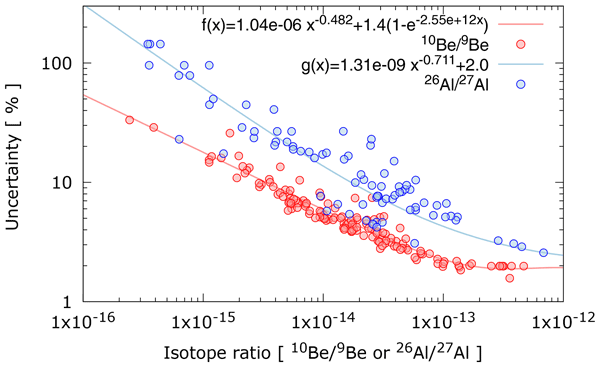
Cosmogenic nuclides are now widely applied in the Earth sciences; however, more recent applications often push the analytical limits of the technique. Our study presents a comprehensive method for analysis of cosmogenic 10Be and 26Al samples down to isotope concentrations of a few thousand atoms per gram of sample, which opens the door to new and more varied applications of cosmogenic nuclide analysis.

Joanne S. Johnson, Ryan A. Venturelli, Greg Balco, Claire S. Allen, Scott Braddock, Seth Campbell, Brent M. Goehring, Brenda L. Hall, Peter D. Neff, Keir A. Nichols, Dylan H. Rood, Elizabeth R. Thomas, and John Woodward
The Cryosphere, 16, 1543–1562, https://doi.org/10.5194/tc-16-1543-2022, https://doi.org/10.5194/tc-16-1543-2022, 2022
Short summary
Short summary
Recent studies have suggested that some portions of the Antarctic Ice Sheet were less extensive than present in the last few thousand years. We discuss how past ice loss and regrowth during this time would leave its mark on geological and glaciological records and suggest ways in which future studies could detect such changes. Determining timing of ice loss and gain around Antarctica and conditions under which they occurred is critical for preparing for future climate-warming-induced changes.

Jennifer R. Shadrick, Martin D. Hurst, Matthew D. Piggott, Bethany G. Hebditch, Alexander J. Seal, Klaus M. Wilcken, and Dylan H. Rood
Earth Surf. Dynam., 9, 1505–1529, https://doi.org/10.5194/esurf-9-1505-2021, https://doi.org/10.5194/esurf-9-1505-2021, 2021
Short summary
Short summary
Here we use topographic and 10Be concentration data to optimise a coastal evolution model. Cliff retreat rates are calculated for two UK sites for the past 8000 years and, for the first time, highlight a strong link between the rate of sea level rise and long-term cliff retreat rates. This method enables us to study past cliff response to sea level rise and so to greatly improve forecasts of future responses to accelerations in sea level rise that will result from climate change.
Cited articles
Adams, J. R., Johnson, J. S., Roberts, S. J., Mason, P. J., Nichols, K. A., Venturelli, R. A., Wilcken, K., Balco, G., Goehring, B., Hall, B., Woodward, J., and Rood, D. H.: New 10Be exposure ages improve Holocene ice sheet thinning history near the grounding line of Pope Glacier, Antarctica, The Cryosphere, 16, 4887–4905, https://doi.org/10.5194/tc-16-4887-2022, 2022.
Adams, J. R., Venturelli, R. A., Goehring, B. M., Johnson, J. S., Roberts, S. J., and Rood, D. H.: Cosmogenic in situ 14C data and calculated surface exposure ages for 9 erratic cobbles collected from Mount Murphy, West Antarctica, UK Polar Data Centre [data set], https://doi.org/10.5285/dbb30962-bbf3-434a-9f27-6de2f61a86e2, 2024.
Adams, J. R., Mason, P. J., Roberts, S. J., Rood, D. H., Smellie, J. L., Nichols, K. A., Woodward, J., and Johnson, J. S.: Remote Mapping of Bedrock for Future Cosmogenic Nuclide Exposure Dating Studies in Unvisited Areas of Antarctica, Remote Sens.-Basel, 17, https://doi.org/10.3390/rs17020314, 2025.
Argento, D. C., Stone, J. O., Reedy, R. C., and O'Brien, K.: Physics-based modeling of cosmogenic nuclides part I – Radiation transport methods and new insights, Quat. Geochronol., 26, 29–43, https://doi.org/10.1016/j.quageo.2014.09.004, 2015a.
Argento, D. C., Stone, J. O., Reedy, R. C., and O'Brien, K.: Physics-based modeling of cosmogenic nuclides part II – Key aspects of in-situ cosmogenic nuclide production, Quat. Geochronol., 26, 44–55, https://doi.org/10.1016/j.quageo.2014.09.005, 2015b.
Balco, G.: Contributions and unrealized potential contributions of cosmogenic-nuclide exposure dating to glacier chronology, 1990–2010, Quaternary Sci. Rev., 30, 3–27, https://doi.org/10.1016/j.quascirev.2010.11.003, 2011.
Balco, G.: Production rate calculations for cosmic-ray-muon-produced 10Be and 26Al benchmarked against geological calibration data, Quat. Geochronol., 39, 150–173, https://doi.org/10.1016/j.quageo.2017.02.001, 2017.
Balco, G.: Glacier Change and Paleoclimate Applications of Cosmogenic-Nuclide Exposure Dating, Annu. Rev. Earth Pl. Sc., 48, https://doi.org/10.1146/annurev-earth-081619-052609, 2020a.
Balco, G.: Technical note: A prototype transparent-middle-layer data management and analysis infrastructure for cosmogenic-nuclide exposure dating, Geochronology, 2, 169–175, https://doi.org/10.5194/gchron-2-169-2020, 2020b.
Balco, G. and Schaefer, J. M.: Exposure-age record of Holocene ice sheet and ice shelf change in the northeast Antarctic Peninsula, Quaternary Sci. Rev., 59, 101–111, https://doi.org/10.1016/j.quascirev.2012.10.022, 2013.
Balco, G., Stone, J. O., Lifton, N. A., and Dunai, T. J.: A complete and easily accessible means of calculating surface exposure ages or erosion rates from 10Be and 26Al measurements, Quat. Geochronol., 3, 174–195, https://doi.org/10.1016/j.quageo.2007.12.001, 2008.
Balco, G., Todd, C., Goehring, B. M., Moening-Swanson, I., and Nichols, K.: Glacial geology and cosmogenic-nuclide exposure ages from the Tucker Glacier – Whitehall Glacier confluence, Northern Victoria Land, Antarctica, Am. J. Sci., 319, 255–286, https://doi.org/10.2475/04.2019.01, 2019.
Balco, G., Brown, N., Nichols, K., Venturelli, R. A., Adams, J., Braddock, S., Campbell, S., Goehring, B., Johnson, J. S., Rood, D. H., Wilcken, K., Hall, B., and Woodward, J.: Reversible ice sheet thinning in the Amundsen Sea Embayment during the Late Holocene, The Cryosphere, 17, 1787–1801, https://doi.org/10.5194/tc-17-1787-2023, 2023.
Binnie, S. A., Dewald, A., Heinze, S., Voronina, E., Hein, A., Wittmann, H., von Blanckenburg, F., Hetzel, R., Christl, M., Schaller, M., Léanni, L., ASTER Team, Hippe, K., Vockenhuber, C., Ivy-Ochs, S., Maden, C., Fülöp, R. H., Fink, D., Wilcken, K. M., Fujioka, T., Fabel, D., Freeman, S. P. H. T., Xu, S., Fifield, L. K., Akçar, N., Spiegel, C., and Dunai, T. J.: Preliminary results of CoQtz-N: A quartz reference material for terrestrial in-situ cosmogenic 10Be and 26Al measurements, Nucl. Instrum. Meth. B, 456, 203–212, https://doi.org/10.1016/j.nimb.2019.04.073, 2019.
Borchers, B., Marrero, S., Balco, G., Caffee, M., Goehring, B., Lifton, N., Nishiizumi, K., Phillips, F., Schaefer, J., and Stone, J.: Geological calibration of spallation production rates in the CRONUS-Earth project, Quat. Geochronol., 31, 188–198, https://doi.org/10.1016/j.quageo.2015.01.009, 2016.
Briner, J. P., Lifton, N. A., Miller, G. H., Refsnider, K., Anderson, R., and Finkel, R.: Using in situ cosmogenic 10Be, 14C, and 26Al to decipher the history of polythermal ice sheets on Baffin Island, Arctic Canada, Quat. Geochronol., 19, 4–13, https://doi.org/10.1016/j.quageo.2012.11.005, 2014.
Corbett, L. B., Bierman, P. R., and Rood, D. H.: An approach for optimizing in situ cosmogenic 10Be sample preparation, Quat. Geochronol., 33, 24–34, https://doi.org/10.1016/j.quageo.2016.02.001, 2016.
Corbett, L. B., Bierman, P. R., Brown, T. A., Caffee, M. W., Fink, D., Freeman, S. P. H. T., Hidy, A. J., Rood, D. H., Wilcken, K. M., and Woodruff, T. E.: Clean quartz matters for cosmogenic nuclide analyses: An exploration of the importance of sample purity using the CRONUS-N reference material, Quat. Geochronol., 73, 101403, https://doi.org/10.1016/j.quageo.2022.101403, 2022.
Dunai, T. J.: Cosmogenic Nuclides: Principles, Concepts and Applications in the Earth Surface Sciences, Cambridge University Press, https://doi.org/10.1017/CBO9780511804519, 2010.
Fülöp, R., Wacker, L., and Dunai, T. J.: Progress report on a novel in situ 14C extraction scheme at the University of Cologne, Nucl. Instrum. Meth. B, 361, 20–24, https://doi.org/10.1016/j.nimb.2015.02.023, 2015.
Fülöp, R. H., Naysmith, P., Cook, G. T., Fabel, D., Xu, S., and Bishop, P.: Update on the performance of the SUERC in situ 14C extraction line, Radiocarbon, 52, 1288–1294, 2010.
Fülöp, R.-H., Fink, D., Yang, B., Codilean, A. T., Smith, A., Wacker, L., Levchenko, V., and Dunai, T. J.: The ANSTO – University of Wollongong in-situ 14C extraction laboratory, Nucl. Instrum. Meth. B, 438, 207–213, https://doi.org/10.1016/j.nimb.2018.04.018, 2019.
Goehring, B. M., Schaefer, J. M., Schluechter, C., Lifton, N. A., Finkel, R. C., Jull, A. J. T., Akçar, N., and Alley, R. B.: The Rhone Glacier was smaller than today for most of the Holocene, Geology, 39, 679–682, https://doi.org/10.1130/G32145.1, 2011.
Goehring, B. M., Schimmelpfennig, I., and Schaefer, J. M.: Capabilities of the lamont-doherty earth observatory in situ 14C extraction laboratory updated, Quat. Geochronol., 19, 194–197, https://doi.org/10.1016/j.quageo.2013.01.004, 2014.
Goehring, B. M., Wilson, J., and Nichols, K.: A fully automated system for the extraction of in situ cosmogenic carbon-14 in the Tulane University cosmogenic nuclide laboratory, Nucl. Instrum. Meth. B, 455, 284–292, https://doi.org/10.1016/j.nimb.2019.02.006, 2019a.
Goehring, B. M., Balco, G., Todd, C., Moening-Swanson, I., and Nichols, K.: Late-glacial grounding line retreat in the northern Ross Sea, Antarctica, Geology, 47, 291–294, https://doi.org/10.1130/G45413.1, 2019b.
Goehring, B. M., Menounos, B., Osborn, G., Hawkins, A., and Ward, B.: Reconciling the apparent absence of a Last Glacial Maximum alpine glacial advance, Yukon Territory, Canada, through cosmogenic beryllium-10 and carbon-14 measurements, Geochronology, 4, 311–322, https://doi.org/10.5194/gchron-4-311-2022, 2022.
Gosse, J. C. and Phillips, F. M.: Terrestrial in situ cosmogenic nuclides: Theory and application, Quaternary Sci. Rev., 20, 1475–1560, https://doi.org/10.1016/S0277-3791(00)00171-2, 2001.
Granger, D. E.: A review of burial dating methods using 26Al and 10Be, Special Paper of the Geological Society of America, 415, 1–16, https://doi.org/10.1130/2006.2415(01), 2006.
Hein, A. S., Fogwill, C. J., Sugden, D. E., and Xu, S.: Geological scatter of cosmogenic-nuclide exposure ages in the Shackleton Range, Antarctica: Implications for glacial history, Quat. Geochronol., 19, 52–66, https://doi.org/10.1016/j.quageo.2013.03.008, 2014.
Heyman, J., Applegate, P. J., Blomdin, R., Gribenski, N., Harbor, J. M., and Stroeven, A. P.: Boulder height – exposure age relationships from a global glacial 10Be compilation, Quat. Geochronol., 34, 1–11, https://doi.org/10.1016/j.quageo.2016.03.002, 2016.
Hillebrand, T. R., Stone, J. O., Koutnik, M., King, C., Conway, H., Hall, B., Nichols, K., Goehring, B., and Gillespie, M. K.: Holocene thinning of Darwin and Hatherton glaciers, Antarctica, and implications for grounding-line retreat in the Ross Sea, The Cryosphere, 15, 3329–3354, https://doi.org/10.5194/tc-15-3329-2021, 2021.
Hippe, K.: Constraining processes of landscape change with combined in situ cosmogenic 14C–10Be analysis, Quaternary Sci. Rev., 173, 1–19, https://doi.org/10.1016/j.quascirev.2017.07.020, 2017.
Hippe, K. and Lifton, N. A.: Calculating Isotope Ratios and Nuclide Concentrations for In Situ Cosmogenic 14C Analyses, Radiocarbon, 56, 1167–1174, https://doi.org/10.2458/56.17917, 2014.
Hippe, K., Kober, F., Baur, H., Ruff, M., Wacker, L., and Wieler, R.: The current performance of the in situ 14C extraction line at ETH, Quat. Geochronol., 4, 493–500, https://doi.org/10.1016/j.quageo.2009.06.001, 2009.
Hippe, K., Kober, F., Wacker, L., Fahrni, S. M., Ivy-Ochs, S., Akçar, N., Schlüchter, C., and Wieler, R.: An update on in situ cosmogenic 14C analysis at ETH Zürich, Nucl. Instrum. Meth. B, 294, 81–86, https://doi.org/10.1016/j.nimb.2012.06.020, 2013.
Hippe, K., Ivy-Ochs, S., Kober, F., Zasadni, J., Wieler, R., Wacker, L., Kubik, P. W., and Schlüchter, C.: Chronology of Lateglacial ice flow reorganization and deglaciation in the Gotthard Pass area, Central Swiss Alps, based on cosmogenic 10Be and in situ 14C, Quat. Geochronol., 19, 14–26, https://doi.org/10.1016/j.quageo.2013.03.003, 2014.
Jeong, A., Il, J., Bae, Y., Balco, G., Yoo, K., Il, H., Domack, E., Hee, H., and Yong, B.: Late Quaternary deglacial history across the Larsen B embayment, Antarctica, Quaternary Sci. Rev., 189, 134–148, https://doi.org/10.1016/j.quascirev.2018.04.011, 2018.
Johnson, J. S., Bentley, M. J., and Gohl, K.: First exposure ages from the Amundsen Sea Embayment, West Antarctica: The Late Quaternary context for recent thinning of Pine Island, Smith, and Pope Glaciers, Geology, 36, 223–226, https://doi.org/10.1130/G24207A.1, 2008.
Johnson, J. S., Bentley, M. J., Smith, J. A., Finkel, R. C., Rood, D. H., Gohl, K., Balco, G., Larter, R. D., and Schaefer, J. M.: Rapid thinning of Pine Island glacier in the early Holocene, Science, 343, 999–1001, https://doi.org/10.1126/science.1247385, 2014.
Johnson, J. S., Roberts, S. J., Rood, D. H., Pollard, D., Schaefer, J. M., Whitehouse, P. L., Ireland, L. C., Lamp, J. L., Goehring, B. M., Rand, C., and Smith, J. A.: Deglaciation of Pope Glacier implies widespread early Holocene ice sheet thinning in the Amundsen Sea sector of Antarctica, Earth Planet. Sc. Lett., 548, 116–501, https://doi.org/10.1016/j.epsl.2020.116501, 2020.
Johnson, J. S., Venturelli, R. A., Balco, G., Allen, C. S., Braddock, S., Campbell, S., Goehring, B. M., Hall, B. L., Neff, P. D., Nichols, K. A., Rood, D. H., Thomas, E. R., and Woodward, J.: Review article: Existing and potential evidence for Holocene grounding line retreat and readvance in Antarctica, The Cryosphere, 16, 1543–1562, https://doi.org/10.5194/tc-16-1543-2022, 2022.
Jones, A. G., Marcott, S. A., Gorin, A. L., Kennedy, T. M., Shakun, J. D., Goehring, B. M., Menounos, B., Clark, D. H., Romero, M., and Caffee, M. W.: Four North American glaciers advanced past their modern positions thousands of years apart in the Holocene, The Cryosphere, 17, 5459–5475, https://doi.org/10.5194/tc-17-5459-2023, 2023.
Jones, R. S., Johnson, J. S., Lin, Y., Mackintosh, A. N., Sefton, J. P., Smith, J. A., Thomas, E. R., and Whitehouse, P. L.: Stability of the Antarctic Ice Sheet during the pre-industrial Holocene, Nature Reviews Earth and Environment, 3, 500–515, https://doi.org/10.1038/s43017-022-00309-5, 2022.
Jull, A. J. T., Scott, E. M., and Bierman, P.: The CRONUS-Earth inter-comparison for cosmogenic isotope analysis, Quat. Geochronol., 26, 3–10, https://doi.org/10.1016/j.quageo.2013.09.003, 2015.
Kingslake, J., Scherer, R. P., Albrecht, T., Coenen, J., Powell, R. D., Reese, R., Stansell, N. D., Tulaczyk, S., Wearing, M. G., and Whitehouse, P. L.: Extensive retreat and re-advance of the West Antarctic Ice Sheet during the Holocene, Nature, 558, 430–434, https://doi.org/10.1038/s41586-018-0208-x, 2018.
Kohl, C. P. and Nishiizumi, K.: Chemical isolation of quartz for measurement of in-situ-produced cosmogenic nuclides, Geochim. Cosmochim. Ac., 56, 3583–3587, https://doi.org/10.1016/0016-7037(92)90401-4, 1992.
Lamp, J. L., Young, N. E., Koffman, T., Schimmelpfennig, I., Tuna, T., Bard, E., and Schaefer, J. M.: Update on the cosmogenic in situ 14C laboratory at the Lamont-Doherty Earth Observatory, Nucl. Instrum. Meth. B, 456, 157–162, https://doi.org/10.1016/j.nimb.2019.05.064, 2019.
Lifton, N. A.: A new extraction technique and production rate estimate for in situ carbon-14 in quartz, Ph.D thesis, The University of Arizona, http://hdl.handle.net/10150/289000 (last access: 11 September 2025), 1997.
Lifton, N. A., Jull, A. J. T., and Quade, J.: A new extraction technique and production rate estimate for in situ cosmognic 14C in quartz, Geochim. Cosmochim. Ac., 65, 1953–1969, https://doi.org/10.1016/S0016-7037(01)00566-X, 2001.
Lifton, N., Sato, T., and Dunai, T. J.: Scaling in situ cosmogenic nuclide production rates using analytical approximations to atmospheric cosmic-ray fluxes, Earth Planet. Sc. Lett., 386, 149–160, https://doi.org/10.1016/j.epsl.2013.10.052, 2014.
Lifton, N., Caffee, M., Finkel, R., Marrero, S., Nishiizumi, K., Phillips, F. M., Goehring, B., Gosse, J., Stone, J., Schaefer, J., Theriault, B., Jull, A. J. T., and Fifield, K.: In situ cosmogenic nuclide production rate calibration for the CRONUS-Earth project from lake Bonneville, Utah, shoreline features, Quat. Geochronol., 26, 56–69, https://doi.org/10.1016/j.quageo.2014.11.002, 2015a.
Lifton, N., Goehring, B., Wilson, J., Kubley, T., and Caffee, M.: Nucl. Instrum. Meth. B, Progress in automated extraction and purification of in situ from quartz: Results from the Purdue in situ 14C laboratory, Nucl. Instrum Meth. B, 361, 381–386, https://doi.org/10.1016/j.nimb.2015.03.028, 2015b.
Lifton, N., Wilson, J., and Koester, A.: Technical note: Studying lithium metaborate fluxes and extraction protocols with a new, fully automated in situ cosmogenic 14C processing system at PRIME Lab, Geochronology, 5, 361–375, 2023.
Longworth, B. E., Von Reden, K. F., Long, P., and Roberts, M. L.: A high output, large acceptance injector for the NOSAMS Tandetron AMS system, Nucl. Instrum. Meth. B, 361, 211–216, https://doi.org/10.1016/j.nimb.2015.04.005, 2015.
Lupker, M., Hippe, K., Wacker, L., Kober, F., Maden, C., Braucher, R., Bourlès, D., Romani, J. R. V., and Wieler, R.: Depth-dependence of the production rate of in situ 14C in quartz from the Leymon High core, Spain, Quat. Geochronol., 28, 80–87, https://doi.org/10.1016/j.quageo.2015.04.004, 2015.
Lupker, M., Hippe, K., Wacker, L., Steinemann, O., Tikhomirov, D., Maden, C., Haghipour, N., and Synal, H. A.: In-situ cosmogenic 14C analysis at ETH Zürich: Characterization and performance of a new extraction system, Nucl. Instrum. Meth. B, 457, 30–36, https://doi.org/10.1016/J.NIMB.2019.07.028, 2019.
Mackintosh, A., White, D., Fink, D., Gore, D. B., Pickard, J., and Fanning, P. C.: Exposure ages from mountain dipsticks in Mac. Robertson Land, East Antarctica, indicate little change in ice-sheet thickness since the Last Glacial Maximum, Geology, 35, 551–554, https://doi.org/10.1130/G23503A.1, 2007.
Marrero, S. M., Phillips, F. M., Borchers, B., Lifton, N., Aumer, R., and Balco, G.: Cosmogenic nuclide systematics and the CRONUScalc program, Quat. Geochronol., 31, 160–187, https://doi.org/10.1016/j.quageo.2015.09.005, 2016.
Merchel, S., Bremser, W., Akhmadaliev, S., Arnold, M., Aumaître, G., Bourlès, D. L., Braucher, R., Caffee, M., Christl, M., Fifield, L. K., Finkel, R. C., Freeman, S. P. H. T., Ruiz-Gómez, A., Kubik, P. W., Martschini, M., Rood, D. H., Tims, S. G., Wallner, A., Wilcken, K. M., and Xu, S.: Quality assurance in accelerator mass spectrometry: Results from an international round-robin exercise for 10Be, Nucl. Instrum. Meth. B, 289, 68–73, https://doi.org/10.1016/j.nimb.2012.07.038, 2012.
Milillo, P., Rignot, E., Rizzoli, P., Scheuchl, B., Mouginot, J., Bueso-Bello, J. L., Prats-Iraola, P., and Dini, L.: Rapid glacier retreat rates observed in West Antarctica, Nat. Geosci., 15, 48–53, https://doi.org/10.1038/S41561-021-00877-Z, 2022.
Nichols, K. A. and Goehring, B. M.: Isolation of quartz for cosmogenic in situ 14C analysis, Geochronology, 1, 43–52, https://doi.org/10.5194/gchron-1-43-2019, 2019.
Nichols, K. A., Goehring, B. M., Balco, G., Johnson, J. S., Hein, A. S., and Todd, C.: New Last Glacial Maximum ice thickness constraints for the Weddell Sea Embayment, Antarctica, The Cryosphere, 13, 2935–2951, https://doi.org/10.5194/tc-13-2935-2019, 2019.
Nichols, K. A., Adams, J. R., Brown, K., Creel, R. C., McKenzie, M. A., Venturelli, R. A., Johnson, J. S., Rood, D. H., Wilcken, K., Woodward, J., and Roberts, S. J.: Direct Geologic Constraints on the Timing of Late Holocene Ice Thickening in the Amundsen Sea Embayment, Antarctica, Geophys. Res. Lett., 51, https://doi.org/10.1029/2024GL110350, 2024.
Phillips, F. M., Argento, D. C., Balco, G., Caffee, M. W., Clem, J., Dunai, T. J., Finkel, R., Goehring, B., Gosse, J. C., Hudson, A. M., Jull, A. J. T., Kelly, M. A., Kurz, M., Lal, D., Lifton, N., Marrero, S. M., Nishiizumi, K., Reedy, R. C., Schaefer, J., Stone, J. O. H., Swanson, T., and Zreda, M. G.: The CRONUS-Earth Project: A synthesis, Quat. Geochronol., 31, 119–154, https://doi.org/10.1016/j.quageo.2015.09.006, 2016a.
Phillips, F. M., Argento, D. C., Bourlès, D. L., Caffee, M. W., Dunai, T. J., Goehring, B., Gosse, J. C., Hudson, A. M., Jull. A. J. T., Kelly, M. A., Lifton, N., Marrero, S. M., Nishiizumi, K., Reedy, R. C., and Stone, J. O. H.: Where now? Reflections on future directions for cosmogenic nuclide research from the CRONUS Projects, Quaternary Geochronol., 31, 155–159, https://doi.org/10.1016/j.quageo.2015.04.010, 2016b.
Pigati, J. S., Lifton, N. A., Timothy Jull, A. J., and Quade, J.: A simplified In Situ cosmogenic 14C extraction system, Radiocarbon, 52, 1236–1243, https://doi.org/10.1017/S0033822200046324, 2010.
Putnam, A. E., Schaefer, J. M., Barrell, D. J. A., Vandergoes, M., Denton, G. H., Kaplan, M. R., Finkel, R. C., Schwartz, R., Goehring, B. M., and Kelley, S. E.: In situ cosmogenic 10Be production-rate calibration from the Southern Alps, New Zealand, Quat. Geochronol., 5, 392–409, https://doi.org/10.1016/j.quageo.2009.12.001, 2010.
Rand, C. and Goehring B. M.: The distribution and magnitude of subglacial erosion on millennial timescales at Engabreen, Norway. Ann. Glaciol., 60, 73–81, https://doi.org/10.1017/aog.2019.42, 2019.
Rand, C., Jones, R. S., Mackintosh, A. N., Goehring, B., and Lilly, K.: A thicker-than-present East Antarctic Ice Sheet plateau during the Last Glacial Maximum, The Cryosphere, 19, 3681–3691, https://doi.org/10.5194/tc-19-3681-2025, 2025.
Rood, D. H., Hall, S., Guilderson, T. P., Finkel, R. C., and Brown, T. A.: Challenges and opportunities in high-precision Be-10 measurements at CAMS, Nucl. Instrum. Meth. B, 268, 730–732, https://doi.org/10.1016/j.nimb.2009.10.016, 2010.
Rood, D. H., Brown, T. A., Finkel, R. C., and Guilderson, T. P.: Poisson and non-Poisson uncertainty estimations of 10Be/9Be measurements at LLNL-CAMS, Nucl. Instrum. Meth. B, 294, 426–429, https://doi.org/10.1016/j.nimb.2012.08.039, 2013.
Santos, G. M., Southon, J. R., Druffel-Rodriguez, K. C., Griffin, S., and Mazon, M.: Magnesium Perchlorate as an Alternative Water Trap in AMS Graphite Sample Preparation: A Report On Sample Preparation at Kccams at the University of California, Irvine, Radiocarbon, 46, 165–173, https://doi.org/10.1017/S0033822200039485, 2004.
Santos, G. M., Mazon, M., Southon, J. R., Rifai, S., and Moore, R.: Evaluation of iron and cobalt powders as catalysts for 14C-AMS target preparation, Nucl. Instrum. Meth. B, 259, 308–315, https://doi.org/10.1016/j.nimb.2007.01.220, 2007.
Sbarra, C. M., Briner, J. P., Graham, B. L., Poinar, K., Thomas, E. K., and Young, N. E.: Evidence for a more extensive Greenland Ice Sheet in southwestern Greenland during the Last Glacial Maximum, Geosphere, 18, 1316–1329, https://doi.org/10.1130/GES02432.1, 2022.
Schimmelpfennig, I., Schaefer, J. M., Goehring, B. M., Lifton, N., Putnam, A. E., and Barrell, D. J. A.: Calibration of the in situ cosmogenic 14C production rate in New Zealand's Southern Alps, J. Quaternary Sci., 27, 671–674, https://doi.org/10.1002/jqs.2566, 2012.
Smellie, J. L.: Lithofacies Architecture and Construction of Volcanoes Erupted in Englacial Lakes: Icefall Nunatak, Mount Murphy, Eastern Marie Byrd Land, Antarctica, in: Volcaniclastic Sedimentation in Lacustrine Settings, John Wiley & Sons, Ltd., 7–34, https://doi.org/10.1002/9781444304251.ch2, 2001.
Søndergaard, A. S., Larsen, N. K., Steinemann, O., Olsen, J., Funder, S., Egholm, D. L., and Kjær, K. H.: Glacial history of Inglefield Land, north Greenland from combined in situ 10Be and 14C exposure dating, Clim. Past, 16, 1999–2015, https://doi.org/10.5194/cp-16-1999-2020, 2020.
Southon, J.: Graphite reactor memory – Where is it from and how to minimize it?, Nucl. Instrum. Meth. B, 259, 288–292, https://doi.org/10.1016/j.nimb.2007.01.251, 2007.
Spector, P., Stone, J., Cowdery, S. G., Hall, B., Conway, H., and Bromley, G.: Rapid early-Holocene deglaciation in the Ross Sea, Antarctica, Geophys. Res. Lett., 44, 7817–7825, https://doi.org/10.1002/2017GL074216, 2017.
Spector, P., Stone, J., and Goehring, B.: Thickness of the divide and flank of the West Antarctic Ice Sheet through the last deglaciation, The Cryosphere, 13, 3061–3075, https://doi.org/10.5194/tc-13-3061-2019, 2019.
Stone, J. O., Balco, G. A., Sugden, D. E., Caffee, M. W., Sass, L. C., Cowdery, S. G., and Siddoway, C.: Holocene deglaciation of Marie Byrd Land, West Antarctica, Science, 299, 99–102, https://doi.org/10.1126/science.1077998, 2003.
Stutz, J., Mackintosh, A., Norton, K., Whitmore, R., Baroni, C., Jamieson, S. S. R., Jones, R. S., Balco, G., Salvatore, M. C., Casale, S., Lee, J. I., Seong, Y. B., McKay, R., Vargo, L. J., Lowry, D., Spector, P., Christl, M., Ivy Ochs, S., Di Nicola, L., Iarossi, M., Stuart, F., and Woodruff, T.: Mid-Holocene thinning of David Glacier, Antarctica: chronology and controls, The Cryosphere, 15, 5447–5471, https://doi.org/10.5194/tc-15-5447-2021, 2021.
Venturelli, R. A., Siegfried, M. R., Roush, K. A., Li, W., Burnett, J., Zook, R., Fricker, H. A., Priscu, J. C., Leventer, A., and Rosenheim, B. E.: Mid-Holocene Grounding Line Retreat and Readvance at Whillans Ice Stream, West Antarctica, Geophys. Res. Lett., 47, https://doi.org/10.1029/2020GL088476, 2020.
Venturelli, R. A., Boehman, B., Davis, C., Hawkings, J. R., Johnston, S. E., Gustafson, C. D., Michaud, A. B., Mosbeux, C., Siegfried, M. R., Vick-Majors, T. J., Galy, V., Spencer, R. G. M., Warny, S., Christner, B. C., Fricker, H. A., Harwood, D. M., Leventer, A., Priscu, J. C., and Rosenheim, B. E.: Constraints on the Timing and Extent of Deglacial Grounding Line Retreat in West Antarctica, AGU Advances, 4, 1–15, https://doi.org/10.1029/2022AV000846, 2023.
White, D., Fülöp, R. H., Bishop, P., Mackintosh, A., and Cook, G.: Can in-situ cosmogenic 14C be used to assess the influence of clast recycling on exposure dating of ice retreat in Antarctica?, Quat. Geochronol., 6, 289–294, https://doi.org/10.1016/j.quageo.2011.03.004, 2011.
Wilcken, K. M., Codilean, A. T., Fülöp, R.-H., Kotevski, S., Rood, A. H., Rood, D. H., Seal, A. J., and Simon, K.: Technical note: Accelerator mass spectrometry of 10Be and 26Al at low nuclide concentrations, Geochronology, 4, 339–352, https://doi.org/10.5194/gchron-4-339-2022, 2022.
Young, N. E., Schaefer, J. M., Briner, J. P., and Goehring, B. M.: A 10Be production-rate calibration for the Arctic, J. Quaternary Sci., 28, 515–526, https://doi.org/10.1002/jqs.2642, 2013.
Young, N. E., Schaefer, J. M., Goehring, B., Lifton, N., Schimmelpfennig, I., and Briner, J. P.: West Greenland and global in situ 14C production-rate calibrations, J. Quaternary Sci., 29, 401–406, https://doi.org/10.1002/jqs.2717, 2014.
Young, N. E., Lesnek, A. J., Cuzzone, J. K., Briner, J. P., Badgeley, J. A., Balter-Kennedy, A., Graham, B. L., Cluett, A., Lamp, J. L., Schwartz, R., Tuna, T., Bard, E., Caffee, M. W., Zimmerman, S. R. H., and Schaefer, J. M.: In situ cosmogenic 10Be–14C–26Al measurements from recently deglaciated bedrock as a new tool to decipher changes in Greenland Ice Sheet size, Clim. Past, 17, 419–450, https://doi.org/10.5194/cp-17-419-2021, 2021.
Short summary
Ice sheet mass loss is adding to sea-level rise, and is expected to increase, but by how much and how fast remains uncertain. Isotopes produced in rock at the Earth’s surface provide records of past ice sheet thinning which help predict future change but are more effective if they are precise enough to determine past changes to the nearest thousand years. Carbon-14 is a unique isotope that provides an accurate record of past change since the last ice age, however, its precision can be improved.
Ice sheet mass loss is adding to sea-level rise, and is expected to increase, but by how much...


