
Articles | Volume 8, issue 2
https://doi.org/10.5194/gchron-8-329-2026
© Author(s) 2026. This work is distributed under
the Creative Commons Attribution 4.0 License.
the Creative Commons Attribution 4.0 License.
https://doi.org/10.5194/gchron-8-329-2026
© Author(s) 2026. This work is distributed under
the Creative Commons Attribution 4.0 License.
the Creative Commons Attribution 4.0 License.
Research article
| 
05 Jun 2026
Research article |
| 05 Jun 2026
| 05 Jun 2026
Testing current estimates of the in situ cosmogenic 10Be production rate in the north-western British Isles, with implications for ice sheet behaviour during Termination 1
Gordon R. M. Bromley
CORRESPONDING AUTHOR

Geography, University of Galway, Galway H91 TK33, Ireland
School of Earth and Climate Sciences and Climate Change Institute, University of Maine, Orono, ME 04469, USA
Brenda L. Hall
School of Earth and Climate Sciences and Climate Change Institute, University of Maine, Orono, ME 04469, USA
Aaron E. Putnam
School of Earth and Climate Sciences and Climate Change Institute, University of Maine, Orono, ME 04469, USA
Thomas V. Lowell
School of Earth and Climate Sciences and Climate Change Institute, University of Maine, Orono, ME 04469, USA
Department of Geology, University of Cincinnati, Cincinnati, OH 45221-0013, USA
Related authors
Gregor M. Rink, Gordon R. M. Bromley, Brenda L. Hall, Alan J. Hidy, and Zuzanna M. Swirad
EGUsphere, https://doi.org/10.5194/egusphere-2026-3761, https://doi.org/10.5194/egusphere-2026-3761, 2026
This preprint is open for discussion and under review for Earth Surface Dynamics (ESurf).
Short summary
Short summary
To identify drivers of coastal erosion in western Ireland, we reconstructed cliff-retreat rates at two sites via cosmogenic nuclide geochemistry and modelling. At both sites, cliff retreat decelerated during the Holocene, but the rate of deceleration was spatially non-uniform due to differences in relative sea level. Variations in modern retreat rates likely reflect contrasting geomorphology, geology and different marine environments.
Gordon R. M. Bromley, Greg Balco, Margaret S. Jackson, Allie Balter-Kennedy, and Holly Thomas
Clim. Past, 21, 145–160, https://doi.org/10.5194/cp-21-145-2025, https://doi.org/10.5194/cp-21-145-2025, 2025
Short summary
Short summary
We constructed a geologic record of East Antarctic Ice Sheet thickness from deposits at Otway Massif to directly assess how Earth's largest ice sheet responds to warmer-than-present climate. Our record confirms the long-term dominance of a cold polar climate but lacks a clear ice sheet response to the mid-Pliocene Warm Period, a common analogue for the future. Instead, an absence of moraines from the late Miocene–early Pliocene suggests the ice sheet was less extensive than present at that time.

Dakota E. Holmes, Tali L. Babila, Ulysses Ninnemann, Gordon Bromley, Shane Tyrrell, Greig A. Paterson, Michelle J. Curran, and Audrey Morley
Clim. Past, 18, 989–1009, https://doi.org/10.5194/cp-18-989-2022, https://doi.org/10.5194/cp-18-989-2022, 2022
Short summary
Short summary
Our proxy-based observations of the glacial inception following MIS 11 advance our mechanistic understanding of (and elucidates antecedent conditions that can lead to) high-magnitude climate instability during low- and intermediate-ice boundary conditions. We find that irrespective of the magnitude of climate variability or boundary conditions, the reorganization between Polar Water and Atlantic Water at subpolar latitudes appears to influence deep-water flow in the Nordic Seas.
Aaron Chesler, Dominic Winski, Karl Kreutz, Bess Koffman, Erich Osterberg, David Ferris, Zayta Thundercloud, Jihong Cole-Dai, Mark Wells, Aaron Putnam, and Katherine Anderson
Clim. Past, 22, 1741–1756, https://doi.org/10.5194/cp-22-1741-2026, https://doi.org/10.5194/cp-22-1741-2026, 2026
Short summary
Short summary
The Southern Hemisphere Westerly Winds impact global climate and Antarctic ice sheet stability; however, there are few complete records over the past 12 000 years. We use a new mineral dust record from a South Pole ice core and identify a decrease in particle concentration and an increase in coarse particle percentage over the past ~ 11 000 years. Together with other records, our data suggests a southward shift in the winds starting ~ 6500 years ago related to warming in the Southern Hemisphere.
Gregor M. Rink, Gordon R. M. Bromley, Brenda L. Hall, Alan J. Hidy, and Zuzanna M. Swirad
EGUsphere, https://doi.org/10.5194/egusphere-2026-3761, https://doi.org/10.5194/egusphere-2026-3761, 2026
This preprint is open for discussion and under review for Earth Surface Dynamics (ESurf).
Short summary
Short summary
To identify drivers of coastal erosion in western Ireland, we reconstructed cliff-retreat rates at two sites via cosmogenic nuclide geochemistry and modelling. At both sites, cliff retreat decelerated during the Holocene, but the rate of deceleration was spatially non-uniform due to differences in relative sea level. Variations in modern retreat rates likely reflect contrasting geomorphology, geology and different marine environments.
Joanne S. Johnson, John Woodward, Ian Nesbitt, Kate Winter, Seth Campbell, Keir A. Nichols, Ryan A. Venturelli, Scott Braddock, Brent M. Goehring, Brenda Hall, Dylan H. Rood, and Greg Balco
The Cryosphere, 19, 303–324, https://doi.org/10.5194/tc-19-303-2025, https://doi.org/10.5194/tc-19-303-2025, 2025
Short summary
Short summary
Determining where and when the Antarctic ice sheet was smaller than present requires recovery and exposure dating of subglacial bedrock. Here we use ice sheet model outputs and field data (geological and glaciological observations, bedrock samples, and ground-penetrating radar) to assess the suitability for subglacial drilling of sites in the Hudson Mountains, West Antarctica. We find that no sites are perfect, but two are feasible, with the most suitable being Winkie Nunatak (74.86°S, 99.77°W).
Gordon R. M. Bromley, Greg Balco, Margaret S. Jackson, Allie Balter-Kennedy, and Holly Thomas
Clim. Past, 21, 145–160, https://doi.org/10.5194/cp-21-145-2025, https://doi.org/10.5194/cp-21-145-2025, 2025
Short summary
Short summary
We constructed a geologic record of East Antarctic Ice Sheet thickness from deposits at Otway Massif to directly assess how Earth's largest ice sheet responds to warmer-than-present climate. Our record confirms the long-term dominance of a cold polar climate but lacks a clear ice sheet response to the mid-Pliocene Warm Period, a common analogue for the future. Instead, an absence of moraines from the late Miocene–early Pliocene suggests the ice sheet was less extensive than present at that time.
Greg Balco, Nathan Brown, Keir Nichols, Ryan A. Venturelli, Jonathan Adams, Scott Braddock, Seth Campbell, Brent Goehring, Joanne S. Johnson, Dylan H. Rood, Klaus Wilcken, Brenda Hall, and John Woodward
The Cryosphere, 17, 1787–1801, https://doi.org/10.5194/tc-17-1787-2023, https://doi.org/10.5194/tc-17-1787-2023, 2023
Short summary
Short summary
Samples of bedrock recovered from below the West Antarctic Ice Sheet show that part of the ice sheet was thinner several thousand years ago than it is now and subsequently thickened. This is important because of concern that present ice thinning in this region may lead to rapid, irreversible sea level rise. The past episode of thinning at this site that took place in a similar, although not identical, climate was not irreversible; however, reversal required at least 3000 years to complete.
Aaron Chesler, Dominic Winski, Karl Kreutz, Bess Koffman, Erich Osterberg, David Ferris, Zayta Thundercloud, Joseph Mohan, Jihong Cole-Dai, Mark Wells, Michael Handley, Aaron Putnam, Katherine Anderson, and Natalie Harmon
Clim. Past, 19, 477–492, https://doi.org/10.5194/cp-19-477-2023, https://doi.org/10.5194/cp-19-477-2023, 2023
Short summary
Short summary
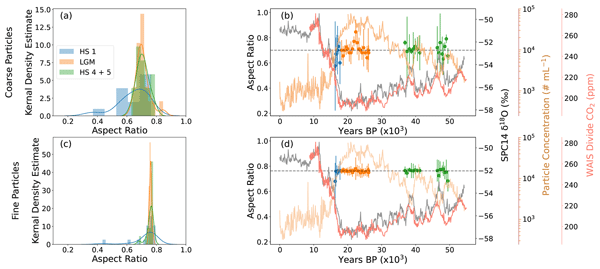
Ice core microparticle data typically use geometry assumptions to calculate particle mass and flux. We use dynamic particle imaging, a novel technique for ice core dust analyses, combined with traditional laser particle counting and Coulter counter techniques to assess particle shape in the South Pole Ice Core (SPC14) spanning 50–16 ka. Our results suggest that particles are dominantly ellipsoidal in shape and that spherical assumptions overestimate particle mass and flux.

Jonathan R. Adams, Joanne S. Johnson, Stephen J. Roberts, Philippa J. Mason, Keir A. Nichols, Ryan A. Venturelli, Klaus Wilcken, Greg Balco, Brent Goehring, Brenda Hall, John Woodward, and Dylan H. Rood
The Cryosphere, 16, 4887–4905, https://doi.org/10.5194/tc-16-4887-2022, https://doi.org/10.5194/tc-16-4887-2022, 2022
Short summary
Short summary
Glaciers in West Antarctica are experiencing significant ice loss. Geological data provide historical context for ongoing ice loss in West Antarctica, including constraints on likely future ice sheet behaviour in response to climatic warming. We present evidence from rare isotopes measured in rocks collected from an outcrop next to Pope Glacier. These data suggest that Pope Glacier thinned faster and sooner after the last ice age than previously thought.
Dakota E. Holmes, Tali L. Babila, Ulysses Ninnemann, Gordon Bromley, Shane Tyrrell, Greig A. Paterson, Michelle J. Curran, and Audrey Morley
Clim. Past, 18, 989–1009, https://doi.org/10.5194/cp-18-989-2022, https://doi.org/10.5194/cp-18-989-2022, 2022
Short summary
Short summary
Our proxy-based observations of the glacial inception following MIS 11 advance our mechanistic understanding of (and elucidates antecedent conditions that can lead to) high-magnitude climate instability during low- and intermediate-ice boundary conditions. We find that irrespective of the magnitude of climate variability or boundary conditions, the reorganization between Polar Water and Atlantic Water at subpolar latitudes appears to influence deep-water flow in the Nordic Seas.

Joanne S. Johnson, Ryan A. Venturelli, Greg Balco, Claire S. Allen, Scott Braddock, Seth Campbell, Brent M. Goehring, Brenda L. Hall, Peter D. Neff, Keir A. Nichols, Dylan H. Rood, Elizabeth R. Thomas, and John Woodward
The Cryosphere, 16, 1543–1562, https://doi.org/10.5194/tc-16-1543-2022, https://doi.org/10.5194/tc-16-1543-2022, 2022
Short summary
Short summary
Recent studies have suggested that some portions of the Antarctic Ice Sheet were less extensive than present in the last few thousand years. We discuss how past ice loss and regrowth during this time would leave its mark on geological and glaciological records and suggest ways in which future studies could detect such changes. Determining timing of ice loss and gain around Antarctica and conditions under which they occurred is critical for preparing for future climate-warming-induced changes.
Cited articles
Arosio, R. and Howe, J. A.: Lateglacial to Holocene palaeoenvironmental change in the Muck Deep, offshore western Scotland, Scott. J. Geol., 54, 99–114, https://doi.org/10.1144/sjg2017-014, 2018.
Balco, G.: Glacier change and paleoclimate applications of cosmogenic-nuclide exposure dating, Ann. Rev. Earth Plan. Sci., 48, 21–48, https://doi.org/10.1146/annurev-earth-081619-052609, 2020a.
Balco, G.: Technical note: A prototype transparent-middle-layer data management and analysis infrastructure for cosmogenic-nuclide exposure dating, Geochronology, 2, 169–175, https://doi.org/10.5194/gchron-2-169-2020, 2020b.
Balco, G., Stone, J. O., Lifton, N. A., and Dunai, T. J.: A complete and easily accessible means of calculating surface exposure ages or erosion rates from 10Be and 26Al measurements, Quat. Geochronol. 3, 174–195, https://doi.org/10.1016/j.quageo.2007.12.001, 2008.
Balco, G., Briner, J. P., Finkel, R., Rayburn, J. A., Ridge, J. C., and Schaefer, J. M.: Regional beryllium-10 production rate calibration for late-glacial northeastern North America, Quat. Geochronol. 4, 93–107, https://doi.org/10.1016/j.quageo.2008.09.001, 2009.
Ballantyne, C. K. and Small, D.: The last Scottish ice sheet, Earth Env. Sci. Trans. Royal Soc. Edinburgh, 110, 93–131, https://doi.org/10.1017/S1755691018000038, 2019.
Ballantyne, C. K. and Stone, J. O.: Did large ice caps persist on low ground in north-west Scotland during the Lateglacial Interstade?, J. Quat. Sci., 27, 297–306, https://doi.org/10.1002/jqs.1544, 2012.
Ballantyne, C. K., Sutherland, D. G., and Reed, W. J.: Introduction, in: Wester Ross: Field Guide, edited by: Ballantyne, C. K. and Sutherland, D. G., Quaternary Research Association, Cambridge, 1–63, https://research-portal.st-andrews.ac.uk/en/publications/wester-ross-field-guide/ (last access: 15 March 2026), 1987.
Ballantyne, C. K., Schnabel, C., and Xu, S.: Readvance of the last British Irish Ice Sheet during Greenland Interstade 1 (GI-1): the Wester Ross Readvance, NW Scotland, Quat. Sci. Rev., 28, 783–789, https://doi.org/10.1016/j.quascirev.2009.01.011, 2009.
Best, L. and Shennan, I.: Scottish landform example no. 47: isolation basins of Arisaig, Scot. Geogr. J., 141, 18–37, https://doi.org/10.1080/14702541.2024.2401166, 2025.
Bickerdike, H. L., Evans, D. J. A., O Cofaigh, C. O., and Stokes, C. R.: The glacial geo morphology of the Loch Lomond Stadial in Britain: a map and geographic information system resource of published evidence, J. Maps, 12, https://doi.org/10.1080/17445647.2016.1145149, 2016.
Björck, S., Walker, M. J., Cwynar, L. C., Johnsen, S., Knudsen, K. L., Lowe, J. J., and Wohlfarth, B.: An event stratigraphy for the Last Termination in the North Atlantic region based on the Greenland ice-core record: a proposal by the INTIMATE group, J. Quat. Sci., 13, 283–292, https://doi.org/10.1002/(SICI)1099-1417(199807/08)13:4<283::AID-JQS386>3.0.CO;2-A, 1998.
Blaauw, M. and Christen, J. A.: Flexible paleoclimate age-depth models using an autoregressive gamma process, Bayesian Anal., 6, 457–474, https://doi.org/10.1214/11-BA618, 2011.
Blundell, A., Charman, D. J., and Barber, K.: Multiproxy late Holocene peat records from Ireland: towards a regional palaeoclimate curve, J. Quat. Sci., 23, 59–71, https://doi.org/10.1002/jqs.1115, 2008.
Borchers, B., Marrero, S., Balco, G., Caffee, M., Goehring, B., Lifton, N., Nishiizumi, K., Phillips, F., Schaefer, J., and Stone, J.: Geological calibration of spallation production rates in the CRONUS-Earth project, Quat. Geochronol., 31, 188–198, https://doi.org/10.1016/j.quageo.2015.01.009, 2016.
Bradwell, T. and Stoker, M. S.: Submarine sediment and landform record of a palaeo-ice stream within the British-Irish Ice Sheet, Boreas, 44, 255–276, https://doi.org/10.1111/bor.12111, 2015.
Bradwell, T., Fabel, D., Clark, C. D., Chiverrell, R. C., Small, D., Smedley, R. K., Saher, M. H., Moreton, S. G., Dove, D., Callard, S. L., and Duller, G. A.: Pattern, style and timing of British–Irish Ice Sheet advance and retreat over the last 45 000 years: evidence from NW Scotland and the adjacent continental shelf, J. Quat. Sci., 35, 871–933, https://doi.org/10.1002/jqs.3296, 2021.
Bromley, G. R. M., Putnam, A. E., Rademaker, K. M., Lowell, T. V., Schaefer, J. M., Hall, B. L., Winckler, G., Birkel, S. D., and Borns, H. W.: Younger Dryas deglaciation of Scotland driven by warming summers, Proc. Natl. Acad. Sci. USA, 111, 6215–6219, https://doi.org/10.1073/pnas.1321122111, 2014.
Bromley, G. R. M., Putnam, A. E., Lowell, T. V., Hall, B. L., and Schaefer, J. M.: Comment on “was Scotland deglaciated during the Younger Dryas?” by Small and Fabel (2016), Quat. Sci. Rev., 152, 203–206, https://doi.org/10.1016/j.quascirev.2016.09.025, 2016a.
Bromley, G. R. M., Schaefer, J. M., Hall, B. L., Rademaker, K. M., Putnam, A. E., Todd, C. E., Hegland, M., Winckler, G., Jackson, M. S., and Strand, P. D.: A cosmogenic 10Be chronology for the local last glacial maximum and termination in the Cordillera Oriental, southern Peruvian Andes: implications for the tropical role in global climate, Quat. Sci. Rev., 148, 54–67, https://doi.org/10.1016/j.quascirev.2016.07.010, 2016b.
Bromley, G., Putnam, A., Borns, H., Lowell, T., Sandford, T., and Barrell, D.: Interstadial rise and Younger Dryas demise of Scotland's last ice fields, Paleocean. Paleoclim., 33, 412–429, https://doi.org/10.1002/2018PA003341, 2018.
Bromley, G., Bunce, C., Hall, B., Putnam, A. and McDermott, F.: Deglaciation of the Burren glacio‐karst, western Ireland, during Termination 1: Implications for North Atlantic climate and karstification, J. Quat. Sci., https://doi.org/10.1002/jqs.70068, online first, 2026.
Charlesworth, J. K.: The Lateglacial history of the Highlands and Islands of Scotland, Trans. Royal Soc. Edinburgh, 62, 769–929, https://doi.org/10.2307/1790579, 1956.
Claude, A., Ivy-Ochs, S., Kober, F., Antognini, M., Salcher, B., and Kubik, P. W.: The Chironico Landslide (Valle Leventina, southern Swiss Alps): age and evolution, Swiss J. Geosci., https://doi.org/10.1007/s00015-014-0170-z, 2014.
Desilets, D., Zreda, M., and Prabu, T.: Extended scaling factors for in situ cosmogenic nuclides: new measurements at low latitude, Earth Planet. Sci. Lett., 246, 265–276, https://doi.org/10.1016/j.epsl.2006.03.051, 2006.
Ellis, C. J.: Interactions between hydrology, burning and contrasting plant groups during the millennial-scale development of sub-montane wet heath, J. Veg. Sci., 19, 693–704, https://doi.org/10.3170/2008-8-18439, 2008.
Ellis, C. J. and Tallis, J. H.: Climatic control of blanket mire development at Kentra Moss, north-west Scotland, J. Ecol., 88, 869–889, https://doi.org/10.1046/j.1365-2745.2000.00495.x, 2000.
Evans, J. M., Stone, J. O. H., Fifield, L. K., and Cresswell, R. G.: Cosmogenic chlorine-36 production in K-feldspar, Nucl. Instrum. Meth. B, 123, 334–340, https://doi.org/10.1016/S0168-583X(96)00714-8, 1997.
Everest, J. D., Bradwell, T., Fogwill, C. J., and Kubik, P. W.: Cosmogenic 10-Be constraints for the Wester Ross Readvance moraine: insights into British ice-sheet behaviour, Geog. Ann., 88A, 9–17, https://doi.org/10.1111/j.0435-3676.2006.00279.x, 2006.
Fabel, D., Ballantyne, C. K., and Xu, S.: Trimlines, blockfields, mountain-top erratics and the vertical dimensions of the last British-Irish Ice Sheet in NW Scotland, Quat. Sci. Rev., 55, 91–102, https://doi.org/10.1016/j.quascirev.2012.09.002, 2012.
Farber, D. L., Hancock, G. S., Finkel, R. C., and Rodbell, D. T.: The age and extent of tropical alpine glaciation in the Cordillera Blanca, Peru, J. Quat. Sci., 20, 759–776, https://doi.org/10.1002/jqs.994, 2005.
Fenton, C. R., Niedermann, S., Dunai, T., and Binnie, S. A.: The SPICE project: Production rates of cosmogenic 21Ne, 10Be, and 14C in quartz from the 72 ka SP basalt flow, Arizona, USA, Quat. Geochron., 54, 101019, https://doi.org/10.1016/j.quageo.2019.101019, 2019.
Foreman, A. C., Bromley, G. R., Hall, B. L., and Rodríguez, P. C.: Thinning and retreat of the temperate Connemara ice centre, Ireland, during Heinrich Stadial 1 constrained with cosmogenic 10Be dating, Geomorph., 109661, https://doi.org/10.1016/j.geomorph.2025.109661, 2025.
Foreman, A. C., Bromley, G. R., and Hall, B. L.: The West Corrib moraine system as evidence for a brief glacial readvance in Ireland during overall Heinrich Stadial 1 deglaciation, Quat. Res., in press, 2026.
Goehring, B. M., Lohne, Ø.S., Mangerud, J., Svendsen, J. I., Gyllencreutz, R., Schaefer, J. M., and Finkel, R.: Late Glacial and Holocene 10Be production rates for western Norway, J. Quat. Sci., 27, 89–96, https://doi.org/10.1002/jqs.1517, 2012.
Hall, A. M., Binnie, S. A., Sugden, D., Dunai, T. J., and Wood, C.: Late readvance and rapid final deglaciation of the last ice sheet in the Grampian Mountains, Scotland, J. Quat. Sci., 31, 869–878, https://doi.org/10.1002/jqs.2911, 2016.
Hall, B. L., Borns Jr., H. W., Bromley, G. R., and Lowell, T. V.: Age of the Pineo Ridge System: Implications for behavior of the Laurentide Ice Sheet in eastern Maine, USA, during the last deglaciation, Quat. Sci. Rev., 169, 344–356, https://doi.org/10.1016/j.quascirev.2017.06.011, 2017.
Hofmann, F. M., Rambeau, C., Gegg, L., Schulz, M., Steiner, M., Fülling, A., Léanni, L., Preusser, F., and ASTER Team: Regional beryllium-10 production rate for the mid-elevation mountainous regions in central Europe, deduced from a multi-method study of moraines and lake sediments in the Black Forest, Geochronology, 6, 147–174, https://doi.org/10.5194/gchron-6-147-2024, 2024.
Holmquist, J. R., Finkelstein, S. A., Garneau, M., Massa, C., Yu, Z., and MacDonald, G. M.: A comparison of radiocarbon ages derived from bulk peat and selected plant macrofossils in basal peat cores from circum-arctic peatlands, Quat. Geochronol., 31, 53–61, https://doi.org/10.1016/j.quageo.2015.10.003, 2016.
Hughes, A. L., Clark, C. D., and Jordan, C. J.: Flow-pattern evolution of the last British Ice Sheet, Quat. Sci. Rev., 89, 148–168, https://doi.org/10.1016/j.quascirev.2014.02.002, 2014.
Humlum, O., Elberling, B., Hormes, A., Fjordheim, K., Hansen, O. H., and Heinemeier, J.: Late-Holocene glacier growth in Svalbard, documented by subglacial relict vegetation and living soil microbes, Holocene, 15, 396–407, https://doi.org/10.1191/0959683605hl817rp, 2005.
Kaplan, M. R., Strelin, J. A., Schaefer, J. M., Denton, G. H., Finkel, R. C., Schwartz, R., Putnam, A. E., Vandergoes, M. J., Goehring, B. M., and Travis, S. G.: In-situ cosmo genic 10Be production rate at Lago Argentino, Patagonia: implications for late-glacial climate chronology, Earth Planet. Sci. Lett., 309, 21–32, https://doi.org/10.1016/j.epsl.2011.06.018, 2011.
Kelly, M. A., Lowell, T. V., Applegate, P. J., Phillips, F. M., Schaefer, J. M., Smith, C. A., Kim, H., Leonard, K. C., and Hudson, A. M.: A locally calibrated, late glacial 10Be production rate from a low-latitude, high-altitude site in the Peruvian Andes, Quat. Geochronol., 26, 70–85, https://doi.org/10.1016/j.quageo.2013.10.007, 2015.
Kirk, W. and Godwin, H.: A Late-glacial site at Loch Droma, Ross and Cromarty, Trans. Royal Soc. Edinburgh, 65, 225–48, https://doi.org/10.1017/S0080456800038394, 1963.
Kohl, C. P. and Nishiizumi, K.: Chemical isolation of quartz for measurement of in-situ-produced cosmogenic nuclides, Geochem. Cosmochim. Ac., 56, 3583–3587, https://doi.org/10.1016/0016-7037(92)90401-4, 1992.
Lal, D.: Cosmic-ray labeling of erosion surfaces: in situ nuclide production rates and erosion models, Earth Planet. Sci. Lett., 104, 424–439, https://doi.org/10.1016/0012-821X(91)90220-C, 1991.
Landmap: Elevation Earth observation collection, NERC Earth Observation Data Centre, http://catalogue.ceda.ac.uk/uuid/f5d48fb0372be25b737f92976e386f53 (last access: 15 March 2026), 2014.
Lane, C. S., Blockley, S. P., Mangerud, J. A. N., Smith, V. C., Lohne, Ø. S., Tomlinson, E. L., Matthews, I. P., and Lotter, A. F.: Was the 12.1 ka Icelandic Vedde Ash one of a kind?, Quat. Sci. Rev., 33, 87–99, https://doi.org/10.1016/j.quascirev.2011.11.011, 2012.
Licciardi, J. M., Kurz, M. D., and Curtice, J. M.: Cosmogenic 3He production rates from Holocene lava flows in Iceland, Earth Planet. Sci. Lett., 246, 251–264, https://doi.org/10.1016/j.epsl.2006.03.016, 2006.
Lifton, N., Sato, T., and Dunai, T. J.: Scaling in situ cosmogenic nuclide production rates using analytical approximations to atmospheric cosmic-ray fluxes, Earth Planet. Sci. Lett., 386, 149–160, https://doi.org/10.1016/j.epsl.2013.10.052, 2014.
Lowe, J. J. and Walker, M. J. C.: Radiocarbon-dates and deglaciation of Rannoch Moor, Scotland, Nature, 264, 632–633, https://doi.org/10.1038/264632a0, 1976.
Lowe, J., Matthews, I., Mayfield, R., Lincoln, P., Palmer, A., Staff, R., and Timms, R.: On the timing of retreat of the Loch Lomond (“Younger Dryas”) Readvance icefield in the SW Scottish Highlands and its wider significance, Quat. Sci. Rev., 219, 171–186, https://doi.org/10.1016/j.quascirev.2019.06.034, 2019.
MacLeod, A., Palmer, A., Lowe, J., Rose, J., Bryant, C., and Merritt, J.: Timing of glacier response to Younger Dryas climatic cooling in Scotland, Global Planet. Change, 79, 264–274, https://doi.org/10.1016/j.gloplacha.2010.07.006, 2011.
Martin, L. C. P., Blard, P.-H., Lavé, J., Braucher, R., Lupker, M., Condom, T., Charreau, J., Mariotti, V., Team, A. S. T. E. R., and Davy, E.: In situ 10Be production rate in the High Tropical Andes, Quat. Geochronol., 30A, 54–68, https://doi.org/10.1016/j.quageo.2015.06.012, 2015.
Matthews, I. P., Birks, H. H., Bourne, A. J., Brooks, S. J., Lowe, J. J., MacLeod, A., and Pyne-O'Donnell, S. D. F.: New age estimates and climatostratigraphic correlations for the Borrobol and Penifiler Tephras: evidence from Abernethy Forest, Scotland, J. Quat. Sci., 26, 247–252, https://doi.org/10.1002/jqs.1498, 2011.
McCabe, A. M., Clark, P. U., Clark, J., and Dunlop, P.: Radiocarbon constraints on readvances of the British-Irish Ice Sheet in the northern Irish Sea Basin during the last deglaciation, Quat. Sci. Rev., 26, 1204–1211, https://doi.org/10.1016/j.quascirev.2007.01.010, 2007.
Merritt, J. W., Gordon, J. E., and Connell, E. R.: Late Pleistocene sediments, landforms and events in Scotland: a review of the terrestrial stratigraphic record, Earth Env. Sci., Trans. Royal Soc. Edinburgh, 110, 39–91, https://doi.org/10.1017/S1755691018000890, 2019.
NGRIP Members: High-resolution record of Northern Hemisphere climate extending into the last interglacial period, Nature, 431, 147–151, https://doi.org/10.1038/nature02805, 2004.
Palmer, A. P. and Lowe, J. J.: Dynamic landscape changes in Glen Roy and vicinity, west Highland Scotland, during the Younger Dryas and early Holocene: a synthesis, Proc. Geol. Assoc., 128, 2–25, https://doi.org/10.1016/j.pgeola.2017.01.003, 2017.
Palmer, A. P., Rose, J., Lowe, J. J., and MacLeod, A.: Annually resolved events of Younger Dryas glaciation in Lochaber (Glen Roy and Glen Spean), western Scottish Highlands, J. Quat. Sci., 25, 581–596, https://doi.org/10.1002/jqs.1370, 2010.
Palmer, A. P., Rose, J., and Rasmussen, S. O.: Evidence for phase-locked changes in climate between Scotland and Greenland during GS-1 (Younger Dryas) using micromorphology of glaciolacustrine varves from Glen Roy, Quat. Sci. Rev., 36, 114–123, https://doi.org/10.1016/j.quascirev.2011.12.003, 2012.
Phillips, F. M., Argento, D. C., Balco, G., Caffee, M. W., Clem, J., Dunai, T. J., Finkel, R., Goehring, B., Gosse, J. C., Hudson, A. M., Jull, A. J. T., Kelly, M. A., Kurz, M., Lal, D., Lifton, N., Marrero, S. M., Nishiizumi, K., Reedy, R. C., Schaefer, J., Stone, J. O. H., Swanson, T., and Zreda, M. G.: The CRONUS-Earth Project: a synthesis, Quat. Geochronol., 31, 119–154, https://doi.org/10.1016/j.quageo.2015.09.006, 2016.
Putnam, A. E., Schaefer, J. M., Barrell, D. J. A., Vandergoes, M., Denton, G. H., Kaplan, M. R., Schwartz, R., Finkel, R. C., Goehring, B. M., and Kelley, S. E.: In situ cosmogenic 10Be production-rate calibration from the Southern Alps, New Zealand, Quat. Geochronol., 5, 392–409, https://doi.org/10.1016/j.quageo.2009.12.001, 2010.
Putnam, A. E., Schaefer, J. M., Denton, G. H., Barrell, D. J. A., Andersen, B. G., Koffman, T. N. B., Rowan, A. V., Finkel, R. C., Rood, D. H., Schwartz, R., Vandergoes, M. J., Plummer, M. A., Brocklehurst, S. H., Kelley, S. E., and Ladig, K. L.: Warming and glacier recession in the Rakaia valley, Southern Alps of New Zealand, during Heinrich Stadial 1, Earth Planet. Sci. Lett., 382, 98–110, https://doi.org/10.1016/j.epsl.2013.09.005, 2013.
Putnam, A. E., Bromley, G. R., Rademaker, K., and Schaefer, J. M.: In situ 10Be production-rate calibration from a 14C-dated late-glacial moraine belt in Rannoch Moor, central Scottish Highlands, Quat. Geochronol., 50, 109–125, https://doi.org/10.1016/j.quageo.2018.11.006, 2019.
Putnam, A. E., Denton, G. H., and Schaefer, J. M.: A 10Be chronology of the Esmark Moraine and Lysefjorden region, southwestern Norway: Evidence for coeval glacier resurgence in both polar hemispheres during the Antarctic Cold Reversal, Quat. Sci. Rev., 316, 108259, https://doi.org/10.1016/j.quascirev.2023.108259, 2023.
Reimer, P. J., Baillie, M. G., Bard, E., Bayliss, A., Beck, J. W., Blackwell, P. G., Ramsey, C. B., Buck, C. E., Burr, G. S., Edwards, R. L., and Friedrich, M.: IntCal09 and Marine09 radiocarbon age calibration curves, 0–50 000 years cal BP, Radiocarbon, 51, 1111–1150, https://doi.org/10.1017/S0033822200034202, 2009.
Reimer, P. J., Austin, W. E., Bard, E., Bayliss, A., Blackwell, P. G., Ramsey, C. B., Butzin, M., Cheng, H., Edwards, R. L., Friedrich, M., and Grootes, P. M.: The IntCal20 Northern Hemisphere radiocarbon age calibration curve (0–55 cal kBP), Radiocarbon, 62, 725–757, https://doi.org/10.1017/RDC.2020.41, 2020.
Robinson, M. and Ballantyne, C. K.: Evidence for a glacial readvance pre-dating the Loch Lomond advance in Wester Ross, Scott. J. Geol., 15, 271–277, https://doi.org/10.1144/sjg15040271, 1979.
Rose, J., Lowe, J. J., and Switsur, R. V.: A radiocarbon date on plant detritus beneath till from the type area of the Loch Lomond Readvance, Scott. J. Geol., 24, 113–124, https://doi.org/10.1144/sjg24020113, 1988.
Schaefer, J. M., Codilean, A. T., Willenbring, J. K., Lu, Z. T., Keisling, B., Fülöp, R. H., and Val, P.: Cosmogenic nuclide techniques, Nat. Rev. Methods Primers, 2, 18, https://doi.org/10.1038/s43586-022-00096-9, 2022.
Simms, A. R., Best, L., Shennan, I., Bradley, S. L., Small, D., Bustamante, E., Lightowler, A., Osleger, D., and Sefton, J.: Investigating the roles of relative sea-level change and glacio-isostatic adjustment on the retreat of a marine based ice stream in NW Scotland, Quat. Sci. Rev., 2777, 107366, https://doi.org/10.1016/j.quascirev.2021.107366, 2022.
Sissons, J. B.: The Loch Lomond readvance in the northern mainland of Scot land, in: Studies in the Scottish Lateglacial Environment, edited by: Gray, J. M. and Lowe, J. J., Pergamon, Oxford, 45–59, https://doi.org/10.1016/B978-0-08-020498-7.50009-1, 1977.
Sissons, J. B. and Dawson, A. G.: Former sea-levels and ice limits in part of Wester Ross, northwest Scotland, Proc. Geol. Assoc., 92, 115–124, https://doi.org/10.1016/S0016-7878(81)80012-0, 1981.
Small, D. and Fabel, D.: A Lateglacial 10Be production rate from glacial lake shorelines in Scotland, J. Quat. Sci., 30, 509–513, https://doi.org/10.1002/jqs.2804, 2015.
Small, D. and Fabel, D.: Was Scotland deglaciated during the Younger Dryas? Quat. Sci. Rev., 145, 259–263, https://doi.org/10.1016/j.quascirev.2016.05.031, 2016.
Small, D., Rinterknecht, V., Austin, W., Fabel, D., Miguens-Rodriguez, M., and Xu, S.: In situ cosmogenic exposure ages from the Isle of Skye, northwest Scotland: implications for the timing of deglaciation and readvance from 15 to 11 ka, J. Quat. Sci., 27, 150–158, https://doi.org/10.1002/jqs.1522, 2012.
Smith, C. G. and Marsden, G. R.: Report on Geophysical and Geological Survey at Blackmount, Argyllshire, Mineral Reconnaissance Progress Report No. 16, Natural Environment Research Council, UK, URI, p. 10, https://nora.nerc.ac.uk/id/eprint/10670 (last access: 15 March 2026), 1977.
Stoker, M. S., Leslie, A. B., Scott, W. D., Briden, J. C., Hine, N. M., Harland, R., Wilkinson, I. P., Evans, D., and Ardus, D. A.: A record of late Cenozoic stratigraphy, sedimentation and climate change from the Hebrides Slope, North-East Atlantic Ocean, J. Geol. Soc. London, 151, 235–249, https://doi.org/10.1144/gsjgs.151.2.0235, 1994.
Stone, J. O.: Air pressure and cosmogenic isotope production, J. Geophys. Res., 105, 23753–23759, https://doi.org/10.1029/2000JB900181, 2000.
Stone, J. O., Ballantyne, C. K., and Fifield, K. L.: Exposure dating and validation of periglacial weathering limits, northwest Scotland, Geology, 26, 587–590, https://doi.org/10.1130/0091-7613(1998)026<0587:EDAVOP>2.3.CO;2, 1998.
Stroeven, A. P., Heyman, J., Fabel, D., Björck, S., Caffee, M. W., Fredin, O., and Harbor, J. M.: A new Scandinavian reference 10Be production rate, Quat. Geochronol., 29, 104–115, https://doi.org/10.1016/j.quageo.2015.06.011, 2015.
Sutherland, D. G.: The Quaternary deposits and landforms of Scotland and the neighbouring shelves: a review, Quat. Sci. Rev., 3, 157–254, https://doi.org/10.1016/0277-3791(84)90017-9, 1984.
Swanson, T. W. and Caffee, M. L.: Determination of 36Cl production rates derived from the well-dated deglaciation surfaces of Whidbey and Fidalgo Islands, Washington, Quat. Res., 56, 366–382, https://doi.org/10.1006/qres.2001.2278, 2001.
Taylor, J., Selby, D., Loyd, J. M., Best, L., Podrecca, L., Sageman, B. B., and Simms, A. R.: From Ice to Isolation: A geochemical reconstruction of the palaeoenvironmental evolution of Gairloch, NW Scotland (UK), since the Last Glacial Maximum, J. Quat. Sci., https://doi.org/10.1002/jqs.70057, 2026.
Turner, J. N., Holmes, N., Davis, S. R., Leng, M. J., Langdon, C., and Scaife, R. G.: A multiproxy (micro-XRF, pollen, chironomid and stable isotope) lake sediment record for the Lateglacial to Holocene transition from Thomastown Bog, Ireland, J. Quat. Sci., 30, 514–528, https://doi.org/10.1002/jqs.2796, 2015.
Uppala, S. M., KÅllberg, P. W., Simmons, A. J., Andrae, U., Bechtold, V. D. C., Fiorino, M., Gibson, J. K., Haseler, J., Hernandez, A., Kelly, G. A., Li, X., Onogi, K., Saarinen, S., Sokka, N., Allan, R. P., Andersson, E., Arpe, K., Balmaseda, M. A., Beljaars, A. C. M., Berg, L. V. D., Bidlot, J., Bormann, N., Caires, S., Chevallier, F., Dethof, A., Dragosavac, M., Fisher, M., Fuentes, M., Hagemann, S., Hólm, E., Hoskins, B. J., Isaksen, L., Janssen, P. A. E. M., Jenne, R., Mcnally, A. P., Mahfouf, J. F., Morcrette, J. J., Rayner, N. A., Saunders, R. W., Simon, P., Sterl, A., Trenberth, K. E., Untch, A., Vasiljevic, D., Viterbo, P., and Woollen, J.: The ERA-40 re-analysis, Q. J. R. Meteorol. Soc., 131, 2961–3012, https://doi.org/10.1256/qj.04.176, 2005.
WAIS Divide Project Members: Precise interpolar phasing of abrupt climate change during the last ice age, Nature, 520, 661–665, https://doi.org/10.1038/nature14401, 2015.
Walker, M., Lowe, J., Blockley, S. P., Bryant, C., Coombes, P., Davies, S., Hardiman, M., Turney, C. S., and Watson, J.: Lateglacial and early Holocene palaeoenvironmental “events” in Sluggan Bog, Northern Ireland: comparisons with the Greenland NGRIP GICC05 event stratigraphy, Quat. Sci. Rev., 36, 124–138, https://doi.org/10.1016/j.quascirev.2011.09.008, 2012.
Walker, M. J. C. and Lowe, J. J.: Postglacial environmental history of Rannoch Moor, Scotland. I. Three pollen diagrams from the Kingshouse area, J. Biogeog., 4, 333–351, https://doi.org/10.2307/3038192, 1977.
Walker, M. J. C. and Lowe, J. J.: Postglacial environmental history of Rannoch Moor, Scotland. II. Pollen diagrams and radiocarbon dates from the Rannoch Station and Corrour areas, J. Biogeog., 6, 349–362, https://doi.org/10.2307/3038087, 1979.
Young, N. E., Schaefer, J. M., Briner, J. P., and Goehring, B. M.: A 10Be production-rate calibration for the Arctic, J. Quat. Sci., 28, 515–526, https://doi.org/10.1002/jqs.2642, 2013.
Young, N. E., Schaefer, J. M., Goehring, B., Lifton, N., Schimmelpfennig, I., and Briner, J. P.: West Greenland and global in situ 14C production-rate calibrations, J. Quat. Sci., 29, 401–406, https://doi.org/10.1002/jqs.2717, 2014.
Short summary
Cosmogenic surface-exposure dating relies on accurate constraint of nuclide production rates. To improve dating resolution, we compare 10Be concentrations in deglacial surfaces in Scotland to local 14C targets to test the performance of 8 production rates. Of these, the Rannoch Moor rate from central Scotland gives the best fit with the 14C; others under-predict exposure age by up to 7 %. Our 10Be record also shows retreat of the last ice sheet was disrupted by a brief pause ~16 200 years ago.
Cosmogenic surface-exposure dating relies on accurate constraint of nuclide production rates. To...


