
Articles | Volume 8, issue 2
https://doi.org/10.5194/gchron-8-351-2026
© Author(s) 2026. This work is distributed under
the Creative Commons Attribution 4.0 License.
the Creative Commons Attribution 4.0 License.
https://doi.org/10.5194/gchron-8-351-2026
© Author(s) 2026. This work is distributed under
the Creative Commons Attribution 4.0 License.
the Creative Commons Attribution 4.0 License.
Research article
| 
10 Jun 2026
Research article |
| 10 Jun 2026
| 10 Jun 2026
Atmospheric 10Be from Talos Dome (East Antarctic) ice core records geomagnetic dipole intensity from 170 to 270 ka BP

Aix Marseille Univ, CNRS, IRD, INRAE, Coll France, CEREGE, Aix-en-Provence, France
now at: International Center for Isotope Effects Research (ICIER), State Key Laboratory of Critical Earth Material Cycling and Mineral Deposits, Nanjing University, Nanjing 210023, China
now at: Frontiers Science Center for Critical Earth Material Cycling, School of Earth Sciences and Engineering, Nanjing University, Nanjing 210023, China
Edouard Bard
Aix Marseille Univ, CNRS, IRD, INRAE, Coll France, CEREGE, Aix-en-Provence, France
Nicolas Thouveny
Aix Marseille Univ, CNRS, IRD, INRAE, Coll France, CEREGE, Aix-en-Provence, France
Ellyn Auriol
Aix Marseille Univ, CNRS, IRD, INRAE, Coll France, CEREGE, Aix-en-Provence, France
Mirko Severi
Department of Chemistry “Ugo Schiff”, University of Florence, Florence, Italy
Rita Traversi
Department of Chemistry “Ugo Schiff”, University of Florence, Florence, Italy
Martine De Angelis
Univ. Grenoble Alpes, CNRS, IRD, INRAE, Grenoble INP, IGE, 38000 Grenoble, France
Frank Wilhelms
Alfred-Wegener-Institut Helmholtz-Zentrum für Polar-und Meeresforschung, Bremerhaven, Germany
Geowissenschaftliches Zentrum, Abteilung Isotopengeologie, Georg-August-Universität, Goldschmidtstraße 1, 37073 Göttingen
Robert Mulvaney
British Antarctic Survey, Cambridge, UK
Fawzi Zaidi
Aix Marseille Univ, CNRS, IRD, INRAE, Coll France, CEREGE, Aix-en-Provence, France
Georges Aumaitre
Aix Marseille Univ, CNRS, IRD, INRAE, Coll France, CEREGE, Aix-en-Provence, France
Karim Keddadouche
Aix Marseille Univ, CNRS, IRD, INRAE, Coll France, CEREGE, Aix-en-Provence, France
Mélanie Baroni
Aix Marseille Univ, CNRS, IRD, INRAE, Coll France, CEREGE, Aix-en-Provence, France
Related authors
Alexis Lamothe, Pete Akers, Patrick Ginot, Wendell Walters, Sarah Albertin, Nicolas Caillon, Elsa Gautier, and Joel Savarino
EGUsphere, https://doi.org/10.5194/egusphere-2026-5825, https://doi.org/10.5194/egusphere-2026-5825, 2026
This preprint is open for discussion and under review for Atmospheric Chemistry and Physics (ACP).
Short summary
Short summary
Ammonia pollution has changed greatly during European industrialisation, but how emissions become deposited ammonium remains unclear. We measured nitrogen isotopes of ammonium in a 1,000-year Alpine ice core. The record shows that atmospheric processing changed over time and cannot be explained by emissions alone. Recent decades show a new relationship between emissions and deposition, highlighting major gaps in our understanding of ammonia transport and removal.
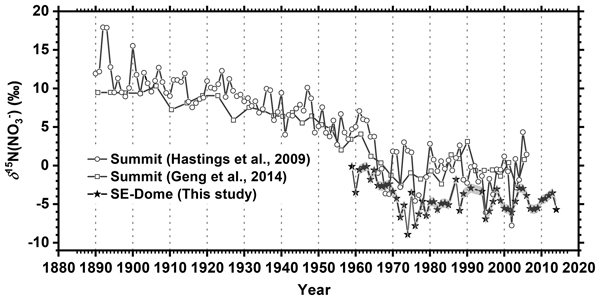
Zhao Wei, Shohei Hattori, Asuka Tsuruta, Zhuang Jiang, Sakiko Ishino, Koji Fujita, Sumito Matoba, Lei Geng, Alexis Lamothe, Ryu Uemura, Naohiro Yoshida, Joel Savarino, and Yoshinori Iizuka
Atmos. Chem. Phys., 25, 5727–5742, https://doi.org/10.5194/acp-25-5727-2025, https://doi.org/10.5194/acp-25-5727-2025, 2025
Short summary
Short summary
Nitrate isotope records in ice cores reveal changes in NOₓ emissions and atmospheric oxidation chemistry driven by human activity. However, UV-driven postdepositional processes can alter nitrate in snow, making snow accumulation rates critical for preserving these records. This study examines nitrate isotopes in a southeastern Greenland ice core, where high snow accumulation minimizes these effects, providing a reliable archive of atmospheric nitrogen cycling.
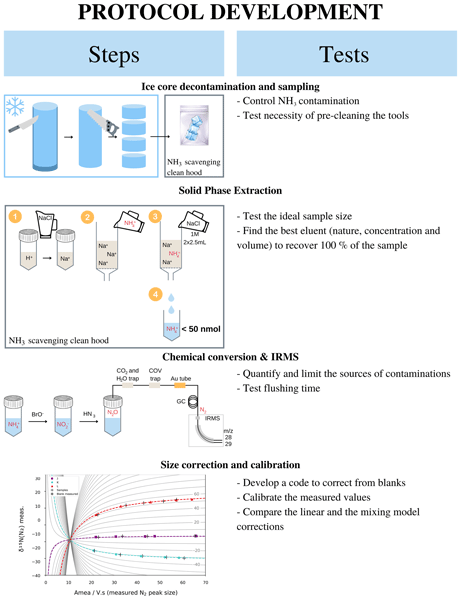
Alexis Lamothe, Joel Savarino, Patrick Ginot, Lison Soussaintjean, Elsa Gautier, Pete D. Akers, Nicolas Caillon, and Joseph Erbland
Atmos. Meas. Tech., 16, 4015–4030, https://doi.org/10.5194/amt-16-4015-2023, https://doi.org/10.5194/amt-16-4015-2023, 2023
Short summary
Short summary
Ammonia is a reactive gas in our atmosphere that is key in air quality issues. Assessing its emissions and how it reacts is a hot topic that can be addressed from the past. Stable isotopes (the mass of the molecule) measured in ice cores (glacial archives) can teach us a lot. However, the concentrations in ice cores are very small. We propose a protocol to limit the contamination and apply it to one ice core drilled in Mont Blanc, describing the opportunities our method brings.
Alexis Lamothe, Pete Akers, Patrick Ginot, Wendell Walters, Sarah Albertin, Nicolas Caillon, Elsa Gautier, and Joel Savarino
EGUsphere, https://doi.org/10.5194/egusphere-2026-5825, https://doi.org/10.5194/egusphere-2026-5825, 2026
This preprint is open for discussion and under review for Atmospheric Chemistry and Physics (ACP).
Short summary
Short summary
Ammonia pollution has changed greatly during European industrialisation, but how emissions become deposited ammonium remains unclear. We measured nitrogen isotopes of ammonium in a 1,000-year Alpine ice core. The record shows that atmospheric processing changed over time and cannot be explained by emissions alone. Recent decades show a new relationship between emissions and deposition, highlighting major gaps in our understanding of ammonia transport and removal.
Yéva Jeaumot, Frédéric Parrenin, Ailsa Chung, Olaf Eisen, Daniel Steinhage, Robert Mulvaney, Marie G. P. Cavitte, David A. Lilien, and Emilie Capron
EGUsphere, https://doi.org/10.5194/egusphere-2026-4174, https://doi.org/10.5194/egusphere-2026-4174, 2026
This preprint is open for discussion and under review for The Cryosphere (TC).
Short summary
Short summary
To choose good drilling sites and interpret ice cores correctly, scientists need reliable estimates of ice age at each depth. We developed a new way to model how ice behaves at the base of ice sheets, where it can melt or stop moving entirely, using radar data from Antarctica. Our estimates matched real measurements at a well-studied site, revealed a layer of stagnant ice at another, and predicted that a newly proposed drilling site could yield ice over two million years old.
Alexander Mattin, Simon J. Barker, V. Holly L. Winton, Andrea Burke, William Hutchison, Patrick J. Sugden, Kirstin Krüger, Alexa R. Van Eaton, Larry G. Mastin, Michael Sigl, Eric W. Wolff, Shuji Fujita, Kumiko Goto-Azuma, Ikumi Oyabu, Motohiro Hirabayashi, Anders Svensson, Magali Verkerk, Colin J. N. Wilson, Stephen B. Piva, Nels A. Iverson, Nelia W. Dunbar, Helle A. Kjær, Nancy A. N. Bertler, Mirko Severi, Andrei V. Kurbatov, and Dominic A. Winski
EGUsphere, https://doi.org/10.5194/egusphere-2026-3434, https://doi.org/10.5194/egusphere-2026-3434, 2026
This preprint is open for discussion and under review for Climate of the Past (CP).
Short summary
Short summary
This study presents evidence of the ~25.3 Ōruanui supereruption preserved in Antarctic ice cores. Glaciochemical signals and volcanic ash were identified across multiple sites, revealing regional differences in volcanic transport, deposition, and preservation. Combining ice core records with climate model simulations, we show the eruption likely caused substantial short-term global cooling and atmospheric change but was unlikely to trigger long-term climate shifts.
Geunwoo Lee, Tobias Erhardt, Piers Larkman, Chantal Zeppenfeld, Sarah Jackson, Jochen Schmitt, Barbara Delmonte, Giovanni Baccolo, Catherine Ritz, Frank Wilhelms, Dorthe Dahl-Jensen, Kevin Michael Nikolaus, Pascal Bohleber, and Hubertus Fischer
EGUsphere, https://doi.org/10.5194/egusphere-2026-4574, https://doi.org/10.5194/egusphere-2026-4574, 2026
Short summary
Short summary
Deep ice cores preserve records of past climate, but chemical reactions inside the ice can blur these signals over time. To find out how, we studied millions of dust particles in a deep Antarctic ice core. We found that, over long timescales, dust dissolves and reforms into new minerals within tiny pockets of liquid, trapping chemical elements. Warm temperatures speed up this process. Accounting for it helps scientists interpret ancient climate records from deep ice more reliably.
Faramarz Bagherzadeh, Johannes Freitag, Udo Frese, and Frank Wilhelms
EGUsphere, https://doi.org/10.5194/egusphere-2026-3185, https://doi.org/10.5194/egusphere-2026-3185, 2026
Short summary
Short summary
We studied a 130 m ice core from East Antarctica to better understand how snow slowly turns into ice and traps air over time. Using advanced image enhancement and 3D imaging, we examined the ice in unprecedented detail along the entire core. We found clear changes in the size, shape, and connections of air spaces with depth. These results provide new information that can improve interpretations of past climate and help refine models of ice formation and air movement in polar ice.
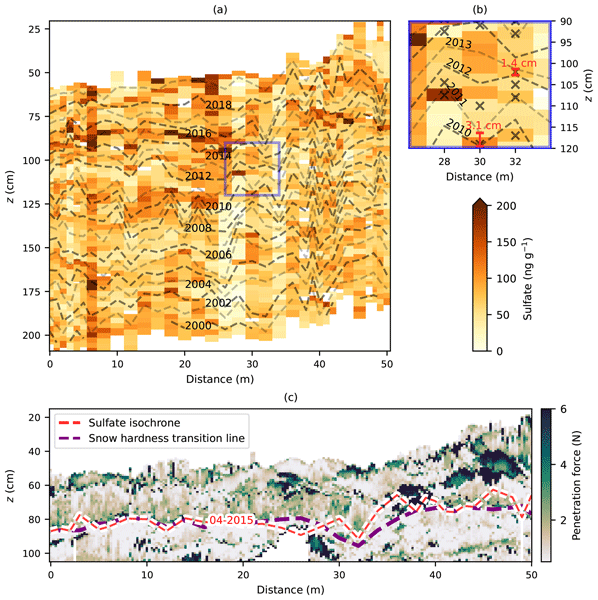
Adrien Ooms, Mathieu Casado, Ghislain Picard, Laurent Arnaud, Maria Hörhold, Andrea Spolaor, Rita Traversi, Joel Savarino, Patrick Ginot, Pete Akers, Birthe Twarloh, and Valérie Masson-Delmotte
The Cryosphere, 20, 3235–3255, https://doi.org/10.5194/tc-20-3235-2026, https://doi.org/10.5194/tc-20-3235-2026, 2026
Short summary
Short summary
This work presents a new approach to the estimation of accumulation rates at Concordia Station, East-Antarctica, for the last 20 years, from a new data set of chemical tracers and snow micro-scale properties measured in a snow trench. Multi-annual and meter to decameter scale variability of accumulation rates are compared again in-situ measurements of surface laser scanner and stake farm, with very good agreement. This further constrains SMB estimation for Antarctica at high temporal resolution.
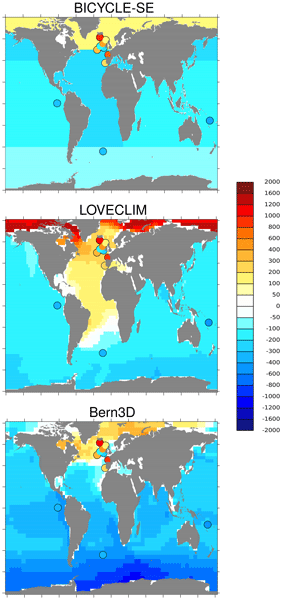
Peter Köhler, Laurie Menviel, Frerk Pöppelmeier, Timothy J. Heaton, Edouard Bard, and Luke C. Skinner
Clim. Past, 22, 729–746, https://doi.org/10.5194/cp-22-729-2026, https://doi.org/10.5194/cp-22-729-2026, 2026
Short summary
Short summary
Radiocarbon (14C) is decaying over time, which is used to determine the age of carbon-containing objects. Calibration curves are necessary to come from measured 14C values to calendar ages. We use different models in order to improve future calibration curves, especially around times of abrupt changes in the Atlantic meridional overturning circulation. We find that uncertainties during those times are underrepresented in present calibrations, especially in the Atlantic.
Elena Barbaro, Francisco Ardini, Silvia Becagli, Stefano Bertinetti, Federica Bruschi, Giulia Calzolai, Alice Cavaliere, David Cappelletti, Stefano Crocchianti, Matteo Feltracco, Andrea Gambaro, Fabio Giardi, Stefania Gilardoni, Marco Grotti, Dominic Heslin-Rees, Radovan Krejci, Mery Malandrino, Matilde Mataloni, Simonetta Montaguti, Silvia Nava, Marco Paglione, Matteo Rinaldi, Chiara Ripa, Mirko Severi, Andrea Spolaor, Rita Traversi, Hilde Uggerud, Giulio Verazzo, Tessa Viglezio, Karl Espen Yttri, Wenche Aas, and Mauro Mazzola
EGUsphere, https://doi.org/10.5194/egusphere-2026-1467, https://doi.org/10.5194/egusphere-2026-1467, 2026
Short summary
Short summary
This study analyzes how Arctic atmospheric layering affects aerosol distribution by comparing data from the Gruvebadet (61 m) and Zeppelin (472 m) observatories in Svalbard. Results show consistent levels of human-made pollutants like sulfate at both heights, confirming long-range transport from Eurasia. Conversely, natural biogenic tracers were more concentrated at lower altitudes. By integrating chemical and meteorological data, the research highlights the need for multi-level monitoring.
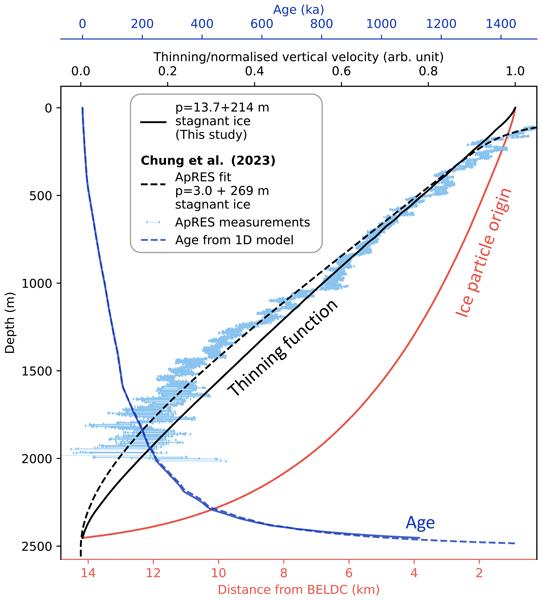
Ailsa Chung, Frédéric Parrenin, Robert Mulvaney, Luca Vittuari, Massimo Frezzotti, Antonio Zanutta, David A. Lilien, Marie G. P. Cavitte, and Olaf Eisen
The Cryosphere, 19, 4125–4140, https://doi.org/10.5194/tc-19-4125-2025, https://doi.org/10.5194/tc-19-4125-2025, 2025
Short summary
Short summary
We applied an ice flow model to a flow line from the summit of Dome C to the Beyond EPICA ice core drill site on Little Dome C in Antarctica. Results show that the oldest ice at the drill site may be 1.12 Ma (at an age density of 20 kyr m-1) and originate from around 15 km upstream. We also discuss the nature of the 200–250 m thick basal layer which could be composed of stagnant ice, disturbed ice or even accreted ice (possibly containing debris).
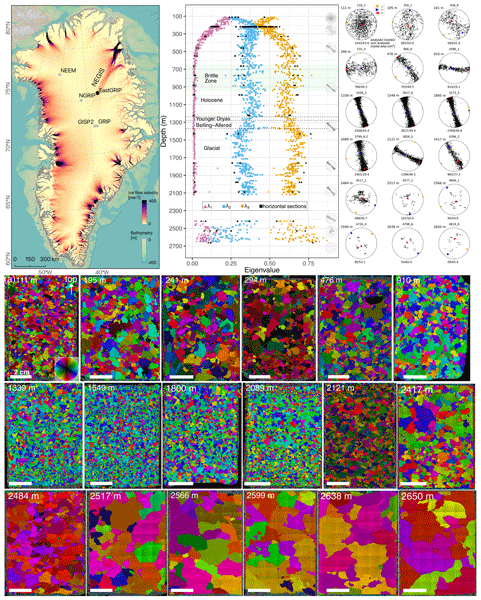
Nicolas Stoll, Ilka Weikusat, Daniela Jansen, Paul Bons, Kyra Darányi, Julien Westhoff, María-Gema Llorens, David Wallis, Jan Eichler, Tomotaka Saruya, Tomoyuki Homma, Sune Olander Rasmussen, Giulia Sinnl, Anders Svensson, Martyn Drury, Frank Wilhelms, Sepp Kipfstuhl, Dorthe Dahl-Jensen, and Johanna Kerch
The Cryosphere, 19, 3805–3830, https://doi.org/10.5194/tc-19-3805-2025, https://doi.org/10.5194/tc-19-3805-2025, 2025
Short summary
Short summary
A better understanding of ice flow requires more observational data. The EastGRIP core is the first ice core through an active ice stream. We discuss crystal orientation data determining the present deformation regimes. A comparison with other deep cores shows the unique properties of EastGRIP and shows that deep ice likely originates from the Eemian. We further show that the overall plug flow of NEGIS is characterised by many small-scale variations, which remain to be considered in ice flow models.
Zhao Wei, Shohei Hattori, Asuka Tsuruta, Zhuang Jiang, Sakiko Ishino, Koji Fujita, Sumito Matoba, Lei Geng, Alexis Lamothe, Ryu Uemura, Naohiro Yoshida, Joel Savarino, and Yoshinori Iizuka
Atmos. Chem. Phys., 25, 5727–5742, https://doi.org/10.5194/acp-25-5727-2025, https://doi.org/10.5194/acp-25-5727-2025, 2025
Short summary
Short summary
Nitrate isotope records in ice cores reveal changes in NOₓ emissions and atmospheric oxidation chemistry driven by human activity. However, UV-driven postdepositional processes can alter nitrate in snow, making snow accumulation rates critical for preserving these records. This study examines nitrate isotopes in a southeastern Greenland ice core, where high snow accumulation minimizes these effects, providing a reliable archive of atmospheric nitrogen cycling.
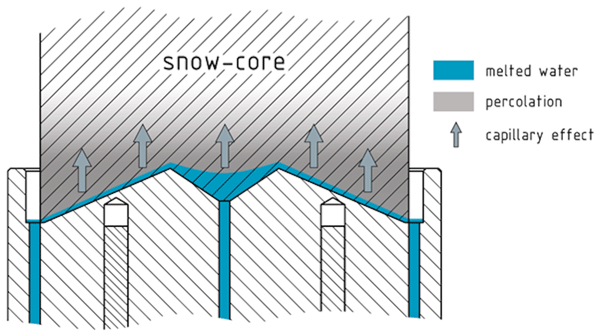
Rémi Dallmayr, Hannah Meyer, Vasileios Gkinis, Thomas Laepple, Melanie Behrens, Frank Wilhelms, and Maria Hörhold
The Cryosphere, 19, 1067–1083, https://doi.org/10.5194/tc-19-1067-2025, https://doi.org/10.5194/tc-19-1067-2025, 2025
Short summary
Short summary
Recent studies showed that a large number of independent vertical profiles allow for inferring a common local climate signal from the stacked stable water isotope record. Through investigating instrumental limitation and the effect of percolation of such porous samples, this study assesses the continuous flow analysis (CFA) technique in order to analyze the significant number of snow surface profiles within a reasonable time and with high quality.
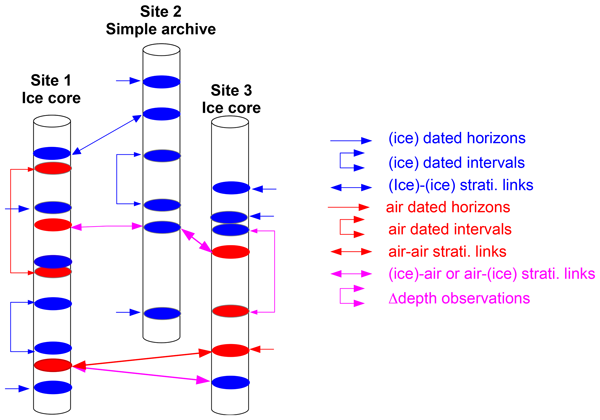
Frédéric Parrenin, Marie Bouchet, Christo Buizert, Emilie Capron, Ellen Corrick, Russell Drysdale, Kenji Kawamura, Amaëlle Landais, Robert Mulvaney, Ikumi Oyabu, and Sune Olander Rasmussen
Geosci. Model Dev., 17, 8735–8750, https://doi.org/10.5194/gmd-17-8735-2024, https://doi.org/10.5194/gmd-17-8735-2024, 2024
Short summary
Short summary
The Paleochrono-1.1 probabilistic dating model allows users to derive a common and optimized chronology for several paleoclimatic sites from various archives (ice cores, speleothems, marine cores, lake cores, etc.). It combines prior sedimentation scenarios with chronological information such as dated horizons, dated intervals, stratigraphic links and (for ice cores) Δdepth observations. Paleochrono-1.1 is available under an open-source license.
Helene Hoffmann, Jason Day, Rachael H. Rhodes, Mackenzie Grieman, Jack Humby, Isobel Rowell, Christoph Nehrbass-Ahles, Robert Mulvaney, Sally Gibson, and Eric Wolff
The Cryosphere, 18, 4993–5013, https://doi.org/10.5194/tc-18-4993-2024, https://doi.org/10.5194/tc-18-4993-2024, 2024
Short summary
Short summary
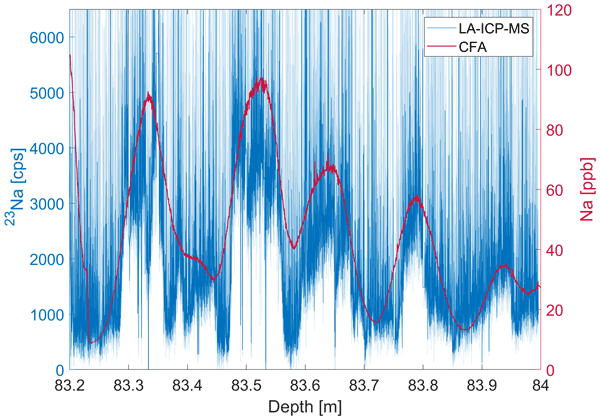
Ice cores are archives of past atmospheric conditions. In deep and old ice, the layers containing this information get thinned to the millimetre scale or below. We installed a setup for high-resolution (182 μm) chemical impurity measurements in ice cores using the laser ablation technique at the University of Cambridge. In a first application to the Skytrain ice core from Antarctica, we discuss the potential to detect fine-layered structures in ice up to an age of 26 000 years.
Rachael H. Rhodes, Yvan Bollet-Quivogne, Piers Barnes, Mirko Severi, and Eric W. Wolff
Clim. Past, 20, 2031–2043, https://doi.org/10.5194/cp-20-2031-2024, https://doi.org/10.5194/cp-20-2031-2024, 2024
Short summary
Short summary
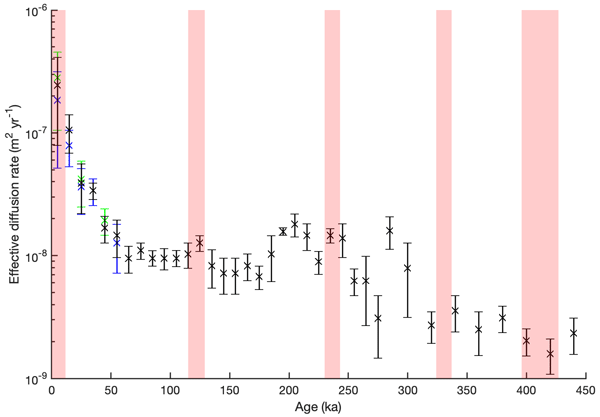
Some ionic components slowly move through glacier ice by diffusion, but the rate of this diffusion, its exact mechanism(s), and the factors that might influence it are poorly understood. In this study, we model how peaks in sulfate, deposited at Dome C on the Antarctic ice sheet after volcanic eruptions, change with depth and time. We find that the sulfate diffusion rate in ice is relatively fast in young ice near the surface, but the rate is markedly reduced over time.
Romilly Harris Stuart, Amaëlle Landais, Laurent Arnaud, Christo Buizert, Emilie Capron, Marie Dumont, Quentin Libois, Robert Mulvaney, Anaïs Orsi, Ghislain Picard, Frédéric Prié, Jeffrey Severinghaus, Barbara Stenni, and Patricia Martinerie
The Cryosphere, 18, 3741–3763, https://doi.org/10.5194/tc-18-3741-2024, https://doi.org/10.5194/tc-18-3741-2024, 2024
Short summary
Short summary
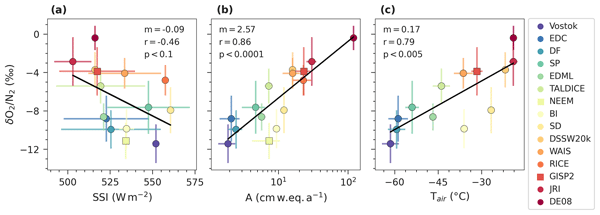
Ice core δO2/N2 records are useful dating tools due to their local insolation pacing. A precise understanding of the physical mechanism driving this relationship, however, remain ambiguous. By compiling data from 15 polar sites, we find a strong dependence of mean δO2/N2 on accumulation rate and temperature in addition to the well-documented insolation dependence. Snowpack modelling is used to investigate which physical properties drive the mechanistic dependence on these local parameters.
V. Holly L. Winton, Robert Mulvaney, Joel Savarino, Kyle R. Clem, and Markus M. Frey
Clim. Past, 20, 1213–1232, https://doi.org/10.5194/cp-20-1213-2024, https://doi.org/10.5194/cp-20-1213-2024, 2024
Short summary
Short summary
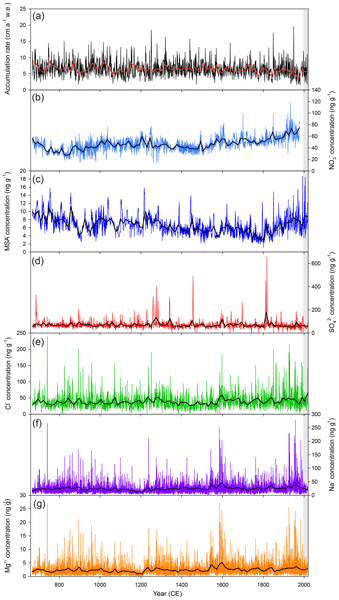
In 2018, a new 120 m ice core was drilled in a region located under the Antarctic ozone hole. We present the first results including a 1300-year record of snow accumulation and aerosol chemistry. We investigate the aerosol and moisture source regions and atmospheric processes related to the ice core record and discuss what this means for developing a record of past ultraviolet radiation and ozone depletion using the stable isotopic composition of nitrate measured in the same ice core.
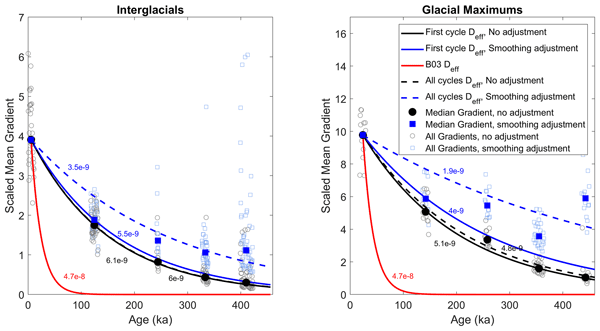
Tyler J. Fudge, Raphael Sauvage, Linh Vu, Benjamin H. Hills, Mirko Severi, and Edwin D. Waddington
Clim. Past, 20, 297–312, https://doi.org/10.5194/cp-20-297-2024, https://doi.org/10.5194/cp-20-297-2024, 2024
Short summary
Short summary
We use the oldest Antarctic ice core to estimate the rate of diffusion of sulfuric acid. Sulfuric acid is a marker of past volcanic activity and is critical in developing ice core timescales. The rate of diffusion is uncertain and is important to know, both for selecting future ice core locations and interpreting ice core records. We find the effective diffusivity of sulfate is 10 times smaller than previously estimated, indicating that the sulfuric acid signals will persist for longer.
Emma Nilsson, Carmen Paulina Vega, Dmitry Divine, Anja Eichler, Tonu Martma, Robert Mulvaney, Elisabeth Schlosser, Margit Schwikowski, and Elisabeth Isaksson
EGUsphere, https://doi.org/10.5194/egusphere-2023-3156, https://doi.org/10.5194/egusphere-2023-3156, 2024
Preprint withdrawn
Short summary
Short summary
To project future climate change it is necessary to understand paleoclimate including past sea ice conditions. We have investigated methane sulphonic acid (MSA) in Antarctic firn and ice cores to reconstruct sea ice extent (SIE) and found that the MSA – SIE as well as the MSA – phytoplankton biomass relationship varies across the different firn and ice cores. These inconsistencies in correlations across records suggest that MSA in Fimbul Ice Shelf cores does not reliably indicate regional SIE.
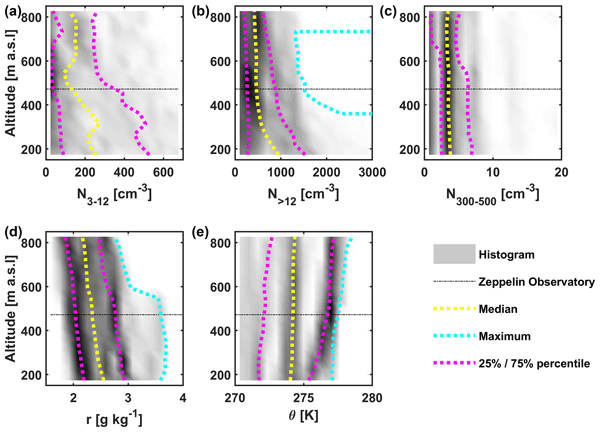
Barbara Harm-Altstädter, Konrad Bärfuss, Lutz Bretschneider, Martin Schön, Jens Bange, Ralf Käthner, Radovan Krejci, Mauro Mazzola, Kihong Park, Falk Pätzold, Alexander Peuker, Rita Traversi, Birgit Wehner, and Astrid Lampert
Aerosol Research, 1, 39–64, https://doi.org/10.5194/ar-1-39-2023, https://doi.org/10.5194/ar-1-39-2023, 2023
Short summary
Short summary
We present observations of aerosol particles and meteorological parameters in the horizontal and vertical distribution measured with uncrewed aerial systems in the Arctic. The field campaign was carried out during the snow melting season, when ultrafine aerosol particles (UFPs) with a size between 3 and 12 nm occurred frequently. A high variability of the measured UFPs was identified in the spatial scale, which was strongly associated with different atmospheric boundary layer properties.
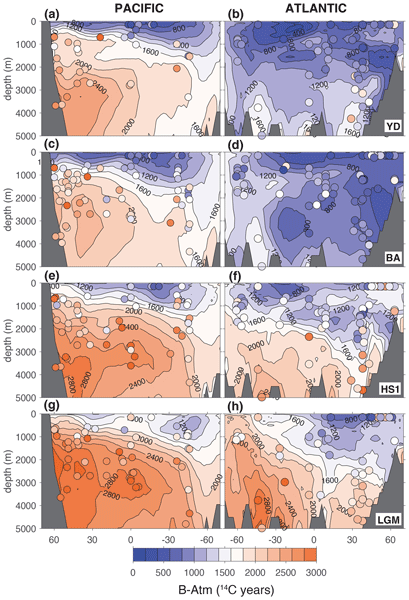
Luke Skinner, Francois Primeau, Aurich Jeltsch-Thömmes, Fortunat Joos, Peter Köhler, and Edouard Bard
Clim. Past, 19, 2177–2202, https://doi.org/10.5194/cp-19-2177-2023, https://doi.org/10.5194/cp-19-2177-2023, 2023
Short summary
Short summary
Radiocarbon is best known as a dating tool, but it also allows us to track CO2 exchange between the ocean and atmosphere. Using decades of data and novel mapping methods, we have charted the ocean’s average radiocarbon ″age” since the last Ice Age. Combined with climate model simulations, these data quantify the ocean’s role in atmospheric CO2 rise since the last Ice Age while also revealing that Earth likely received far more cosmic radiation during the last Ice Age than hitherto believed.
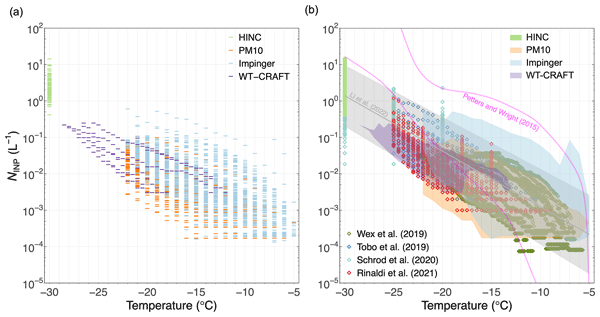
Guangyu Li, Elise K. Wilbourn, Zezhen Cheng, Jörg Wieder, Allison Fagerson, Jan Henneberger, Ghislain Motos, Rita Traversi, Sarah D. Brooks, Mauro Mazzola, Swarup China, Athanasios Nenes, Ulrike Lohmann, Naruki Hiranuma, and Zamin A. Kanji
Atmos. Chem. Phys., 23, 10489–10516, https://doi.org/10.5194/acp-23-10489-2023, https://doi.org/10.5194/acp-23-10489-2023, 2023
Short summary
Short summary
In this work, we present results from an Arctic field campaign (NASCENT) in Ny-Ålesund, Svalbard, on the abundance, variability, physicochemical properties, and potential sources of ice-nucleating particles (INPs) relevant for mixed-phase cloud formation. This work improves the data coverage of Arctic INPs and aerosol properties, allowing for the validation of models predicting cloud microphysical and radiative properties of mixed-phase clouds in the rapidly warming Arctic.
Alexis Lamothe, Joel Savarino, Patrick Ginot, Lison Soussaintjean, Elsa Gautier, Pete D. Akers, Nicolas Caillon, and Joseph Erbland
Atmos. Meas. Tech., 16, 4015–4030, https://doi.org/10.5194/amt-16-4015-2023, https://doi.org/10.5194/amt-16-4015-2023, 2023
Short summary
Short summary
Ammonia is a reactive gas in our atmosphere that is key in air quality issues. Assessing its emissions and how it reacts is a hot topic that can be addressed from the past. Stable isotopes (the mass of the molecule) measured in ice cores (glacial archives) can teach us a lot. However, the concentrations in ice cores are very small. We propose a protocol to limit the contamination and apply it to one ice core drilled in Mont Blanc, describing the opportunities our method brings.
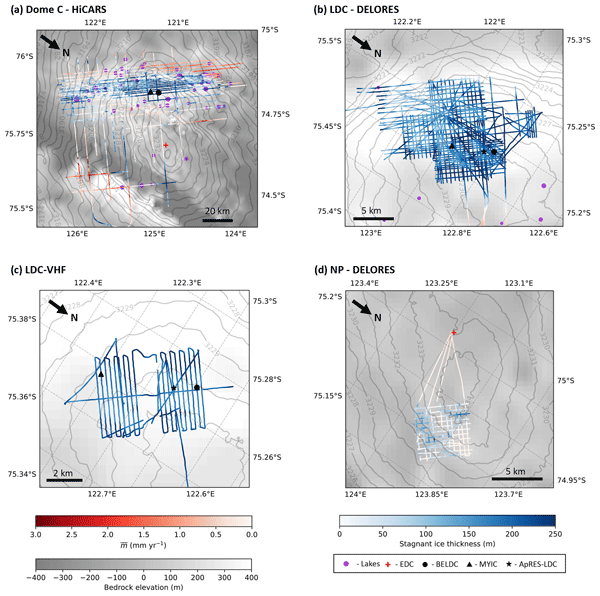
Ailsa Chung, Frédéric Parrenin, Daniel Steinhage, Robert Mulvaney, Carlos Martín, Marie G. P. Cavitte, David A. Lilien, Veit Helm, Drew Taylor, Prasad Gogineni, Catherine Ritz, Massimo Frezzotti, Charles O'Neill, Heinrich Miller, Dorthe Dahl-Jensen, and Olaf Eisen
The Cryosphere, 17, 3461–3483, https://doi.org/10.5194/tc-17-3461-2023, https://doi.org/10.5194/tc-17-3461-2023, 2023
Short summary
Short summary
We combined a numerical model with radar measurements in order to determine the age of ice in the Dome C region of Antarctica. Our results show that at the current ice core drilling sites on Little Dome C, the maximum age of the ice is almost 1.5 Ma. We also highlight a new potential drill site called North Patch with ice up to 2 Ma. Finally, we explore the nature of a stagnant ice layer at the base of the ice sheet which has been independently observed and modelled but is not well understood.
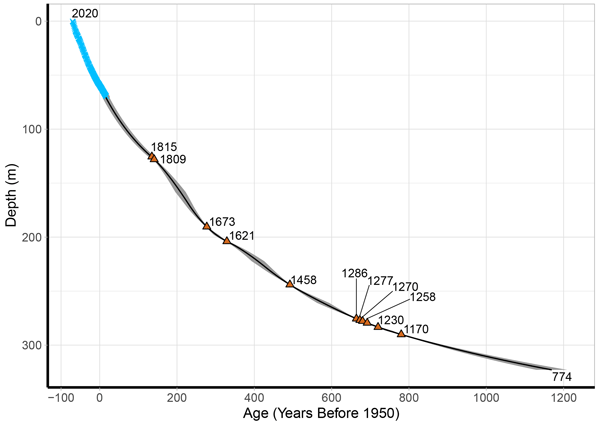
Isobel Rowell, Carlos Martin, Robert Mulvaney, Helena Pryer, Dieter Tetzner, Emily Doyle, Hara Madhav Talasila, Jilu Li, and Eric Wolff
Clim. Past, 19, 1699–1714, https://doi.org/10.5194/cp-19-1699-2023, https://doi.org/10.5194/cp-19-1699-2023, 2023
Short summary
Short summary
We present an age scale for a new type of ice core from a vulnerable region in West Antarctic, which is lacking in longer-term (greater than a few centuries) ice core records. The Sherman Island core extends to greater than 1 kyr. We provide modelling evidence for the potential of a 10 kyr long core. We show that this new type of ice core can be robustly dated and that climate records from this core will be a significant addition to existing regional climate records.
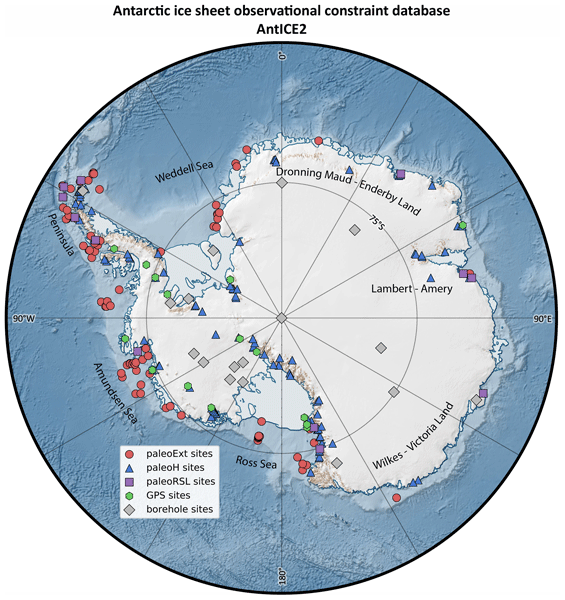
Benoit S. Lecavalier, Lev Tarasov, Greg Balco, Perry Spector, Claus-Dieter Hillenbrand, Christo Buizert, Catherine Ritz, Marion Leduc-Leballeur, Robert Mulvaney, Pippa L. Whitehouse, Michael J. Bentley, and Jonathan Bamber
Earth Syst. Sci. Data, 15, 3573–3596, https://doi.org/10.5194/essd-15-3573-2023, https://doi.org/10.5194/essd-15-3573-2023, 2023
Short summary
Short summary
The Antarctic Ice Sheet Evolution constraint database version 2 (AntICE2) consists of a large variety of observations that constrain the evolution of the Antarctic Ice Sheet over the last glacial cycle. This includes observations of past ice sheet extent, past ice thickness, past relative sea level, borehole temperature profiles, and present-day bedrock displacement rates. The database is intended to improve our understanding of past Antarctic changes and for ice sheet model calibrations.
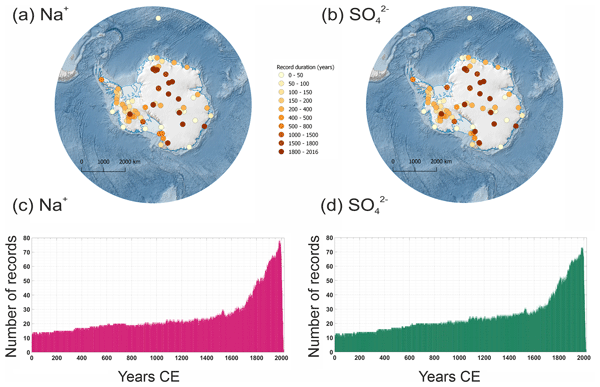
Elizabeth R. Thomas, Diana O. Vladimirova, Dieter R. Tetzner, B. Daniel Emanuelsson, Nathan Chellman, Daniel A. Dixon, Hugues Goosse, Mackenzie M. Grieman, Amy C. F. King, Michael Sigl, Danielle G. Udy, Tessa R. Vance, Dominic A. Winski, V. Holly L. Winton, Nancy A. N. Bertler, Akira Hori, Chavarukonam M. Laluraj, Joseph R. McConnell, Yuko Motizuki, Kazuya Takahashi, Hideaki Motoyama, Yoichi Nakai, Franciéle Schwanck, Jefferson Cardia Simões, Filipe Gaudie Ley Lindau, Mirko Severi, Rita Traversi, Sarah Wauthy, Cunde Xiao, Jiao Yang, Ellen Mosely-Thompson, Tamara V. Khodzher, Ludmila P. Golobokova, and Alexey A. Ekaykin
Earth Syst. Sci. Data, 15, 2517–2532, https://doi.org/10.5194/essd-15-2517-2023, https://doi.org/10.5194/essd-15-2517-2023, 2023
Short summary
Short summary
The concentration of sodium and sulfate measured in Antarctic ice cores is related to changes in both sea ice and winds. Here we have compiled a database of sodium and sulfate records from 105 ice core sites in Antarctica. The records span all, or part, of the past 2000 years. The records will improve our understanding of how winds and sea ice have changed in the past and how they have influenced the climate of Antarctica over the past 2000 years.
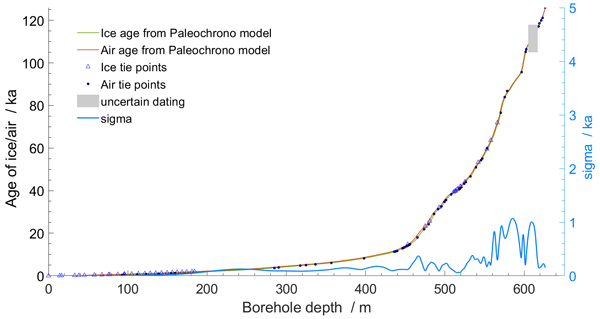
Robert Mulvaney, Eric W. Wolff, Mackenzie M. Grieman, Helene H. Hoffmann, Jack D. Humby, Christoph Nehrbass-Ahles, Rachael H. Rhodes, Isobel F. Rowell, Frédéric Parrenin, Loïc Schmidely, Hubertus Fischer, Thomas F. Stocker, Marcus Christl, Raimund Muscheler, Amaelle Landais, and Frédéric Prié
Clim. Past, 19, 851–864, https://doi.org/10.5194/cp-19-851-2023, https://doi.org/10.5194/cp-19-851-2023, 2023
Short summary
Short summary
We present an age scale for a new ice core drilled at Skytrain Ice Rise, an ice rise facing the Ronne Ice Shelf in Antarctica. Various measurements in the ice and air phases are used to match the ice core to other Antarctic cores that have already been dated, and a new age scale is constructed. The 651 m ice core includes ice that is confidently dated to 117 000–126 000 years ago, in the last interglacial. Older ice is found deeper down, but there are flow disturbances in the deeper ice.
Simone Ventisette, Samuele Baldini, Claudio Artoni, Silvia Becagli, Laura Caiazzo, Barbara Delmonte, Massimo Frezzotti, Raffaello Nardin, Joel Savarino, Mirko Severi, Andrea Spolaor, Barbara Stenni, and Rita Traversi
EGUsphere, https://doi.org/10.5194/egusphere-2023-393, https://doi.org/10.5194/egusphere-2023-393, 2023
Preprint archived
Short summary
Short summary
The paper reports the spatial variability of concentration and fluxes of chemical impurities in superficial snow over unexplored area of the East Antarctic ice sheet. Pinatubo and Puyehue-Cordón Caulle volcanic eruptions in non-sea salt sulfate and dust snow pits record were used to achieve the accumulation rates. Deposition (wet, dry and uptake from snow surface) and post deposition processes are constrained. These knowledges are fundamental in Antarctic ice cores stratigraphies interpretation.
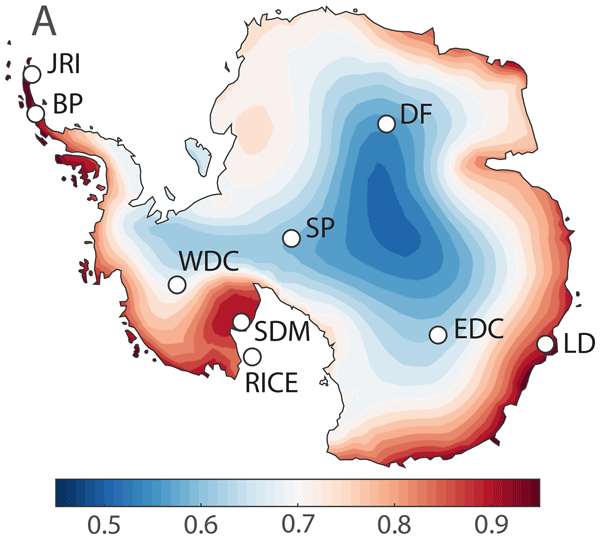
Christo Buizert, Sarah Shackleton, Jeffrey P. Severinghaus, William H. G. Roberts, Alan Seltzer, Bernhard Bereiter, Kenji Kawamura, Daniel Baggenstos, Anaïs J. Orsi, Ikumi Oyabu, Benjamin Birner, Jacob D. Morgan, Edward J. Brook, David M. Etheridge, David Thornton, Nancy Bertler, Rebecca L. Pyne, Robert Mulvaney, Ellen Mosley-Thompson, Peter D. Neff, and Vasilii V. Petrenko
Clim. Past, 19, 579–606, https://doi.org/10.5194/cp-19-579-2023, https://doi.org/10.5194/cp-19-579-2023, 2023
Short summary
Short summary
It is unclear how different components of the global atmospheric circulation, such as the El Niño effect, respond to large-scale climate change. We present a new ice core gas proxy, called krypton-86 excess, that reflects past storminess in Antarctica. We present data from 11 ice cores that suggest the new proxy works. We present a reconstruction of changes in West Antarctic storminess over the last 24 000 years and suggest these are caused by north–south movement of the tropical rain belt.
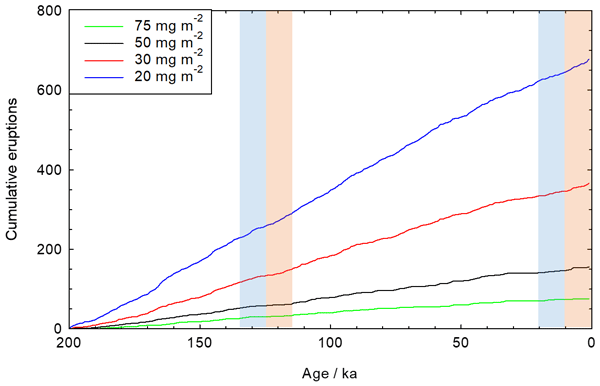
Eric W. Wolff, Andrea Burke, Laura Crick, Emily A. Doyle, Helen M. Innes, Sue H. Mahony, James W. B. Rae, Mirko Severi, and R. Stephen J. Sparks
Clim. Past, 19, 23–33, https://doi.org/10.5194/cp-19-23-2023, https://doi.org/10.5194/cp-19-23-2023, 2023
Short summary
Short summary
Large volcanic eruptions leave an imprint of a spike of sulfate deposition that can be measured in ice cores. Here we use a method that logs the number and size of large eruptions recorded in an Antarctic core in a consistent way through the last 200 000 years. The rate of recorded eruptions is variable but shows no trends. In particular, there is no increase in recorded eruptions during deglaciation periods. This is consistent with most recorded eruptions being from lower latitudes.
Xavier Giraud, Mélanie Baroni, and Rita Traversi
EGUsphere, https://doi.org/10.5194/egusphere-2022-1455, https://doi.org/10.5194/egusphere-2022-1455, 2023
Preprint archived
Short summary
Short summary
The snowpack in High Antarctic Plateau is an interface medium between the atmosphere and the firn, where past climate conditions are recorded. Originating mainly from oceanic sources, chlorine is deposited along with snow. We propose a mechanism implying the diffusion of HCl at the scale of snow grains, longing a few decades for its release to the Antarctic atmosphere. Based on this scenario, the fate of the anthropogenic 36Cl originating from the nuclear tests can be forcasted.
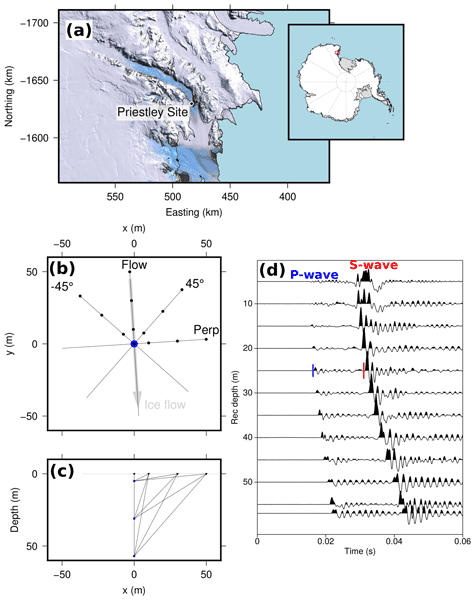
Franz Lutz, David J. Prior, Holly Still, M. Hamish Bowman, Bia Boucinhas, Lisa Craw, Sheng Fan, Daeyeong Kim, Robert Mulvaney, Rilee E. Thomas, and Christina L. Hulbe
The Cryosphere, 16, 3313–3329, https://doi.org/10.5194/tc-16-3313-2022, https://doi.org/10.5194/tc-16-3313-2022, 2022
Short summary
Short summary
Ice crystal alignment in the sheared margins of fast-flowing polar ice is important as it may control the ice sheet flow rate, from land to the ocean. Sampling shear margins is difficult because of logistical and safety considerations. We show that crystal alignments in a glacier shear margin in Antarctica can be measured using sound waves. Results from a seismic experiment on the 50 m scale and from ultrasonic experiments on the decimetre scale match ice crystal measurements from an ice core.
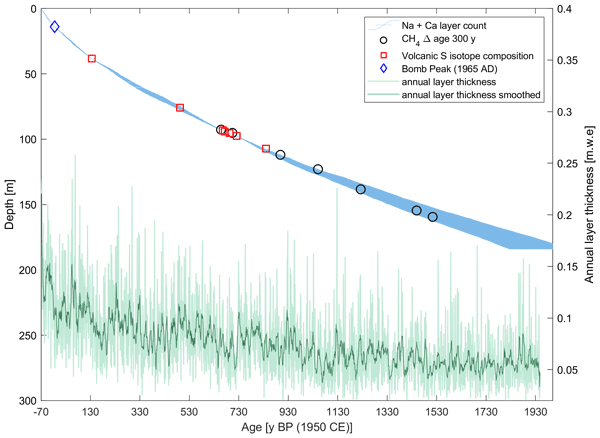
Helene M. Hoffmann, Mackenzie M. Grieman, Amy C. F. King, Jenna A. Epifanio, Kaden Martin, Diana Vladimirova, Helena V. Pryer, Emily Doyle, Axel Schmidt, Jack D. Humby, Isobel F. Rowell, Christoph Nehrbass-Ahles, Elizabeth R. Thomas, Robert Mulvaney, and Eric W. Wolff
Clim. Past, 18, 1831–1847, https://doi.org/10.5194/cp-18-1831-2022, https://doi.org/10.5194/cp-18-1831-2022, 2022
Short summary
Short summary
The WACSWAIN project (WArm Climate Stability of the West Antarctic ice sheet in the last INterglacial) investigates the fate of the West Antarctic Ice Sheet during the last warm period on Earth (115 000–130 000 years before present). Within this framework an ice core was recently drilled at Skytrain Ice Rise. In this study we present a stratigraphic chronology of that ice core based on absolute age markers and annual layer counting for the last 2000 years.
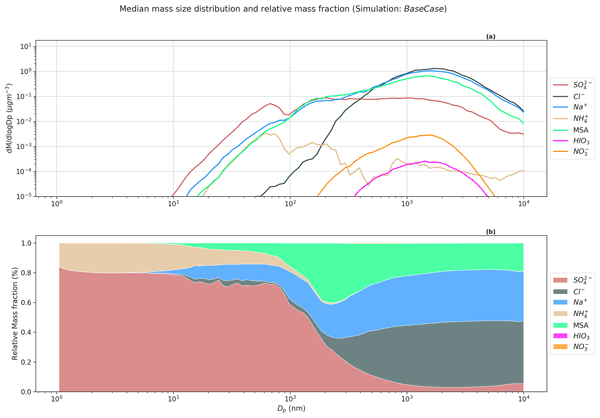
Carlton Xavier, Metin Baykara, Robin Wollesen de Jonge, Barbara Altstädter, Petri Clusius, Ville Vakkari, Roseline Thakur, Lisa Beck, Silvia Becagli, Mirko Severi, Rita Traversi, Radovan Krejci, Peter Tunved, Mauro Mazzola, Birgit Wehner, Mikko Sipilä, Markku Kulmala, Michael Boy, and Pontus Roldin
Atmos. Chem. Phys., 22, 10023–10043, https://doi.org/10.5194/acp-22-10023-2022, https://doi.org/10.5194/acp-22-10023-2022, 2022
Short summary
Short summary
The focus of this work is to study and improve our understanding of processes involved in the formation and growth of new particles in a remote Arctic marine environment. We run the 1D model ADCHEM along air mass trajectories arriving at Ny-Ålesund in May 2018. The model finds that ion-mediated H2SO4–NH3 nucleation can explain the observed new particle formation at Ny-Ålesund. The growth of particles is driven via H2SO4 condensation and formation of methane sulfonic acid in the aqueous phase.

Fabio Giardi, Silvia Nava, Giulia Calzolai, Giulia Pazzi, Massimo Chiari, Andrea Faggi, Bianca Patrizia Andreini, Chiara Collaveri, Elena Franchi, Guido Nincheri, Alessandra Amore, Silvia Becagli, Mirko Severi, Rita Traversi, and Franco Lucarelli
Atmos. Chem. Phys., 22, 9987–10005, https://doi.org/10.5194/acp-22-9987-2022, https://doi.org/10.5194/acp-22-9987-2022, 2022
Short summary
Short summary
The restriction measures adopted to contain the COVID-19 virus offered a unique opportunity to study urban particulate emissions in the near absence of traffic, which is one of the main emission sources in the urban environment. However, the drastic decrease in this source of particulate matter during the months of national lockdown did not lead to an equal decrease in the total particulate load. This is due to the inverse behavior shown by different sources, especially secondary sources.
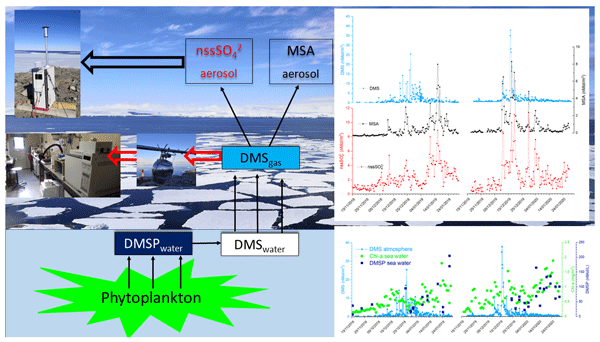
Silvia Becagli, Elena Barbaro, Simone Bonamano, Laura Caiazzo, Alcide di Sarra, Matteo Feltracco, Paolo Grigioni, Jost Heintzenberg, Luigi Lazzara, Michel Legrand, Alice Madonia, Marco Marcelli, Chiara Melillo, Daniela Meloni, Caterina Nuccio, Giandomenico Pace, Ki-Tae Park, Suzanne Preunkert, Mirko Severi, Marco Vecchiato, Roberta Zangrando, and Rita Traversi
Atmos. Chem. Phys., 22, 9245–9263, https://doi.org/10.5194/acp-22-9245-2022, https://doi.org/10.5194/acp-22-9245-2022, 2022
Short summary
Short summary
Measurements of phytoplanktonic dimethylsulfide and its oxidation products in the Antarctic atmosphere allow us to understand the role of the oceanic (sea ice melting, Chl α and dimethylsulfoniopropionate) and atmospheric (wind direction and speed, humidity, solar radiation and transport processes) factors in the biogenic aerosol formation, concentration and characteristic ratio between components in an Antarctic coastal site facing the polynya of the Ross Sea.
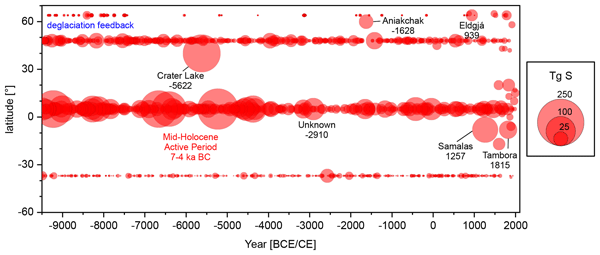
Michael Sigl, Matthew Toohey, Joseph R. McConnell, Jihong Cole-Dai, and Mirko Severi
Earth Syst. Sci. Data, 14, 3167–3196, https://doi.org/10.5194/essd-14-3167-2022, https://doi.org/10.5194/essd-14-3167-2022, 2022
Short summary
Short summary
Volcanism is a key driver of climate. Based on ice cores from Greenland and Antarctica, we reconstruct its climate impact potential over the Holocene. By aligning records on a well-dated chronology from Antarctica, we resolve long-standing inconsistencies in the dating of past volcanic eruptions. We reconstruct 850 eruptions (which, in total, injected 7410 Tg of sulfur in the stratosphere) and estimate how they changed the opacity of the atmosphere, a prerequisite for climate model simulations.

Astrid Oetting, Emma C. Smith, Jan Erik Arndt, Boris Dorschel, Reinhard Drews, Todd A. Ehlers, Christoph Gaedicke, Coen Hofstede, Johann P. Klages, Gerhard Kuhn, Astrid Lambrecht, Andreas Läufer, Christoph Mayer, Ralf Tiedemann, Frank Wilhelms, and Olaf Eisen
The Cryosphere, 16, 2051–2066, https://doi.org/10.5194/tc-16-2051-2022, https://doi.org/10.5194/tc-16-2051-2022, 2022
Short summary
Short summary
This study combines a variety of geophysical measurements in front of and beneath the Ekström Ice Shelf in order to identify and interpret geomorphological evidences of past ice sheet flow, extent and retreat.
The maximal extent of grounded ice in this region was 11 km away from the continental shelf break.
The thickness of palaeo-ice on the calving front around the LGM was estimated to be at least 305 to 320 m.
We provide essential boundary conditions for palaeo-ice-sheet models.
M. Reza Ershadi, Reinhard Drews, Carlos Martín, Olaf Eisen, Catherine Ritz, Hugh Corr, Julia Christmann, Ole Zeising, Angelika Humbert, and Robert Mulvaney
The Cryosphere, 16, 1719–1739, https://doi.org/10.5194/tc-16-1719-2022, https://doi.org/10.5194/tc-16-1719-2022, 2022
Short summary
Short summary
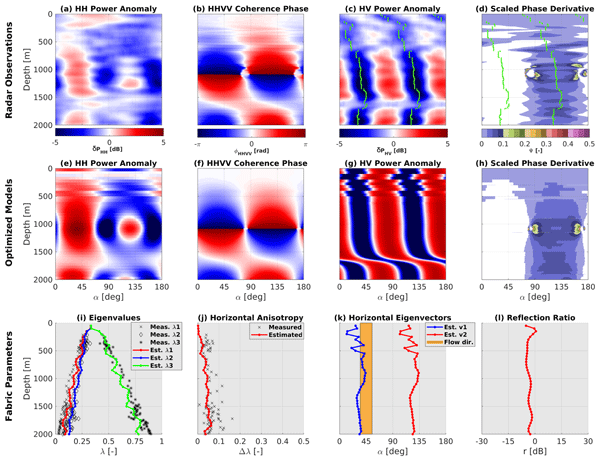
Radio waves transmitted through ice split up and inform us about the ice sheet interior and orientation of single ice crystals. This can be used to infer how ice flows and improve projections on how it will evolve in the future. Here we used an inverse approach and developed a new algorithm to infer ice properties from observed radar data. We applied this technique to the radar data obtained at two EPICA drilling sites, where ice cores were used to validate our results.
Cynthia H. Whaley, Rashed Mahmood, Knut von Salzen, Barbara Winter, Sabine Eckhardt, Stephen Arnold, Stephen Beagley, Silvia Becagli, Rong-You Chien, Jesper Christensen, Sujay Manish Damani, Xinyi Dong, Konstantinos Eleftheriadis, Nikolaos Evangeliou, Gregory Faluvegi, Mark Flanner, Joshua S. Fu, Michael Gauss, Fabio Giardi, Wanmin Gong, Jens Liengaard Hjorth, Lin Huang, Ulas Im, Yugo Kanaya, Srinath Krishnan, Zbigniew Klimont, Thomas Kühn, Joakim Langner, Kathy S. Law, Louis Marelle, Andreas Massling, Dirk Olivié, Tatsuo Onishi, Naga Oshima, Yiran Peng, David A. Plummer, Olga Popovicheva, Luca Pozzoli, Jean-Christophe Raut, Maria Sand, Laura N. Saunders, Julia Schmale, Sangeeta Sharma, Ragnhild Bieltvedt Skeie, Henrik Skov, Fumikazu Taketani, Manu A. Thomas, Rita Traversi, Kostas Tsigaridis, Svetlana Tsyro, Steven Turnock, Vito Vitale, Kaley A. Walker, Minqi Wang, Duncan Watson-Parris, and Tahya Weiss-Gibbons
Atmos. Chem. Phys., 22, 5775–5828, https://doi.org/10.5194/acp-22-5775-2022, https://doi.org/10.5194/acp-22-5775-2022, 2022
Short summary
Short summary
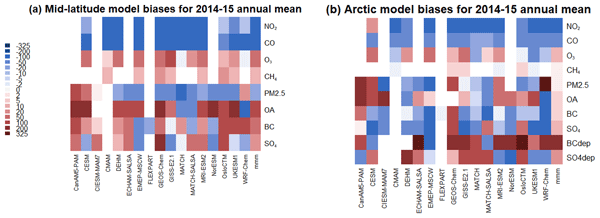
Air pollutants, like ozone and soot, play a role in both global warming and air quality. Atmospheric models are often used to provide information to policy makers about current and future conditions under different emissions scenarios. In order to have confidence in those simulations, in this study we compare simulated air pollution from 18 state-of-the-art atmospheric models to measured air pollution in order to assess how well the models perform.
Aki Virkkula, Henrik Grythe, John Backman, Tuukka Petäjä, Maurizio Busetto, Christian Lanconelli, Angelo Lupi, Silvia Becagli, Rita Traversi, Mirko Severi, Vito Vitale, Patrick Sheridan, and Elisabeth Andrews
Atmos. Chem. Phys., 22, 5033–5069, https://doi.org/10.5194/acp-22-5033-2022, https://doi.org/10.5194/acp-22-5033-2022, 2022
Short summary
Short summary
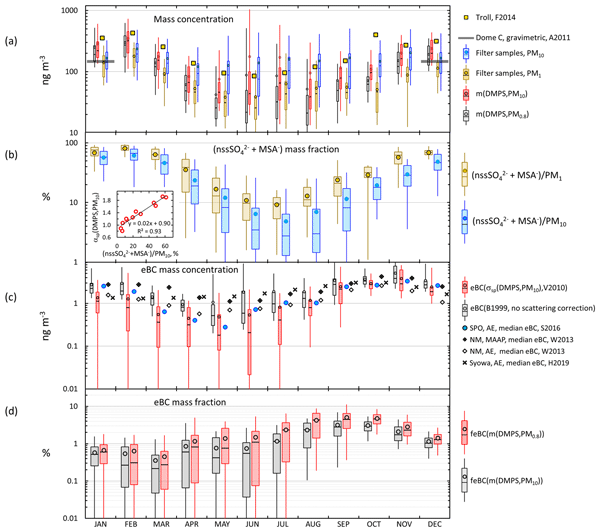
Optical properties of surface aerosols at Dome C, Antarctica, in 2007–2013 and their potential source areas are presented. The equivalent black carbon (eBC) mass concentrations were compared with eBC measured at three other Antarctic sites: the South Pole (SPO) and two coastal sites, Neumayer and Syowa. Transport analysis suggests that South American BC emissions are the largest contributor to eBC at Dome C.
Tobias Erhardt, Matthias Bigler, Urs Federer, Gideon Gfeller, Daiana Leuenberger, Olivia Stowasser, Regine Röthlisberger, Simon Schüpbach, Urs Ruth, Birthe Twarloh, Anna Wegner, Kumiko Goto-Azuma, Takayuki Kuramoto, Helle A. Kjær, Paul T. Vallelonga, Marie-Louise Siggaard-Andersen, Margareta E. Hansson, Ailsa K. Benton, Louise G. Fleet, Rob Mulvaney, Elizabeth R. Thomas, Nerilie Abram, Thomas F. Stocker, and Hubertus Fischer
Earth Syst. Sci. Data, 14, 1215–1231, https://doi.org/10.5194/essd-14-1215-2022, https://doi.org/10.5194/essd-14-1215-2022, 2022
Short summary
Short summary
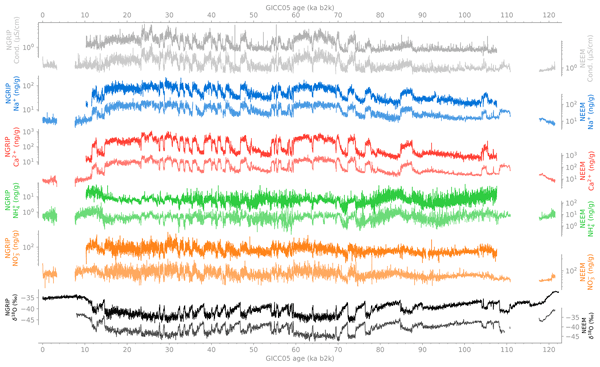
The datasets presented alongside this manuscript contain high-resolution concentration measurements of chemical impurities in deep ice cores, NGRIP and NEEM, from the Greenland ice sheet. The impurities originate from the deposition of aerosols to the surface of the ice sheet and are influenced by source, transport and deposition processes. Together, these records contain detailed, multi-parameter records of past climate variability over the last glacial period.
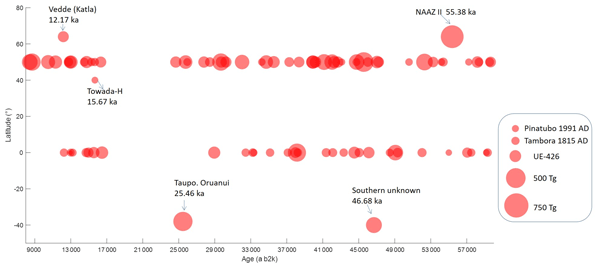
Jiamei Lin, Anders Svensson, Christine S. Hvidberg, Johannes Lohmann, Steffen Kristiansen, Dorthe Dahl-Jensen, Jørgen Peder Steffensen, Sune Olander Rasmussen, Eliza Cook, Helle Astrid Kjær, Bo M. Vinther, Hubertus Fischer, Thomas Stocker, Michael Sigl, Matthias Bigler, Mirko Severi, Rita Traversi, and Robert Mulvaney
Clim. Past, 18, 485–506, https://doi.org/10.5194/cp-18-485-2022, https://doi.org/10.5194/cp-18-485-2022, 2022
Short summary
Short summary
We employ acidity records from Greenland and Antarctic ice cores to estimate the emission strength, frequency and climatic forcing for large volcanic eruptions from the last half of the last glacial period. A total of 25 volcanic eruptions are found to be larger than any eruption in the last 2500 years, and we identify more eruptions than obtained from geological evidence. Towards the end of the glacial period, there is a notable increase in volcanic activity observed for Greenland.
Marjan Marbouti, Sehyun Jang, Silvia Becagli, Gabriel Navarro, Rita Traversi, Kitack Lee, Tuomo Nieminen, Lisa J. Beck, Markku Kulmala, Veli-Matti Kerminen, and Mikko Sipilä
Atmos. Chem. Phys. Discuss., https://doi.org/10.5194/acp-2022-52, https://doi.org/10.5194/acp-2022-52, 2022
Publication in ACP not foreseen
Short summary
Short summary
This research was done to understand and investigate the roles of Chl-a, PP and sea ice extent in controlling and producing the in-situ measured MSA, SA, HIO3, HOM and aerosol concentrations over the Greenland and Barents Seas. Our results provide strong support to the hypothesis that MSA, SA and small-particle concentrations in the Svalbard area are directly linked to ocean biological activity and sea ice melting during springtime.
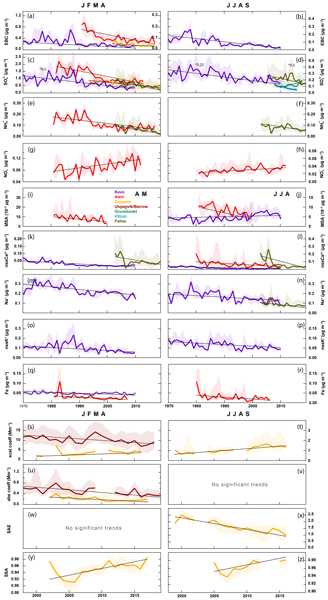
Julia Schmale, Sangeeta Sharma, Stefano Decesari, Jakob Pernov, Andreas Massling, Hans-Christen Hansson, Knut von Salzen, Henrik Skov, Elisabeth Andrews, Patricia K. Quinn, Lucia M. Upchurch, Konstantinos Eleftheriadis, Rita Traversi, Stefania Gilardoni, Mauro Mazzola, James Laing, and Philip Hopke
Atmos. Chem. Phys., 22, 3067–3096, https://doi.org/10.5194/acp-22-3067-2022, https://doi.org/10.5194/acp-22-3067-2022, 2022
Short summary
Short summary
Long-term data sets of Arctic aerosol properties from 10 stations across the Arctic provide evidence that anthropogenic influence on the Arctic atmospheric chemical composition has declined in winter, a season which is typically dominated by mid-latitude emissions. The number of significant trends in summer is smaller than in winter, and overall the pattern is ambiguous with some significant positive and negative trends. This reflects the mixed influence of natural and anthropogenic emissions.
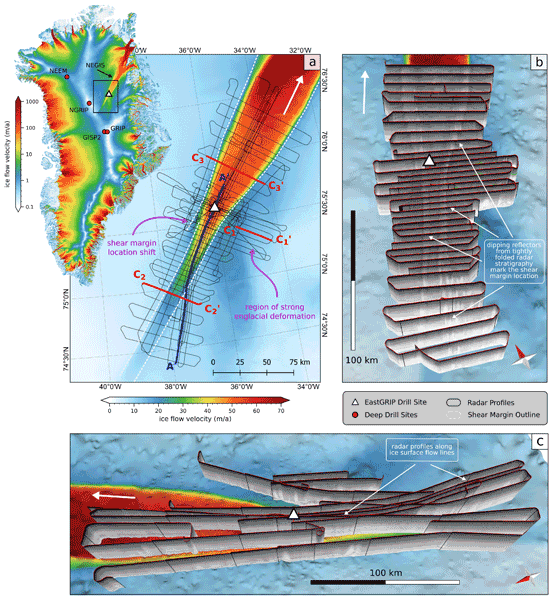
Steven Franke, Daniela Jansen, Tobias Binder, John D. Paden, Nils Dörr, Tamara A. Gerber, Heinrich Miller, Dorthe Dahl-Jensen, Veit Helm, Daniel Steinhage, Ilka Weikusat, Frank Wilhelms, and Olaf Eisen
Earth Syst. Sci. Data, 14, 763–779, https://doi.org/10.5194/essd-14-763-2022, https://doi.org/10.5194/essd-14-763-2022, 2022
Short summary
Short summary
The Northeast Greenland Ice Stream (NEGIS) is the largest ice stream in Greenland. In order to better understand the past and future dynamics of the NEGIS, we present a high-resolution airborne radar data set (EGRIP-NOR-2018) for the onset region of the NEGIS. The survey area is centered at the location of the drill site of the East Greenland Ice-Core Project (EastGRIP), and radar profiles cover both shear margins and are aligned parallel to several flow lines.
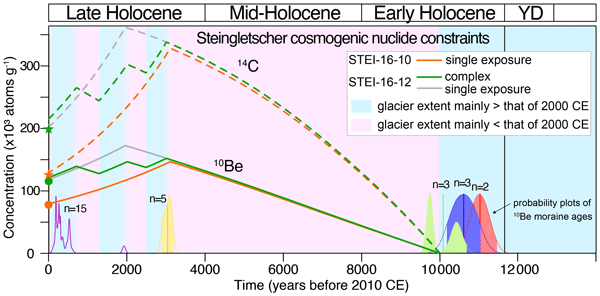
Irene Schimmelpfennig, Joerg M. Schaefer, Jennifer Lamp, Vincent Godard, Roseanne Schwartz, Edouard Bard, Thibaut Tuna, Naki Akçar, Christian Schlüchter, Susan Zimmerman, and ASTER Team
Clim. Past, 18, 23–44, https://doi.org/10.5194/cp-18-23-2022, https://doi.org/10.5194/cp-18-23-2022, 2022
Short summary
Short summary
Small mountain glaciers advance and recede as a response to summer temperature changes. Dating of glacial landforms with cosmogenic nuclides allowed us to reconstruct the advance and retreat history of an Alpine glacier throughout the past ~ 11 000 years, the Holocene. The results contribute knowledge to the debate of Holocene climate evolution, indicating that during most of this warm period, summer temperatures were similar to or warmer than in modern times.

Marie G. P. Cavitte, Duncan A. Young, Robert Mulvaney, Catherine Ritz, Jamin S. Greenbaum, Gregory Ng, Scott D. Kempf, Enrica Quartini, Gail R. Muldoon, John Paden, Massimo Frezzotti, Jason L. Roberts, Carly R. Tozer, Dustin M. Schroeder, and Donald D. Blankenship
Earth Syst. Sci. Data, 13, 4759–4777, https://doi.org/10.5194/essd-13-4759-2021, https://doi.org/10.5194/essd-13-4759-2021, 2021
Short summary
Short summary
We present a data set consisting of ice-penetrating-radar internal stratigraphy: 26 internal reflecting horizons that cover the greater Dome C area, East Antarctica, the most extensive IRH data set to date in the region. This data set uses radar surveys collected over the span of 10 years, starting with an airborne international collaboration in 2008 to explore the region, up to the detailed ground-based surveys in support of the European Beyond EPICA – Oldest Ice (BE-OI) project.
Raffaello Nardin, Mirko Severi, Alessandra Amore, Silvia Becagli, Francois Burgay, Laura Caiazzo, Virginia Ciardini, Giuliano Dreossi, Massimo Frezzotti, Sang-Bum Hong, Ishaq Khan, Bianca Maria Narcisi, Marco Proposito, Claudio Scarchilli, Enricomaria Selmo, Andrea Spolaor, Barbara Stenni, and Rita Traversi
Clim. Past, 17, 2073–2089, https://doi.org/10.5194/cp-17-2073-2021, https://doi.org/10.5194/cp-17-2073-2021, 2021
Short summary
Short summary
The first step to exploit all the potential information buried in ice cores is to produce a reliable age scale. Based on chemical and isotopic records from the 197 m Antarctic GV7(B) ice core, accurate dating was achieved and showed that the archive spans roughly the last 830 years. The relatively high accumulation rate allowed us to use the non-sea-salt sulfate seasonal pattern to count annual layers. The accumulation rate reconstruction exhibited a slight increase since the 18th century.
Cited articles
Adolphi, F., Herbst, K., Nilsson, A., and Panovska, S.: On the Polar Bias in Ice Core 10Be Data, J. Geophys. Res.-Atmos., 128, e2022JD038203, https://doi.org/10.1029/2022JD038203, 2023.
Arnold, M., Merchel, S., Bourlès, D. L., Braucher, R., Benedetti, L., Finkel, R. C., Aumaître, G., Gottdang, A., and Klein, M.: The French accelerator mass spectrometry facility ASTER: Improved performance and developments, Nuclear Instruments and Methods in Physics Research Section B: Beam Interactions with Materials and Atoms, 268, 1954–1959, https://doi.org/10.1016/j.nimb.2010.02.107, 2010.
Baccolo, G., Delmonte, B., Niles, P. B., Cibin, G., Di Stefano, E., Hampai, D., Keller, L., Maggi, V., Marcelli, A., Michalski, J., Snead, C., and Frezzotti, M.: Jarosite formation in deep Antarctic ice provides a window into acidic, water-limited weathering on Mars, Nat. Commun., 12, 436, https://doi.org/10.1038/s41467-020-20705-z, 2021.
Bard, E., Raisbeck, G., Yiou, F., and Jouzel, J.: Solar irradiance during the last 1200 years based on cosmogenic nuclides, Tellus B, 52, 985–992, https://doi.org/10.1034/j.1600-0889.2000.d01-7.x, 2000.
Baroni, M., Bard, E., Petit, J.-R., Magand, O., and Bourlès, D.: Volcanic and solar activity, and atmospheric circulation influences on cosmogenic 10Be fallout at Vostok and Concordia (Antarctica) over the last 60 years, Geochim. Cosmochim. Ac., 75, 7132–7145, https://doi.org/10.1016/j.gca.2011.09.002, 2011.
Baumgartner, S., Beer, J., Wagner, G., Kubik, P., Suter, M., Raisbeck, G. M., and Yiou, F.: 10Be and dust, Nuclear Instruments and Methods in Physics Research Section B: Beam Interactions with Materials and Atoms, 123, 296–301, https://doi.org/10.1016/S0168-583X(96)00751-3, 1997.
Berggren, A.-M., Beer, J., Possnert, G., Aldahan, A., Kubik, P., Christl, M., Johnsen, S. J., Abreu, J., and Vinther, B. M.: A 600-year annual 10Be record from the NGRIP ice core, Greenland, Geophys. Res. Lett., 36, https://doi.org/10.1029/2009GL038004, 2009.
Bono, R. K., Paterson, G. A., and Biggin, A. J.: MCADAM: A Continuous Paleomagnetic Dipole Moment Model for at Least 3.7 Billion Years, Geophys. Res. Lett., 49, e2022GL100898, https://doi.org/10.1029/2022GL100898, 2022.
Bouchet, M., Landais, A., Grisart, A., Parrenin, F., Prié, F., Jacob, R., Fourré, E., Capron, E., Raynaud, D., Lipenkov, V. Y., Loutre, M.-F., Extier, T., Svensson, A., Legrain, E., Martinerie, P., Leuenberger, M., Jiang, W., Ritterbusch, F., Lu, Z.-T., and Yang, G.-M.: The Antarctic Ice Core Chronology 2023 (AICC2023) chronological framework and associated timescale for the European Project for Ice Coring in Antarctica (EPICA) Dome C ice core, Clim. Past, 19, 2257–2286, https://doi.org/10.5194/cp-19-2257-2023, 2023.
Bowman, C. L., Rand, D. S., Lisiecki, L. E., and Bova, S. C.: An 800 kyr planktonic δ18O stack for the Western Pacific Warm Pool, Earth Syst. Sci. Data, 16, 701–713, https://doi.org/10.5194/essd-16-701-2024, 2024.
Braucher, R., Guillou, V., Bourlès, D. L., Arnold, M., Aumaître, G., Keddadouche, K., and Nottoli, E.: Preparation of ASTER in-house 10Be/9Be standard solutions, Nuclear Instruments and Methods in Physics Research Section B: Beam Interactions with Materials and Atoms, 361, 335–340, https://doi.org/10.1016/j.nimb.2015.06.012, 2015.
Caillon, N., Severinghaus, J. P., Jouzel, J., Barnola, J.-M., Kang, J., and Lipenkov, V. Y.: Timing of atmospheric CO2 and Antarctic temperature changes across Termination III, Science, 299, 1728–1731, 2003.
Carcaillet, J., Bourlès, D. L., Thouveny, N., and Arnold, M.: A high resolution authigenic
Cauquoin, A.: Flux de 10Be en Antarctique durant les 800 000 dernières années et interprétation, phdthesis, Université Paris Sud – Paris XI, Université Paris Sud-Paris XI, https://doi.org/10.70675/675a9050zd4e8z4a38z9d29zf9739e958c62, 2013.
Champion, D. E., Dalrymple, G. B., and Kuntz, M. A.: Radiometric and paleomagnetic evidence for the Emperor reversed polarity event at 0.46±0.05 M.Y. in basalt lava flows from the eastern Snake River Plain, Idaho, Geophys. Res. Lett., 8, 1055–1058, https://doi.org/10.1029/GL008i010p01055, 1981.
Champion, D. E., Lanphere, M. A., and Kuntz, M. A.: Evidence for a new geomagnetic reversal from Lava flows in Idaho: Discussion of short polarity reversals in the Brunhes and late Matuyama polarity chrons, J. Geophys. Res.-Sol. Ea., 93, 11667–11680, https://doi.org/10.1029/JB093iB10p11667, 1988.
Channell, J.: Late Brunhes polarity excursions (Mono Lake, Laschamp, Iceland Basin and Pringle Falls) recorded at ODP Site 919 (Irminger Basin), Earth Planet. Sc. Lett., 244, 378–393, https://doi.org/10.1016/j.epsl.2006.01.021, 2006.
Channell, J. E. T.: Geomagnetic paleointensity and directional secular variation at Ocean Drilling Program (ODP) Site 984 (Bjorn Drift) since 500 ka: Comparisons with ODP Site 983 (Gardar Drift), J. Geophys. Res.-Sol. Ea., 104, 22937–22951, https://doi.org/10.1029/1999JB900223, 1999.
Channell, J. E. T.: The Iceland Basin excursion: Age, duration, and excursion field geometry, Geochem. Geophys. Geosyst., 15, 4920–4935, https://doi.org/10.1002/2014GC005564, 2014.
Channell, J. E. T. and Raymo, M. E.: Paleomagnetic record at ODP Site 980 (Feni Drift, Rockall) for the past 1.2 Myrs, Geochem. Geophys. Geosyst., 4, https://doi.org/10.1029/2002GC000440, 2003.
Channell, J. E. T., Hodell, D. A., and Lehman, B.: Relative geomagnetic paleointensity and d18O at ODP Site 983 (Gardar Drift, North Atlantic) since 350 ka, Earth Planet. Sc. Lett., 153, 103–118, 1997.
Channell, J. E. T., Xuan, C., and Hodell, D. A.: Stacking paleointensity and oxygen isotope data for the last 1.5 Myr (PISO-1500), Earth Planet. Sc. Lett., 283, 14–23, https://doi.org/10.1016/j.epsl.2009.03.012, 2009.
Channell, J. E. T., Hodell, D. A., and Curtis, J. H.: ODP Site 1063 (Bermuda Rise) revisited: Oxygen isotopes, excursions and paleointensity in the Brunhes Chron, Geochem. Geophys. Geosyst., 13, https://doi.org/10.1029/2011GC003897, 2012.
Channell, J. E. T., Singer, B. S., and Jicha, B. R.: Timing of Quaternary geomagnetic reversals and excursions in volcanic and sedimentary archives, Quaternary Sci. Rev., 228, 106114, https://doi.org/10.1016/j.quascirev.2019.106114, 2020.
Chmeleff, J., Von Blanckenburg, F., Kossert, K., and Jakob, D.: Determination of the 10Be half-life by multicollector ICP-MS and liquid scintillation counting, Nuclear Instruments and Methods in Physics Research Section B: Beam Interactions with Materials and Atoms, 268, 192–199, https://doi.org/10.1016/j.nimb.2009.09.012, 2010.
Christl, M., Lippold, J., Steinhilber, F., Bernsdorff, F., and Mangini, A.: Reconstruction of global 10Be production over the past 250 ka from highly accumulating Atlantic drift sediments, Quaternary Sci. Rev., 29, 2663–2672, https://doi.org/10.1016/j.quascirev.2010.06.017, 2010.
Chung, A., Parrenin, F., Mulvaney, R., Vittuari, L., Frezzotti, M., Zanutta, A., Lilien, D. A., Cavitte, M. G. P., and Eisen, O.: Age, thinning and spatial origin of the Beyond EPICA ice from a 2.5D ice flow model, The Cryosphere, 19, 4125–4140, https://doi.org/10.5194/tc-19-4125-2025, 2025.
Cooper, A., Turney, C. S. M., Palmer, J., Hogg, A., McGlone, M., Wilmshurst, J., Lorrey, A. M., Heaton, T. J., Russell, J. M., McCracken, K., Anet, J. G., Rozanov, E., Friedel, M., Suter, I., Peter, T., Muscheler, R., Adolphi, F., Dosseto, A., Faith, J. T., Fenwick, P., Fogwill, C. J., Hughen, K., Lipson, M., Liu, J., Nowaczyk, N., Rainsley, E., Bronk Ramsey, C., Sebastianelli, P., Souilmi, Y., Stevenson, J., Thomas, Z., Tobler, R., and Zech, R.: A global environmental crisis 42,000 years ago, Science, 371, 811–818, https://doi.org/10.1126/science.abb8677, 2021.
Crotti, I., Landais, A., Stenni, B., Bazin, L., Parrenin, F., Frezzotti, M., Ritterbusch, F., Lu, Z.-T., Jiang, W., Yang, G.-M., Fourré, E., Orsi, A., Jacob, R., Minster, B., Prié, F., Dreossi, G., and Barbante, C.: An extension of the TALDICE ice core age scale reaching back to MIS 10.1, Quaternary Sci. Rev., 266, 107078, https://doi.org/10.1016/j.quascirev.2021.107078, 2021.
Czymzik, M., Nowaczyk, N. R., Dellwig, O., Wegwerth, A., Muscheler, R., Christl, M., and Arz, H. W.: Lagged atmospheric circulation response in the Black Sea region to Greenland Interstadial 10, P. Natl. Acad. Sci. USA, 117, 28649–28654, https://doi.org/10.1073/pnas.2005520117, 2020.
Dasari, S., Paris, G., Charreau, J., and Savarino, J.: Sulfur-isotope anomalies recorded in Antarctic ice cores as a potential proxy for tracing past ozone layer depletion events, P. Natl. Acad. Sci. USA Nexus, 1, pgac170, https://doi.org/10.1093/pnasnexus/pgac170, 2022.
Delaygue, G. and Bard, E.: An Antarctic view of Beryllium-10 and solar activity for the past millennium, Clim. Dynam., 36, 2201–2218, https://doi.org/10.1007/s00382-010-0795-1, 2011.
Demory, F., Nowaczyk, N. R., Witt, A., and Oberhänsli, H.: High-resolution magnetostratigraphy of late quaternary sediments from Lake Baikal, Siberia: timing of intracontinental paleoclimatic responses, Glob. Planet. Change, 46, 167–186, https://doi.org/10.1016/j.gloplacha.2004.09.016, 2005.
Evans, H. F., Channell, J. E. T., Stoner, J. S., Hillaire-Marcel, C., Wright, J. D., Neitzke, L. C., and Mountain, G. S.: Paleointensity-assisted chronostratigraphy of detrital layers on the Eirik Drift (North Atlantic) since marine isotope stage 11, Geochem. Geophys. Geosyst., 8, https://doi.org/10.1029/2007GC001720, 2007.
Field, C. V., Schmidt, G. A., Koch, D., and Salyk, C.: Modeling production and climate-related impacts on 10Be concentration in ice cores, J. Geophys. Res.-Atmos., 111, https://doi.org/10.1029/2005JD006410, 2006.
Fischer, H., Severinghaus, J., Brook, E., Wolff, E., Albert, M., Alemany, O., Arthern, R., Bentley, C., Blankenship, D., Chappellaz, J., Creyts, T., Dahl-Jensen, D., Dinn, M., Frezzotti, M., Fujita, S., Gallee, H., Hindmarsh, R., Hudspeth, D., Jugie, G., Kawamura, K., Lipenkov, V., Miller, H., Mulvaney, R., Parrenin, F., Pattyn, F., Ritz, C., Schwander, J., Steinhage, D., van Ommen, T., and Wilhelms, F.: Where to find 1.5 million yr old ice for the IPICS “Oldest-Ice” ice core, Clim. Past, 9, 2489–2505, https://doi.org/10.5194/cp-9-2489-2013, 2013.
Frank, M., Schwarz, B., Baumann, S., Kubik, P. W., Suter, M., and Mangini, A.: A 200 kyr record of cosmogenic radionuclide production rate and geomagnetic field intensity from 10Be in globally stacked deep-sea sediments1, Earth Planet. Sc. Lett., 149, 121–129, https://doi.org/10.1016/S0012-821X(97)00070-8, 1997.
Frezzotti, M., Bitelli, G., Michelis, P. D., Deponti, A., Forieri, A., Gandolfi, S., Maggi, V., Mancini, F., Remy, F., Tabacco, I. E., Urbini, S., Vittuari, L., and Zirizzottl, A.: Geophysical survey at Talos Dome, East Antarctica: the search for a new deep-drilling site, Ann. Glaciol., 39, 423–432, https://doi.org/10.3189/172756404781814591, 2004.
Gee, J. S., Cande, S. C., Hildebrand, J. A., Donnelly, K., and Parker, R. L.: Geomagnetic intensity variations over the past 780 kyr obtained from near-seafloor magnetic anomalies, Nature, 408, 827–832, https://doi.org/10.1038/35048513, 2000.
Geissman, J. W., Brown, L., Turrin, B. D., Mcfadden, L. D., and Harlan, S. S.: Brunhes chron excursion/polarity episode recorded during the late pleistocene, Albuquerque Volcanoes, New Mexico, USA, Geophys. J. Int., 102, 73–88, https://doi.org/10.1111/j.1365-246X.1990.tb00531.x, 1990.
Gissinger, C.: A new deterministic model for chaotic reversals, Eur. Phys. J. B, 85, 137, https://doi.org/10.1140/epjb/e2012-20799-5, 2012.
Golubenko, K., Rozanov, E., Kovaltsov, G., and Usoskin, I.: Zonal Mean Distribution of Cosmogenic Isotope (7Be, 10Be, 14C, and 36Cl) Production in Stratosphere and Troposphere, J. Geophys. Res.-Atmos., 127, e2022JD036726, https://doi.org/10.1029/2022JD036726, 2022.
Golubenko, K., Rozanov, E., Kovaltsov, G., Baroni, M., Sukhodolov, T., and Usoskin, I.: Full Modeling and Practical Parameterization of Cosmogenic 10Be Transport for Cosmic-Ray Studies: SOCOL-AERv2-BE Model, J. Geophys. Res.-Space Phys., 129, e2024JA032504, https://doi.org/10.1029/2024JA032504, 2024.
Guyodo, Y. and Valet, J.-P.: Relative variations in geomagnetic intensity from sedimentary records: the past 200,000 years, Earth Planet. Sc. Lett., 143, 23–36, https://doi.org/10.1016/0012-821X(96)00121-5, 1996.
Heikkilä, U., Beer, J., and Feichter, J.: Meridional transport and deposition of atmospheric 10Be, Atmos. Chem. Phys., 9, 515–527, https://doi.org/10.5194/acp-9-515-2009, 2009.
Herrero-Bervera, E., Helsley, C. E., Sarna-Wojcicki, A. M., Lajoie, K. R., Meyer, C. E., McWilliams, M. O., Negrini, R. M., Turrin, B. D., Nolan, J. M. D., and Liddicoat, J. C.: Age and correlation of a paleomagnetic episode in the western United States by 40Ar/39Ar dating and tephrochronology: The Jamaica, Blake, or a new polarity episode?, J. Geophys. Res.-Sol. Ea., 99, 24091–24103, https://doi.org/10.1029/94JB01546, 1994.
Horiuchi, K., Uchida, T., Sakamoto, Y., Ohta, A., Matsuzaki, H., Shibata, Y., and Motoyama, H.: Ice core record of 10Be over the past millennium from Dome Fuji, Antarctica: A new proxy record of past solar activity and a powerful tool for stratigraphic dating, Quaternary Geochronol., 3, 253–261, https://doi.org/10.1016/j.quageo.2008.01.003, 2008.
Horiuchi, K., Kamata, K., Maejima, S., Sasaki, S., Sasaki, N., Yamazaki, T., Fujita, S., Motoyama, H., and Matsuzaki, H.: Multiple 10Be records revealing the history of cosmic-ray variations across the Iceland Basin excursion, Earth Planet. Sc. Lett., 440, 105–114, https://doi.org/10.1016/j.epsl.2016.01.034, 2016.
Horiuchi, K., Kato, S., Ohtani, K., Kurita, N., Tsutaki, S., Nakazawa, F., Motoyama, H., Kawamura, K., Tazoe, H., Akata, N., Yamagata, T., and Matsuzaki, H.: Spatial variations of 10Be in surface snow along the inland traverse route of Japanese Antarctic Research Expeditions, Nuclear Instruments and Methods in Physics Research Section B: Beam Interactions with Materials and Atoms, 533, 61–65, https://doi.org/10.1016/j.nimb.2022.10.018, 2022.
Houghton, B. F., Wilson, C. J. N., McWilliams, M. O., Lanphere, M. A., Weaver, S. D., Briggs, R. M., and Pringle, M. S.: Chronology and dynamics of a large silicic magmatic system: Central Taupo Volcanic Zone, New Zealand, Geology, 23, 13–16, https://doi.org/10.1130/0091-7613(1995)023<0013:CADOAL>2.3.CO;2, 1995.
Jeromson, M. R., Fujioka, T., Fink, D., Simon, K., Post, A. L., Blaxell, M., Sánchez-Palacios, J. T., Enge, T. G., Beggs, C., and White, D. A.: Beryllium-isotope signatures in ice sheet proximal marine sediments, Chem. Geol., 691, 122912, https://doi.org/10.1016/j.chemgeo.2025.122912, 2025.
Jouzel, J., Cauquoin, A., Bard, E., Zhang, L., Hou, S., Wu, Z., Zhou, W., Lipenkov, V., Petit, J.-R., Raisbeck, G., and Yiou, F.: Beryllium 10 in Antarctica over the last seven millennia, Sci. Data, 13, 129, https://doi.org/10.1038/s41597-025-06444-0, 2026.
Kappelt, N., Muscheler, R., Baroni, M., Beer, J., Christl, M., Vockenhuber, C., Bard, E., and Wolff, E.: Ice core dating with the 36Cl/10Be ratio, Quaternary Sci. Rev., 355, 109254, https://doi.org/10.1016/j.quascirev.2025.109254, 2025.
Kawamura, K., Parrenin, F., Lisiecki, L., Uemura, R., Vimeux, F., Severinghaus, J. P., Hutterli, M. A., Nakazawa, T., Aoki, S., Jouzel, J., Raymo, M. E., Matsumoto, K., Nakata, H., Motoyama, H., Fujita, S., Goto-Azuma, K., Fujii, Y., and Watanabe, O.: Northern Hemisphere forcing of climatic cycles in Antarctica over the past 360,000 years, Nature, 448, 912–916, https://doi.org/10.1038/nature06015, 2007.
Knudsen, M. F., Henderson, G. M., Frank, M., Mac Niocaill, C., and Kubik, P. W.: In-phase anomalies in Beryllium-10 production and palaeomagnetic field behaviour during the Iceland Basin geomagnetic excursion, Earth Planet. Sc. Lett., 265, 588–599, https://doi.org/10.1016/j.epsl.2007.10.051, 2008.
Kok, Y. S. and Tauxe, L.: Saw-toothed pattern of sedimentary paleointensity records explained by cumulative viscous remanence, Earth Planet. Sc. Lett., 144, E9–E14, https://doi.org/10.1016/S0012-821X(96)00175-6, 1996.
Korschinek, G., Bergmaier, A., Faestermann, T., Gerstmann, U. C., Knie, K., Rugel, G., Wallner, A., Dillmann, I., Dollinger, G., Von Gostomski, Ch. L., Kossert, K., Maiti, M., Poutivtsev, M., and Remmert, A.: A new value for the half-life of 10Be by Heavy-Ion Elastic Recoil Detection and liquid scintillation counting, Nuclear Instruments and Methods in Physics Research Section B: Beam Interactions with Materials and Atoms, 268, 187–191, https://doi.org/10.1016/j.nimb.2009.09.020, 2010.
Laj, C., Kissel, C., and Roberts, A. P.: Geomagnetic field behavior during the Iceland Basin and Laschamp geomagnetic excursions: A simple transitional field geometry?, Geochem. Geophys. Geosyst., 7, https://doi.org/10.1029/2005GC001122, 2006.
Lal, D., Jull, A. J. T., Donahue, D. J., Burr, G. S., Deck, B., Jouzel, J., and Steig, E.: Record of cosmogenic in situ produced 14C in Vostok and Taylor Dome ice samples: Implications for strong role of wind ventilation processes, J. Geophys. Res.-Atmos., 106, 31933–31941, https://doi.org/10.1029/2001JD900086, 2001.
Lamothe, A., Bard, E., Thouveny, N., Ellyn, A., Severi, M., Traversi, R., de Angelis, M., Wilhelms, F., Mulvaney, R., Aster, T., and Baroni, M.: TALDICE 10Be and major ions 1470–1531 m, Zenodo [data set], https://doi.org/10.5281/zenodo.17433639, 2025.
Langereis, C. G., Dekkers, M. J., de Lange, G. J., Paterne, M., and van Santvoort, P. J. M.: Magnetostratigraphy and astronomical calibration of the last 1.1 Myr from an eastern Mediterranean piston core and dating of short events in the Brunhes, Geophys. J. Int., 129, 75–94, https://doi.org/10.1111/j.1365-246X.1997.tb00938.x, 1997.
Leduc, G., Thouveny, N., Bourles, D., Blanchet, C., and Carcaillet, J.: Authigenic
Legrand, M., Preunkert, S., Wolff, E., Weller, R., Jourdain, B., and Wagenbach, D.: Year-round records of bulk and size-segregated aerosol composition in central Antarctica (Concordia site) – Part 1: Fractionation of sea-salt particles, Atmos. Chem. Phys., 17, 14039–14054, https://doi.org/10.5194/acp-17-14039-2017, 2017.
Lehman, B., Laj, C., Kissel, C., Mazaud, A., Paterne, M., and Labeyrie, L.: Relative changes of the geomagnetic field intensity during the last 280 kyear from piston cores in the A ores area, Phys. Earth Planet. In., 93, 269–284, https://doi.org/10.1016/0031-9201(95)03070-0, 1996.
Lisiecki, L. E. and Raymo, M. E.: A Pliocene-Pleistocene stack of 57 globally distributed benthic δ18O records, Paleoceanography, 20, https://doi.org/10.1029/2004PA001071, 2005.
Littot, G. C., Mulvaney, R., Röthlisberger, R., Udisti, R., Wolff, E. W., Castellano, E., Angelis, M. D., Hansson, M. E., Sommer, S., and Steffensen, J. P.: Comparison of analytical methods used for measuring major ions in the EPICA Dome C (Antarctica) ice core, Ann. Glaciol., 35, 299–305, https://doi.org/10.3189/172756402781817022, 2002.
Lund, S. P., Williams, T., Acton, G. D., Clement, B., and Okada, M.: 10. Brunhes Chron Magnetic Field Excursions Recovered from Leg 172 Sediments, Proc. Ocean Drill. Program Sci. Res., 172, 1–18, 2001.
Mazaud, A.: `Sawtooth' variation in magnetic intensity profiles and delayed acquisition of magnetization in deep sea cores, Earth Planet. Sc. Lett., 139, 379–386, https://doi.org/10.1016/0012-821X(96)00026-X, 1996.
Mcwilliams, M.: Global Correlation of the 223 ka Pringle Falls Event, Int. Geol. Rev., 43, 191–195, https://doi.org/10.1080/00206810109465007, 2001.
Ménabréaz, L., Bourlès, D. L., and Thouveny, N.: Amplitude and timing of the Laschamp geomagnetic dipole low from the global atmospheric 10Be overproduction: Contribution of authigenic 10Be/9Be ratios in west equatorial Pacific sediments, J. Geophys. Res.-Sol. Ea., 117, https://doi.org/10.1029/2012JB009256, 2012.
Meynadier, L. and Valet, J.-P.: Post-depositional realignment of magnetic grains and asymmetrical saw-tooth patterns of magnetization intensity, Earth Planet. Sc. Lett., 140, 123–132, https://doi.org/10.1016/0012-821X(96)00018-0, 1996.
Meynadier, L., Valet, J.-P., Guyodo, Y., and Richter, C.: Saw-toothed variations of relative paleointensity and cumulative viscous remanence: Testing the records and the model, J. Geophys. Res.-Sol. Ea., 103, 7095–7105, https://doi.org/10.1029/97JB03515, 1998.
Molina-Cardín, A., Dinis, L., and Osete, M. L.: Simple stochastic model for geomagnetic excursions and reversals reproduces the temporal asymmetry of the axial dipole moment, P. Natl. Acad. Sci. USA, 118, e2017696118, https://doi.org/10.1073/pnas.2017696118, 2021.
Morganti, A., Becagli, S., Castellano, E., Severi, M., Traversi, R., and Udisti, R.: An improved flow analysis–ion chromatography method for determination of cationic and anionic species at trace levels in Antarctic ice cores, Anal. Chim. Acta, 603, 190–198, https://doi.org/10.1016/j.aca.2007.09.050, 2007.
Müller, N. P., Gissinger, C., and Pétrélis, F.: Magnetic reversals in a geodynamo model with a stably-stratified layer, arXiv [preprint], https://doi.org/10.48550/arXiv.2508.17777, 25 August 2025.
Muscheler, R., Beer, J., Kubik, P. W., and Synal, H.-A.: Geomagnetic field intensity during the last 60,000 years based on 10Be and 36Cl from the Summit ice cores and 14C, Quaternary Sci. Rev., 24, 1849–1860, https://doi.org/10.1016/j.quascirev.2005.01.012, 2005.
Nowaczyk, N. R. and Frederichs, T. W.: Geomagnetic events and relative palaeointensity variations during the past 300 ka as recorded in Kolbeinsey Ridge sediments, Iceland Sea: indication for a strongly variable geomagnetic field, Int. J. Earth Sci., 88, 116–131, https://doi.org/10.1007/s005310050250, 1999.
Oda, H., Nakamura, K., Ikehara, K., Nakano, T., Nishimura, M., and Khlystov, O.: Paleomagnetic record from Academician Ridge, Lake Baikal: a reversal excursion at the base of marine oxygen isotope stage 6, Earth Planet. Sc. Lett., 202, 117–132, https://doi.org/10.1016/S0012-821X(02)00755-0, 2002.
ODP Leg 172 Scientific Party, Lund, S. P., Acton, G., Clement, B., Hastedt, M., Okada, M., and Williams, T.: Geomagnetic field excursions occurred often during the last million years, Eos, Transactions American Geophysical Union, 79, 178–179, https://doi.org/10.1029/98EO00134, 1998.
Oyabu, I., Kawamura, K., Buizert, C., Parrenin, F., Orsi, A., Kitamura, K., Aoki, S., and Nakazawa, T.: The Dome Fuji ice core DF2021 chronology (0–207 kyr BP), Quaternary Sci. Rev., 294, 107754, https://doi.org/10.1016/j.quascirev.2022.107754, 2022.
Panovska, S., Poluianov, S., Gao, J., Korte, M., Mishev, A., Shprits, Y. Y., and Usoskin, I.: Effects of Global Geomagnetic Field Variations Over the Past 100,000 Years on Cosmogenic Radionuclide Production Rates in the Earth's Atmosphere, J. Geophys. Res.-Space Phys., 128, e2022JA031158, https://doi.org/10.1029/2022JA031158, 2023.
Parrenin, F., Dreyfus, G., Durand, G., Fujita, S., Gagliardini, O., Gillet, F., Jouzel, J., Kawamura, K., Lhomme, N., Masson-Delmotte, V., Ritz, C., Schwander, J., Shoji, H., Uemura, R., Watanabe, O., and Yoshida, N.: 1-D-ice flow modelling at EPICA Dome C and Dome Fuji, East Antarctica, Clim. Past, 3, 243–259, https://doi.org/10.5194/cp-3-243-2007, 2007.
Parrenin, F., Cavitte, M. G. P., Blankenship, D. D., Chappellaz, J., Fischer, H., Gagliardini, O., Masson-Delmotte, V., Passalacqua, O., Ritz, C., Roberts, J., Siegert, M. J., and Young, D. A.: Is there 1.5-million-year-old ice near Dome C, Antarctica?, The Cryosphere, 11, 2427–2437, https://doi.org/10.5194/tc-11-2427-2017, 2017.
Parrenin, F., Bouchet, M., Buizert, C., Capron, E., Corrick, E., Drysdale, R., Kawamura, K., Landais, A., Mulvaney, R., Oyabu, I., and Rasmussen, S. O.: The Paleochrono-1.1 probabilistic model to derive a common age model for several paleoclimatic sites using absolute and relative dating constraints , Geosci. Model Dev., 17, 8735–8750, https://doi.org/10.5194/gmd-17-8735-2024, 2024.
Pérez-Mejías, C., Moreno, A., Sancho, C., Bartolomé, M., Stoll, H., Cacho, I., Cheng, H., and Edwards, R. L.: Abrupt climate changes during Termination III in Southern Europe, P. Natl. Acad. Sci. USA, 114, 10047–10052, https://doi.org/10.1073/pnas.1619615114, 2017.
Poizat, M., Picard, G., Arnaud, L., Narteau, C., Amory, C., and Brun, F.: Widespread longitudinal snow dunes in Antarctica shaped by sintering, Nat. Geosci., 17, 889–895, https://doi.org/10.1038/s41561-024-01506-1, 2024.
Poluianov, S. V., Kovaltsov, G. A., Mishev, A. L., and Usoskin, I. G.: Production of cosmogenic isotopes 7Be, 10Be, 14C, 22Na, and 36Cl in the atmosphere: Altitudinal profiles of yield functions, J. Geophys. Res.-Atmos., 121, 8125–8136, https://doi.org/10.1002/2016JD025034, 2016.
Railsback, L. B., Gibbard, P. L., Head, M. J., Voarintsoa, N. R. G., and Toucanne, S.: An optimized scheme of lettered marine isotope substages for the last 1.0 million years, and the climatostratigraphic nature of isotope stages and substages, Quaternary Sci. Rev., 111, 94–106, https://doi.org/10.1016/j.quascirev.2015.01.012, 2015.
Raisbeck, G. M., Yiou, F., Bourles, D., and Kent, D. V.: Evidence for an increase in cosmogenic 10Be during a geomagnetic reversal, Nature, 315, 315–317, https://doi.org/10.1038/315315a0, 1985.
Raisbeck, G. M., Yiou, F., Cattani, O., and Jouzel, J.: 10Be evidence for the Matuyama–Brunhes geomagnetic reversal in the EPICA Dome C ice core, Nature, 444, 82–84, https://doi.org/10.1038/nature05266, 2006.
Raisbeck, G. M., Cauquoin, A., Jouzel, J., Landais, A., Petit, J.-R., Lipenkov, V. Y., Beer, J., Synal, H.-A., Oerter, H., Johnsen, S. J., Steffensen, J. P., Svensson, A., and Yiou, F.: An improved north–south synchronization of ice core records around the 41 kyr 10Be peak, Clim. Past, 13, 217–229, https://doi.org/10.5194/cp-13-217-2017, 2017.
Regoli, F., de Garidel-Thoron, T., Tachikawa, K., Jian, Z., Ye, L., Droxler, A. W., Lenoir, G., Crucifix, M., Barbarin, N., and Beaufort, L.: Progressive shoaling of the equatorial Pacific thermocline over the last eight glacial periods, Paleoceanography, 30, 439–455, https://doi.org/10.1002/2014PA002696, 2015.
Roberts, A. P., Lehman, B., Weeks, R. J., Verosub, K. L., and Laj, C.: Relative paleointensity of the geomagnetic field over the last 200,000 years from ODP Sites 883 and 884, North Pacific Ocean, Earth Planet. Sc. Lett., 152, 11–23, https://doi.org/10.1016/S0012-821X(97)00132-5, 1997.
Ryan, D. A. and Sarson, G. R.: Are geomagnetic field reversals controlled by turbulence within the Earth's core?, Geophys. Res. Lett., 34, https://doi.org/10.1029/2006GL028291, 2007.
Ryan, W. B. F.: Stratigraphy of late Quaternary sediments in the eastern Mediterranean, The Mediterranean Sea, 765, 1972.
Savranskaia, T., Egli, R., Valet, J.-P., Bassinot, F., Meynadier, L., Bourlès, D. L., Simon, Q., and Thouveny, N.: Disentangling magnetic and environmental signatures of sedimentary
Savranskaia, T., Egli, R., Simon, Q., Valet, J., Bassinot, F., and Thouveny, N.: Removing Climatic Overprints in Sedimentary Cosmogenic Beryllium Records: Potentials and Limits, Geochem. Geophys. Geosyst., 25, e2024GC011761, https://doi.org/10.1029/2024GC011761, 2024.
Severi, M., Becagli, S., Traversi, R., and Udisti, R.: Recovering Paleo-Records from Antarctic Ice-Cores by Coupling a Continuous Melting Device and Fast Ion Chromatography, Anal. Chem., 87, 11441–11447, https://doi.org/10.1021/acs.analchem.5b02961, 2015.
Shane, P., Black, T., and Westgate, J.: Isothermal plateau fission-Track age for a paleomagnetic excursion in the Mamaku Ignimbrite, New Zealand, and implications for Late Quaternary stratigraphy, Geophys. Res. Lett., 21, 1695–1698, https://doi.org/10.1029/94GL01576, 1994.
Shibuya, H., Iwasaki, Y., Tanaka, H., and Hoshizumi, H.: Paleomagnetism of Unzen volcano: A volcanic record (Senbongi excursion) of the Iceland Basin event and the Brunhes VGP distribution for Japan, Earth Planet. Sp., 59, 763–774, https://doi.org/10.1186/BF03352739, 2007.
Simon, Q., Thouveny, N., Bourlès, D. L., Valet, J.-P., Bassinot, F., Ménabréaz, L., Guillou, V., Choy, S., and Beaufort, L.: Authigenic
Simon, Q., Bourlès, D. L., Thouveny, N., Horng, C.-S., Valet, J.-P., Bassinot, F., and Choy, S.: Cosmogenic signature of geomagnetic reversals and excursions from the Réunion event to the Matuyama–Brunhes transition (0.7–2.14 Ma interval), Earth Planet. Sc. Lett., 482, 510–524, https://doi.org/10.1016/j.epsl.2017.11.021, 2018.
Simon, Q., Thouveny, N., Bourlès, D. L., Valet, J.-P., and Bassinot, F.: Cosmogenic 10Be production records reveal dynamics of geomagnetic dipole moment (GDM) over the Laschamp excursion (20–60 ka), Earth Planet. Sc. Lett., 550, 116547, https://doi.org/10.1016/j.epsl.2020.116547, 2020.
Singer, B. S., Jicha, B. R., Kirby, B. T., Geissman, J. W., and Herrero-Bervera, E.: 40Ar/39Ar dating links Albuquerque Volcanoes to the Pringle Falls excursion and the Geomagnetic Instability Time Scale, Earth Planet. Sc. Lett., 267, 584–595, https://doi.org/10.1016/j.epsl.2007.12.009, 2008.
Stenni, B., Buiron, D., Frezzotti, M., Albani, S., Barbante, C., Bard, E., Barnola, J. M., Baroni, M., Baumgartner, M., Bonazza, M., Capron, E., Castellano, E., Chappellaz, J., Delmonte, B., Falourd, S., Genoni, L., Iacumin, P., Jouzel, J., Kipfstuhl, S., Landais, A., Lemieux-Dudon, B., Maggi, V., Masson-Delmotte, V., Mazzola, C., Minster, B., Montagnat, M., Mulvaney, R., Narcisi, B., Oerter, H., Parrenin, F., Petit, J. R., Ritz, C., Scarchilli, C., Schilt, A., Schüpbach, S., Schwander, J., Selmo, E., Severi, M., Stocker, T. F., and Udisti, R.: Expression of the bipolar see-saw in Antarctic climate records during the last deglaciation, Nat. Geosci., 4, 46–49, https://doi.org/10.1038/ngeo1026, 2011.
Stoner, J. S., Channell, J. E. T., and Hillaire-Marcel, C.: A 200 ka geomagnetic chronostratigraphy for the Labrador Sea: Indirect correlation of the sediment record to SPECMAP, Earth Planet. Sc. Lett., 159, 165–181, https://doi.org/10.1016/S0012-821X(98)00069-7, 1998.
Stoner, J. S., Channell, J. E. T., Hodell, D. A., and Charles, C. D.: A ∼580 kyr paleomagnetic record from the sub-Antarctic South Atlantic (Ocean Drilling Program Site 1089), J. Geophys. Res.-Sol. Ea., 108, https://doi.org/10.1029/2001JB001390, 2003.
Tachikawa, K., Timmermann, A., Vidal, L., Sonzogni, C., and Timm, O. E.: CO2 radiative forcing and Intertropical Convergence Zone influences on western Pacific warm pool climate over the past 400 ka, Quaternary Sci. Rev., 86, 24–34, https://doi.org/10.1016/j.quascirev.2013.12.018, 2014.
Tanaka, H., Turner, G. M., Houghton, B. F., Tachibana, T., Kono, M., and McWilliams, M. O.: Palaeomagnetism and chronology of the central Taupo Volcanic Zone, New Zealand, Geophys. J. Int., 124, 919–934, https://doi.org/10.1111/j.1365-246X.1996.tb05645.x, 1996.
Tauxe, L. and Wu, G.: Normalized remanence in sediments of the western equatorial Pacific: Relative paleointensity of the geomagnetic field?, J. Geophys. Res.-Sol. Ea., 95, 12337–12350, https://doi.org/10.1029/JB095iB08p12337, 1990.
Thouveny, N., Carcaillet, J., Moreno, E., Leduc, G., and Nérini, D.: Geomagnetic moment variation and paleomagnetic excursions since 400 kyr BP: a stacked record from sedimentary sequences of the Portuguese margin, Earth Planet. Sc. Lett., 219, 377–396, https://doi.org/10.1016/S0012-821X(03)00701-5, 2004.
Traversi, R., Becagli, S., Castellano, E., Marino, F., Rugi, F., Severi, M., Angelis, M. de, Fischer, H., Hansson, M., Stauffer, B., Steffensen, J. P., Bigler, M., and Udisti, R.: Sulfate Spikes in the Deep Layers of EPICA-Dome C Ice Core: Evidence of Glaciological Artifacts, Environ. Sci. Technol., 43, 8737–8743, https://doi.org/10.1021/es901426y, 2009.
Valet, J. and Meynadier, L.: Geomagnetic field intensity and reversals during the past four million years, Nature, 366, 234–238, https://doi.org/10.1038/366234a0, 1993.
Valet, J.-P., Meynadier, L., and Guyodo, Y.: Geomagnetic dipole strength and reversal rate over the past two million years, Nature, 435, 802–805, https://doi.org/10.1038/nature03674, 2005.
Valet, J.-P., Plenier, G., and Herrero-Bervera, E.: Geomagnetic excursions reflect an aborted polarity state, Earth Planet. Sc. Lett., 274, 472–478, https://doi.org/10.1016/j.epsl.2008.07.056, 2008.
Valet, J.-P., Thevarasan, A., Bassinot, F., Savranskaia, T., and Haddam, N.: Two Records of Relative Paleointensity for the Past 4 Myr, Front. Earth Sci., 8, https://doi.org/10.3389/feart.2020.00148, 2020.
Valet, J.-P., Savranskaia, T., Egli, R., Simon, Q., Bassinot, F., and Thouveny, N.: Beryllium ten production and relative paleointensity for the past 1.2 million years, Quaternary Sci. Rev., 344, 108993, https://doi.org/10.1016/j.quascirev.2024.108993, 2024.
Valet, J.-P., Savranskaia, T., Simon, Q., Egli, R., Bassinot, F., and Thouveny, N.: Geomagnetic moment variation over the last 4.4 Million years through high resolution paleointensity and 10Be production records along ocean sediment sequences, Quaternary Sci. Rev., 359, 109367, https://doi.org/10.1016/j.quascirev.2025.109367, 2025.
Weeks, R. J., Laj, C., Endignoux, L., Mazaud, A., Labeyrie, L., Roberts, A. P., Kissel, C., and Blanchard, E.: Normalised natural remanent magnetisation intensity during the last 240 000 years in piston cores from the central North Atlantic Ocean: geomagnetic field intensity or environmental signal?, Phys. Earth Planet. In., 87, 213–229, https://doi.org/10.1016/0031-9201(94)02966-F, 1995.
Wille, J. D., Favier, V., Gorodetskaya, I. V., Agosta, C., Kittel, C., Beeman, J. C., Jourdain, N. C., Lenaerts, J. T. M., and Codron, F.: Antarctic Atmospheric River Climatology and Precipitation Impacts, J. Geophys. Res.-Atmos., 126, e2020JD033788, https://doi.org/10.1029/2020JD033788, 2021.
Wolff, E. W., Fischer, H., van Ommen, T., and Hodell, D. A.: Stratigraphic templates for ice core records of the past 1.5 Myr, Clim. Past, 18, 1563–1577, https://doi.org/10.5194/cp-18-1563-2022, 2022.
Yamamoto, Y., Shibuya, H., Tanaka, H., and Hoshizumi, H.: Geomagnetic paleointensity deduced for the last 300 kyr from Unzen Volcano, Japan, and the dipolar nature of the Iceland Basin excursion, Earth Planet. Sc. Lett., 293, 236–249, https://doi.org/10.1016/j.epsl.2010.02.024, 2010.
Yamazaki, T. and Ioka, N.: Long-term secular variation of the geomagnetic field during the last 200 kyr recorded in sediment cores from the western equatorial Pacific, Earth Planet. Sc. Lett., 128, 527–544, https://doi.org/10.1016/0012-821X(94)90168-6, 1994.
Yamazaki, T., Ioka, N., and Eguchi, N.: Relative paleointensity of the geomagnetic field during the Brunhes Chron, Earth Planet. Sc. Lett., 136, 525–540, https://doi.org/10.1016/0012-821X(95)00189-J, 1995.
Yiou, F., Raisbeck, G. M., Bourles, D., Lorius, C., and Barkov, N. I.: 10Be in ice at Vostok Antarctica during the last climatic cycle, Nature, 316, 616–617, https://doi.org/10.1038/316616a0, 1985.
Zheng, M., Adolphi, F., Ferrachat, S., Mekhaldi, F., Lu, Z., Nilsson, A., and Lohmann, U.: Modeling Atmospheric Transport of Cosmogenic Radionuclide 10Be Using GEOS-Chem 14.1.1 and ECHAM6.3-HAM2.3: Implications for Solar and Geomagnetic Reconstructions, Geophys. Res. Lett., 51, e2023GL106642, https://doi.org/10.1029/2023GL106642, 2024.
Short summary
We studied changes in Earth's magnetic field between 170 000 and 270 000 years ago using beryllium data from Antarctic ice. Our results reveal three periods when the magnetic field weakened, including one major event with a rapid fall and gradual recovery. These findings help explain how Earth's magnetic field behaves during short-term disturbances and improve the timing of past climate and geological records.
We studied changes in Earth's magnetic field between 170 000 and 270 000 years ago using...


