Beaumont, C., Kooi, H., and Willett, S. D.: Coupled Tectonic-Surface Process Models with Applications to Rifted Margins and Collisional Orogens, in: Geomorphology and Global Tectonics, edited by Summerfield, M. A., John Wiley & Sons, Ltd., West Sussex, U.K., 367 pp., ISBN 978-0-471-97193-1, 2000. a
Bidgoli, T. S., Amir, E., Walker, J. D., Stockli, D. F., Andrew, J. E., and Caskey, S. J.: Low-Temperature Thermochronology of the Black and Panamint Mountains, Death Valley, California: Implications for Geodynamic Controls on Cenozoic Intraplate Strain, Lithosphere,
https://doi.org/10.1130/L406.1, 2015.
a
Braun, J.: Pecube: A New Finite-Element Code to Solve the 3D Heat Transport Equation Including the Effects of a Time-Varying, Finite Amplitude Surface Topography, Comput. Geosci., 29, 787–794, 2003.
a,
b
Braun, J., van der Beek, P., Valla, P. G., Robert, X., Herman, F., Glotzbach, C., Pedersen, V., Perry, C., Simon-Labric, T., and Prigent, C.: Quantifying Rates of Landscape Evolution and Tectonic Processes by Thermochronology and Numerical Modeling of Crustal Heat Transport Using PECUBE, Tectonophysics, 524, 1–28, 2012.
a,
b,
c
Dai, J., Wang, C., Hourigan, J., Li, Z., and Zhuang, G.: Exhumation History of the Gangdese Batholith, Southern Tibetan Plateau: Evidence from Apatite and Zircon (U–Th)/He Thermochronology, J. Geol., 121, 155–172,
https://doi.org/10.1086/669250, 2013.
a
Drew, S. T., Ducea, M. N., and Schoenbohm, L. M.: Mafic Volcanism on the Puna Plateau, NW Argentina: Implications for Lithospheric Composition and Evolution with an Emphasis on Lithospheric Foundering, Lithosphere, 1, 305–318,
https://doi.org/10.1130/L54.1, 2009.
a
Ehlers, T. A.: Crustal Thermal Processes and the Interpretation of Thermochronometer Data, in: Low-Temperature Thermochronology: Techniques, Interpretations and Applications, Mineralogical Society of America, 315–350,
https://doi.org/10.2138/rmg.2005.58.12, 2005.
a,
b
Flowers, R. M., Ketcham, R. A., Shuster, D. L., and Farley, K. A.: Apatite (U–Th)/He Thermochronometry Using a Radiation Damage Accumulation and Annealing Model, Geochim. Cosmochim. Ac., 73, 2347–2365, 2009.
a,
b
Flowers, R. M., Farley, K. A., and Ketcham, R. A.: A Reporting Protocol for Thermochronologic Modeling Illustrated with Data from the Grand Canyon, Earth Planet. Sc. Lett., 432, 425–435,
https://doi.org/10.1016/j.epsl.2015.09.053, 2015.
a
Fraser, K. I., Enkelmann, E., Jess, S., Gilbert, H., and Grieco, R.: Resolving the Cenozoic History of Rock Exhumation Along the Central Rocky Mountain Trench Using Apatite Low-Temperature Thermochronology, Tectonics, 40, e2021TC006847,
https://doi.org/10.1029/2021TC006847, 2021.
a
Garzione, C. N., Molnar, P., Libarkin, J. C., and MacFadden, B. J.: Rapid Late Miocene Rise of the Bolivian Altiplano: Evidence for Removal of Mantle Lithosphere, Earth Planet. Sc. Lett., 241, 543–556,
https://doi.org/10.1016/j.epsl.2005.11.026, 2006.
a
Garzione, C. N., Hoke, G. D., Libarkin, J. C., Withers, S., MacFadden, B., Eiler, J., Ghosh, P., and Mulch, A.: Rise of the Andes, Science, 320, 1304–1307, 2008. a
Gautheron, C., Pinna-Jamme, R., Derycke, A., Ahadi, F., Sanchez, C., Haurine, F., Monvoisin, G., Barbosa, D., Delpech, G., Maltese, J., Sarda, P., and Tassan-Got, L.: Technical note: Analytical protocols and performance for apatite and zircon (U–Th) ∕ He analysis on quadrupole and magnetic sector mass spectrometer systems between 2007 and 2020, Geochronology, 3, 351–370,
https://doi.org/10.5194/gchron-3-351-2021, 2021.
a
Gleadow, A. J. W. and Fitzgerald, P. G.: Uplift History and Structure of the Transantarctic Mountains: New Evidence from Fission Track Dating of Basement Apatites in the Dry Valleys Area, Southern Victoria Land, Earth Planet. Sc. Lett., 82, 1–14,
https://doi.org/10.1016/0012-821X(87)90102-6, 1987.
a
Göğüş, O. H. and Ueda, K.: Peeling Back the Lithosphere: Controlling Parameters, Surface Expressions and the Future Directions in Delamination Modeling, J. Geodyn., 117, 21–40,
https://doi.org/10.1016/j.jog.2018.03.003, 2018.
a
Guenthner, W. R.: Implementation of an Alpha Damage Annealing Model for Zircon (U–Th)/He Thermochronology With Comparison to a Zircon Fission Track Annealing Model, Geochem. Geophy. Geosy., 22, e2019GC008757,
https://doi.org/10.1029/2019GC008757, 2021.
a
Guenthner, W. R., Reiners, P. W., Ketcham, R. A., Nasdala, L., and Giester, G.: Helium Diffusion in Natural Zircon: Radiation Damage, Anisotropy, and the Interpretation of Zircon (U–Th)/He Thermochronology, Am. J. Sci., 313, 145–198,
https://doi.org/10.2475/03.2013.01, 2013.
a,
b
Ketcham, R. A.: Forward and Inverse Modeling of Low-Temperature Thermochronometry Data, in: Low-Temperature Thermochronology: Techniques, Interpretations and Applications, Mineralogical Society of America, 275–314,
https://doi.org/10.2138/rmg.2005.58.11, 2005.
a
Ketcham, R. A., Donelick, R. A., and Carlson, W. D.: Variability of Apatite Fission-Track Annealing Kinetics; III, Extrapolation to Geological Time Scales, Am. Mineral., 84, 1235–1255, 1999. a
Ketcham, R. A., Mora, A., and Parra, M.: Deciphering Exhumation and Burial History with Multi-Sample down-Well Thermochronometric Inverse Modelling, Basin Res., 30, 48–64,
https://doi.org/10.1111/bre.12207, 2018.
a
Lock, J. and Willett, S.: Low-Temperature Thermochronometric Ages in Fold-and-Thrust Belts, Tectonophysics, 456, 147–162, 2008. a
Mansour, J., Giordani, J., Moresi, L., Beucher, R., Kaluza, O., Velic, M., Farrington, R., Quenette, S., and Beall, A.: Underworld2: Python Geodynamics Modelling for Desktop, HPC and Cloud, Journal of Open Source Software, 5, 1797,
https://doi.org/10.21105/joss.01797, 2020.
a
McMillan, M. and Schoenbohm, L. M.: Diverse Styles of Lithospheric Dripping: Synthesizing Gravitational Instability Models, Continental Tectonics, and Geologic Observations, Geochem. Geophy. Geosy., 24, e2022GC010488,
https://doi.org/10.1029/2022GC010488, 2023.
a,
b
McQuarrie, N. and Ehlers, T. A.: Influence of Thrust Belt Geometry and Shortening Rate on Thermochronometer Cooling Ages: Insights from Thermokinematic and Erosion Modeling of the Bhutan Himalaya, Tectonics, 34, 1055–1079, 2015. a
McQuarrie, N., Ehlers, T. A., Law, R. D., Thigpen, J. R., Merschat, A. J., and Stowell, H. H.: Techniques for Understanding Fold-and-Thrust Belt Kinematics and Thermal Evolution, in: Linkages and Feedbacks in Orogenic Systems, Geological Society of America,
https://doi.org/10.1130/2017.1213(02), 2017.
a
Murray, K. E., Braun, J., and Reiners, P. W.: Toward Robust Interpretation of Low-Temperature Thermochronometers in Magmatic Terranes, Geochem. Geophy. Geosy., 19, 3739–3763,
https://doi.org/10.1029/2018GC007595, 2018.
a
Oxburgh, E. R. and Turcotte, D. L.: Thermal Gradients and Regional Metamorphism in Overthrust Terrains with Special Reference to the Eastern Alps, Schweiz. Miner. Petrog., 54,
https://doi.org/10.5169/seals-42213, 1974.
a
Rahn, M. K., Brandon, M. T., Batt, G. E., and Garver, J. I.: A Zero-Damage Model for Fission-Track Annealing in Zircon, Am. Mineral., 89, 473–484,
https://doi.org/10.2138/am-2004-0401, 2004.
a
Reiners, P. W., Carlson, R. W., Renne, P. R., Cooper, K. M., Granger, D. E., McLean, N. M., and Schoene, B.: Geochronology and Thermochronology, John Wiley & Sons,
https://doi.org/10.1002/9781118455876, 2017.
a
Schutt, D. L., Lowry, A. R., and Buehler, J. S.: Moho Temperature and Mobility of Lower Crust in the Western United States, Geology, 46, 219–222,
https://doi.org/10.1130/G39507.1, 2018.
a
Stern, C. R., Huang, W.-L., and Wyllie, P. J.: Basalt-Andesite-Rhyolite-
H2O: Crystallization Intervals with Excess
H2O and
H2O-undersaturated Liquidus Surfaces to 35 Kilobars, with Implications for Magma Genesis, Earth Planet. Sc. Lett., 28, 189–196,
https://doi.org/10.1016/0012-821X(75)90226-5, 1975.
a
Stockli, D. F.: Application of Low-Temperature Thermochronometry to Extensional Tectonic Settings, in: Low-Temperature Thermochronology: Techniques, Interpretations and Applications, Mineralogical Society of America, 411–448,
https://doi.org/10.2138/rmg.2005.58.16, 2005.
a
Stüwe, K., White, L., and Brown, R.: The Influence of Eroding Topography on Steady-State Isotherms; Application to Fission Track Analysis, Earth Planet. Sc. Lett., 124, 63–74, 1994. a
Tagami, T., Galbraith, R. F., Yamada, R., and Laslett, G. M.: Revised Annealing Kinetics of Fission Tracks in Zircon and Geological Implications, in: Advances in Fission-Track Geochronology: A Selection of Papers Presented at the International Workshop on Fission-Track Dating, Ghent, Belgium, 1996, edited by: van den Haute, P. and de Corte, F., Springer Netherlands, Dordrecht, 99–112,
https://doi.org/10.1007/978-94-015-9133-1_8, 1998.
a
van der Beek, P., Andriessen, P., and Cloetingh, S.: Morphotectonic Evolution of Rifted Continental Margins: Inferences from a Coupled Tectonic-Surface Processes Model and Fission Track Thermochronology, Tectonics, 14, 406–421,
https://doi.org/10.1029/94TC02445, 1995.
a
Whipp, D. M., Ehlers, T. A., Blythe, A. E., Huntington, K. W., Hodges, K. V., and Burbank, D. W.: Plio-Quaternary Exhumation History of the Central Nepalese Himalaya: 2. Thermo-kinematic and Thermochronometer Age Prediction Model, Tectonics, 26,
https://doi.org/10.1029/2006TC001991, 2007.
a
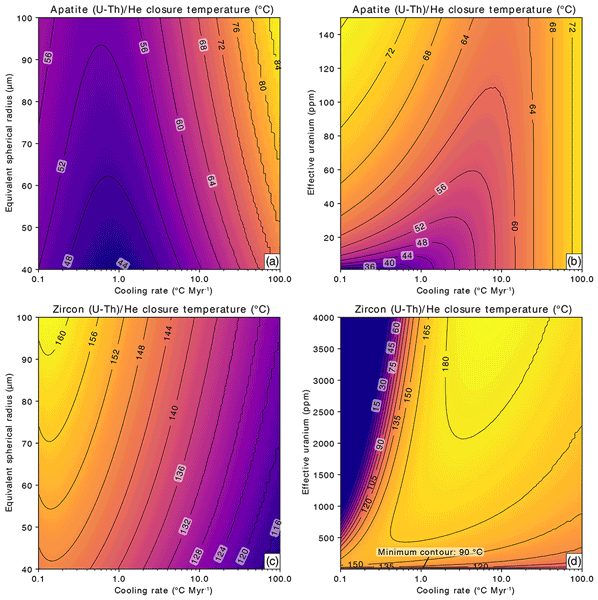
Whipp, D. M., Kellett, D. A., Coutand, I., and Ketcham, R. A.: Short communication: Modeling competing effects of cooling rate, grain size, and radiation damage in low-temperature thermochronometers, Geochronology, 4, 143–152,
https://doi.org/10.5194/gchron-4-143-2022, 2022.
a,
b,
c
Whipp, D. M., Gérard, B., Laaksonen, S., and Kellett, D. A.: Technical note:
Tc1D – a 1D thermal and thermochronometer age prediction model, EGUsphere [preprint],
https://doi.org/10.5194/egusphere-2026-2514, 2026.
a,
b
Willett, S. D.: Orogeny and Orography; the Effects of Erosion on the Structure of Mountain Belts, J. Geophys. Res.-Solid, 104, 28957–28982, 1999. a
Wolf, S. G., Huismans, R. S., Braun, J., and Yuan, X.: Topography of Mountain Belts Controlled by Rheology and Surface Processes, Nature, 1–6,
https://doi.org/10.1038/s41586-022-04700-6, 2022.
a,
b,
c
Zandt, G., Gilbert, H., Owens, T. J., Ducea, M., Saleeby, J., and Jones, C. H.: Active Foundering of a Continental Arc Root beneath the Southern Sierra Nevada in California, Nature, 431, 41–46,
https://doi.org/10.1038/nature02847, 2004.
a