
the Creative Commons Attribution 4.0 License.
the Creative Commons Attribution 4.0 License.
 | 11 Nov 2026
Advancing meteorite impact chronology with in situ mica Rb–Sr dating: insights from the Australian Acraman and Gosses Bluff impact structures
Bruno V. Ribeiro

Jayden Squire
Christopher L. Kirkland
Juraj Farkaš
Kai Rankenburg
Darwinaji Subarkah
Cecilia Loyola
Victoria Cousins
Victor Gostin
Charles Verdel
Meteorite impacts are highly energetic processes that drive deformation under extreme pressure and temperature conditions, far exceeding those of typical terrestrial crustal processes. Constraining the timing of impacts through Earth history is important for understanding its role in Earth's biogeodynamics, yet less than ∼20 % of the impacts worldwide are precisely dated. Here, we present novel in situ mica Rb–Sr isotopic measurements from the Australian Acraman and Gosses Bluff impact sites collected via laser ablation inductively coupled plasma tandem mass spectrometry (LA-ICP-MS/MS), including single- and multi-collector instruments to expand the chronological toolbox for dating meteorite impacts. Whilst apatite yield older U–Pb ages (1462±82 Ma) compared to the expected Acraman impact age of 588±35 Ma, in situ muscovite Rb–Sr measurements from the Acraman ejecta layer (580±8 Ma) and texturally-related fine-grained zircon (565±19 Ma) are consistent with the proposed impact age. For the Gosses Bluff impact, an apatite U–Pb age of 132±14 Ma and an aliettite (smectite group phyllosilicate) Rb–Sr isochron age of 137±9 Ma are both consistent, within uncertainty, with the established impact age of 133±3 Ma. The comparison between single- and multi-collector ICP-MS/MS has shown that the latter yielded significantly more precise Sr measurements, likely owing to simultaneous isotope collection using Faraday amplifiers equipped with high-resistance amplifiers (1013 Ω). This configuration minimizes the effects of temporal signal fluctuations and improves signal-to-noise ratios at low ion-beam intensities, enabling greater precision on Sr isotope measurements. Our results demonstrate that in situ Rb–Sr dating of newly-grown micas during impact metamorphism may be a suitable target to determine the age of meteorite impact events. This novel approach effectively addresses the textural complexities of impact-related rocks, often overlooked by bulk isotope-dilution techniques. The effectiveness of in situ mica Rb–Sr geochronology for dating impact events may reflect its ability to target mineral domains that preserve their original isotopic signatures despite subsequent alteration. This contrasts with previous results from the Acraman impact structure, which yielded younger apparent ages attributed to post-impact hydrothermal overprinting. We propose that in situ Rb–Sr geochronology offers an efficient approach to impact dating, with the potential to substantially expand the number of reliably dated impact structures worldwide while requiring minimal sample preparation.
- Article
(15716 KB) - Full-text XML
-
Supplement
(465 KB) - BibTeX
- EndNote


Like other rocky bodies in the Solar System, Earth is subject to collisions with extraterrestrial material, principally asteroids and comets. Although much of this material ablates or fragments during atmospheric entry, sufficiently large impactors can reach Earth's surface at hypervelocity, producing impact craters. Some meteorite impacts are known for their destructive potential, such as the Chicxulub impact in the Yucatán Peninsula (Mexico), potentially resulting in global consequences that could reshape entire ecosystems (Hildebrand et al., 1991; Schulte et al., 2010; Artemieva and Morgan, 2017). Conversely, while locally and immediately catastrophic, impacts can create favorable environmental conditions for the blossoming of primordial life (Cockell et al., 2002; Collins et al., 2012; Osinski et al., 2020) and may even host economically significant mineral systems (Tuchscherer and Spray, 2002; Reimold et al., 2005; Hayward et al., 2005). Importantly, knowing the timing of impact is essential to unravel its role in the broader evolution of our planet and its biological cargo (Jourdan et al., 2009, 2012; Osinski et al., 2022).
Establishing the timing of impact structures remains a significant challenge, with fewer than 20 % of known examples yielding radiometric ages precise to within 2 % uncertainty (French and Koeberl, 2010; Quintero et al., 2021). The last revision of the Australian impact database has shown that only five out of 31 confirmed impact craters/structures have a well-constrained radiometric age (Quintero et al., 2021). Obtaining impact ages is complicated by the enormous energy released during impacts, subjecting rocks to extreme pressure–temperature deformation conditions far exceeding those of typical crustal processes (Collins et al., 2012; Timms et al., 2017). Rock deformation at these conditions generates profound mineralogical and chemical–isotopic complexities in commonly used geochronometers such as zircon and monazite, often resulting in incomplete isotopic resetting and cryptic age spectra that are challenging to interpret (e.g., Guerrero et al., 2025; Herrmann et al., 2024; McGregor et al., 2019). There is therefore a need to expand the geochronological toolkit for dating impact events, particularly through approaches targeting common rock-forming minerals, such as mica and feldspar, that can preserve temporal records of impact-related processes. Here, we test a novel approach to date fine-grained micas from shock-related rocks from the Australian Acraman and Gosses Bluff (Tnorala) impact sites via in situ Rb–Sr geochronology carried out using single- and multi-collectors instruments. This comparison also allows us to test the accuracy and precision of each instrument configuration and demonstrate their use in dating terrestrial impacts.
2.1 Acraman impact structure (South Australia, Australia)
The Acraman impact site displays a circular structure of ∼30 km diameter within the Proterozoic volcanics in the Gawler Ranges (Williams, 1986, 1992) (Fig. 1). The volcanic rocks that underwent impact deformation exhibit shatter cones and shock lamellae (planar deformation feature) in quartz, suggesting shock pressures higher than 15 GPa (Williams, 1986, 1992). Based on its size and estimated impact energy (Williams and Wallace, 2003), the Acraman impact has been suggested to be a trigger for environmental crisis in the Late Vendian spanning 600–543 Ma, a known period of increased diversification of fossil assemblages prior to the Cambrian explosion (McCall, 2006). Chronological data from the impact rocks has either yielded the protoliths' ages, or younger orogenic resetting events (Compston et al., 1987; Schmieder et al., 2015). Complex degassing spectra from K-Ar and analyses of quartz-feldspar bearing melt rocks from the center of the Acraman structure were interpreted as the timing of rock alteration post-impact (ca. 450 Ma; Baldwin et al., 1991; Jourdan, 2012; Schmieder et al., 2015). Currently, the Acraman structure is stratigraphically constrained between 625–570 Ma (Hill et al., 2007). The age of the Acraman structure is based on a distinct ejecta layer that is prominent in parts of the Adelaide Superbasin and the Officer Basin (Gostin et al., 1986), with the unit yielding a whole-rock Rb–Sr age of 588±35 (Webb et al., 1983).

Figure 1Geological context of the Gosses Bluff and Acraman impact sites in respect to the Australian main geological provinces, including the extent of the ejecta layer of the Acraman impact (Bunyeroo Formation).
2.2 Gosses Bluff impact structure (Northern Territory, Australia)
Gosses Bluff is a widely known impact structure located within the northern part of the Paleozoic Amadeus Basin in Central Australia (Fig. 1). This structure represents a complex crater of an estimated 24 km diameter that underwent extensive erosion exposing a circular rim of ∼5 km in diameter (Milton et al., 1972; Milton and Sutter, 1987). The circular structure is developed within originally subhorizontal sedimentary strata comprising sandstone, shale and limestone. Abundant evidence of shock metamorphism includes shatter cones and intensely deformed sandstones in which primary sedimentary fabrics have been obliterated and quartz grains preserve planar deformation features (PDFs) (Crook and Cook, 1966; Dietz, 1967). Impact melt breccias composed of mosaic fine-grained quartz and micas with locally rounded quartz grains (i.e., partly recrystallized sandstone) and devitrified glassy rocks (including melt-pellets) displaying fine-grained quartz, micas and feldspars are common in the Gosses Bluff structure (Milton and Sutter, 1987). Pioneer chronological constraints produced via total fusion K-Ar of sanidine-rich suevite (133±3 Ma) and zircon fission track (130±6 Ma) from a sandstone beneath the melt breccia suggested a Lower Cretaceous age for the formation of the Glosses Bluff impact structure (Milton et al., 1972). Subsequently, Milton and Sutter (1987) proposed an older impact age of 142.5±0.8 Ma based on total fusion dating of pumiceous suevite clasts from the melt breccia composed of fine-grained sanidine, potentially linking the formation of the Gosses Bluff impact with the Jurassic–Cretaceous stratigraphic boundary. Yet, this older age must be treated with some caution given it is from a complex 39Ar spectrum. Similarly, analyses of sanidine-rich impact rocks yielded disturbed age spectra, with high-temperature steps approaching ca. 145 Ma (Jourdan, 2012). These patterns have been interpreted as reflecting diffusive Ar loss, with the oldest apparent ages providing a minimum constraint on the timing of the Gosses Bluff impact (Jourdan, 2012). Thus, despite multiple attempts, a temporal link between this impact and the Jurassic-Cretaceous stratigraphic boundary remains uncertain.
Notably, the Acraman and the Gosses Bluff impact structures were tentatively dated via total fusion K-Ar and analyses of whole-rock specimens, dismissing the mineralogical and microstructural diversity of such rocks produced complex results. In situ geochronological approach may address the textural complexity of impact rocks by targeting individual mineral domains, allowing their isotopic ages to be interpreted within a petrographic and microstructural framework.
3.1 Automated mineralogy mapping
The samples were scanned with a TESCAN Integrated Mineral Analyzer (TIMA) at Curtin University's John de Laeter Centre to characterize the mineral assemblage, focusing on micas in the Acraman and Gosses Bluff samples. The TIMA is an automated scanning electron microscopy system that integrates quantitative EDS analysis and a statistical approach that can obtain up to 500 spectra per second (Hrstka et al., 2018), which is further combined with backscatter electron (BSE) images providing high-resolution mineralogy, chemistry and textural data. The analyses were carried out with an accelerating voltage of 25 kV, beam intensity of 19.8, probe current of 7.15 nA, spot size of 124 nm, field size of 1000 µm and working distance of 15 mm. A pure Mn standard was used for EDS spectra standardization.
3.2 In situ Rb–Sr geochronology
Impact-related samples from the Acraman and Gosses Bluff were dated via in situ Rb–Sr geochronology through different analytical approaches to evaluate instrument sensitivity and further implications to isotopic ratio uncertainties, including single-quadrupole and multi-collector ICP-MS/MS. The Rb–Sr isochrons and ages were calculated using the maximum likelihood model in IsoplotR (Vermeesch, 2018) with the 87Rb decay constant from Villa et al. (2015). Ages and uncertainties are presented at 2-standard error (2 SE). Error propagation follows the approach from (Rösel and Zack, 2022; Gilbert et al., 2024) with long-term reproducibility reported elsewhere (Glorie et al., 2024; Olierook et al., 2026). Detailed instrument parametrization and additional information are provided in the Supplement.
3.2.1 Single-collector ICP-MS/MS (Adelaide Microscopy, Adelaide University)
The protocol employed at Adelaide Microscopy (Adelaide University) includes RESOlution ArF excimer LA system (193 nm) coupled to an Agilent 8900 triple quadrupole in MS/MS mode with N2O (Zack and Hogmalm, 2016; Hogmalm et al., 2017). The analyses were carried out using a 67 µm circular beam diameter, 5 Hz repetition rate and a laser fluence of ∼3.5 J cm−2 measured above the cell prior to the analytical session. The international reference glass NIST SRM 610 with known and ratios (Woodhead and Hergt, 2001) was employed as primary reference material for normalization and instrumental drift correction, while MDC phlogopite (Redaa et al., 2021) is used as the matrix matched secondary reference material for correction. Entire Creek biotite (312.1±5.1 Ma; Mortimer et al., 1987; Glorie et al., 2024) and Robins Folly muscovite (320±22 Ma; Mortimer et al., 1987; Gilbert et al., 2026) were employed as secondary reference materials and treated as unknowns to account for secondary age checks.
Data reduction was carried out using LADR to determine drift-corrected and isotopic ratios (Redaa et al., 2021) employing NIST SRM 610 (Woodhead and Hergt, 2001) as primary reference materials. Matrix correction was carried out offline using the MDC phlogopite (519.4±6.5 Ma; Redaa et al., 2021) to account for the ∼ 9.5 % offset in the ratio following the isochronous approach (Glorie et al., 2024; Giuliani et al., 2024). Secondary reference materials such as the Robins Folly muscovite and Entire Creek biotite yielded matrix-corrected isochron ages of 320±10 Ma (MSWD = 1.3, N=25) and 311±8 Ma (MSWD = 0.1, N=24), respectively, in agreement with reference ages.
3.2.2 Single-collector ICP-MS/MS (GeoHistory Facility; Curtin University)
The analytical setup in the GeoHistory Facility includes a RESOlution 193 nm ArF excimer laser with a Laurin Technic S155 sample cell coupled to an Agilent 8900 triple quadrupole mass spectrometer in MS/MS mode using the N2O in the reaction cell (Hogmalm et al., 2017). The analyses were carried out using a 90 µm circular beam diameter, 7 Hz repetition rate and a laser fluence of ∼2.8 J cm−2 measured above the cell prior to the analytical session. A `squid' mixing device (Laurin Technic) was used to smooth the aerosol pulses between the laser and mass spectrometer. Instrument tunning was performed using NIST SRM 610 glass in single quadrupole (no-gas mode) to optimize plasma conditions, minimize oxide interferences and maximize 85Rb sensitivity. After shifting to MS/MS mode, the ICP-MS was tuned to maximize sensitivity for SrO+ reaction products. Ablation was performed in a He atmosphere (320 mL min−1), mixed with Ar (1 L min−1), and N2 (4 mL min−1) was added to the carrier gas before the ICP torch to enhance sensitivity (Hu et al., 2008).
Data reduction was performed in Iolite 4 (Paton et al., 2011) using an in-house data reduction scheme adapted from Redaa et al. (2021). The and ratios were drift-corrected and calibrated against NIST SRM 610 with recommended isotopic ratios from Woodhead and Hergt (2001). Further matrix correction was carried out using an isochronous calibration (Glorie et al., 2024; Giuliani et al., 2024) using LaPosta biotite as the matrix correction reference material ( reference age of 91.3±0.25 Ma; Olierook et al., 2026) to account for the ∼8.1 % offset difference in the ratios. Unknowns were additionally bracketed with Mount Dromedary biotite ( reference age of 99.37±0.20 Ma; Olierook et al., 2026). Matrix-corrected Mount Dromedary returned an isochron date of 99±3 Ma (n=32, MSWD = 1.4) considering an initial of 0.70446 (cf., Rösel and Zack, 2022).
3.2.3 Multi-collector ICP-MS/MS (GeoHistory Facility, Curtin University)
The approach utilized at the GeoHistory Facility (Curtin University) includes a Coherent LR laser ablation system (193 nm) equipped with a Lauren Technic S155 sample cell connected to a ThermoFisher Scientific Neoma multi-collector ICP-MS/MS. The analyses were carried out across two analytical sessions using identical laser and mass spectrometer settings, including a 90 µm circular beam diameter, 7 Hz repetition rate and a laser fluence of ∼ 2.8 J cm−2 measured above the cell prior to the analytical session. A “squid” mixing device (Laurin Technic) was used to smooth the aerosol pulses between the laser and mass spectrometer. Ablation was performed in a He atmosphere (320 mL min−1), mixed with Ar (1 L min−1), and N2 (3 mL min−1) was added to the carrier gas before the ICP torch to enhance sensitivity (Hu et al., 2008). The reaction cell is continuously flushed with ultrahigh-purity N2 5.0 (99.999 %) to reduce the oxide levels prior to analyses, minimizing the instrument oxide levels thus reducing the interference effects of ZrO-YO on the SrF peak.
The mass spectrometer was run in MS/MS mode using SF6 as reaction gas to facilitate simultaneous measurement of Rb and Sr isotopes (Bevan et al., 2021; Dauphas et al., 2022; Cruz-Uribe et al., 2023). All relevant masses from 85Rb to 88Sr19F were measured for 140 integrations for 0.5 s with a 30 s baseline acquisition, followed by a 30 s sample ablation and 10 s washout. The 86Sr19F (H3 cup) and 87Sr19F (H4 cup) analytes were measured in Faraday cups connected to 1013 Ω amplifiers to enhance signal to noise ratios, whereas all other analytes were measured in Faraday cups connected to 1011 Ω amplifiers. The peak center was positioned on the left shoulder of the time-resolved peak to reduce potential interferences from SF3O and SF3OH2 on masses 105 and 107. The pre-filter was initially adjusted using a mixed Rb–Sr-Rh solution without the introduction of SF6. The central mass was set to 86Sr, and the bandpass was tuned in order to remove the 103Rh whilst fully transmitting 85Rb using a Wien Filter magnetic field (B) of 70 %, an electric field (E) of 427 V and a pre-slit position of 30 %.
Data reduction was performed in Iolite 4 (Paton et al., 2011) using an in-house data reduction scheme. The and were drift-corrected and calibrated against NIST SRM 612 (Woodhead and Hergt, 2001), preferred due to its lower Zr and Y concentration compared to NIST SRM 610. Further matrix correction was carried using an isochronous calibration (Glorie et al., 2024; Giuliani et al., 2024) based on the Rb–Sr measurements from Mount Dromedary biotite, which has shown to be a well-behaved reference material for Rb–Sr analyses via multi-collector ICP-MS/MS (Rodrigues et al., 2026; Olierook et al., 2026). The matrix offset of ∼15.5 % (session one) ∼ 16.9 % (session two) were applied as a correction factor to the ratios of secondary reference materials and samples. The matrix-corrected LaPosta returned an isochron date of 87±4 Ma (n=13, MSWD = 0.2; session 1) and 92±3 Ma (n=26, MSWD = 0.4; session 2) in agreement with reference values (Rösel and Zack, 2022) and with long-term laboratory reproducibility (Olierook et al., 2026).
3.3 In situ U–Pb geochronology
We obtained apatite and zircon U–Pb data from the Acraman and Gosses Bluff impact to compare with mica Rb–Sr ages. The analytical setup includes a Coherent LR laser ablation system (193 nm) equipped with a Lauren Technic S155 sample cell connected to an Agilent 8900 for the measurement of U–Pb isotopes. A “squid” mixing device (Laurin Technic) was used to smooth the aerosol pulses between the laser and mass-spectrometer. The sample cell was flushed with ultrahigh purity He (320 mL min−1) and N2 (1.0 mL min−1), both of which were passed through an inline Hg trap. The N2 was added to the carrier gas before the ICP torch to enhance sensitivity (Hu et al., 2008).The samples and reference materials were ablated using a laser fluence of ∼2.7 J cm−2, repetition rate of 10 Hz and a circular beam of 23 µm for apatite and zircon. Each analysis consisted of 30 s of baseline acquisition, followed by 20 s sample ablation and 10 s fast washout. Instrument tunning was performed using NIST SRM 610 glass to optimize plasma conditions, maximize instrument sensitivity and minimize oxide interferences.
Unknowns were bracketed by a suite of reference materials. Madagascar MAD-2 apatite (474±1 Ma; Thomson et al., 2012), zircon GJ-1 (608.5±0.4 Ma; Jackson et al., 2004) were employed as primary reference materials for U–Pb calibration. McClure Mountain (523±2 Ma; Schoene and Bowring, 2006) and FC-Duluth apatite (ca. 1099 Ma; Schmitz et al., 2003; Thomson et al., 2012), zircon 91 500 (1062.4±0.4; Wiedenbeck et al., 1995) and Plesovice (337.1±0.4 Ma; Slama et al., 2008) were employed as secondary reference materials and treated as unknowns. Data reduction was performed in Iolite4 (Paton et al., 2011) using an exponential with linear equation to account for U–Pb downhole fractionation. Uncertainty propagation was carried out in Iolite4 following the approach described in Paton et al. (2010). No common-Pb correction has been applied to the U–Pb data. The U–Pb diagrams and dates were calculated using IsoplotR (Vermeesch, 2018), with ages and propagated uncertainties being presented at 2 SE.

Figure 2(A) TIMA-based mineral phase map of the Acraman sample; (B) Muscovite EDS spectra compared to simulated data, highlighting the peaks of major components (K-energy level); (C–E) electron backscattered photomicrographs of the fine-grained muscovite domain. The laser-Neoma spot in panels (D) and (E) are 90 µm in diameter. Mineral abbreviations follow Whitney and Evans (2010).
4.1 Sample description
The ejecta layer sample from the Acraman impact displays feldspar and fine-grained mica domains (Fig. 2A). The feldspar domain is composed of coarse-grained albite containing fine-grained, anhedral quartz inclusions, which are likely clasts of the Yardea Dacite, Gawler Ranges Volcanics. The fine-grained mica domain consists of elongated white-mica sheets, identified as muscovite through comparison of its EDS chemical composition with simulated data (Fig. 2B). In addition, fine-grained quartz, albite and ilmenite also occurs in minor abundance (Fig. 2C, D). The grain-size and polymineralic nature of the mica domain could have direct implication for in situ Rb–Sr dating, imposing limitations to date individual mica sheets (Fig. 2E). Nevertheless, fine-grained muscovite predominates in this texture, surpassing other minerals generally lack significant amounts of Rb and Sr, except for minor occurrences of very fine-grained feldspar. Thus, the Rb–Sr isotopic signal is likely to reflect the direct response of micas.

Figure 3(A) TIMA-based mineral phase map of the Gosses Bluff sample; (B) Aliettite EDS spectra compared to simulated data, highlighting the peaks of major components (K-energy level); (C–E) electron backscattered photomicrographs of the fine-grained aliettite domains. The laser-Neoma spot in panels (D) and (E) are 90 µm in diameter. Mineral abbreviations follow Whitney and Evans (2010).
The Gosses Bluff melt-pellet features complex mineral textures with quartz-feldspar-mica intergrowth, and patches composed of ultrafine-grained mica targeted for in situ Rb–Sr geochronology (Fig. 3A). The ultrafine-grained micas are Fe-Mg-bearing classified as aliettite based on the comparison between its chemistry and simulated EDS composition (Fig. 3B). Simply, aliettite is a rare phyllosilicate linked to the dehydration of interstratified talc-trioctahedral smectite (Brigatti and Poppi, 1987), already reported in chondrites and impact-related settings (Bland et al., 2014). In high-spatial resolution backscatter images, the aliettite domains display extremely fine-grained, acicular micas with complex texture and potential chemical zoning (especially in Fe, Mg and Ca; major elements) with subordinate ilmenite (Fig. 3C). Some aliettite-bearing domains are sufficiently clear (i.e., monomineralic) to allow for individual laser spots (Fig. 3D). However, the intricate intergrowth with quartz-feldspar presents challenges in obtaining uncontaminated isotopic measurements from pure aliettite domains, as it often results in mixing with a representative proportion of feldspar (Fig. 3E). To minimize potential biases arising from differences in ablation behavior and matrix-dependent elemental fractionation, analyses containing detectable feldspar contributions were excluded from the final Rb–Sr isochron regressions. This filtering was particularly important for the multi-collector ICP-MS/MS dataset given its higher sensitivity.

Figure 4In situ single-collector Rb–Sr data from the Acraman (A–C) and Gosses Bluff (D–F) impact samples. Propagated uncertainties are presented at 2-standard error.
4.2 Single-collector triple quadrupole Rb–Sr geochronology
Muscovite from the Acraman sample yielded single Rb–Sr isochrons based on the data acquired by Adelaide and Curtin Universities. We collected 46 Rb–Sr data at Adelaide University, which yield an inverse isochron age of 562±34 Ma (MSWD = 0.9) with an initial of 0.7279±0.0074 (Fig. 4A). Overall, the individual ratios have an average internal uncertainty of 5.2±2.8 % (standard deviation hereafter), and corresponding measurements with average internal uncertainty of 2.0±0.8 %. At Curtin University, we collected 53 Rb–Sr data yielding an inverse isochron age of 584±23 Ma (MSWD = 1.5) with an initial of 0.7189±0.0067 (Fig. 4A). This dataset yielded comparatively more precise (2.7±1.4 %) and (1.2±0.6 %) likely due to the difference in laser parameters (e.g., greater beam diameter). Combined, these datasets yield a single isochron age of 572±16 Ma (MSWD = 1.2, N=98) with an initial of 0.7233±0.0042 (Fig. 4C).
The Rb–Sr data obtained at Adelaide University from aliettite domains in Gosses Bluff melt-pellet sample yield an average and internal uncertainties of 1.8±1.3 % and 1.1±0.4 %, respectively. These data yield an overdispersed isochron age of 134±52 Ma (MSWD = 2.7, N=62) with an initial of 0.7387±0.0030 (Fig. 4D). The data obtained at Curtin University yielded comparatively less precise uncertainties (average of 3.7±1.7 %; with some outliers with over 10 % internal uncertainty), but more precise (0.4±0.2 %) compared to the Adelaide University analyses. The Curtin dataset yields an inverse isochron date of 169±23 Ma (MSWD = 1.3) with an initial of 0.7174±0.0004 (Fig. 4E). Collectively, these datasets fail to yield a single isochron age (Fig. 4F). The large number of analyses with low ratios (Curtin dataset) combined with a high-density data with ratios between 5–15 yield an errorchron age of 327±34 Ma (Fig. 4F). The offset in ratios between both datasets might be attributed to the textural complexity between aliettite and K-feldspar, albeit analytically unresolvable given the limitation in precision for the single-collector dataset.
4.3 Multi-collector Rb–Sr geochronology
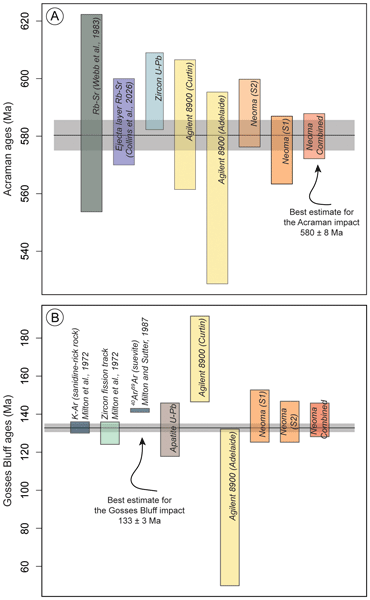
The protocol utilized at Curtin University employing the ThermoFisher Neoma multi-collector yielded an overall internal precision of 3.7±2.1 %, and significantly improved measurements (0.8±0.3 %) compared to the single-collector triple quadrupole results. Across two analytical sessions, the Neoma data from the Acraman sample yielded the most precise isochron ages, mostly controlled by the more precise Sr isotope measurements carried out on Faraday cups with 1013 Ω amplifiers. The data collected in session one yield an inverse isochron age of 575±12 Ma (MSWD = 1.2, N=42) with an initial of 0.7188±0.0026, whereas the data collected in session two yield an inverse isochron age of 588±12 Ma (MSWD = 0.9, N=40) with an initial 0.7187±0.0023. The combined dataset yields an inverse isochron age of 580±8 Ma (MSWD = 1.2, N=82) with an initial of 0.7190±0.0017, hereafter considered the most reliable age for the Acraman ejecta layer.
The Gosses Bluff melt-pellet yielded complex Rb–Sr data dispersion due to the textural mixing between aliettite and feldspar (Fig. 3A, E). Data from the mixing spots (44 out of 73 from both sessions) are aligned with a reference isochron age of ca. 160 Ma, similar to the isochron age obtained from the Rb–Sr data obtained by the Agilent 8900 at Curtin University (Fig. 4E). We note that these mixing domains yield distinguishably lower Sr ratios when measured with high precision, reinforcing that the offset observed in the single-collector data from Adelaide and Curtin (Fig. 4F) may be impacted by some degree of textural mixing.
The Rb–Sr data from spots from pure aliettite domains (i.e., with minimum feldspar mixing; Fig. 3D) yield an inverse isochron ages of 139±14 Ma (MSWD = 1.2, N=17; session one) with initial of 0.7124±0.0016 and 136±11 Ma (MSWD = 1.5, N=12; session two) with initial of 0.7236±0.0015 (Fig. 5B). The combined dataset yields an inverse isochron age of 137±9 Ma (MSWD = 1.6, N=29) with initial of 0.7237±0.0012, which we interpret as the best age estimate for the aliettite crystallization in the Gosses Bluff melt-pellet sample.

Figure 5In situ multi-collector Rb–Sr data from the Acraman and Gosses Bluff impact samples. Propagated uncertainties are presented at 2-standard error.

Figure 6(A–B) Zircon and apatite U–Pb data from the Acraman ejecta layer, respectively. (C–D) Zircon apatite U–Pb data from the Gosses Bluff K-rich melt pellet, respectively. Uncertainties are presented at 2-standard error.
4.4 U–Pb geochronology
Zircon and apatite in both Acraman and Gosses Bluff samples are fine-grained (below 30 µm) and low-abundant (below 0.5 %). Fine-grained zircon embedded in the Acraman ejecta layer micaceous matrix yield a lower intercept age of 565±19 Ma (MSWD = 0.4, N=6; Fig. 6A) with an initial of 0.851±0.047 as expected for the Neoproterozoic (Stacey and Kramers, 1975). Fine-grained apatite texturally associated with the mica-bearing domain in the Acraman ejecta layer yield a lower intercept age of 1462±82 Ma (MSWD = 2.0, N=13; Fig. 6B) with an initial of 0.907±0.031.
Zircon from the Gosses Bluff melt-pellet yield significantly overdispersed U–Pb data (concordance between 34 % and 88 %), with only three concordant data (91 %–98 %) spanning from 1550 to 550 Ma (Fig. 6C). Fine-grained apatite yield a well-defined mixing line between radiogenic and common-Pb components in Tera-Wasserburg space with a lower intercept age of 132±14 Ma (MSWD = 0.4, N=23; Fig. 6D) and initial of 0.856±0.013.
5.1 Comparison between in situ single- and multi-collector Rb–Sr geochronology
In situ Rb–Sr geochronology has been widely propelled by the new advances in mass spectrometers with collision-reaction cell that enable oxidizing reactions and consequently the measurement of 87Rb-87Sr interference-free (Cheng et al., 2008; Zack and Hogmalm, 2016; Hogmalm et al., 2017; Redaa et al., 2021). Although single-collector triple quadrupole instruments have proven its ability to successfully date mica and feldspar from a range of rocks and textural settings (e.g., Li et al., 2020; Tillberg et al., 2020; Subarkah et al., 2022; Ribeiro et al., 2022, 2023a, b, 2025; Liebmann et al., 2022; Zametzer et al., 2022; Kirkland et al., 2023; Larson et al., 2023; Almeida et al., 2023; Kellett et al., 2024; Nicomedes et al., 2025; Bedoya et al., 2025; Caxito et al., 2025), the development and optimization of analytical routines using multi-collector MS/MS instruments are still in its infancy (Bevan et al., 2021; Dauphas et al., 2022; Cruz-Uribe et al., 2023; Huang et al., 2025) – especially when referring to the comparison between those two instruments.
The protocols used at Curtin University employed identical laser parameters for Rb–Sr analyses with both the single-collector Agilent 8900 MS/MS and the Thermo Fisher Neoma multi-collector ICP-MS/MS, thereby enabling an independent comparison of instrument performance. Such comparison is often carried out using homogeneous materials (e.g., NIST SRM glasses), to exclude internal variability as a factor on measurement precision. As such, the Neoma MS/MS results yielded significantly more precise and accurate and ratios from NIST SRM 612 compared to the single-collector Agilent 8900 MS/MS (Fig. 7A). This improvement in precision or age uncertainty is attributed to improved performance of the Neoma MS/MS in simultaneous analyses of 84SrF, 86SrF and 87SrF with Faraday cups connected to 1013 Ω amplifiers (e.g., Huang et al., 2025) improving signal-to-noise ratio resulting in more precise Sr isotopic ratios. The precision improvement on acquired Rb–Sr data is more significant for minerals with high Sr concentration such as feldspar and some mica variations (e.g., white-mica and some biotite) (Bevan et al., 2021; Rankenburg et al., 2024), often yielding 10 times better internal precision on Sr isotopic measurements, further leading to better constrained isochron age uncertainties. For instance, we observed that Mount Dromedary biotite yielded more precise (1.1±0.5 %, internal precision) and (0.9±0.2 %) ratios compared to Agilent 8900 ( of 1.4±0.3 %, and of 1.1±0.2 %) (Fig. 7B, C). Conversely, low-Sr micas such as LaPosta biotite yield more precise isotope ratios when analyzed with ion counter detectors equipped instruments like the Agilent 8900 ICP-MS/MS compared to multi-collector ICP-MS/MS equipped with solely equipped with Faradays (Fig. 7B, C).

Figure 7Analytical comparison between single- and multi-collector mass spectrometers, including (A) the measurement of and measurements on NIST SRM 612, and (B) natural mica reference materials (Mount Dromedary and LaPosta biotite).
In summary, these results indicate that choosing the best analytical approach for unknown samples relies on knowing the estimated Sr concentration in the mineral of interest. Overall, the Neoma MS/MS equipped with Faraday cups (especially 1013 Ω amplifiers) achieves its best precision for high-Sr (somewhat greater than 20 µg g−1), low ratio specimens like K-feldspar and some white-mica and clay mineral varieties (e.g., sericite, muscovite, illite and glauconite) (Bevan et al., 2021; Huang et al., 2025; Kirkland et al., 2025; Olierook et al., 2026), resulting in tighter constrained isochron ages in spite of the narrow spread of ratios.
5.2 Assessing the chronology of the Acraman and Gosses Bluff impacts
The Acraman and Gosses Bluff impacts have attracted interest for their potential links to major environmental and biological changes, highlighting the importance of precise geochronology in establishing temporal correlations and evaluating possible causal relationships. Various dating approaches including whole-rock Rb–Sr (isotope dilution), whole-rock and minerals (e.g., feldspar) total fusion K-Ar and , and zircon U–Pb and fission track have been applied to an array of impact-related samples including suevite and melt breccias (e.g., Jourdan, 2012; Milton et al., 1972; Milton and Sutter, 1987; Webb et al., 1983; Williams and Schmidt, 2021), nevertheless, the impact age of both Acraman and Gosses Bluff remains debatable (Jourdan, 2012).
5.2.1 Acraman impact structure
Schmieder et al. (2015) carried out a comprehensive investigation of Acraman impact chronology focusing on U–Pb geochronology of unshocked and shocked zircon from impact-melt rocks and step-heating measurement of melted lithic dacite clasts and feldspar separates from shatter cones. Unshocked to moderately shocked zircon (with planar deformation features) from impact-melt rocks and from ejecta layers returned Mesoproterozoic ages (ca. 1.6 Ga) reflecting the magmatic age of the Gawler Volcanic Rages (Compston et al., 1987; Schmieder et al., 2015). Granular zircon with decomposed monoclinic-ZrO2, utilized as a robust impact chronometer (Timms et al., 2017; Erickson et al., 2020, 2021; Osinski et al., 2022), defined an ancient Pb-loss trend with upper intercept age of 1143±130 Ma (Schmieder et al., 2015). Notably, this age is far from the Ediacaran ejecta-stratigraphic age bracket spanning 635–540 Ma considered the most reliable age interval for the timing of the Acraman impact, suggesting that granular zircon experienced partial Pb diffusion attributed to impact metamorphism. Successive attempts at obtaining step-heating ages from impact-melt rocks and K-bearing mineral separates like alkali feldspar failed to yield plateau ages due to 39Ar and 37Ar recoil redistribution (Jourdan, 2012), or yielded (mini)-plateau ages younger than 460–450 Ma (Baldwin et al., 1991; Jourdan, 2012; Schmieder et al., 2015). Such young ages are interpreted to reflect post-impact hydrothermal alteration when compared to the ejecta-stratigraphic constraints, supported by the presence of secondary minerals (e.g., zeolite in vugs and chlorite and baryte in voids). Earlier estimates of the Acraman impact age relied on indirect stratigraphic constraints, including a whole-rock Rb–Sr isochron age of 588±35 Ma from the Yarloo Shale (Webb et al., 1983). However, this age is compromised by substantial isotopic scatter (MSWD = 8.7) and uncertainty in the stratigraphic assignment of analysed samples (Compston et al., 1987; Lloyd et al., 2020). More recently, direct in situ Rb–Sr dating of the Acraman ejecta horizon yielded 585±15 Ma (Collins et al., 2026).

Figure 8Comparison between new ages from the Acraman (A) and Gosses Bluff (B) impact and available literature data from both sites (Milton et al., 1972; Webb et al., 1983; Milton and Sutter, 1987; Collins et al., 2026).
Considering the superior precision for analyzing muscovite with multi-collector ICP-MS/MS instruments, the combined Neoma Rb–Sr isochron age of 580±8 Ma from the Acraman ejecta layer is interpreted as the best age estimate for the impact (Fig. 8A). This age is supported by the new zircon U–Pb lower intercept age of 598±16 Ma (although less precise given the small number of analyses) from the ejecta layer, and with the recent in situ Rb–Sr age of 585±15 Ma from the Acraman ejecta layer obtained via single-collector ICP-MS/MS (Collins et al., 2026). These results show that the known complications in dating the Acraman impact – including inheritance or partial resetting preserved in apatite, as well as hydrothermal alteration recorded by the data – can be overcome using in situ laser-beam techniques. The contrasting response of mica Rb–Sr compared to isotopes to hydrothermal alteration can be explained by differences in their crystal-chemical behaviour and the mobility of their constituent elements. Although Rb+ readily substitutes for K+ within mica interlayer sites, their radiogenic daughter products behave fundamentally differently. Radiogenic 40Ar is a noble gas whose retention is sensitive to crystal defects, diffusion pathways and fluid-mediated mineral reactions, whereas radiogenic 87Sr is a divalent cation whose redistribution depends on ionic diffusion, mineral–fluid exchange or dissolution–reprecipitation (Dahl, 1996). Hydrothermal reactions, including chloritization and alkali exchange, can mobilise K and modify mica crystal structures, facilitating radiogenic Ar loss without necessarily producing equivalent resetting of the Rb–Sr system. Consequently, under certain hydrothermal conditions, Rb–Sr may preserve earlier mineral growth ages that have been partially or completely obscured by subsequent Ar loss.
This differential behaviour is supported by paired Rb–Sr and investigations of white mica (Kellett et al., 2024; Jakobsson et al., 2026). In particular, Jakobsson et al. (2026) demonstrated that fluid-assisted retrogression can substantially reset mica ages while leaving older Rb–Sr isotopic signatures comparatively well preserved. Nevertheless, Rb–Sr is not universally resistant to hydrothermal alteration. The relative preservation of these isotope systems therefore depends on fluid chemistry, temperature, reaction mechanisms and the extent of mineralogical re-equilibration. In this context, in situ Rb–Sr geochronology offers an important advantage for impact studies by allowing the selective analysis of newly crystallised or preserved mica domains, potentially recovering impact-related chronological information that is obscured in bulk-mineral analyses.
5.2.2 Gosses Bluff impact crater
Early investigations on the Gosses Bluff chronology have set an important framework to constraint the timing of meteorite impact directly using impact-related melt-rocks. Total fusion K–Ar dating of melt-rock (133±3 Ma) and zircon fission track dating (134±6 Ma) defined the best estimate for the timing of the Gosses Bluff impact (Milton et al., 1972; Milton and Sutter, 1987). Further attempts to refine this age with high-precision dating from pumiceous suevite clast and single sanidine grains from melt-rock yielded complex, discordant 39Ar* degassing patterns failing to yield plateau ages, rather displaying an increase age spectrum converging towards ca. 145 Ma (Milton and Sutter, 1987; Jourdan, 2012) (Fig. 8B). The older apparent age has been interpreted as minimum age for the Gosses Bluff impact (Jourdan, 2012).
In situ Rb–Sr measurements carried out with single-collector instruments did not yield precise, reproducible data (Fig. 4D–F). This may be attributed to younger age of the Gosses Bluff, and thus less radiogenic Sr isotope variations, coupled with sequential (rather than simultaneous) isotope measurement by mass hopping and higher background compared to multi-collector instruments. The Neoma MS/MS yielded significantly more precise Sr isotopic measurements, allowing the distinction between isochrons defined by pure aliettite (137±9 Ma) and mixing feldspar-aliettite domains (Fig. 5B), notably displaying comparatively lower Sr ratios. The younger isochron age from the pure aliettite domains is consistent with new apatite U–Pb lower intercept age of 132±14 Ma, likely reflecting apatite growth from the impact melt, and with melt-rock K-Ar and zircon fission track ages (Milton et al., 1972; Milton and Sutter, 1987). Whilst zircon from the Gosses Bluff melt-pellet yielded mostly discordant U–Pb data, preliminary results from granular, shock-recrystallized zircon from polymict breccia dykes indicate a mean U–Pb age of 139±4 Ma (Cousins et al., 2025).
Collectively, the published and new ages (this study) from the Gosses Bluff points to an impact age of 133±3 Ma (Fig. 8B), indicating that older data with complex degassing spectra could represent excess and/or inherited 40Ar* likely producing older apparent ages (e.g., Jourdan et al., 2007).
5.3 Advances and limitations of in situ mica Rb–Sr geochronology in meteorite impacts
In situ mica Rb–Sr geochronology has been successfully applied to dating complex textures in deformed rocks (e.g., Kirkland et al., 2023; Larson et al., 2023; Ribeiro et al., 2023a, b; Tollefson and Larson, 2026; Tollefson et al., 2025), yet the behavior of Rb–Sr isotopes in shocked micas and its potential to constraint the timing of impact processes remain underexplored (Ribeiro et al., 2026).
The Rb–Sr results from the Acraman and Gosses Bluff impacts have shown that newly grown micas in ejecta layer and melt-rocks have the potential to preserve the timing of impact processes, whilst apparently less susceptible to post-impact hydrothermal alteration compared to Ar isotopes (Milton and Sutter, 1987; Jourdan, 2012). Additionally, the lateral-spatial resolution achieved by modern laser ablation system provide the means to resolve complex textural relationships, intrinsic to impact-related rocks, aid in obtaining measurements from pure mica domains. Combined with high-precision multi-collectors equipped with reaction-cell instruments and high-resistance amplifiers, in situ Rb–Sr dating of complex mica textures can overcome challenges posed by inherited or altered isotopic systems and obtain chronologies that more accurately reflect the timing of meteorite impacts such as inherited and/or excess 40Ar* (Jourdan et al., 2007; Jourdan, 2012). Since micas are widely abundant on terrestrial rocks (Bailey, 1984), in situ Rb–Sr also circumvents the challenges of dating accessory phases (< 1 vol. %) such as apatite, zircon and monazite. Despite being powerful to precisely define the timing of impact via U–Pb system in some cases (Kenny et al., 2019; Erickson et al., 2020, 2021; Kirkland et al., 2025), those accessory minerals often yield complex datasets due to inheritance components and/or partial isotopic resetting as observed in this study and in many other impact sites (Bohor et al., 1993; Schmieder et al., 2015; Erickson et al., 2017, 2021; McGregor et al., 2019; Kirkland et al., 2025; Ribeiro et al., 2026). In such cases, newly grown micas not only are far more abundant and easier to date via in situ Rb–Sr techniques, but it can also provide high-quality isotopic data to pinpoint the timing of impact processes at relevant precision. As this field advances, the reliability and applicability of in situ Rb–Sr geochronology may provide valuable insights into both terrestrial and planetary impact events (e.g., Luu et al., 2026).
Despite these encouraging new results, in situ Rb–Sr results of pre-impact micas from the Yarrabubba impact structure have shown that these isotopes are resilient to impact-driven resetting despite the formation of shock-related microstructures that could enhance isotope diffusion (Ribeiro et al., 2026). Yet they preserve the protolith's crystallization age rather than the impact age, likely due to the short timescale of the thermal peak phase associated with impact metamorphism (Ribeiro et al., 2026). Future mica dating in impact-related rocks should focus on newly grown textures, as they are more likely to provide accurate impact ages.
5.4 Further applications for in situ Rb–Sr dating in planetary sciences
K-bearing minerals including alkali feldspar and a wide variety of micas (white-mica, biotite, phlogopite) and clays (illite-smectite) are common on Earth's terrestrial rocks, but also on extraterrestrial rocks (Foland, 1998). In addition to being datable via K-Ar, , they are also potential targets for in situ Rb–Sr dating opening a new research avenue to investigate impact-melt formation, deformation and syn- to post-impact hydrothermal alteration on Earth and extraterrestrial materials (e.g., Papanastassiou and Wasserburg, 1972a, b). The use of Rb–Sr isotopes, chemically separated via isotope dilution and independently measured in solution mode, has been successfully employed to explore the timing and nature of aqueous alteration of Martian meteorites (Beard et al., 2013), defining the time and duration of lunar crust formation (Carlson et al., 2014) and the overall isotopic evolution of Martian meteorites in combination with other radiogenic isotopes (Borg et al., 2005).
Although isotope dilution Rb–Sr isotopic measurements provide precise isotopic ratios from low-abundance Rb and Sr minerals in extraterrestrial rocks (e.g., Papanastassiou and Wasserburg, 1972b; Beard et al., 2013), the development and optimization of in situ Rb–Sr measurements via multi-collector ICP-MS/MS holds significant promise for exploring extraterrestrial materials (Dauphas et al., 2022; Nie et al., 2024). Yet, there is a pressing need for new Rb–Sr reference materials to encompass a wide range of target mineral to span the wide variety of target minerals like micas and feldspars. Whilst mica varieties like biotite, white-mica, phlogopite and glauconite display similar laser ablation response and downhole fractionation suggesting they can be used as interchangeable matrix correction reference materials (Glorie et al., 2024; Olierook et al., 2026), additional reference materials encompassing a wider chemical-isotopic range would provide a more direct matrix-match.
The capability to target specific mineral phases could provide critical insights into the timing of planetary surface evolution, the chronology of impact events across the solar system, and the associated effects on planetary environments and potential habitability. As analytical techniques continue to improve, in situ Rb–Sr geochronology is poised to become a valuable tool for unraveling complex geological histories both on Earth and beyond.
This study demonstrates the potential of in situ Rb–Sr geochronology to constrain meteorite impact histories through the targeted analysis of impact-related mineral domains. The Rb–Sr ages of 580±8 Ma for Acraman and 137±9 Ma for Gosses Bluff correspond to relative age uncertainties of approximately 1.4 % and 6.6 %, respectively. The Gosses Bluff result is consistent with the independently established impact age of 133±3 Ma, demonstrating the potential of this approach to recover meaningful chronological constraints from mineralogically complex impact rocks. Spatially resolved laser ablation enables individual mineral domains to be targeted, reducing the mixing of inherited and impact-related components associated with bulk-rock or mineral-separate analyses. Multi-collector ICP-MS/MS further improves Sr isotope measurement precision from 0.7 %–0.8 % (single-collector ICP-MS/MS) down to below 0.2 % in homogeneous materials (e.g., NIST SRM glasses), further producing more precise Rb–Sr isochron ages for white-micas and other varieties (e.g., Mount Dromedary biotite). Nevertheless, several limitations remain, including mineral intergrowths within ablation volumes, matrix-dependent fractionation, limited variability, and potential isotopic disturbance during post-impact alteration. Importantly, the preservation of pre-impact mica ages demonstrates that impact events do not necessarily reset the Rb–Sr system, while newly formed minerals may record impact-related crystallisation or subsequent hydrothermal activity rather than the impact itself. Consequently, reliable interpretation requires integration of isotopic data with petrography, microstructural relationships and independent chronological constraints. In situ Rb–Sr therefore provides a complementary approach to established impact-dating methods, with particular potential for extending the chronology of impact structures where conventional geochronometers are absent, disturbed or difficult to interpret.
The data that support the findings of this study are available in the Supplement of this article.
The supplement related to this article is available online at https://doi.org/10.5194/gchron-8-693-2026-supplement.
Bruno V. Ribeiro: Conceptualization, formal analysis, data curation, writing – original draft. Jayden Squire: Conceptualization, formal analysis, data curation, writing – original draft. Christopher Kirkland: Conceptualization, validation, writing – original draft. Juraj Farkas: Conceptualization, validation, writing – original draft. Kai Rankenburg: Formal analysis, data curation, writing – review and editing. Darwinaji Subarkah: Formal analysis, data curation, writing – review and editing. Cecilia Loyola: Formal analysis, data curation, writing – review and editing. Victoria Cousins: Formal analysis, data curation, writing – review and editing. Victor Gostin: Validation, writing – review and editing. Charles Verdel: Validation, writing – review and editing.
The contact author has declared that none of the authors has any competing interests.
Publisher's note: Copernicus Publications remains neutral with regard to jurisdictional claims made in the text, published maps, institutional affiliations, or any other geographical representation in this paper. The authors bear the ultimate responsibility for providing appropriate place names. Views expressed in the text are those of the authors and do not necessarily reflect the views of the publisher.
This work is supported by the Timescales of Mineral Systems Group (Curtin University). Research in the John de Laeter Centre (JdLC) is enabled by Curtin University, the West Australian Government, AuScope and the Australian Government via the National Collaborative Research Infrastructure Strategy (NCRIS). Darwinaji Subarkah and Charles Verdel publishes with the permission of the Senior Executive Director, Northern Territory Geological Survey. We appreciate the reviewers and editors comments.
This research benefit from the John de Laeter Centre facilities supported by the Australian Research Council (grant nos. LE2001000035, LE190100176, and LE140100150). We also acknowledge additional support from the Australian Research Council Linkage Project (grant no. LP210200822) entitled “Novel isotope techniques to explore Centralian Superbasin, Australia”.
This paper was edited by Daniela Rubatto and reviewed by Thomas Belgrano and Alicia Cruz-Uribe.
Almeida, V. V., Ribeiro, B. V., Rodrigues, J. B., Cawood, P. A., Neto, I. C., Silveira, F. V., Faleiros, F. M., and Kirscher, U.: Linking kimberlite magmatism in the Brazilian Platform with Pangea break-up events using in situ Rb Sr in phlogopite, Lithos, 107486, https://doi.org/10.1016/j.lithos.2023.107486, 2023.
Artemieva, N. and Morgan, J.: Quantifying the Release of Climate-Active Gases by Large Meteorite Impacts With a Case Study of Chicxulub, Geophys. Res. Lett., 44, https://doi.org/10.1002/2017GL074879, 2017.
Bailey, S. W.: Micas: Reviews in Mineralogy, Mineralogical Society of America, 1984.
Baldwin, S. L., McDougall, I., and Williams, G. E.: and analyses of meltrock from the Acraman impact structure, Gawler Ranges, South Australia, Aust. J. Earth Sci., 38, 291–298, https://doi.org/10.1080/08120099108727973, 1991.
Beard, B. L., Ludois, J. M., Lapen, T. J., and Johnson, C. M.: Pre-4.0 billion year weathering on Mars constrained by Rb–Sr geochronology on meteorite ALH84001, Earth Planet. Sc. Lett., 361, 173–182, https://doi.org/10.1016/j.epsl.2012.10.021, 2013.
Bedoya, A., Glorie, S., Hand, M., Kirkland, C. L., and De Vries Van Leeuwen, A. T.: In situ Rb–Sr insights in the cooling history of the Petermann Orogeny, Central Australia, Geosci. Front., 16, 102080, https://doi.org/10.1016/j.gsf.2025.102080, 2025.
Bevan, D., Coath, C. D., Lewis, J., Schwieters, J., Lloyd, N., Craig, G., Wehrs, H., and Elliott, T.: In situ Rb–Sr dating by collision cell, multicollection inductively-coupled plasma mass-spectrometry with pre-cell mass-filter, (CC-MC-ICPMS/MS), J. Anal. At. Spectrom., 36, 917–931, https://doi.org/10.1039/D1JA00006C, 2021.
Bland, P. A., Collins, G. S., Davison, T. M., Abreu, N. M., Ciesla, F. J., Muxworthy, A. R., and Moore, J.: Pressure–temperature evolution of primordial solar system solids during impact-induced compaction, Nat. Commun., 5, 5451, https://doi.org/10.1038/ncomms6451, 2014.
Bohor, B. F., Betterton, W. J., and Krogh, T. E.: Impact-shocked zircons: discovery of shock-induced textures reflecting increasing degrees of shock metamorphism, Earth Planet. Sc. Lett., 119, 419–424, https://doi.org/10.1016/0012-821X(93)90149-4, 1993.
Borg, L. E., Edmunson, J. E., and Asmerom, Y.: Constraints on the U–Pb isotopic systematics of Mars inferred from a combined U–Pb, Rb–Sr, and Sm-Nd isotopic study of the Martian meteorite Zagami, Geochim. Cosmochim. Ac., 69, 5819–5830, https://doi.org/10.1016/j.gca.2005.08.007, 2005.
Brigatti, M. F. and Poppi, L.: Natural and monoionic aliettite: hydration and dehydration states, Clay Miner., 22, 187–197, https://doi.org/10.1180/claymin.1987.022.2.07, 1987.
Carlson, R. W., Borg, L. E., Gaffney, A. M., and Boyet, M.: Rb–Sr, Sm-Nd and Lu-Hf isotope systematics of the lunar Mg-suite: the age of the lunar crust and its relation to the time of Moon formation, Philos. T. R. Soc. A, 372, 20130246, https://doi.org/10.1098/rsta.2013.0246, 2014.
Caxito, F. A., Ribeiro, B. V., Alkmim, F., Deramchi, A., and Kirkland, C. L.: Near-Synchronous Cambrian Evolution of the Transbrasiliano-Kandi-4°50′ Shear Zone in South America and Africa, Terra Nova, https://doi.org/10.1111/ter.70017, 2025.
Cheng, P., Koyanagi, G. K., and Bohme, D. K.: On the chemical resolution of the 87Rb+ (s0)/87Sr+ (s1) isobaric interference: A kinetic search for an optimum reagent, Anal. Chim. Acta, 627, 148–153, https://doi.org/10.1016/j.aca.2008.03.057, 2008.
Cockell, C. S., Lee, P., Osinski, G., Horneck, G., and Broady, P.: Impact-induced microbial endolithic habitats, Meteorit. Planet. Sci., 37, 1287–1298, https://doi.org/10.1111/j.1945-5100.2002.tb01029.x, 2002.
Collins, A. S., Blades, M. L., Subarkah, D., Cooke, H., Edwards, L., Forbister, C., Jolly, J., Lloyd, J. C., Gilbert, S. E., Löhr, S., Farkaš, J., and Gostin, V.: Age of the Acraman impact ejecta layer in the adelaide superbasin and Implications on clay-mineral provenance from the Rb–Sr systematics of middle Ediacaran shales, Precambrian Res., 435, 108015, https://doi.org/10.1016/j.precamres.2026.108015, 2026.
Collins, G. S., Melosh, H. J., and Osinski, G. R.: The Impact-Cratering Process, Elements, 8, 25–30, https://doi.org/10.2113/gselements.8.1.25, 2012.
Compston, W., Williams, I. S., Jenkins, R. J. F., Gostin, V. A., and Haines, P. W.: Zircon age evidence for the Late Precambrian Acraman ejecta blanket, Aust. J. Earth Sci., 34, 435–445, https://doi.org/10.1080/08120098708729424, 1987.
Cousins, V. K., Cavosie, A. J., Timms, N. E., Quintero, R. R., Kirkland, C. L., Evans, N. J., and McDonald, B.: Constraining the Age of Impact: A Microstructural Investigation of Zircon from the Gosses Bluff Impact Structure, Australia, in: 87th Annual Meeting of the Meteoritical Society, July 2025, Perth, Western Australia, 2025.
Crook, K. A. W. and Cook, P. J.: Gosses bluff – diapir, crypto-volcanic structure or astrobleme?*, Journal of the Geological Society of Australia, 13, 495–516, https://doi.org/10.1080/00167616608728628, 1966.
Cruz-Uribe, A. M., Craig, G., Garber, J. M., Paul, B., Arkula, C., and Bouman, C.: Single Spot Rb–Sr Isochron Dating of Biotite by LA-MC-ICP-MS/MS, Geostand. Geoanal. Res., 47, 795–809, https://doi.org/10.1111/ggr.12518, 2023.
Dahl, P. S.: The crystal-chemical basis for Ar retention in micas: inferences from interlayer partitioning and implications for geochronology, Contrib. Mineral. Petr., 123, 22–39, https://doi.org/10.1007/s004100050141, 1996.
Dauphas, N., Hopp, T., Craig, G., Zhang, Z. J., Valdes, M. C., Heck, P. R., Charlier, B. L. A., Bell, E. A., Harrison, T. M., Davis, A. M., Dussubieux, L., Williams, P. R., Krawczynski, M. J., Bouman, C., Lloyd, N. S., Tollstrup, D., and Schwieters, J. B.: In situ 87Rb–87Sr analyses of terrestrial and extraterrestrial samples by LA-MC-ICP-MS/MS with double Wien filter and collision cell technologies, J. Anal. At. Spectrom., 37, 2420–2441, https://doi.org/10.1039/D2JA00135G, 2022.
Dietz, R. S.: Shatter Cone Orientation at Gosses Bluff Astrobleme, Nature, 216, 1082–1084, https://doi.org/10.1038/2161082a0, 1967.
Erickson, T. M., Timms, N. E., Kirkland, C. L., Tohver, E., Cavosie, A. J., Pearce, M. A., and Reddy, S. M.: Shocked monazite chronometry: integrating microstructural and in situ isotopic age data for determining precise impact ages, Contrib. Mineral. Petr., 172, 11, https://doi.org/10.1007/s00410-017-1328-2, 2017.
Erickson, T. M., Kirkland, C. L., Timms, N. E., Cavosie, A. J., and Davison, T. M.: Precise radiometric age establishes Yarrabubba, Western Australia, as Earth's oldest recognised meteorite impact structure, Nat. Commun., 11, 300, https://doi.org/10.1038/s41467-019-13985-7, 2020.
Erickson, T. M., Kirkland, C. L., Jourdan, F., Schmieder, M., Hartnady, M. I. H., Cox, M. A., and Timms, N. E.: Resolving the age of the Haughton impact structure using coupled and U–Pb geochronology, Geochim. Cosmochim. Ac., 304, 68–82, https://doi.org/10.1016/j.gca.2021.04.008, 2021.
Foland, K. A.: Potassium-argon dating method, in: Geochemistry, Kluwer Academic Publishers, Dordrecht, 522–525, https://doi.org/10.1007/1-4020-4496-8_259, 1998.
French, B. M. and Koeberl, C.: The convincing identification of terrestrial meteorite impact structures: What works, what doesn't, and why, Earth. Sci. Rev., 98, 123–170, https://doi.org/10.1016/j.earscirev.2009.10.009, 2010.
Gilbert, S. E., Glorie, S., and Zack, T.: Insitu beta decay dating by LA-ICP-MS/MS, in: Methods and Applications of Geochronology, Elsevier, 243–295, https://doi.org/10.1016/B978-0-443-18803-9.00005-5, 2024.
Gilbert, S. E., Glorie, S., and Lloyd, J. C.: Coupled K–Ca and Rb–Sr dating by LA-ICP-MS/MS – reaction gas optimisation and geological applications, Geochronology, 8, 661–678, https://doi.org/10.5194/gchron-8-661-2026, 2026.
Giuliani, A., Oesch, S., Guillong, M., and Howarth, G. H.: Mica Rb–Sr dating by laser ablation ICP-MS/MS using an isochronous calibration material and application to West African kimberlites, Chem. Geol., 649, 121982, https://doi.org/10.1016/j.chemgeo.2024.121982, 2024.
Glorie, S., Gilbert, S. E., Hand, M., and Lloyd, J. C.: Calibration methods for laser ablation Rb–Sr geochronology: comparisons and recommendation based on NIST glass and natural reference materials, Geochronology, 6, 21–36, https://doi.org/10.5194/gchron-6-21-2024, 2024.
Gostin, V. A., Haines, P. W., Jenkins, R. J. F., Compston, W., and Williams, I. S.: Impact Ejecta Horizon Within Late Precambrian Shales, Adelaide Geosyncline, South Australia, Science, 233, 198–200, https://doi.org/10.1126/science.233.4760.198, 1986.
Guerrero, D., Reimold, W. U., Hauser, N., Kenny, G., Whitehouse, M., and Lambert, P.: Shock deformation and U–Pb isotope systematics in zircon from impactites of the Rochechouart impact structure: Impact age and zircon provenance, Geochim. Cosmochim. Ac., 402, 338–358, https://doi.org/10.1016/j.gca.2025.05.049, 2025.
Hayward, C. L., Reimold, W. U., Gibson, R. L., and Robb, L. J.: Gold mineralization within the Witwatersrand Basin, South Africa: evidence for a modified placer origin, and the role of the Vredefort impact event, Geological Society, London, Special Publications, 248, 31–58, https://doi.org/10.1144/GSL.SP.2005.248.01.02, 2005.
Herrmann, M., Kenny, G. G., Martell, J., Whitehouse, M. J., and Alwmark, C.: The first U–Pb age for shocked zircon from the Mien impact structure, Sweden, and implications for metamictization-induced zircon texture formed during impact events, Meteorit. Planet. Sci., 59, 211–241, https://doi.org/10.1111/maps.14116, 2024.
Hildebrand, A. R., Penfield, G. T., Kring, D. A., Pilkington, M., Camargo Z., A., Jacobsen, S. B., and Boynton, W. V.: Chicxulub Crater: A possible Cretaceous/Tertiary boundary impact crater on the Yucatán Peninsula, Mexico, Geology, 19, 867, https://doi.org/10.1130/0091-7613(1991)019<0867:CCAPCT>2.3.CO;2, 1991.
Hill, A. C., Haines, P. W., Grey, K., and Willman, S.: New records of Ediacaran Acraman ejecta in drillholes from the Stuart Shelf and Officer Basin, South Australia, Meteorit. Planet. Sci., 42, 1883–1891, https://doi.org/10.1111/j.1945-5100.2007.tb00547.x, 2007.
Hogmalm, K. J., Zack, T., Karlsson, A. K., Sjoqvist, A. S. L., and Grabe-Schonberg, D.: In-situ Rb–Sr and K-Ca dating by LA-ICP-MS/MS: An evaluation of N2O and SF6 as reaction gases, J. Anal. At. Spectrom., 32, 305–313, 2017.
Hrstka, T., Gottlieb, P., Skála, R., Breiter, K., and Motl, D.: Automated mineralogy and petrology – applications of TESCAN Integrated Mineral Analyzer (TIMA), J. Geosci., 47–63, https://doi.org/10.3190/jgeosci.250, 2018.
Hu, Z., Gao, S., Liu, Y., Hu, S., Chen, H., and Yuan, H.: Signal enhancement in laser ablation ICP-MS by addition of nitrogen in the central channel gas, J. Anal. At. Spectrom., 23, 1093, https://doi.org/10.1039/b804760j, 2008.
Huang, C., Wang, H., Xie, L., Xu, L., Wu, S., Yang, Y., and Yang, J.: High-precision Rb–Sr isotope analysis with Neoma MS/MS: Enhancing in situ geochronology by laser ablation, Spectrochim. Acta Part B, 224, 107117, https://doi.org/10.1016/j.sab.2025.107117, 2025.
Jackson, S. E., Pearson, N. J., Griffin, W. L., and Belousova, E. A.: The application of laser ablation-inductively coupled plasma-mass spectrometry to in situ U–Pb zircon geochronology, Chem. Geol., 211, 47–69, 2004.
Jakobsson, V., Spikings, R., Kutzschbach, M., Ribeiro, B., Hames, W., Berger, A., Erhardt, T., and Müller, W.: Impact of intragrain chemical heterogeneities on and 87Rb–87Sr white mica dates, Contrib. Mineral. Petr., 181, 23, https://doi.org/10.1007/s00410-026-02299-9, 2026.
Jourdan, F.: The dating technique applied to planetary sciences and terrestrial impacts, Aust. J. Earth Sci., 59, 199–224, https://doi.org/10.1080/08120099.2012.644404, 2012.
Jourdan, F., Renne, P. R., and Reimold, W. U.: The problem of inherited 40Ar* in dating impact glass by the method: Evidence from the Tswaing impact crater (South Africa), Geochim. Cosmochim. Ac., 71, 1214–1231, https://doi.org/10.1016/j.gca.2006.11.013, 2007.
Jourdan, F., Renne, P. R., and Reimold, W. U.: An appraisal of the ages of terrestrial impact structures, Earth Planet. Sc. Lett., 286, 1–13, https://doi.org/10.1016/j.epsl.2009.07.009, 2009.
Jourdan, F., Reimold, W. U., and Deutsch, A.: Dating Terrestrial Impact Structures, Elements, 8, 49–53, https://doi.org/10.2113/gselements.8.1.49, 2012.
Kellett, D. A., Larson, K. P., and Skipton, D. R.: Integration of white mica in situ with in situ and step-heat dates in orogenic settings, Lithos, 482–483, 107687, https://doi.org/10.1016/j.lithos.2024.107687, 2024.
Kenny, G. G., Schmieder, M., Whitehouse, M. J., Nemchin, A. A., Morales, L. F. G., Buchner, E., Bellucci, J. J., and Snape, J. F.: A new U–Pb age for shock-recrystallised zircon from the Lappajärvi impact crater, Finland, and implications for the accurate dating of impact events, Geochim. Cosmochim. Ac., 245, 479–494, https://doi.org/10.1016/j.gca.2018.11.021, 2019.
Kirkland, C. L., Olierook, H. K. H., Danišík, M., Liebmann, J., Hollis, J., Ribeiro, B. V., and Rankenburg, K.: Dating mylonitic overprinting of ancient rocks, Commun. Earth Environ., 4, 47, https://doi.org/10.1038/s43247-023-00709-5, 2023.
Kirkland, C. L., Erickson, T. M., Johnson, T. E., Prave, T., Strachan, R. A., Daggitt, M. L., Hartnady, M. I. H., Reddy, S. M., Taylor, R. J. M., Ribeiro, B. V., Rankenburg, K., Kirscher, U., and Fischer, S.: A one-billion-year-old Scottish meteorite impact, Geology, 53, 621–625, https://doi.org/10.1130/G53121.1, 2025.
Larson, K. P., Button, M., Shrestha, S., and Camacho, A.: A comparison of and dates: Evaluating the problem of excess 40Ar in Himalayan mica, Earth Planet. Sc. Lett., 609, 118058, https://doi.org/10.1016/j.epsl.2023.118058, 2023.
Li, S. S., Santosh, M., Farkaš, J., Redaa, A., Ganguly, S., Kim, S. W., Zhang, C., Gilbert, S., and Zack, T.: Coupled U–Pb and Rb–Sr laser ablation geochronology trace Archean to Proterozoic crustal evolution in the Dharwar Craton, India, Precambrian Res., 343, https://doi.org/10.1016/j.precamres.2020.105709, 2020.
Liebmann, J., Kirkland, C. L., Kelsey, D. E., Korhonen, F. J., and Rankenburg, K.: Lithological fabric as a proxy for Rb–Sr isotopic complexity, Chem. Geol., 608, 121041, https://doi.org/10.1016/j.chemgeo.2022.121041, 2022.
Lloyd, J. C., Blades, M. L., Counts, J. W., Collins, A. S., Amos, K. J., Wade, B. P., Hall, J. W., Hore, S., Ball, A. L., Shahin, S., and Drabsch, M.: Neoproterozoic geochronology and provenance of the Adelaide Superbasin, Precambrian Res., 350, 105849, https://doi.org/10.1016/j.precamres.2020.105849, 2020.
Luu, T.-H., Peters, D., Gérard, Y., Crawshaw, H., and Moynier, F.: Precise in situ 87Rb-87Sr dating of terrestrial and extraterrestrial samples with Nu Sapphire XD LA-CRC-MC-ICP-MS/MS, J. Anal. At. Spectrom., 41, 2465–2474, https://doi.org/10.1039/D6JA00061D, 2026.
McCall, G. J. H.: The Vendian (Ediacaran) in the geological record: Enigmas in geology's prelude to the Cambrian explosion, Earth. Sci. Rev., 77, 1–229, https://doi.org/10.1016/j.earscirev.2005.08.004, 2006.
McGregor, M., McFarlane, C. R. M., and Spray, J. G.: In situ multiphase U–Pb geochronology and shock analysis of apatite, titanite and zircon from the Lac La Moinerie impact structure, Canada, Contrib. Mineral. Petr., 174, 62, https://doi.org/10.1007/s00410-019-1598-y, 2019.
Milton, D. J. and Sutter, J. F.: Revised age for the Gosses Bluff impact structure, Northern Territory, Australia, based on dating, Meteoritics, 22, 281–289, https://doi.org/10.1111/j.1945-5100.1987.tb00625.x, 1987.
Milton, D. J., Glikson, A. Y., Manwaring, E. A., Moss, F. J., Sedmik, E. C. E., Van Son, J., Barlow, B. C., Brett, R., and Young, G. A.: Gosses Bluff Impact Structure, Australia, Science, 175, 1199–1207, https://doi.org/10.1126/science.175.4027.1199, 1972.
Mortimer, G. E., Cooper, J. A., and James, P. R.: U–Pb and Rb–Sr geochronology and geological evolution of the Harts Range ruby mine area of the Arunta Inlier, central Australia, Lithos, 20, 445–467, https://doi.org/10.1016/0024-4937(87)90029-6, 1987.
Nicomedes, I. S., Ribeiro, B. V., Caxito, F. A., Kirkland, C. L., Victoria, A., and Quadir, Z.: In situ Rb–Sr geochronology of slickensides reveals reactivation of cratonic margins post-Gondwana assembly, J. Struct. Geol., 191, 105305, https://doi.org/10.1016/j.jsg.2024.105305, 2025.
Nie, N. X., Dauphas, N., Zhang, Z. J., Hopp, T., and Sarantos, M.: Lunar soil record of atmosphere loss over eons, Sci. Adv., 10, https://doi.org/10.1126/sciadv.adm7074, 2024.
Olierook, H. K. H., Ribeiro, B. V., Liebmann, J., Rankenburg, K., Jourdan, F., Redaa, A., Lloyd, J. C., Belgrano, T. M., Corella Santa Cruz, C. R., Jegal, Y., Mercadier, J., Zimmermann, C., Yu, J., Zametzer, A., Kirkland, C. L., Gilbert, S. E., Storey, C. D., Doucet, L. S., Jones, I., Stokes, L., Zack, T., Rösel, D., Fougerouse, D., Kaempf, J., Datta, P., Hameed, H., Evans, N. J., Roberts, M. P., Farkas, J., Glorie, S., Mayers, C., Frew, R. A., Al Odeh, S., Roche, C. E., Chiaradia, M., Cruz-Uribe, A. M., Collins, A. S., Karlsson, A., and Shantha Kumara, A.: Appraisal of Six Natural Mica Reference Materials for In Situ Rb–Sr Geochronology, Geostand. Geoanal. Res., online first, https://doi.org/10.1111/ggr.70061, 2026.
Osinski, G. R., Cockell, C. S., Pontefract, A., and Sapers, H. M.: The Role of Meteorite Impacts in the Origin of Life, Astrobiology, 20, 1121–1149, https://doi.org/10.1089/ast.2019.2203, 2020.
Osinski, G. R., Grieve, R. A. F., Ferrière, L., Losiak, A., Pickersgill, A. E., Cavosie, A. J., Hibbard, S. M., Hill, P. J. A., Bermudez, J. J., Marion, C. L., Newman, J. D., and Simpson, S. L.: Impact Earth: A review of the terrestrial impact record, Earth. Sci. Rev., 232, 104112, https://doi.org/10.1016/j.earscirev.2022.104112, 2022.
Papanastassiou, D. A. and Wasserburg, G. J.: Rb–Sr age of a Luna 16 basalt and the model age of lunar soils, Earth Planet. Sc. Lett., 13, 368–374, https://doi.org/10.1016/0012-821X(72)90111-2, 1972a.
Papanastassiou, D. A. and Wasserburg, G. J.: The Rb–Sr age of a crystalline rock from Apollo 16, Earth Planet. Sc. Lett., 16, 289–298, https://doi.org/10.1016/0012-821X(72)90205-1, 1972b.
Paton, C., Woodhead, J. D., Hellstrom, J. C., Hergt, J. M., Greig, A., and Maas, R.: Improved laser ablation U–Pb zircon geochronology through robust downhole fractionation correction, Geochem. Geophys. Geosyst., 11, https://doi.org/10.1029/2009GC002618, 2010.
Paton, C., Hellstrom, J., Paul, B., Woodhead, J., and Hergt, J.: Iolite: Freeware for the visualisation and processing of mass spectrometric data, J. Anal. At. Spectrom., 26, 2508–2518, https://doi.org/10.1039/c1ja10172b, 2011.
Quintero, R. R., Cavosie, A. J., Cox, M. A., Miljković, K., and Dugdale, A.: Australian impact cratering record: Updates and recent discoveries, in: Large Meteorite Impacts and Planetary Evolution VI, Geological Society of America, 41–68, https://doi.org/10.1130/2021.2550(02), 2021.
Rankenburg, K., Ribeiro, B. V., Evans, N. J., and McDonald, B.: Comparing CRC-MC-ICPMS to QQQ-ICPMS/MS for in situ Rb–Sr applications, in: Goldschmidt, conference proceeding, 2024.
Redaa, A., Farkaš, J., Gilbert, S., Collins, A. S., Wade, B., Löhr, S., Zack, T., and Garbe-Schönberg, D.: Assessment of elemental fractionation and matrix effects during in situ Rb–Sr dating of phlogopite by LA-ICP-MS/MS: implications for the accuracy and precision of mineral ages, J. Anal. At. Spectrom., 36, 322–344, https://doi.org/10.1039/D0JA00299B, 2021.
Reimold, W. U., Koeberl, C., Gibson, R. L., and Dressler, B. O.: Economic Mineral Deposits in Impact Structures: A Review, Impact Tectonics, 479–552, https://doi.org/10.1007/3-540-27548-7_20, 2005.
Ribeiro, B. V., Finch, M. A., Cawood, P. A., Faleiros, F. M., Murphy, T. D., Simpson, A., Glorie, S., Tedeschi, M., Armit, R., and Barrote, V. R.: From microanalysis to supercontinents: Insights from the Rio Apa Terrane into the Mesoproterozoic SW Amazonian Craton evolution during Rodinia assembly, J. Metamorph. Geol., 40, 631–663, https://doi.org/10.1111/jmg.12641, 2022.
Ribeiro, B. V., Kirkland, C. L., Finch, M. A., Faleiros, F. M., Reddy, S. M., Rickard, W. D. A., and Hartnady, M. I. H.: Microstructures, geochemistry, and geochronology of mica fish: Review and advances, J. Struct. Geol., 104947, https://doi.org/10.1016/j.jsg.2023.104947, 2023a.
Ribeiro, B. V., Kirkland, C. L., Kelsey, D. E., Reddy, S. M., Hartnady, M. I. H., Faleiros, F. M., Rankenburg, K., Liebmann, J., Korhonen, F. J., and Clark, C.: Time-strain evolution of shear zones from petrographically constrained Rb–Sr muscovite analysis, Earth Planet. Sc. Lett., 602, 117969, https://doi.org/10.1016/j.epsl.2022.117969, 2023b.
Ribeiro, B. V., Kirkland, C. L., Finch, M. A., Yakymchuk, C., Reddy, S. M., Faleiros, F. M., Goemann, K., and Belousov, I.: Dislocation networks facilitate element diffusion in deformed garnet, Earth Planet. Sc. Lett., 656, 119271, https://doi.org/10.1016/j.epsl.2025.119271, 2025.
Ribeiro, B. V., Jakobsson, V., Kirkland, C. L., Spikings, R. A., Zametzer, A., Rickard, W. D. A., Centrella, S., Timms, N. E., Cavosie, A. J., and Danišík, M.: Microstructural and geochemical response of muscovite to impact metamorphism, Geology, 54, 179–183, https://doi.org/10.1130/G53895.1, 2026.
Rodrigues, R. T., Ribeiro, B. V., Rosenbaum, G., Jourdan, F., Ubide, T., and Rankenburg, K.: Texturally targeted multi-isotopic dating of ductile deformation: the Clarke River Shear Zone, northeastern Australia, J. Struct. Geol., 209, 105719, https://doi.org/10.1016/j.jsg.2026.105719, 2026.
Rösel, D. and Zack, T.: LA-ICP-MS/MS Single-Spot Rb–Sr Dating, Geostand. Geoanal. Res., 46, 143–168, https://doi.org/10.1111/ggr.12414, 2022.
Schmieder, M., Tohver, E., Jourdan, F., Denyszyn, S. W., and Haines, P. W.: Zircons from the Acraman impact melt rock (South Australia): Shock metamorphism, U–Pb and systematics, and implications for the isotopic dating of impact events, Geochim. Cosmochim. Ac., 161, 71–100, https://doi.org/10.1016/j.gca.2015.04.021, 2015.
Schmitz, M. D., Bowring, S. A., and Ireland, T. R.: Evaluation of Duluth Complex anorthositic series (AS3) zircon as a U–Pb geochronological standard: new high-precision isotope dilution thermal ionization mass spectrometry results, Geochim. Cosmochim. Ac., 67, 3665–3672, https://doi.org/10.1016/S0016-7037(03)00200-X, 2003.
Schoene, B. and Bowring, S. A.: U–Pb systematics of the McClure Mountain syenite: Thermochronological constraints on the age of the standard MMhb, Contrib. Mineral. Petr., 151, 615–630, https://doi.org/10.1007/s00410-006-0077-4, 2006.
Schulte, P., Alegret, L., Arenillas, I., Arz, J. A., Barton, P. J., Bown, P. R., Bralower, T. J., Christeson, G. L., Claeys, P., Cockell, C. S., Collins, G. S., Deutsch, A., Goldin, T. J., Goto, K., Grajales-Nishimura, J. M., Grieve, R. A. F., Gulick, S. P. S., Johnson, K. R., Kiessling, W., Koeberl, C., Kring, D. A., MacLeod, K. G., Matsui, T., Melosh, J., Montanari, A., Morgan, J. V., Neal, C. R., Nichols, D. J., Norris, R. D., Pierazzo, E., Ravizza, G., Rebolledo-Vieyra, M., Reimold, W. U., Robin, E., Salge, T., Speijer, R. P., Sweet, A. R., Urrutia-Fucugauchi, J., Vajda, V., Whalen, M. T., and Willumsen, P. S.: The Chicxulub Asteroid Impact and Mass Extinction at the Cretaceous-Paleogene Boundary, Science, 327, 1214–1218, https://doi.org/10.1126/science.1177265, 2010.
Slama, J., Kosler, J., Condon, D. J., Crowley, J. L., Gerdes, A., Hanchar, J. M. Horstwood, M. S. A. Morris, G. A., Nasdala, L., Norberg, N., Schaltegger, U. Schoene, N., and Tubrett, M. N. Whitehouse, M. J.: Plesovice zircon – a new natural reference material for U–Pb and Hf isotopic microanalysis, Chem. Geol., 249, 1–35, 2008.
Stacey, J. S. and Kramers, J. D.: Approximation of terrestrial lead isotope evolution by a two-stage model, Earth Planet. Sc. Lett., 26, 207–221, https://doi.org/10.1016/0012-821X(75)90088-6, 1975.
Subarkah, D., Blades, M. L., Collins, A. S., Farkaš, J., Gilbert, S., Löhr, S. C., Redaa, A., Cassidy, E., and Zack, T.: Unraveling the histories of Proterozoic shales through in situ Rb–Sr dating and trace element laser ablation analysis, Geology, 50, 66–70, https://doi.org/10.1130/G49187.1, 2022.
Thomson, S. N., Gehrels, G. E., Ruiz, J., and Buchwaldt, R.: Routine low-damage apatite U–Pb dating using laser ablation–multicollector–ICPMS, Geochem. Geophys. Geosyst., 13, https://doi.org/10.1029/2011GC003928, 2012.
Tillberg, M., Drake, H., Zack, T., Kooijman, E., Whitehouse, M. J., and Åström, M. E.: In situ Rb–Sr dating of slickenfibres in deep crystalline basement faults, Sci. Rep., 10, 562, https://doi.org/10.1038/s41598-019-57262-5, 2020.
Timms, N. E., Erickson, T. M., Pearce, M. A., Cavosie, A. J., Schmieder, M., Tohver, E., Reddy, S. M., Zanetti, M. R., Nemchin, A. A., and Wittmann, A.: A pressure-temperature phase diagram for zircon at extreme conditions, Earth. Sci. Rev., 165, 185–202, https://doi.org/10.1016/j.earscirev.2016.12.008, 2017.
Tollefson, K. and Larson, K.: Investigation of the effects of ductile deformation on in situ biotite and muscovite Rb–Sr geochronology, Geol. Mag., 163, e22, https://doi.org/10.1017/S0016756826100685, 2026.
Tollefson, K. T., Larson, K. P., Moynihan, D. P., and Cleven, N. R.: In situ mica Rb–Sr geochronology and microstructural analysis to evaluate the timing and sense of shear zone movement: Shannon and d'Abbadie Faults, Yukon, Canada, Can. J. Earth Sci., 62, 1320–1341, https://doi.org/10.1139/cjes-2024-0144, 2025.
Tuchscherer, M. G. and Spray, J. G.: Geology, Mineralization, and Emplacement of the Foy Offset Dike, Sudbury Impact Structure, Econ. Geol., 97, 1377–1397, https://doi.org/10.2113/gsecongeo.97.7.1377, 2002.
Vermeesch, P.: IsoplotR: A free and open toolbox for geochronology, Geosci. Front., 2, 1479–1493, 2018.
Villa, I. M., De Bièvre, P., Holden, N. E., and Renne, P. R.: IUPAC-IUGS recommendation on the half life of 87Rb, Geochim. Cosmochim. Ac., 164, 382–385, https://doi.org/10.1016/j.gca.2015.05.025, 2015.
Webb, A. W., Coats, R. P., Fanning, C. M., and Flint, R. B.: Geochronological framework of the Adelaide Geosyncline, in: Geological Society of Australia Abstracts, conference proceeding, 1983.
Whitney, D. L. and Evans, B. W.: Abbreviations for names of rock-forming minerals, Am. Mineral., 95, 185–187, https://doi.org/10.2138/am.2010.3371, 2010.
Wiedenbeck, M., Allé, P., Corfu, F., Griffin, W. L., Meier, M., Oberli, F., Von Quadt, A., Roddick, J. C., and Spiegel, W.: Three natural zircon standards for U-Th-Pb, Lu-Hf, trace element and REE analyses, Geostandards Newsletter, 1–23, 1995.
Williams, G. E.: The Acraman Impact Structure: Source of Ejecta in Late Precambrian Shales, South Australia, Science, 233, 200–203, https://doi.org/10.1126/science.233.4760.200, 1986.
Williams, G. E.: Acraman: A major impact structure from the Neoproterozoic of Australia, 209–224, https://doi.org/10.1130/SPE293-p209, 1992.
Williams, G. E. and Schmidt, P. W.: Dating the Acraman asteroid impact, South Australia: the case for deep drilling the `hot shock' zone of the central uplift, Aust. J. Earth Sci., 68, 355–367, https://doi.org/10.1080/08120099.2020.1808066, 2021.
Williams, G. E. and Wallace, M. W.: The Acraman asteroid impact, South Australia: magnitude and implications for the late Vendian environment, J. Geol. Soc. London., 160, 545–554, https://doi.org/10.1144/0016-764902-142, 2003.
Woodhead, J. D. and Hergt, J. M.: Strontium, Neodymium and Lead Isotope Analyses of NIST Glass Certified Reference Materials: SRM 610, 612, 614, Geostand. Geoanal. Res., 25, 261–266, https://doi.org/10.1111/j.1751-908X.2001.tb00601.x, 2001.
Zack, T. and Hogmalm, K. J.: Laser ablation dating by online chemical separation of Rb and Sr in an oxygen-filled reaction cell, Chem. Geol., 437, 120–133, https://doi.org/10.1016/j.chemgeo.2016.05.027, 2016.
Zametzer, A., Kirkland, C. L., Barham, M., Hartnady, M. I. H., Bath, A. B., and Rankenburg, K.: Episodic alteration within a gold-bearing Archean shear zone revealed by in situ biotite Rb–Sr dating, Precambrian Res., 382, 106872, https://doi.org/10.1016/j.precamres.2022.106872, 2022.