
the Creative Commons Attribution 4.0 License.
the Creative Commons Attribution 4.0 License.
 | 11 Nov 2026
Short communication: A linear regression model for amino acid dating of Bithynia opercula from deep-core material
Ellie Frances Nelson

J. Andres Christen
Estimating numerical ages from the extent of amino acid racemisation observed in fossil biominerals has been the aim of many researchers in the field of amino acid geochronology. Here, the use of temperature profiles and independent age estimates to build a linear regression model for IcPD with uncertainty calculated using a Bayesian approach is explored. This work presents a pilot study to test the potential of this methodology and determine what next steps need to be taken to make this a viable approach to produce numerical ages from IcPD data. To progress this work, a comprehensive study of the sources of uncertainty in the model needs to be made.
- Article
(2245 KB) - Full-text XML
- BibTeX
- EndNote


Amino acid geochronology (AAG) is a relative dating technique that relies on the predictable breakdown of protein in fossil biominerals (Hare and Mitterer, 1966). The intra-crystalline protein decomposition (IcPD) approach to AAG (Penkman et al., 2008) has become a valuable technique for dating the European Quaternary (e.g. Penkman et al., 2011, 2013, 2024; Dickinson et al., 2019; Tesakov et al., 2020; Conti et al., 2024; Nelson et al., 2024, 2025a, b). This approach isolates the protein within faceted voids of mollusc shell (Gries et al., 2009). These intra-crystalline proteins behave as a closed system. As such, the extent of protein decomposition within this fraction is due to burial temperature and time since burial, yielding less variable data when compared to the whole biomineral (Penkman et al., 2008). A key reaction pathway that takes place during protein decomposition is racemisation. In the majority of living organisms only the L-isomer of each amino acid is incorporated into the protein chain. When tissue turnover ceases, amino acids will start to spontenously racemise until a racemic equilibrium is reached. This is quantified as the D/L value, and is used to place sites containing fossil biominerals into chronological order (Hare and Mitterer, 1966).
Aminostratigraphic frameworks are developed using a single genus or species of biomineral from sites that have experienced the same effective diagenetic temperature history. This produces a relative chronology that allows age correlations between sites. Numerical dates and independent chronostratigraphy – which may be limited to a few sites in an area – can then be expanded to other sites where numerical age control is unavailable (e.g., Penkman et al., 2011, 2013; reviewed in Penkman et al., 2022; Nelson et al., 2025, 2026).
Previous researchers have attempted to produce numerical dates using amino acid geochronology using two different approaches to calibrate D/L values with age. The first is to calibrate extent of racemisation during burial against isothermal heating experiments. However, this approach requires making assumptions about the integrated diagenetic temperature to which the fossils were exposed (e.g., Hare and Mitterer, 1968; Kvenvolden et al., 1979; Schroeder and Bada, 1976; Davies and Treloar, 1977; Williams and Smith, 1977; reviewed in Clarke and Murray-Wallace, 2006). This method relies on the assumption that racemisation follows first-order rate kinetics (reviewed in Clarke and Murray-Wallace, 2006). In practice, the thermal history of sites is often poorly understood, the rate of racemisation within fossils does not strictly follow first-order kinetics, and this apparent conformity is not observed across the entire range of D/L values (e.g., Sejrup and Haugen, 1992; Clarke and Murray-Wallace, 2006). Furthermore, Tomiak et al. (2013) demonstrated that the rate-determining step for protein decomposition in some biominerals varies between low (25 °C) and high (80–140 °C) temperatures. These challenges mean that this approach to calibration can result in inaccurate age estimations, which has often overshadowed the more reliable relative age assignments provided by amino acid geochronology.
An alternative approach involves empirical calibration of the extent of fossil racemisation over time. Various mathematical expressions have been used to describe the relationship between protein decomposition, time, and temperature, including logarithmic equations (e.g. Wehmiller, 1989), parabolic curve fitting (e.g. Mitterer and Kriausakul, 1989), simple and stepped linear models (e.g. Miller et al., 1999; Hearty, 2003), power transformations (e.g. Goodfriend et al., 1995; Kaufman, 2006), and Bayesian approaches (Allen et al., 2013). These approaches rely on independent numerical dates for the fossils of interest. While these calibrations have historically relied on radiocarbon-dated Holocene material (e.g., Goodfriend and Meyer, 1991; Wehmiller et al., 1995; Miller et al., 2000), they can also incorporate U-series dating (e.g., Wehmiller, 1982; Ortiz et al., 2004), palaeomagnetism, and other radioactive isotopes such as strontium (Chauhan et al., 2022) to calibrate older material. Empirical calibrations have provided a more reliable way to produce numerical ages, but is reliant on independent age control, limiting the use of this approach to where this is available. As extent of racemisation is dependent of time since cessation of tissue turnover and the temperature history, better estimations of the temperature history of a biomineral could provide an opportunity to calibrate the age of a sample without the need for independent age control.
Nelson et al. (2024) developed an aminostratigraphy for the Pannonian Basin in Hungary. Seven fully cored boreholes containing Quaternary fluvial sediments from this basin yielded Bithynia opercula – a common substrate for IcPD (e.g., Penkman et al., 2011, 2013, 2024; Tesakov et al., 2020; Nelson et al., 2024). The age of these sediments was constrained by an existing age model that used magnetic stratigraphy, biostratigraphy, and cycles of magnetic susceptibility and grain size to date sediments throughout each core and correlate the cores to one another (Püspöki et al., 2013, 2016; 2020, 2021, 2023), hereafter referred to as the Püspöki age model. The steep and variable geothermal gradient (40–50 °C km−1; Bodri, 1981; Horváth et al., 2015; Table 1) in this region means that burial temperature does not increase uniformly with depth across borehole locations. This provides an opportunity to model the relationship between IcPD, time, and temperature under actual burial conditions, while further testing the validity of the Püspöki age model. If successful, this approach may provide an age calibration tool for IcPD data where burial temperature and depth below the surface are known, but independent numerical ages are unavailable.
Table 1Sub-basin and boreholes within the Pannonian Basin (Hungary), depth of Quaternary sediments (m below ground surface) and geothermal gradient (°C km−1) within each core (Nelson et al., 2024).

Here, the relationship between the extent of IcPD, estimated age and burial temperature has been modelled using a linear regression model (LRM), selected to allow for all calculations made to be analytical. This model is then used to estimate the age of a test dataset. Possible sources of uncertainty within the model are evaluated, and next steps to improve the model are proposed. The ultimate aim is to develop a new method using a statistically valid approach to estimate numerical ages from IcPD analysis, which is based on the modelled behaviour of racemisation during real-world burial conditions.
2.1 Quaternary sediments of the Pannonian Basin (Hungary)
2.1.1 Geological setting
Surrounded by the Carpathian mountain range, the Pannonian Basin (Fig. 1) is a large, tectonically subsiding basin. Quaternary sediments within the basin extend between 150–700 m below the surface (Franyó, 1992), comprising fluvial deposits that lie within an alluvial plain that contains multiple glacial and interglacial cycles (Rónai, 1985). Glacial deposits are characterised by fine-grained sediments, indicative of low-transport capacity of rivers running into the basin during these periods. Conversely, interglacial sediments are characterised by coarser-grained material, due to increased transport capacity of rivers as conditions became warmer and wetter (Nádor et al., 2003).

Figure 1Estimated Surface heat flow mW m−2 of the Pannonian Basin (Hungary; Davies, 2013). All borehole localities and sub-basins are located in an area where the 30 °C isotherm is located between 300–350 m below ground level, and average is 90–100 mW m−1. Sources: Esri | Powered by Esri. Outline of Pannonian Basin is defined by dashed grey line.
The Hungarian portion of the Pannonian Basin is known to possess a positive geothermal anomaly (Toth, 2017), with a mean heat density of 90–100 mW m−2 (Fig. 1) and a geothermal gradient of ∼ 45 °C km−1 (Dövényi et al., 1983; Lenkey et al., 2002; Table 1). Rock temperatures are known to reach 30 °C between 250–450 m across the study region (Toth, 2017). 15 out of the 59 opercula-containing sedimentary horizons within the cores were located between 250–450 m. Modern mean annual temperature at the surface is 10.5–11.5 °C (Hungarian Meteorological Service, 2024), demonstrating that the temperature gets significantly warmer throughout the sediment column. However, the geothermal gradient is not consistent across the study area (Fig. 1, Table 1).
2.1.2 Previous work defining chronology of the sediments
The Püspöki age model was developed using a combination of magnetic and molluscan biostratigraphy, and cycles of magnetic susceptibility and mean grain size. The paleomagnetic data (Cooke et al., 1979) from the Vésztő and Dévaványa cores demonstrated multiple short-lived polarity events throughout the Quaternary sediments. Magnetic susceptibility (MS) measurements by Nádor et al. (2003), supported by mineralogical data, indicated that early postglacial melt-waters resulted in episodes of significant sedimentation. This resulted in magnetic susceptibility peaks due to climate-controlled thawing of permafrost within the surrounding mountainous catchment areas (Püspöki et al., 2021).
The Quaternary succession has been divided into MS cycles. Each cycle begins with an MS maxima followed by a disappearance of magnetic minerals from the sediment load, defined as “susceptibility termination surfaces” (STS). The MS maxima have been correlated with cold marine oxygen isotope stages (MIS) and STS with the subsequent warm MIS. MIS correlations have been constrained by the timing of the polarity events identified throughout the Dévaványa and Vésztő cores and the first and last appearance of the important mollusc stratigraphic marker Viviparus boeckhi (Halaváts, 1888); first appearance: Olduvai subchron (∼ 1.9–1.8 Ma), last appearance ∼ 550 ka (Püspöki et al., 2016). A similar pattern of MS cycles has been observed in cores collected throughout the Pannonian Basin, which has been used to correlate sediments between cores (Püspöki et al., 2021).
2.1.3 The relationship between IcPD, depth, temperature and time
Opercula IcPD (Nelson et al., 2024) was used to independently test the correlations between the cores made by the Püspöki age model. The Quaternary sediments within the Pannonian Basin cover multiple glacial cycles, and initially were thought to be continuous for the past 2.5 Ma based on palaeomagnetic data (Cooke et al., 1979). Regional unconformities have been identified (e.g. Püspöki et al., 2013, 2016), however through both magnetic cyclo-stratigraphy and aminostratigrapy a quasi-continuous sequence has been demonstrated for this region (Püspöki et al., 2013, 2016, 2020, 2021, 2023). Assuming that continual sedimentation had occurred (except for known unconformities), a linear interpolation model was used to estimate the age of sediments containing opercula (Nelson et al., 2024).
Nelson et al. (2024) reported that amino acid geochronology provided temporal resolution for the Pannonian Basin up to ∼ 2.3 Ma (Fig. 2). The D/L values of four amino acids were presented, which were able to provide temporal resolution over different periods depending on how quickly each amino acid racemised. Aspartic acid/asparagine (Asx) provided age discrimination up to ∼ 450 ka, alanine (Ala) to ∼ 750 ka, glutamic acid/glutamine (Glx) to ∼ 1.5 Ma and valine (Val) ∼ 2.3 Ma for the total hydrolysable amino acid (THAA) fraction. Initial analysis of the Körös Basin cores supported the correlations between the boreholes made previously. However, systematically higher D/L values were observed for material attributed to < 450 ka within the Jászladány, Kevermes and Mindszent when compared with the Körös Basin cores.
Investigation into the cause of these differences in IcPD suggested that they were due to the variable burial depths for equivalent age sediments and the steeper than average geothermal gradient of the region. Opercula buried deeper below the surface had been exposed to warmer temperatures for longer periods of time, resulting in a greater extent of protein decomposition than more shallowly buried specimens. The relationship between depth and the geothermal gradient was described by the geothermal effect (ΔT) for each core. This was strongly correlated with the interpolated D/L values for the cores. This therefore provides an opportunity to design a model for the relationship of IcPD with time and temperature under burial conditions. The model may also provide any additional test of the validity of the Püspöki age model.
2.2 Linear Regression Model (LRM)
To build the model, a dataset comprised of amino acid dating results from seven Pannonian Basin cores containing ∼ 600 m deep Quaternary sediments were used. To build the linear regression model (LRM) the following assumptions were made:
-
The Püspöki age model created by Püspöki et al. (2013, 2016, 2020, 2021, 2023; described in Sect. 2.1.2) is correct.
-
The interpolated geothermal effect (ΔT) for each borehole has been used to describe the temperature history over time. Rationale: The geothermal effect (ΔT) is used to describe the relationship between burial depth and temperature. It is calculated by multiplying the depth of the sample by the slope of the geothermal gradient estimated for the vicinity of each borehole (Nelson et al., 2024).
-
Only total hydrolysable amino acid (THAA) fraction of Ala, Glx and Val were considered in the analysis (Fig. 2). Rationale: Nearly all opercula specimens analysed by Nelson et al. (2024) can be attributed to the Middle and Early Pleistocene. The three amino acids selected for this analysis have been demonstrated to provide consistently chromatographically resolved pairs of D and L isomers for bithyniid opercula. In addition, as moderate (Ala) to slow (Glx/Val) racemisers, these amino acids have been proven to provide temporal resolution for Middle and Early Pleistocene within Europe (Penkman et al., 2011, 2013; Tesakov et al., 2020; Nelson et al., 2024, 2025a, b).
-
An exponential decay in time model was assumed, including the temperature profile. Rationale: Previous studies have investigated the impact of increasing temperature on the rate of racemisation in fossil material. They have demonstrated that the rate of racemisation increases exponentially with temperature (Hearty et al., 1986; Murray-Wallace, 2000). Therefore, an exponential decay was assumed for the increase in the extent of IcPD against temperature.
-
The LRM model does not start at 1 as initial rate of racemisation (< 40 ka) cannot be predicted by the model. An intercept has been added to the equation to account for this. Rationale: The age of the youngest opercula specimen analysed by Nelson et al. (2024) was ∼ 49 ka (based on Puspoki age model and linear interpolation of magnetic cyclo stratigraphy); as such, the extent of IcPD due to time and temperature in material younger than this is not known, resulting in the need to include an intercept in the equation to account for this.

Figure 2The extent of racemisation vs. age for the THAA fraction of three amino acids: alanine (top), Glx (middle), valine (bottom).
Considering these assumptions, a model describing the relationship between the increase in racemisation, accumulated temperature and time was created. Namely, for , where Ri(t) is the D/L value of the amino acid i at depth d.
For a sample found at depth d, the LRM model will describe the extent of racemisation (exponential decay) by the rate parameter for each amino acid i. k(γ) is the known temperature profile and g(d)=t is the established estimated age-depth model mentioned above.
The temperature profile k(d) is an estimated linear model , and g(d) is an interpolated age-depth model, that both vary from borehole to borehole. To avoid a more complex notation we leave the dependence on the borehole implicit.
For each sample j of amino acid i, found at depth dj, we take the log and assume a normal error to estimate a regression,
where represents the start of the model at depth 0. A Bayesian approach was taken to estimate , and σi and to predict the age of the sample. Since this is a linear model, all necessary calculations are analytical (Aitchison and Dunsmore, 1975). Note that the original model in Eq. (1) assumes an exponential decay in Ei; this linear model is only a result of taking log's, no further assumptions are required.
All amino acids reach a state of racemic equilibrium after sufficient time has passed since the cessation of protein turnover within an operculum. The time in which this occurs depends on the rate of racemisation for each amino acid and integrated temperature. For the Pannonian Basin opercula, Ala began to approach racemic equilibrium in specimens attributed to ∼ 750 ka and ∼ 1 Ma for Glx and Val. Therefore, data in excess of these ages have been removed from the LRM model for the relevant amino acids.
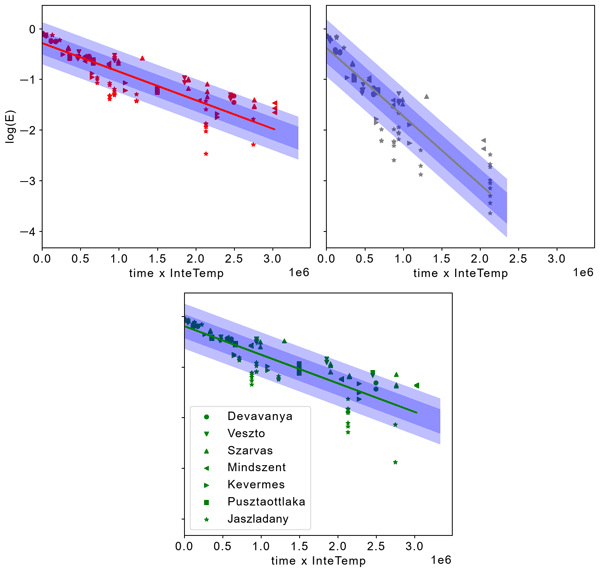
Once the LRM model was defined, a regression for each amino acid, including data from all of the boreholes, was produced (Fig. 3). As expected, Ala showed a steeper increase in the extent of racemisation with time compared with Val and Glx, due to it being the fastest racemiser of these three amino acids (e.g. Penkman et al., 2008, 2013; Nelson et al., 2024). Val and Glx presented a nearly identical slope. The unknown start of the LRM model, λ0 is very similar for Ala, Val and Glx, which is to be expected. This may be clearly seen in Fig. 4 where the posterior distribution of λ0, λ1 and the error precison are presented.

Figure 3Linear regression models (LRM) of three amino acids: Glx = red (top left), Ala = gray (top right) and Val = green (bottom), combining data from all sites (see legend on the bottom panel). For each regression, probability intervals, [0.1,0.9] (light blue) and [0.25,0.75] (blue) are also presented.

Figure 4Posterior distributions for λ0, λ1 and σ (standard deviation in the regression mode, see Eq. (2), for each of the three amino acids in opercula used Glx = red, Ala = gray and Val = green. The posteriors for λ0 and σ are similar, while, as expected, the posterior for the slope λ1 is nearly identical for Glx and Val and quite different for Ala (see text).
Following the usual Bayesian procedure, a predictive distribution of the age of a sample at depth d, given its observed log(Ei) and its temperature profile , may be easily produced (Aitchison and Dunsmore, 1975). Since we are using three amino acids, we produce a predictive distribution corresponding to each Ala, Val and Glx. We have proposed multiplying and re-scaling as our method to calibrate the D/L data () into a single posterior distribution for the predicted calendar age of the sample.
As an example, four samples from three of the boreholes were used to test the model, where the D/L values were used to calculate a calibrated age prediction, (Fig. 5). These age estimates are point estimates from the Püspöki age model, which inhibits the inclusion of the uncertainty within the model developed by Püspöki and colleagues.

Figure 5The predictive age distribution made by the model for four samples and the original interpolated age from the age model created by Püspöki et al. (2013, 2016, 2020, 2021, 2023) is represented by the blue circle on each plot.
Three out of the four samples tested produced a predictive age distribution that covered the age previously estimated (Püspöki et al., 2016; 2021, 2023; Fig. 5). The exception was Mindszent 275.3–276.10 m, where the LRM model estimates a predictive age distribution that is younger than the age estimated by Püspöki et al. (2021). All calibrated age distributions are relatively broad, covering several hundred ka. In the case of Dévaványa (E23-1 HD2941Blo1), the calibrated age distribution was uninformative as the lower half of the distribution was truncated at zero and the upper half covered a broad age range of ∼ 1 million years. These predictions are a first attempt to use a linear regression model that uses the geothermal gradient of sediments and independent age estimates to create an age calibration model for IcPD. The current estimates from the model are broad and do not yet provide informative age estimates. In the next section we discuss sources of uncertainty that may be hindering the effectiveness of the model and propose next steps to improve the precision and accuracy of the model.
Here, we have used a linear regression approach to model the extent of racemisation of three amino acids within fossil opercula buried in Quaternary sediments from the Pannonian Basin. Burial depth and temperature are not consistent across the Pannonian Basin for equivalently aged opercula fossils (Nelson et al., 2024). As both an estimated age and burial temperature (based on the geothermal gradient) are available for all opercula samples analysed for IcPD analysis, a model that considers both the impact of time and temperature on IcPD was produced.
Amino acids Ala, Glx and Val were considered in the analysis. Using a standard exponential decay model for the D/L values, compensated by the temperature profile (Eq. 1), a regression model was proposed (Eq. 2). A Bayesian approach was used, accordingly, a posterior distribution for the predicted age of a sample may be produced (Fig. 5).
Although the inherent uncertainty in both the borehole temperature profile k(d) and the age-depth model g(d) were not taken into consideration in the model, the resulting quantified uncertainty for the age results is large. This is likely due to, due to the variability in the extent of racemisation used in the construction of the LRM model. However, in some cases, results with reasonable precision may be produced (e.g. sample E22-8 HM27535Blo2 in Fig. 5).
A source of uncertainty is the error associated with the point estimates from the Püspöki age model. Quantification of the uncertainty of these age estimates will involve evaluation of all parts of the process, including the palaeomagnetic measurements (e.g. Püspöki et al., 2016), and correlations with marine oxygen isotope record (e.g. Püspöki et al., 2021). This also makes the comparison of the age estimates by the new LRM for the test samples challenging to compare. Point estimates were also used in the estimation of the geothermal effect (Nelson et al., 2024). A quantification of the uncertainty of these age and temperature estimates is needed to build an improved age-depth model.
Additional uncertainty comes from the initial burial phase temperature profile. During the initial phase of protein decomposition, the opercula were buried much closer to the surface, where the climate would have predominantly influenced the temperature of the burial environment. It is likely that the unknown influence of the climate on the burial temperature for the initial phase of racemisation is contributing to the broader age predictions of the younger test samples (Fig. 5). Dévaványa (E22-1 HD2941Blo1) was located 29.4 m below ground level, whereas all other test samples were buried < 75 m below ground level. Nelson et al. (2024) observed that systematic differences in extent of racemisation with age could be observed in material buried in excess of 80–100 m. Opercula buried below these depths were interpreted to be buried below the influence of the surface climate on burial temperature. The extent of IcPD in these opercula will, therefore, be more greatly influenced by sub-surface factors than those buried more closely to the surface.
An intercept was included in our regression model in an attempt to address the uncertainty of IcPD in younger opercula samples buried closer to the surface ( in Eq. 2), however, the uncertainty in estimating this intercept does add to the overall age predictives. To enable more accurate age predictions for shallower deposits, future work could look to adapt the mathematical parameters and assumptions of the current model to integrate modern ground temperature data from core sampling sites to observe the depth limit of surface temperature influence.
At present this model provides more informative age predictions for more deeply buried material, and in its current iteration would be most applicable to opercula found in similar geological contexts. However, outside of the Pannonian Basin, Quaternary deposits bearing opercula are much more likely to be found within shallower sediments where climate is the controlling factor for burial temperature. Adapting the model to better describe the initial phase of racemisation will improve it's applicability to other geological settings where sensible estimations of the integrated burial temperature can be made.
Only the THAA D/L values of Ala, Glx and Val were used in the LRM due to these three amino acids providing the best temporal resolution for the Quaternary in the Pannonian Basin and the enantiomeric pairs of each being consistently resolved by RP-HPLC analysis (Penkman et al., 2008). IcPD analysis produces a multi-variant dataset with other variables that are indicative of age of an operculum. Further development of this model should seek to explore the use of other IcPD variables that have been demonstrated to be an indicator of sample age, including the FAA D/L values, ratio of the concentration of serine over alanine ([Ser] [Ala] and proportion of free amino acids (e.g. Penkman et al., 2008; Nelson et al., 2024).
There is a still a great degree of uncertainty unaccounted for within the LRM. In order to improve the age-depth model, future work will need to investigate these sources of uncertainty, so their impact on the model can be understood.
Due to the unique conditions of this area, the Pannonian Basin IcPD dataset provides an excellent opportunity to study the kinetics of IcPD at lower temperatures. A model that could effectively describe the relationship between extent of racemisation, temperature history and time could allow for comparison between the kinetics of racemisation at burial temperatures with high temperature experiments, in addition to providing a new way to estimate numerical age from IcPD data. Should this approach to modelling eventually prove successful, this should be a path for future research.
In this study, we have explored a potential new approach to model the extent of opercula IcPD with time to produce a calibrated age-depth model. A linear regression model was developed using the extent of THAA Ala, Glx and Val racemisation, estimated age and burial temperature described by Nelson et al. (2024) for Quaternary sediments within seven sediment cores from the Pannonian Basin (Hungary). Four test samples from three of the sediment cores were used to test the accuracy of the model. All calibrated age distributions were relatively broad, covering several hundred ka. This provided lower resolution than is currently possible with the traditional relative approach to interpretation of IcPD data. More informative and narrower distributions were produced in the older/more deeply buried opercula test samples suggesting that this approach was more effective in deeper material where the influence of the surface climate on the rate of IcPD has been attenuated. An overall sensitivity analysis needs to be undertaken, to establish the greater contribution to age uncertainty and corresponding strategies for further sampling, temperature profile updating and an improved age-depth model.
A Python code is available upon request from J. Andres Christen.
The data used here is available in the SI of Nelson et al. (2024) and also on the NOAA database (https://www.ncei.noaa.gov/pub/data/paleo/aar/, last access: 2 July 2025).
Both authors contributed equally to building the model, overall research and drafting and finalising the manuscript.
JAC made the code and plots with the results. EN provided the background for the model, the published data, and lead on the first draft of the manuscript.
The contact author has declared that neither of the authors has any competing interests.
Publisher's note: Copernicus Publications remains neutral with regard to jurisdictional claims made in the text, published maps, institutional affiliations, or any other geographical representation in this paper. The authors bear the ultimate responsibility for providing appropriate place names. Views expressed in the text are those of the authors and do not necessarily reflect the views of the publisher.
This research has received funding from the European Research Council (ERC) under the European Union's Horizon 2020 research and innovation programme (grant agreement no. 865222). JAC is partially supported by a Office of Naval Research Global grant (N62909-24-1-2016). We would like to thank the University of Cambridge's Accelerate Programme for Scientific Discovery and C2D3 AI and Statistical Innovations for their support in facilitating this collaboration and for their assistance in developing this model.
This research has been supported by the European Research Council, EU HORIZON EUROPE European Research Council (grant no. 865222) and the Office of Naval Research Global (grant no. N62909-241-2016).
This paper was edited by Norbert Frank and reviewed by Colin Murray-Wallace and one anonymous referee.
Allen, A. P., Kosnik, M. A., and Kaufman, D. S.: Characterizing the dynamics of amino acid racemization using time-dependent reaction kinetics: A Bayesian approach to fitting age-calibration models, Quat. Geochronol., 18, 63–77, https://doi.org/10.1016/j.quageo.2013.06.003, 2013.
Aitchison, J. and Dunsmore, I. R.: Statistical Prediction Analysis, 1st edn., Cambridge University Press, https://doi.org/10.1017/CBO9780511569647, 1975.
Bodri, L.: Geothermal model of the earth's crust in the pannonian basin, Tectonophysics, 72, 61–73, https://doi.org/10.1016/0040-1951(81)90087-1, 1981.
Chauhan, T., Sejrup, H. P., Hjelstuen, B. O., Kaufman, D. S., Baig, I., and Reinardy, B. T. I.: Chronology of early to Mid-Pleistocene sediments in the northern North Sea: New evidence from amino acid and strontium isotope analyses, Quat. Geochronol., 101336, https://doi.org/10.1016/j.quageo.2022.101336, 2022.
Clarke, S. J. and Murray-Wallace, C. V.: Mathematical expressions used in amino acid racemisation geochronology – A review, Quat. Geochronol., 1, 261–278, https://doi.org/10.1016/j.quageo.2006.12.002, 2006.
Conti, M. L. G., Butler, P. G., Reynolds, D. J., Trofimova, T., Scourse, J. D., and Penkman, K. E. H.: A new method for amino acid geochronology of the shell of the bivalve mollusc Arctica islandica, Geochronology, 6, 175–198, https://doi.org/10.5194/gchron-6-175-2024, 2024.
Cooke, H. B. S., Hall, J. M., and Rónai, A.: Paleomagnetic Sedimentary and Climactic Records from Boreholes at Dévaványa and Vésztő, Hungary, 22, 89–109, 1979.
Davies, J. H.: Global map of solid Earth surface heat flow, Geochemistry, Geophysics, Geosystems, 14, 4608–4622, https://doi.org/10.1002/ggge.20271, 2013.
Davies, W. D. and Treloar, F. E.: The application of racemisation dating in archaeology: a critical review, The Artefact, 2, 63–94, 1977.
Dickinson, M. R., Lister, A. M., and Penkman, K. E. H.: A new method for enamel amino acid racemization dating: A closed system approach, Quat. Geochronol., 50, 29–46, https://doi.org/10.1016/j.quageo.2018.11.005, 2019.
Dövényi, P., Horváth, F., Liebe, P., and Erki, I.: Component parts of the World Heat Flow Data Collection, PANGAEA [data set], https://doi.org/10.1594/PANGAEA.808029, 1983.
Franyó, F.: Quaternary isopach map of Hungary, 1:200 000, SARA datastore, 1992.
Goodfriend, G. A. and Meyer, V. R.: A comparative study of the kinetics of amino acid racemization/epimerization in fossil and modern mollusk shells, Geochim. Cosmochim. Ac., 55, 3355–3367, https://doi.org/10.1016/0016-7037(91)90493-O, 1991.
Goodfriend, G. A., Kashgarian, M., and Harasewych, M. G.: Use of aspartic acid racemization and post-bomb 14C to reconstruct growth rate and longevity of the deep-water slit shell Entemnotrochus adansonianus, Geochim. Cosmochim. Ac., 59, 1125–1129, https://doi.org/10.1016/0016-7037(95)00029-Y, 1995.
Gries, K., Kröger, R., Kübel, C., Fritz, M., and Rosenauer, A.: Investigations of voids in the aragonite platelets of nacre, Acta Biomater., 5, 3038–3044, https://doi.org/10.1016/j.actbio.2009.04.017, 2009.
Halaváts, J.: Der artesische Brunnen von Szentes, Mitteilungen aus dem Jahrbuche der königlichen ungarischen Geologischen Reichsanstalt, 8, 165–194, https://real-j.mtak.hu/id/eprint/23231 (last access: 16 May 2024), 1888.
Hare, P. E. and Mitterer, R. M.: Nonprotein amino acids in fossil shells, in: Year book – Carnegie Institution of Washington, 65, Carnegie Institution of Washington, Washington D.C., United States of America, 362–364, https://archive.org/details/yearbookcarne65196566carn/page/362/mode/2up (last access: 2 February 2026), 1966.
Hare, P. E. and Mitterer, R. M.: Laboratory simulations of amino acid diagenezis in fossils, in: Carnegie Institute Year Book, Carnegie Institution of Washington, Washington D.C., United States of America, 205–212, https://archive.org/details/yearbookcarne67196768carn/page/204/mode/2up (last access: 26 October 2026), 1968.
Hearty, P. J.: Stratigraphy and timing of eolianite deposition on Rottnest Island, Western Australia, Quaternary Res., 60, 211–222, https://doi.org/10.1016/S0033-5894(03)00063-2, 2003.
Hearty, P. J., Miller, G. H., Stearns, C. E., and Szabo, B. J.: Aminostratigraphy of Quaternary shorelines in the Mediterranean basin, Geol. Soc. Am. Bull., 97, 850–858, https://doi.org/10.1130/0016-7606(1986)97<850:AOQSIT>2.0.CO;2, 1986.
Horváth, F., Musitz, B., Balázs, A., Végh, A., Uhrin, A., Nádor, A., Koroknai, B., Pap, N., Tóth, T., and Wórum, G.: Evolution of the Pannonian basin and its geothermal resources, Geothermics, 53, 328–352, https://doi.org/10.1016/j.geothermics.2014.07.009, 2015.
Hungarian Meteorological Service: Precipitation in Hungary, Hungarian Meteorological Service, https://www.met.hu/en/eghajlat/magyarorszag_eghajlata/altalanos_eghajlati_jellemzes/csapadek/index.php, last access: 23 October 2024.
Kaufman, D. S.: Temperature sensitivity of aspartic and glutamic acid racemization in the foraminifera Pulleniatina, Quat. Geochronol., 1, 188–207, https://doi.org/10.1016/j.quageo.2006.06.008, 2006.
Kvenvolden, K. A., Blunt, D. J. and Clifton, H. E.: Amino acid racemization in Quaternary shell deposits at Willapa Bay, Washington, Geochim. Cosmochim. Ac., 43, 1505–1520, 1979.
Lenkey, L., Dövényi, P., Horvath, F., and Cloetingh, S.: Geothermics of the Pannonian basin and its bearing on the neotectonics, Stephan Mueller Special Publication Series, 3, https://doi.org/10.5194/smsps-3-29-2002, 2002.
Miller, G. H., Magee, J. W., Johnson, B. J., Fogel, M. L., Spooner, N. A., McCulloch, M. T., and Ayliffe, L. K.: Pleistocene Extinction of Genyornis newtoni: Human Impact on Australian Megafauna, Science, 283, 205–208, https://doi.org/10.1126/science.283.5399.205, 1999.
Miller, G. H., Hart, C. P., Roark, E. B., and Johnson, B. J.: Isoleucine epimerization in eggshells of the flightless Australian birds Genyornis and Dromaius, in: Perspectives in Amino Acid and Protein Geochemistry, edited by: Goodfriend, G. A., Collins, M. J., Fogel, M. L., Macko, S. A., and Wehmiller, J. F., New York, Oxford University Press, 161–181, ISBN 0195135075, 9780195135077, 2000.
Mitterer, R. and Kriausakul, N.: Calculation of amino acid racemization ages based on apparent parabolic kinetics, Quaternary Sci. Rev., https://doi.org/10.1016/0277-3791(89)90035-8, 1989.
Murray-Wallace, C. V.: Quaternary coastal aminostratigraphy: Australian data in a global context, in: Perspectives in Amino Acid and Protein Geochemistry, edited by: Goodfriend, G. A., Collins, M. J., Fogel, M. L., Macko, S. A., and Wehmiller, J., Oxford University Press, New York, 279–300, ISBN 0195135075, 9780195135077, 2000.
Nádor, A., Lantos, M., Tóth-Makk, Á., and Thamó-Bozsó, E.: Milankovitch-scale multi-proxy records from fluvial sediments of the last 2.6 Ma, Pannonian Basin, Hungary, Quaternary Sci. Rev., 22, 2157–2175, https://doi.org/10.1016/S0277-3791(03)00134-3, 2003.
Nelson, E., Püspöki, Z., White, D., Pogácsás, G., McIntosh, R. W., Szappanos, B., Wheeler, L., Fancsik, T., and Penkman, K.: A Quaternary aminostratigraphy for the Pannonian Basin: The competing influences of time, burial depth and temperature in deep-core material, Quaternary Sci. Rev., 346, 109044, https://doi.org/10.1016/j.quascirev.2024.109044, 2024.
Nelson, E., White, D., Wheeler, L., Wedel, J., Hoselmann, C., Heggemann, H., Rähle, W., and Penkman, K.: An aminostratigraphy of the northern Upper Rhine Graben, Germany, J. Quaternary Sci., 40, 1147–1175, https://doi.org/10.1002/jqs.70004, 2025.
Nelson, E., White, D., Wheeler, L., Meng, S., Szymanek, M., Strahl, J., Hein, M., Alexandrowicz, W. P., Urban, B., Greeves, S., Stahlschmidt, M., Kahlke, R.-D., Lauer, T., Tanner, D. C., and Penkman, K. E. H.: Quaternary aminostratigraphies for the eastern North European Plain, Open Res. Europe, 5, 396, https://doi.org/10.12688/openreseurope.21815.2, 2026.
Ortiz, J. E., Torres, T., Julià, R., Delgado, A., Juan Llamas, F., Soler, V., and Delgado, J.: Numerical dating algorithms of amino acid racemization ratios from continental ostracodes. Application to the Guadix-Baza Basin (southern Spain), Quaternary Sci. Rev., 23, 717–730, https://doi.org/10.1016/j.quascirev.2003.06.001, 2004.
Penkman, K. E. H., Kaufman, D. S., Maddy, D., and Collins, M. J.: Closed-system behaviour of the intra-crystalline fraction of amino acids in mollusc shells, Quat. Geochronol., 3, 2–25, https://doi.org/10.1016/j.quageo.2007.07.001, 2008.
Penkman, K. E. H., Preece, R. C., Bridgland, D. R., Keen, D. H., Meijer, T., Parfitt, S. A., White, T. S., and Collins, M. J.: A chronological framework for the British Quaternary based on Bithynia opercula, Nature, 476, 446–449, https://doi.org/10.1038/nature10305, 2011.
Penkman, K. E. H., Preece, R. C., Bridgland, D. R., Keen, D. H., Meijer, T., Parfitt, S. A., White, T. S., and Collins, M. J.: An aminostratigraphy for the British Quaternary based on Bithynia opercula, Quaternary Sci. Rev., 61, 111–134, https://doi.org/10.1016/j.quascirev.2012.10.046, 2013.
Penkman, K. E. H., Duller, G. A. T., Roberts, H. M., Colarossi, D., Dickinson, M. R., and White, D.: Dating the Paleolithic: Trapped charge methods and amino acid geochronology, P. Natl. Acad. Sci. USA, 119, e2109324119, https://doi.org/10.1073/pnas.2109324119, 2022.
Penkman, K., Thew, N., Presslee, S., Taylor, S., Nelson, E., Kalin, D., Buchi, M., and Deplazes, G.: An aminostratigraphy for the Quaternary of the Swiss Plateau, Anal. Chem., https://doi.org/10.31223/X57700, 2024.
Püspöki, Z., Demeter, G., Tóth-Makk, Á., Kozák, M., Dávid, Á., Virág, M., Kovács-Pálffy, P., Kónya, P., Gyuricza, Gy., Kiss, J., McIntosh, R.W., Forgács, Z., Buday, T., Kovács, Z., Gombos, T. and Kummer, I.: Tectonically controlled Quaternary intracontinental fluvial sequence development in the Nyírség-Pannonian Basin, Hungary, Sediment. Geol., 283, 34–56, https://doi.org/10.1016/j.sedgeo.2012.11.003, 2013.
Püspöki, Z., Kovács, I. J., Fancsik, T., Nádor, A., Thamó-Bozsó, E., Tóth-Makk, Á., Udvardi, B., Kónya, P., Füri, J., Bendő, Z., Zilahi-Sebess, L., Stercel, F., Gulyás, Á., and Mcintosh, R. W.: Magnetic susceptibility as a possible correlation tool in Quaternary alluvial stratigraphy, Boreas, 45, 861–875, https://doi.org/10.1111/bor.12196, 2016.
Püspöki, Z., Fogarassy-Pummer, T., Thamó-Bozsó, E., Berényi, B., Cserkész-Nagy, Á., Szappanos, B., Márton, E., Lantos, Z., Nádor, A., Fancsik, T., Stercel, F., Tóth-Makk, Á., Mcintosh, R. W., Szőcs, T., and Faragó, E.: High-resolution stratigraphy of a Quaternary fluvial deposit based on magnetic susceptibility variations (Jászság Basin, Hungary), Boreas, 49, 181–199, https://doi.org/10.1111/bor.12412, 2020.
Püspöki, Z., Fogarassy-Pummer, T., Thamó-Bozsó, E., Falus, G., Cserkész-Nagy, Á., Szappanos, B., Márton, E., Lantos, Z., Szabó, S., Stercel, F., Tóth-Makk, Á., Mcintosh, R. W., Szőcs, T., Pálóczy, P., and Fancsik, T.: High-resolution stratigraphy of Quaternary fluvial deposits in the Makó Trough and the Danube-Tisza Interfluve, Hungary, based on magnetic susceptibility data, Boreas, 50, 205–223, https://doi.org/10.1111/bor.12471, 2021.
Püspöki, Z., Gibbard, P. L., Kiss, L. F., McIntosh, R. W., Thamó-Bozsó, E., Krassay, Z., Szappanos, B., Maigut, V., Kovács, P., Karácsony, D., Stercel, F., Visnovitz, F., Demény, K., Bereczki, L., Szőcs, T., Rotár-Szalkai, Á., and Fancsik, T.: Obliquity-driven mountain permafrost-related fluvial magnetic susceptibility cycles in the Quaternary mid-latitude long-term (2.5 Ma) fluvial Maros Fan in the Pannonian Basin, Boreas, 52, 402–426, https://doi.org/10.1111/bor.12618, 2023.
Rónai, A.: The Quaternary of the Great Hungarian Plain, Institutum Geologicum Hungaricum, https://searchworks.stanford.edu/selections/5499543 (last access: 4 April 2024), 1985.
Schroeder, R. A. and Bada, J. L.: A Review of the geochemical applications of the amino acid racemization reaction, Earth Sci. Rev., 12, 347–391, 1976.
Sejrup, H. P. and Haugen, J.-E.: Foraminiferal amino acid stratigraphy of the Nordic Seas: geological data and pyrolysis experiments, Deep-Sea Res., 39, S603–S623, https://doi.org/10.1016/S0198-0149(06)80022-1, 1992.
Tesakov, A. S., Frolov, P. D., Titov, V. V., Dickinson, M., Meijer, T., Parfitt, S. A., Preece, R. C., and Penkman, K. E. H.: Aminostratigraphical test of the East European Mammal Zonation for the late Neogene and Quaternary, Quaternary Sci. Rev., 245, 106434, https://doi.org/10.1016/j.quascirev.2020.106434, 2020.
Tomiak, P. J., Penkman, K. E. H., Hendy, E. J., Demarchi, B., Murrells, S., Davis, S. A., McCullagh, P., and Collins, M. J.: Testing the limitations of artificial protein degradation kinetics using known-age massive Porites coral skeletons, Quat. Geochronol., 16, 87–109, https://doi.org/10.1016/j.quageo.2012.07.001, 2013.
Toth, A.: Creating a Geothermal Atlas of Hungary, in: 42nd Workshop on Geothermal Reservoir Engineering, Stanford University, Stanford, California, 1–9, https://pangea.stanford.edu/ERE/db/IGAstandard/record_detail.php?id=27991 (last access: 10 March 2026), 2017.
Wehmiller, J. F.: A review of amino acid racemization studies in Quaternary mollusks: Stratigraphic and chronologic applications in coastal and interglacial sites, pacific and Atlantic coasts, United States, United Kingdom, baffin Island, and tropical islands, Quaternary Sci. Rev., 1, 83–120, https://doi.org/10.1016/0277-3791(82)90001-4, 1982.
Wehmiller, J. F.: Amino acid racemization: applications in chemical taxonomy and chronostratigraphy of Quaternary fossils, Skeletal biomineralization: Patterns, processes and evolutionary trends, edited by: Carter, J. G., American Geophysical Union, 5, 287–313, ISBN 9781118667279, 9780875907024, https://doi.org/10.1029/SC005p0287, 1989.
Wehmiller, J. F., York, L. L., and Bart, M. L.: Amino acid racemization geochronology of reworked Quaternary mollusks on U.S. Atlantic coast beaches: implications for chronostratigraphy, taphonomy, and coastal sediment transport, Mar. Geol., 124, 303–337, https://doi.org/10.1016/0025-3227(95)00047-3, 1995.
Williams, K. M. and Smith, G. G.: A critical evaluation of the application of amino acid racemization to geochronology and geothermometry, Origins of Life, 8, 91–144, 1977.