
Articles | Volume 8, issue 4
https://doi.org/10.5194/gchron-8-741-2026
© Author(s) 2026. This work is distributed under
the Creative Commons Attribution 4.0 License.
the Creative Commons Attribution 4.0 License.
Special issue:
https://doi.org/10.5194/gchron-8-741-2026
© Author(s) 2026. This work is distributed under
the Creative Commons Attribution 4.0 License.
the Creative Commons Attribution 4.0 License.
Short communication/technical note
| 
19 Nov 2026
Short communication/technical note |
| 19 Nov 2026
| 19 Nov 2026
Technical note: The enhanced Controlled Random Search (CRS) algorithm for thermal history analysis in HeFTy

Department of Geosciences, Idaho State University, Pocatello, ID, 83209, USA
Richard A. Ketcham
Jackson School of Geosciences, University of Texas at Austin, Austin, TX, 78712, USA
Andrea L. Stevens Goddard
Department of Earth and Atmospheric Sciences, Indiana University, Bloomington, IN, 47408, USA
Related authors
Andrea L. Stevens Goddard, Kendra E. Murray, Alyssa L. Abbey, and Mark Wildman
Geochronology Discuss., https://doi.org/10.5194/gchron-2024-20, https://doi.org/10.5194/gchron-2024-20, 2024
Manuscript not accepted for further review
Short summary
Short summary
We present a set of six standardized time-temperature histories, which we call benchmark paths, that can be used by the low-temperature thermochronology community to evaluate and visualize the sensitivity of thermochronologic systems to the variables inherent in the interpretation of thermochronologic data. As an example, we present a method for “tuning” each benchmark path to eleven published kinetics models (for the apatite (U-Th-Sm)/He, apatite fission-track, and zircon (U-Th)/He systems).
Maximilian K. Ehrenfels, Daniel F. Stockli, Richard A. Ketcham, Desmond B. Patterson, and Michael G. Prior
EGUsphere, https://doi.org/10.5194/egusphere-2026-4367, https://doi.org/10.5194/egusphere-2026-4367, 2026
Short summary
Short summary
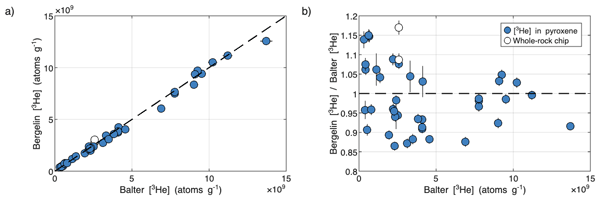
Minerals can be dated by measuring helium produced by radioactive decay of uranium and thorium to reveal when rocks cooled. Extracting this helium from within mineral grains with a laser instead of dissolving whole crystals is faster and more versatile, but the ages scatter more than expected. Using machine learning on over 800 measurements with our improved workflow, we trace most of this scatter to uneven uranium hidden in a polished-away part of the crystal that future methods must capture.
Marie Bergelin, Greg Balco, and Richard A. Ketcham
Geochronology, 8, 19–35, https://doi.org/10.5194/gchron-8-19-2026, https://doi.org/10.5194/gchron-8-19-2026, 2026
Short summary
Short summary
We developed a faster and simpler method to measure helium gas in targeted minerals within whole rocks to determine how long they have been exposed at Earth's surface. Instead of manually separating minerals, our method uses heat to release gas from the specific minerals of interest. This reduces time, cost, and physical effort, making it easier to collect large amounts of data when studying landscape change or when only small rock samples are available.
Richard A. Ketcham
Geochronology, 7, 449–458, https://doi.org/10.5194/gchron-7-449-2025, https://doi.org/10.5194/gchron-7-449-2025, 2025
Short summary
Short summary
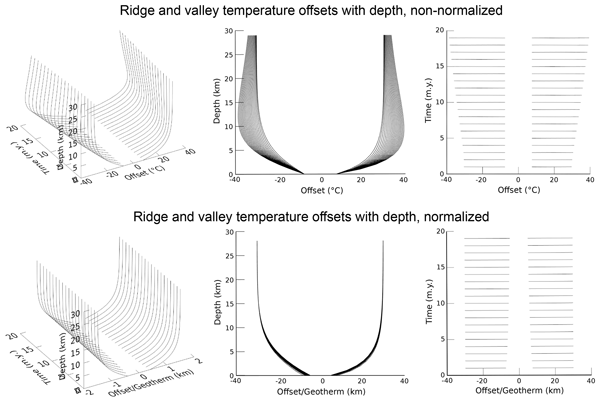
This technical note develops and demonstrates an improvement in how to calculate the temperatures experienced by rocks as they come from deep in the Earth to the surface due to erosion in mountainous regions that feature significant topographic relief. The solution is fast and flexible, and works even in areas where erosion rates have varied through time. The new method has been added to software used to interpret thermochronologic data to help discern the history of mountain ranges.
Murat T. Tamer, Ling Chung, Richard A. Ketcham, and Andrew J. W. Gleadow
Geochronology, 7, 45–58, https://doi.org/10.5194/gchron-7-45-2025, https://doi.org/10.5194/gchron-7-45-2025, 2025
Short summary
Short summary
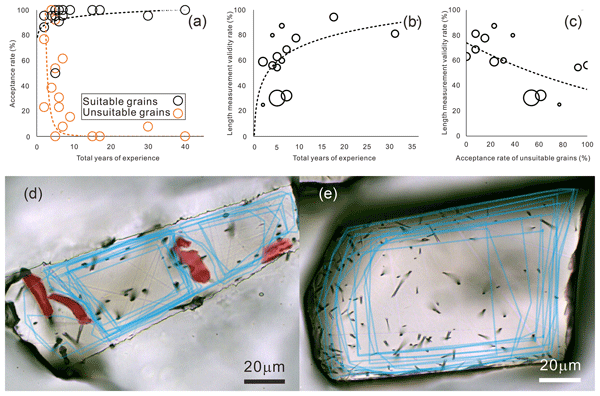
We present the first new image-based study to reveal how choices made by different analysts affect the results obtained by fission-track analysis. Participants analyzed an identical image dataset with varying grain quality. Experienced analysts tend to select lower numbers of unsuitable grains and conduct lower numbers of invalid length measurements. Fission-track studies need image data repositories, teaching modules, guidelines, an open science culture, and new approaches for calibration.
Andrea L. Stevens Goddard, Kendra E. Murray, Alyssa L. Abbey, and Mark Wildman
Geochronology Discuss., https://doi.org/10.5194/gchron-2024-20, https://doi.org/10.5194/gchron-2024-20, 2024
Manuscript not accepted for further review
Short summary
Short summary
We present a set of six standardized time-temperature histories, which we call benchmark paths, that can be used by the low-temperature thermochronology community to evaluate and visualize the sensitivity of thermochronologic systems to the variables inherent in the interpretation of thermochronologic data. As an example, we present a method for “tuning” each benchmark path to eleven published kinetics models (for the apatite (U-Th-Sm)/He, apatite fission-track, and zircon (U-Th)/He systems).
Alyssa J. McKanna, Isabel Koran, Blair Schoene, and Richard A. Ketcham
Geochronology, 5, 127–151, https://doi.org/10.5194/gchron-5-127-2023, https://doi.org/10.5194/gchron-5-127-2023, 2023
Short summary
Short summary
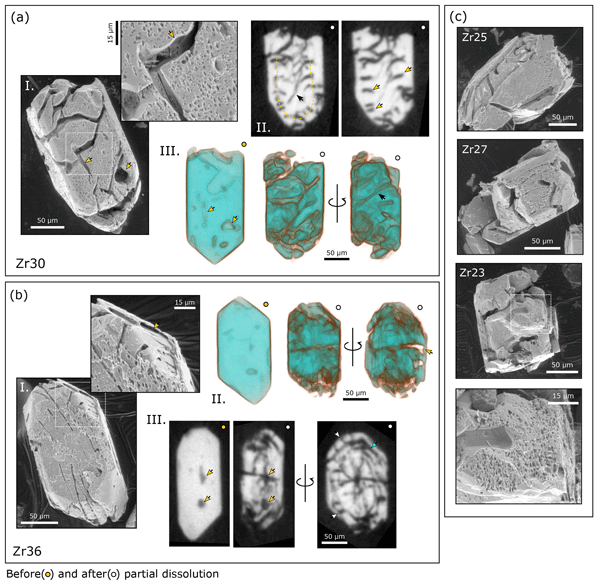
Acid leaching is commonly used to remove damaged portions of zircon crystals prior to U–Pb dating. However, a basic understanding of the microstructural processes that occur during leaching is lacking. We present the first 3D view of zircon dissolution based on X-ray computed tomography data acquired before and after acid leaching. These data are paired with images of etched grain surfaces and Raman spectral data. We also reveal exciting opportunities for imaging radiation damage zoning in 3D.
David M. Whipp, Dawn A. Kellett, Isabelle Coutand, and Richard A. Ketcham
Geochronology, 4, 143–152, https://doi.org/10.5194/gchron-4-143-2022, https://doi.org/10.5194/gchron-4-143-2022, 2022
Short summary
Short summary
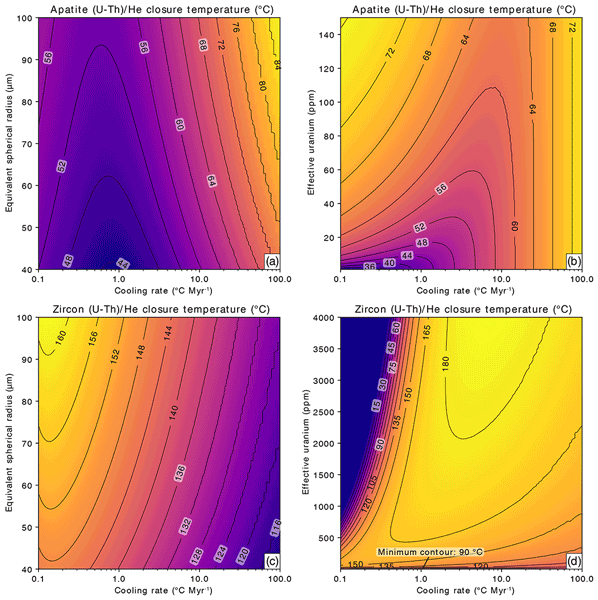
Multi-thermochronometry, in which methods such as (U-Th)/He dating of zircon and apatite and apatite fission track dating are combined, is used to reconstruct rock thermal histories. Our ability to reconstruct thermal histories and interpret the geological significance of measured ages requires modeling. Here we use forward models to explore effects of grain size and chemistry on cooling ages and closure temperatures for the (U-Th)/He decay systems in apatite and zircon.
Cited articles
Abbey, A. L., Wildman, M., Stevens Goddard, A. L., and Murray, K. E.: Thermal history modeling techniques and interpretation strategies: Applications using QTQt, Geosphere, 19, 493–530, https://doi.org/10.1130/GES02528.1, 2023.
Flowers, R. M., Ketcham, R. A., Shuster, D. L., and Farley, K. A.: Apatite
Flowers, R. M., Farley, K. A., and Ketcham, R. A.: Response to comment on “A reporting protocol for thermochronologic modeling illustrated with data from the Grand Canyon,” Earth Planet. Sci. Lett., 441, 213, https://doi.org/10.1016/j.epsl.2016.02.024, 2016.
Gallagher, K.: Transdimensional inverse thermal history modeling for quantitative thermochronology, J. Geophys. Res.-Sol. Ea., 117, 1–16, https://doi.org/10.1029/2011JB008825, 2012.
Gallagher, K.: Comment on `A reporting protocol for thermochronologic modeling illustrated with data from the Grand Canyon' by Flowers, Farley and Ketcham, Earth Planet. Sc. Lett., 441, 211–212, https://doi.org/10.1016/j.epsl.2016.02.021, 2016.
Gallagher, K. and Ketcham, R. A.: Comment on “Thermal history modelling: HeFTy vs. QTQt” by Vermeesch and Tian, Earth-Sci. Rev. (2014), 139, 279–290, Earth-Sci. Rev., 176, 387–394, https://doi.org/10.1016/j.earscirev.2017.11.001, 2018.
Gallagher, K. and Sambridge, M.: Genetic algorithms: A powerful tool for large-scale non-linear optimization problems, Comput. Geosci., 20, 1229–1236, https://doi.org/10.1016/0098-3004(94)90072-8, 1994.
Gautheron, C. and Zeitler, P. K.: Noble gases deliver cool dates from hot rocks, Elements, 16, 303–309, https://doi.org/10.2138/GSELEMENTS.16.5.303, 2020.
Gautheron, C., Tassan-Got, L., Barbarand, J., and Pagel, M.: Effect of alpha-damage annealing on apatite
Guenthner, W. R., Reiners, P. W., Ketcham, R. A., Nasdala, L., and Giester, G.: Helium diffusion in natural zircon: radiation damage, anisotropy, and the interpretation of zircon
Hestnes, Å., Gasser, D., Ketcham, R., Dunkl, I., Ksienzyk, A. K., Scheiber, T., Sirevaag, H., and Jacobs, J.: The Thermal Evolution of Western Norway Based on Multi-Sample Models of an Elevation Transect: Implications for the Formation of High-Elevation Low-Relief Surfaces on an Elevated Rifted Continental Margin, Geochem., Geophy., Geosy., 25, https://doi.org/10.1029/2023gc010986, 2024.
Ketcham, R.: Thermal history inversion from thermochronometric data and complementary information: New methods and recommended practices, Chem. Geol., 122042, https://doi.org/10.1016/j.chemgeo.2024.122042, 2024.
Ketcham, R. A.: Forward and Inverse Modeling of Low-Temperature Thermochronometry Data, Rev. Mineral. Geochem., 58, 275–314, https://doi.org/10.2138/rmg.2005.58.11, 2005.
Ketcham, R. A.: Replication Data for: “Technical note: Incorporating topographic deflection effects into thermal history modelling”, Texas Data Repository [data set], https://doi.org/10.18738/T8/EZ5AA0, 2025.
Ketcham, R. A., Donelick, R. A., and Donelick, M. B.: AFTSolve: A program for multi-kinetic modeling of apatite fission-track data, Geological Materials Research, 2, 1–32, 2000.
Lutz, T. M. and Omar, G.: An inverse method of modeling thermal histories from apatite fission-track data, Earth Planet. Sci. Lett., 104, 181–195, https://doi.org/10.1016/0012-821X(91)90203-T, 1991.
Mackaman-Lofland, C., Lossada, A. C., Fosdick, J. C., Litvak, V. D., Rodríguez, M. P., Llano, M. B. del, Ketcham, R. A., Stockli, D. F., Horton, B. K., Mescua, J., Suriano, J., and Giambiagi, L.: Unraveling the tectonic evolution of the Andean hinterland (Argentina and Chile, 30° S) using multi-sample thermal history models, Earth Planet. Sci. Lett., 643, 118888, https://doi.org/10.1016/j.epsl.2024.118888, 2024.
McDannell, K. T. and Flowers, R. M.: Vestiges of the ancient: Deep-time noble gas thermochronology, Elements, 16, 325–330, https://doi.org/10.2138/GSELEMENTS.16.5.325, 2020.
McDannell, K. T. and Issler, D. R.: Simulating sedimentary burial cycles – Part 1: Investigating the role of apatite fission track annealing kinetics using synthetic data, Geochronology, 3, 321–335, https://doi.org/10.5194/gchron-3-321-2021, 2021.
Murray, K. E., Goddard, A. L. S., Abbey, A. L., and Wildman, M.: Thermal history modeling techniques and interpretation strategies: Applications using HeFTy, Geosphere, 18, 1622–1642, https://doi.org/10.1130/GES02500.1, 2022a.
Murray, K. E., Niemi, N. A., and Clark, M. C.: Apatite and Zircon (U-Th)/He Thermochronometry Data from the Colorado Front Range, Boulder County, Colorado, USA, University of Michigan – Deep Blue Data [data set], https://doi.org/10.7302/g4eg-vr84, 2022b.
Murray, K. E., Niemi, N. A., and Clark, M. K.: Evidence for the Neoproterozoic Rifting of Rodinia in the Rocky Mountain Front Range, Tectonics, 44, https://doi.org/10.1029/2023tc008216, 2025.
Reiners, P. W.: Nonmonotonic thermal histories and contrasting kinetics of multiple thermochronometers, Geochim. Cosmochim. Ac., 73, 3612–3629, https://doi.org/10.1016/j.gca.2009.03.038, 2009.
Stevens Goddard, A. L., Fosdick, J. C., Calderón, M., Ghiglione, M. C., VanderLeest, R. A., and Romans, B. W.: Thermochronological Evidence for Eocene Deformation in the Southern Patagonian Andes: Linking Orogenesis Along the Patagonian Orocline, Tectonics, 42, https://doi.org/10.1029/2022TC007677, 2023.
Vermeesch, P. and Tian, Y.: Thermal history modelling: HeFTy vs. QTQt, Earth-Sci. Rev., 139, 279–290, https://doi.org/10.1016/j.earscirev.2014.09.010, 2014.
Willett, S. D.: Inverse Modeling of Annealing of Fission Tracks in Apatite; 1, A Controlled Random Search Method, Am. J. Sci., 297, 939–969, https://doi.org/10.2475/ajs.297.10.939, 1997.
Wolf, R. A., Farley, K. A., and Kass, D. M.: Modeling of the temperature sensitivity of the apatite
Zeitler, P. K.: Inversion of
Short summary
We demonstrate the ability and limitations of a new Controlled Random Search (CRS) algorithm in the thermal history modeling software HeFTy using synthetic and real datasets. We demonstrate the CRS returns solutions efficiently. However, in CRS results some solution clustering is common. We discuss not only how to identify CRS solution clustering but also how to leverage it to find solution families that can help one build a robust thermal history analysis of thermochronologic data.
We demonstrate the ability and limitations of a new Controlled Random Search (CRS) algorithm in...


Special issue