Articles | Volume 8, issue 1
https://doi.org/10.5194/gchron-8-85-2026
© Author(s) 2026. This work is distributed under
the Creative Commons Attribution 4.0 License.
https://doi.org/10.5194/gchron-8-85-2026
© Author(s) 2026. This work is distributed under
the Creative Commons Attribution 4.0 License.
Global and regional Pleistocene benthic δ18O stacks with a comparison of different age modeling strategies

Yuxin Zhou
School of Earth and Atmospheric Sciences, Georgia Institute of Technology, Atlanta, GA 30332, USA
Lorraine E. Lisiecki
CORRESPONDING AUTHOR
Department of Earth Science, University of California, Santa Barbara, Santa Barbara, CA 93106, USA
Stephen R. Meyers
Department of Geoscience, University of Wisconsin–Madison, Madison, WI 53706, USA
Taehee Lee
Department of Earth, Environmental and Planetary Sciences, Brown University, Providence, RI 02912, USA
Charles Lawrence
Division of Applied Mathematics, Brown University, Providence, RI 02912, USA
Related authors
No articles found.
Jennifer L. Middleton, Julia Gottschalk, Gisela Winckler, Jean Hanley, Carol Knudson, Jesse R. Farmer, Frank Lamy, Lorraine E. Lisiecki, and Expedition 383 Scientists
Geochronology, 6, 125–145, https://doi.org/10.5194/gchron-6-125-2024, https://doi.org/10.5194/gchron-6-125-2024, 2024
Short summary
Short summary
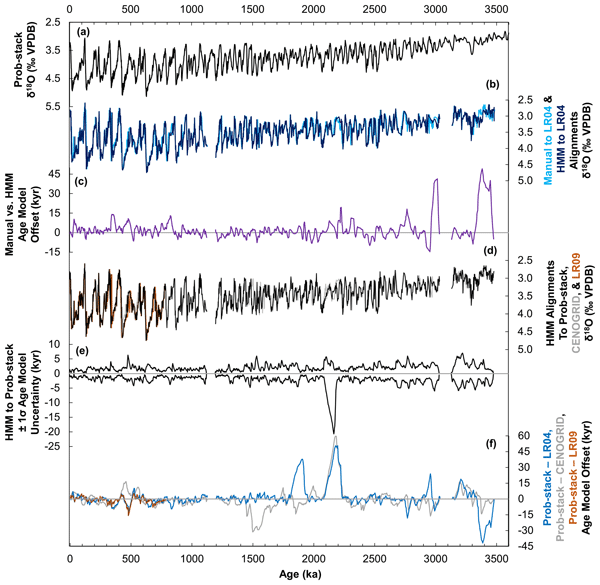
We present oxygen isotope data for a new sediment core from the South Pacific and assign ages to our record by aligning distinct patterns in observed oxygen isotope changes to independently dated target records with the same patterns. We examine the age uncertainties associated with this approach caused by human vs. automated alignment and the sensitivity of outcomes to the choice of alignment target. These efforts help us understand the timing of past climate changes.
Christen L. Bowman, Devin S. Rand, Lorraine E. Lisiecki, and Samantha C. Bova
Earth Syst. Sci. Data, 16, 701–713, https://doi.org/10.5194/essd-16-701-2024, https://doi.org/10.5194/essd-16-701-2024, 2024
Short summary
Short summary
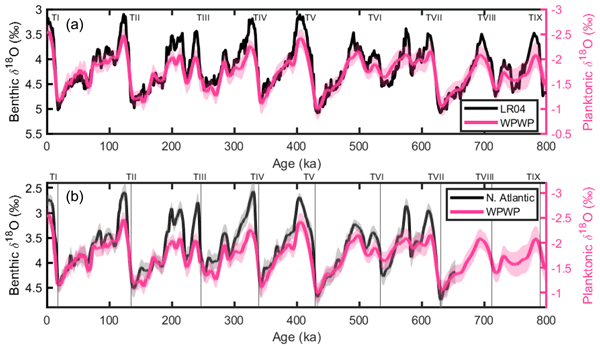
We estimate an average (stack) of Western Pacific Warm Pool (WPWP) sea surface climate records over the last 800 kyr from 10 ocean sediment cores. To better understand glacial–interglacial differences between the tropical WPWP and high-latitude climate change, we compare our WPWP stack to global and North Atlantic deep-ocean stacks. Although we see similar timing in glacial–interglacial change between the stacks, the WPWP exhibits less amplitude of change.
Taehee Lee, Devin Rand, Lorraine E. Lisiecki, Geoffrey Gebbie, and Charles Lawrence
Clim. Past, 19, 1993–2012, https://doi.org/10.5194/cp-19-1993-2023, https://doi.org/10.5194/cp-19-1993-2023, 2023
Short summary
Short summary
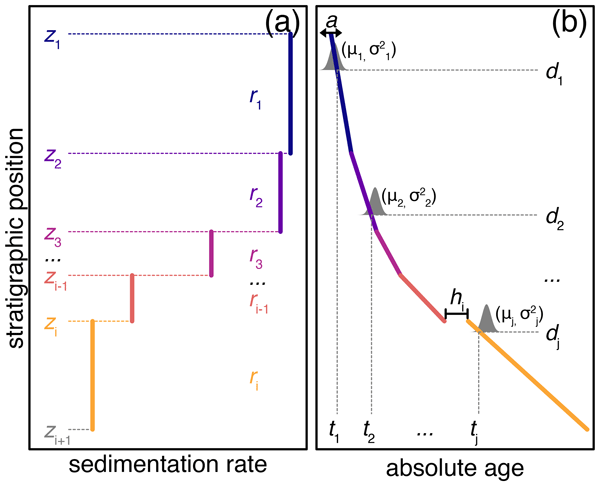
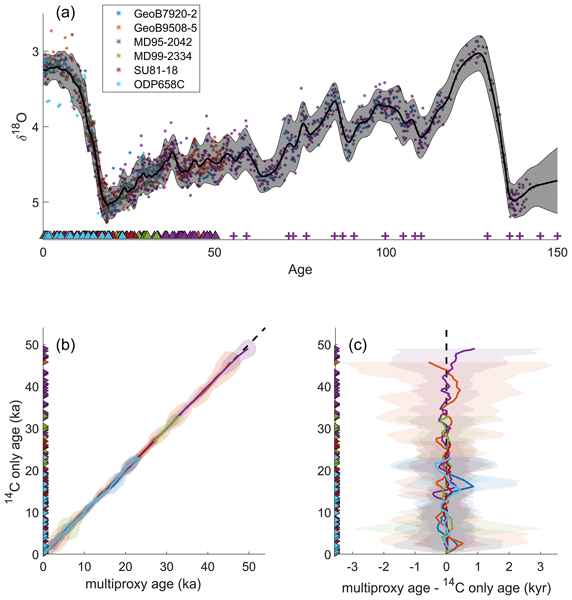
Understanding of past climate change depends, in part, on how accurately we can estimate the ages of events recorded in geologic archives. Here we present a new software package, called BIGMACS, to improve age estimates for paleoclimate data from ocean sediment cores. BIGMACS creates multiproxy age estimates that reduce age uncertainty by probabilistically combining information from direct age estimates, such as radiocarbon dates, and the alignment of regional paleoclimate time series.
Stefan Mulitza, Torsten Bickert, Helen C. Bostock, Cristiano M. Chiessi, Barbara Donner, Aline Govin, Naomi Harada, Enqing Huang, Heather Johnstone, Henning Kuhnert, Michael Langner, Frank Lamy, Lester Lembke-Jene, Lorraine Lisiecki, Jean Lynch-Stieglitz, Lars Max, Mahyar Mohtadi, Gesine Mollenhauer, Juan Muglia, Dirk Nürnberg, André Paul, Carsten Rühlemann, Janne Repschläger, Rajeev Saraswat, Andreas Schmittner, Elisabeth L. Sikes, Robert F. Spielhagen, and Ralf Tiedemann
Earth Syst. Sci. Data, 14, 2553–2611, https://doi.org/10.5194/essd-14-2553-2022, https://doi.org/10.5194/essd-14-2553-2022, 2022
Short summary
Short summary
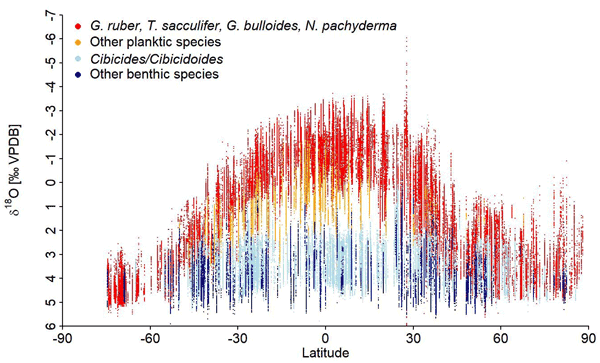
Stable isotope ratios of foraminiferal shells from deep-sea sediments preserve key information on the variability of ocean circulation and ice volume. We present the first global atlas of harmonized raw downcore oxygen and carbon isotope ratios of various planktonic and benthic foraminiferal species. The atlas is a foundation for the analyses of the history of Earth system components, for finding future coring sites, and for teaching marine stratigraphy and paleoceanography.
Shannon A. Bengtson, Laurie C. Menviel, Katrin J. Meissner, Lise Missiaen, Carlye D. Peterson, Lorraine E. Lisiecki, and Fortunat Joos
Clim. Past, 17, 507–528, https://doi.org/10.5194/cp-17-507-2021, https://doi.org/10.5194/cp-17-507-2021, 2021
Short summary
Short summary
The last interglacial was a warm period that may provide insights into future climates. Here, we compile and analyse stable carbon isotope data from the ocean during the last interglacial and compare it to the Holocene. The data show that Atlantic Ocean circulation was similar during the last interglacial and the Holocene. We also establish a difference in the mean oceanic carbon isotopic ratio between these periods, which was most likely caused by burial and weathering carbon fluxes.
Cited articles
Abe-Ouchi, A., Saito, F., Kawamura, K., Raymo, M. E., Okuno, J., Takahashi, K., and Blatter, H.: Insolation-driven 100,000-year glacial cycles and hysteresis of ice-sheet volume, Nature, 500, 190–193, https://doi.org/10.1038/nature12374, 2013.
Ahn, S., Khider, D., Lisiecki, L. E., and Lawrence, C. E.: A probabilistic Pliocene–Pleistocene stack of benthic δ18O using a profile hidden Markov model, Dynamics and Statistics of the Climate System, 2, https://doi.org/10.1093/climsys/dzx002, 2017.
Anderson, R. F., Barker, S., Fleisher, M., Gersonde, R., Steven, L., Kuhn, G., Mortyn, P. G., Pahnke, K., Julian, P., Anderson, R. F., Barker, S., Fleisher, M., Gersonde, R., Goldstein, S. L., Kuhn, G., Mortyn, P. G., Pahnke, K., and Sachs, J. P.: Biological response to millennial variability of dust and nutrient supply in the Subantarctic South Atlantic Ocean Biological response to millennial variability of dust and nutrient supply in the Subantarctic South Atlantic Ocean, Philosophical Transactions of the Royal Society A: Mathematical, Physical and Engineering Sciences, 372, https://doi.org/10.1098/rsta.2013.0054, 2014.
Barker, S., Lisiecki, L. E., Knorr, G., Nuber, S., and Tzedakis, P. C.: Distinct roles for precession, obliquity, and eccentricity in Pleistocene 100 kyr glacial cycles, Science, 387, eadp3491, https://doi.org/10.1126/science.adp3491, 2025.
Barnett, R. L., Austermann, J., Dyer, B., Telfer, M. W., Barlow, N. L. M., Boulton, S. J., Carr, A. S., and Creel, R. C.: Constraining the contribution of the Antarctic Ice Sheet to Last Interglacial sea level, Science Advances, 9, eadf0198, https://doi.org/10.1126/sciadv.adf0198, 2023.
Bazin, L., Landais, A., Lemieux-Dudon, B., Toyé Mahamadou Kele, H., Veres, D., Parrenin, F., Martinerie, P., Ritz, C., Capron, E., Lipenkov, V., Loutre, M.-F., Raynaud, D., Vinther, B., Svensson, A., Rasmussen, S. O., Severi, M., Blunier, T., Leuenberger, M., Fischer, H., Masson-Delmotte, V., Chappellaz, J., and Wolff, E.: An optimized multi-proxy, multi-site Antarctic ice and gas orbital chronology (AICC2012): 120–800 ka, Clim. Past, 9, 1715–1731, https://doi.org/10.5194/cp-9-1715-2013, 2013.
Berggren, W. A. and Van Couvering, J. A.: The late Neogene: biostratigraphy, geochronology, and paleoclimatology of the last 15 million years in marine and continental sequences, Elsevier, ISBN 978-0-444-41246-1, 2011.
Blaauw, M. and Christen, J. A.: Flexible paleoclimate age-depth models using an autoregressive gamma process, Bayesian Analysis, 6, 457–474, https://doi.org/10.1214/11-BA618, 2011.
Bond, G. C., Broecker, W. S., Johnsen, S. J., McManus, J. F., Labeyrie, L., Jouzel, J., and Bonani, G.: Correlations between climate records from North Atlantic sediments and Greenland ice, Nature, 365, 143–147, 1993.
Bouchet, M., Landais, A., Grisart, A., Parrenin, F., Prié, F., Jacob, R., Fourré, E., Capron, E., Raynaud, D., Lipenkov, V. Y., Loutre, M.-F., Extier, T., Svensson, A., Legrain, E., Martinerie, P., Leuenberger, M., Jiang, W., Ritterbusch, F., Lu, Z.-T., and Yang, G.-M.: The Antarctic Ice Core Chronology 2023 (AICC2023) chronological framework and associated timescale for the European Project for Ice Coring in Antarctica (EPICA) Dome C ice core, Clim. Past, 19, 2257–2286, https://doi.org/10.5194/cp-19-2257-2023, 2023.
Brüggemann, W.: A minimal cost function method for optimizing the age-Depth relation of deep-sea sediment cores, Paleoceanography, 7, 467–487, https://doi.org/10.1029/92PA01235, 1992.
Caballero-Gill, R. P., Clemens, S. C., and Prell, W. L.: Direct correlation of Chinese speleothem δ18O and South China Sea planktonic δ18O: Transferring a speleothem chronology to the benthic marine chronology, Paleoceanography, 27, https://doi.org/10.1029/2011PA002268, 2012.
Caballero-Gill, R. P., Herbert, T. D., and Dowsett, H. J.: 100 kyr Paced Climate Change in the Pliocene Warm Period, Southwest Pacific, Paleoceanography and Paleoclimatology, 34, 524–545, https://doi.org/10.1029/2018PA003496, 2019.
Cartapanis, O., Bianchi, D., Jaccard, S. L., and Galbraith, E. D.: Global pulses of organic carbon burial in deep-sea sediments during glacial maxima, Nat. Commun., 7, 10796, https://doi.org/10.1038/ncomms10796, 2016.
Cartapanis, O., Galbraith, E. D., Bianchi, D., and Jaccard, S. L.: Carbon burial in deep-sea sediment and implications for oceanic inventories of carbon and alkalinity over the last glacial cycle, Clim. Past, 14, 1819–1850, https://doi.org/10.5194/cp-14-1819-2018, 2018.
Channell, J. E. T.: Geomagnetic paleointensity and directional secular variation at Ocean Drilling Program (ODP) Site 984 (Bjorn Drift) since 500 ka: Comparisons with ODP Site 983 (Gardar Drift), Journal of Geophysical Research: Solid Earth, 104, 22937–22951, https://doi.org/10.1029/1999JB900223, 1999.
Channell, J. E. T., Hodell, D. A., and Lehman, B.: Relative geomagnetic paleointensity and δ18O at ODP Site 983 (Gardar Drift, North Atlantic) since 350 ka, Earth and Planetary Science Letters, 153, 103–118, https://doi.org/10.1016/S0012-821X(97)00164-7, 1997.
Channell, J. E. T., Singer, B. S., and Jicha, B. R.: Timing of Quaternary geomagnetic reversals and excursions in volcanic and sedimentary archives, Quaternary Science Reviews, 228, 106114, https://doi.org/10.1016/j.quascirev.2019.106114, 2020.
Cheng, H., Edwards, R. L., Sinha, A., Spötl, C., Yi, L., Chen, S., Kelly, M., Kathayat, G., Wang, X., Li, X., Kong, X., Wang, Y., Ning, Y., and Zhang, H.: The Asian monsoon over the past 640,000 years and ice age terminations, Nature, 534, 640–646, https://doi.org/10.1038/nature18591, 2016.
Costa, K. M., Hayes, C. T., Anderson, R. F., Pavia, F. J., Bausch, A., Deng, F., Dutay, J., Geibert, W., Heinze, C., Henderson, G., Hillaire-Marcel, C., Hoffmann, S., Jaccard, S. L., Jacobel, A. W., Kienast, S. S., Kipp, L., Lerner, P., Lippold, J., Lund, D., Marcantonio, F., McGee, D., McManus, J. F., Mekik, F., Middleton, J. L., Missiaen, L., Not, C., Pichat, S., Robinson, L. F., Rowland, G. H., Roy-Barman, M., Tagliabue, A., Torfstein, A., Winckler, G., and Zhou, Y.: 230Th Normalization: New Insights on an Essential Tool for Quantifying Sedimentary Fluxes in the Modern and Quaternary Ocean, Paleoceanography and Paleoclimatology, 35, https://doi.org/10.1029/2019PA003820, 2020.
Davies, S. M., Abbott, P. M., Meara, R. H., Pearce, N. J. G., Austin, W. E. N., Chapman, M. R., Svensson, A., Bigler, M., Rasmussen, T. L., Rasmussen, S. O., and Farmer, E. J.: A North Atlantic tephrostratigraphical framework for 130–60 ka b2k: new tephra discoveries, marine-based correlations, and future challenges, Quaternary Science Reviews, 106, 101–121, https://doi.org/10.1016/j.quascirev.2014.03.024, 2014.
Deino, A. L., Kingston, J. D., Glen, J. M., Edgar, R. K., and Hill, A.: Precessional forcing of lacustrine sedimentation in the late Cenozoic Chemeron Basin, Central Kenya Rift, and calibration of the Gauss/Matuyama boundary, Earth and Planetary Science Letters, 247, 41–60, https://doi.org/10.1016/j.epsl.2006.04.009, 2006.
Drysdale, R. N., Hellstrom, J. C., Zanchetta, G., Fallick, A. E., Goñi, M. F. S., Couchoud, I., McDonald, J., Maas, R., Lohmann, G., and Isola, I.: Evidence for obliquity forcing of glacial termination II, Science, 325, 1527–1531, https://doi.org/10.1126/science.1170371, 2009.
Dumitru, O. A., Dyer, B., Austermann, J., Sandstrom, M. R., Goldstein, S. L., D'Andrea, W. J., Cashman, M., Creel, R., Bolge, L., and Raymo, M. E.: Last interglacial global mean sea level from high-precision U-series ages of Bahamian fossil coral reefs, Quaternary Science Reviews, 318, 108287, https://doi.org/10.1016/j.quascirev.2023.108287, 2023.
Engel, J. and Pickering, R.: The role of inherited Pb in controlling the quality of speleothem U-Pb ages, Quaternary Geochronology, 67, 101243, https://doi.org/10.1016/j.quageo.2021.101243, 2022.
EPICA Community Members: Eight glacial cycles from an Antarctic ice core, Nature, 429, 623–628, https://doi.org/10.1038/nature02599, 2004.
Gebbie, G.: Tracer transport timescales and the observed Atlantic-Pacific lag in the timing of the Last Termination, Paleoceanography, 27, https://doi.org/10.1029/2011PA002273, 2012.
Govin, A., Michel, E., Labeyrie, L., Waelbroeck, C., Dewilde, F., and Jansen, E.: Evidence for northward expansion of Antarctic Bottom Water mass in the Southern Ocean during the last glacial inception, Paleoceanography, 24, https://doi.org/10.1029/2008PA001603, 2009.
Govin, A., Braconnot, P., Capron, E., Cortijo, E., Duplessy, J.-C., Jansen, E., Labeyrie, L., Landais, A., Marti, O., Michel, E., Mosquet, E., Risebrobakken, B., Swingedouw, D., and Waelbroeck, C.: Persistent influence of ice sheet melting on high northern latitude climate during the early Last Interglacial, Clim. Past, 8, 483–507, https://doi.org/10.5194/cp-8-483-2012, 2012.
Govin, A., Capron, E., Tzedakis, P. C., Verheyden, S., Ghaleb, B., Hillaire-Marcel, C., St-Onge, G., Stoner, J. S., Bassinot, F., Bazin, L., Blunier, T., Combourieu-Nebout, N., El Ouahabi, A., Genty, D., Gersonde, R., Jimenez-Amat, P., Landais, A., Martrat, B., Masson-Delmotte, V., Parrenin, F., Seidenkrantz, M.-S., Veres, D., Waelbroeck, C., and Zahn, R.: Sequence of events from the onset to the demise of the Last Interglacial: Evaluating strengths and limitations of chronologies used in climatic archives, Quaternary Science Reviews, 129, 1–36, https://doi.org/10.1016/j.quascirev.2015.09.018, 2015.
Heaton, T. J., Köhler, P., Butzin, M., Bard, E., Reimer, R. W., Austin, W. E. N., Bronk Ramsey, C., Grootes, P. M., Hughen, K. A., Kromer, B., Reimer, P. J., Adkins, J., Burke, A., Cook, M. S., Olsen, J., and Skinner, L. C.: Marine20—The Marine Radiocarbon Age Calibration Curve (0–55,000 cal BP), Radiocarbon, 62, 779–820, https://doi.org/10.1017/RDC.2020.68, 2020.
Herrero-Bervera, E. and Jicha, B. R.: New 40Ar/39Ar age of the full vector Upper Mammoth geomagnetic polarity transition recorded in the Pu'u Kualakauila volcanic sequence, Hawaii, Physics of the Earth and Planetary Interiors, 331, 106915, https://doi.org/10.1016/j.pepi.2022.106915, 2022.
Hilgen, F. J., Hinnov, L. A., Abdul Aziz, H., Abels, H. A., Batenburg, S., Bosmans, J. H. C., De Boer, B., Hüsing, S. K., Kuiper, K. F., Lourens, L. J., Rivera, T., Tuenter, E., Van De Wal, R. S. W., Wotzlaw, J.-F., and Zeeden, C.: Stratigraphic continuity and fragmentary sedimentation: the success of cyclostratigraphy as part of integrated stratigraphy, SP, 404, 157–197, https://doi.org/10.1144/SP404.12, 2015.
Hobart, B., Lisiecki, L. E., Rand, D., Lee, T., and Lawrence, C. E.: Late Pleistocene 100 kyr glacial cycles paced by precession forcing of summer insolation, Nat. Geosci., 1–6, https://doi.org/10.1038/s41561-023-01235-x, 2023.
Hughen, K. A. and Heaton, T. J.: Updated Cariaco Basin 14C Calibration Dataset from 0–60 cal kyr BP, Radiocarbon, 62, 1001–1043, https://doi.org/10.1017/RDC.2020.53, 2020.
Huybers, P. and Wunsch, C.: A depth-derived Pleistocene age model: Uncertainty estimates, sedimentation variability, and nonlinear climate change, Paleoceanography, 19, https://doi.org/10.1029/2002PA000857, 2004.
Huybers, P. and Wunsch, C.: Obliquity pacing of the late Pleistocene glacial terminations, Nature, 434, 491–494, https://doi.org/10.1038/nature03401, 2005.
Imbrie, J. and Imbrie, J. Z.: Modeling the Climatic Response to Orbital Variations, Science, 207, 943–953, https://doi.org/10.1126/science.207.4434.943, 1980.
Jouzel, J., Masson-Delmotte, V., Cattani, O., Dreyfus, G., Falourd, S., Hoffmann, G., Minster, B., Nouet, J., Barnola, J. M., Chappellaz, J., Fischer, H., Gallet, J. C., Johnsen, S., Leuenberger, M., Loulergue, L., Luethi, D., Oerter, H., Parrenin, F., Raisbeck, G., Raynaud, D., Schilt, A., Schwander, J., Selmo, E., Souchez, R., Spahni, R., Stauffer, B., Steffensen, J. P., Stenni, B., Stocker, T. F., Tison, J. L., Werner, M., and Wolff, E. W.: Orbital and Millennial Antarctic Climate Variability over the Past 800,000 Years, Science, 317, 793–796, https://doi.org/10.1126/science.1141038, 2007.
Kemp, D. B.: Optimizing significance testing of astronomical forcing in cyclostratigraphy, Paleoceanography, 31, 1516–1531, https://doi.org/10.1002/2016PA002963, 2016.
Kienast, S. S., Winckler, G., Lippold, J., Albani, S., and Mahowald, N. M.: Tracing dust input to the global ocean using thorium isotopes in marine sediments: ThoroMap, Global Biogeochemical Cycles, 30, 1526–1541, https://doi.org/10.1002/2016GB005408, 2016.
Lam, A. R., Crundwell, M. P., Leckie, R. M., Albanese, J., and Uzel, J. P.: Diachroneity Rules the Mid-Latitudes: A Test Case Using Late Neogene Planktic Foraminifera across the Western Pacific, Geosciences, 12, https://doi.org/10.3390/geosciences12050190, 2022.
Lamy, F., Kaiser, J., Ninnemann, U., Hebbeln, D., Arz, H. W., and Stoner, J.: Antarctic Timing of Surface Water Changes off Chile and Patagonian Ice Sheet Response, Science, 304, 1959–1962, https://doi.org/10.1126/science.1097863, 2004.
Laskar, J., Robutel, P., Joutel, F., Gastineau, M., Correia, A. C. M., and Levrard, B.: A long-term numerical solution for the insolation quantities of the Earth, A&A, 428, 261–285, https://doi.org/10.1051/0004-6361:20041335, 2004.
Laskar, J., Fienga, A., Gastineau, M., and Manche, H.: La2010: a new orbital solution for the long-term motion of the Earth, A&A, 532, A89, https://doi.org/10.1051/0004-6361/201116836, 2011.
Lee, T., Rand, D., Lisiecki, L. E., Gebbie, G., and Lawrence, C.: Bayesian age models and stacks: combining age inferences from radiocarbon and benthic δ18O stratigraphic alignment, Clim. Past, 19, 1993–2012, https://doi.org/10.5194/cp-19-1993-2023, 2023.
Li, M., Hinnov, L., and Kump, L.: Acycle: Time-series analysis software for paleoclimate research and education, Computers and Geosciences, 127, 12–22, https://doi.org/10.1016/j.cageo.2019.02.011, 2019.
Lin, L., Khider, D., Lisiecki, L. E., and Lawrence, C. E.: Probabilistic sequence alignment of stratigraphic records, Paleoceanography, 29, 976–989, https://doi.org/10.1002/2014PA002713, 2014.
Lisiecki, L. E.: Links between eccentricity forcing and the 100,000-year glacial cycle, Nature Geosci., 3, 349–352, https://doi.org/10.1038/ngeo828, 2010.
Lisiecki, L. E. and Raymo, M. E.: A Pliocene-Pleistocene stack of 57 globally distributed benthic δ18O records, Paleoceanography, 20, 1–17, https://doi.org/10.1029/2004PA001071, 2005.
Lisiecki, L. E. and Raymo, M. E.: Plio–Pleistocene climate evolution: trends and transitions in glacial cycle dynamics, Quaternary Science Reviews, 26, 56–69, https://doi.org/10.1016/j.quascirev.2006.09.005, 2007.
Lisiecki, L. E. and Raymo, M. E.: Diachronous benthic δ18O responses during late Pleistocene terminations, Paleoceanography, 24, https://doi.org/10.1029/2009PA001732, 2009.
Lisiecki, L. E. and Stern, J. V.: Regional and global benthic δ18O stacks for the last glacial cycle, Paleoceanography, 31, 1368–1394, https://doi.org/10.1002/2016PA003002, 2016.
Lowe, D. J.: Tephrochronology and its application: A review, Quaternary Geochronology, 6, 107–153, https://doi.org/10.1016/j.quageo.2010.08.003, 2011.
Lund, D. C., Tessin, A. C., Hoffman, J. L., and Schmittner, A.: Southwest Atlantic water mass evolution during the last deglaciation, Paleoceanography, 30, 477–494, https://doi.org/10.1002/2014PA002657, 2015.
Ma, P., Ma, C., Yang, S., and Fernandez, A. R.: East Asian summer monsoon evolution recorded by the middle Miocene pelagic reddish clay, South China Sea, Global and Planetary Change, 222, 104072, https://doi.org/10.1016/j.gloplacha.2023.104072, 2023.
Malinverno, A., Erba, E., and Herbert, T. D.: Orbital tuning as an inverse problem: Chronology of the early Aptian oceanic anoxic event 1a (Selli Level) in the Cismon APTICORE, Paleoceanography, 25, https://doi.org/10.1029/2009PA001769, 2010.
Martínez-Garcia, A., Rosell-Melé, A., McClymont, E. L., Gersonde, R., and Haug, G. H.: Subpolar link to the emergence of the modern equatorial Pacific cold tongue, Science, 328, 1550–1553, 2010.
Martinson, D. G., Menke, W., and Stoffa, P.: An inverse approach to signal correlation, Journal of Geophysical Research: Solid Earth, 87, 4807–4818, https://doi.org/10.1029/JB087iB06p04807, 1982.
Martrat, B., Grimalt, J. O., Shackleton, N. J., de Abreu, L., Hutterli, M. A., and Stocker, T. F.: Four Climate Cycles of Recurring Deep and Surface Water Destabilizations on the Iberian Margin, Science, 317, 502–507, https://doi.org/10.1126/science.1139994, 2007.
McManus, J. F., Anderson, R. F., Broecker, W. S., Fleisher, M. Q., and Higgins, S. M.: Radiometrically determined sedimentary fluxes in the sub-polar North Atlantic during the last 140,000 years, Earth and Planetary Science Letters, 155, 29–43, https://doi.org/10.1016/S0012-821X(97)00201-X, 1998.
Meyers, S. R.: The evaluation of eccentricity-related amplitude modulation and bundling in paleoclimate data: An inverse approach for astrochronologic testing and time scale optimization, Paleoceanography, 30, 1625–1640, https://doi.org/10.1002/2015PA002850, 2015.
Meyers, S. R.: Cyclostratigraphy and the problem of astrochronologic testing, Earth-Science Reviews, 190, 190–223, https://doi.org/10.1016/j.earscirev.2018.11.015, 2019.
NEEM community members: Eemian interglacial reconstructed from a Greenland folded ice core, Nature, 493, 489–494, https://doi.org/10.1038/nature11789, 2013.
Ogg, J. G.: Geomagnetic Polarity Time Scale, in: Geologic Time Scale 2020, Elsevier, 159–192, https://doi.org/10.1016/B978-0-12-824360-2.00005-X, 2020.
Opdyke, N. D. and Channell, J.: Magnetic stratigraphy, Academic Press, San Diego, 346 pp., ISBN 978-0-12-527470-8, 1996.
Pälike, H. and Kotov, S.: QAnalySeries/QAnalySeriesWASM: v1.0.0, Zenodo [code], https://doi.org/10.5281/zenodo.10892347, 2024.
Patterson, M. O., McKay, R., Naish, T., Escutia, C., Jimenez-Espejo, F., Raymo, M., Meyers, S., Tauxe, L., and Brinkhuis, H.: Orbital forcing of the East Antarctic ice sheet during the Pliocene and Early Pleistocene, Nature Geoscience, 7, 841–847, 2014.
Railsback, L. B., Gibbard, P. L., Head, M. J., Voarintsoa, N. R. G., and Toucanne, S.: An optimized scheme of lettered marine isotope substages for the last 1.0 million years, and the climatostratigraphic nature of isotope stages and substages, Quaternary Science Reviews, 111, 94–106, https://doi.org/10.1016/j.quascirev.2015.01.012, 2015.
Rand, D., Lisiecki, L. E., Lee, T., Lawrence, C. W., and Gebbie, G.: Quantifying Benthic δ18O Lags Across Termination 1: A Probabilistic Approach Based on Radiocarbon and Benthic δ18O Chronologies, Geochemistry, Geophysics, Geosystems, 25, e2023GC011068, https://doi.org/10.1029/2023GC011068, 2024.
Rand, D. S.: Ocean Sediment Core Age Models, Stacks, and Benthic Foraminiferal δ18O Lags, University of California, Santa Barbara, United States — California, ProQuest ID: Rand_ucsb_0035D_16187, Merritt ID: ark:/13030/m51949ts, https://escholarship.org/uc/item/11m6q1vn (last access: 29 January 2026), 2023.
Raymo, M. E., Lisiecki, L. E., and Nisancioglu, K. H.: Plio-Pleistocene Ice Volume, Antarctic Climate, and the Global δ18O Record, Science, 313, 492–495, https://doi.org/10.1126/science.1123296, 2006.
Renaudie, J., Lazarus, D. B., and Diver, P.: NSB (Neptune Sandbox Berlin): An expanded and improved database of marine planktonic microfossil data and deep-sea stratigraphy, Palaeontol. Electron., 23, 1–28, https://doi.org/10.26879/1032, 2020.
Rohling, E. J., Grant, K., Bolshaw, M., Roberts, A. P., Siddall, M., Hemleben, C., and Kucera, M.: Antarctic temperature and global sea level closely coupled over the past five glacial cycles, Nature Geosci., 2, 500–504, https://doi.org/10.1038/ngeo557, 2009.
Schimmelmann, A., Hendy, I. L., Dunn, L., Pak, D. K., and Lange, C. B.: Revised ∼ 2000-year chronostratigraphy of partially varved marine sediment in Santa Barbara Basin, California, GFF, 135, 258–264, https://doi.org/10.1080/11035897.2013.773066, 2013.
Shackleton, N. J.: The deep-sea sediment record and the Pliocene-Pleistocene boundary, Quaternary International, 40, 33–35, https://doi.org/10.1016/S1040-6182(96)00058-4, 1997.
Shackleton, N. J. and Opdyke, N. D.: Oxygen isotope and palaeomagnetic stratigraphy of Equatorial Pacific core V28-238: Oxygen isotope temperatures and ice volumes on a 105 year and 106 year scale, Quaternary Research, 3, 39–55, https://doi.org/10.1016/0033-5894(73)90052-5, 1973.
Shakun, J. D., Raymo, M. E., and Lea, D. W.: An early Pleistocene Mg/Ca-δ18O record from the Gulf of Mexico: Evaluating ice sheet size and pacing in the 41 kyr world, Paleoceanography, 31, 1011–1027, https://doi.org/10.1002/2016PA002956, 2016.
Singer, B. S.: A Quaternary geomagnetic instability time scale, Quaternary Geochronology, 21, 29–52, https://doi.org/10.1016/j.quageo.2013.10.003, 2014.
Sinnesael, M., De Vleeschouwer, D., Zeeden, C., Batenburg, S. J., Da Silva, A.-C., de Winter, N. J., Dinarès-Turell, J., Drury, A. J., Gambacorta, G., Hilgen, F. J., Hinnov, L. A., Hudson, A. J. L., Kemp, D. B., Lantink, M. L., Laurin, J., Li, M., Liebrand, D., Ma, C., Meyers, S. R., Monkenbusch, J., Montanari, A., Nohl, T., Pälike, H., Pas, D., Ruhl, M., Thibault, N., Vahlenkamp, M., Valero, L., Wouters, S., Wu, H., and Claeys, P.: The Cyclostratigraphy Intercomparison Project (CIP): consistency, merits and pitfalls, Earth-Science Reviews, 199, 102965, https://doi.org/10.1016/j.earscirev.2019.102965, 2019.
Skinner, L. C. and Shackleton, N. J.: An Atlantic lead over Pacific deep-water change across Termination I: implications for the application of the marine isotope stage stratigraphy, Quaternary Science Reviews, 24, 571–580, https://doi.org/10.1016/j.quascirev.2004.11.008, 2005.
Stern, J. V. and Lisiecki, L. E.: Termination 1 timing in radiocarbon-dated regional benthic δ18O stacks: Regional benthic δ18O stacks, Paleoceanography, 29, 1127–1142, https://doi.org/10.1002/2014PA002700, 2014.
Stoner, J. S., Channell, J. E. T., Hodell, D. A., and Charles, C. D.: A ∼ 580 kyr paleomagnetic record from the sub-Antarctic South Atlantic (Ocean Drilling Program Site 1089), Journal of Geophysical Research: Solid Earth, 108, https://doi.org/10.1029/2001JB001390, 2003.
Tiedemann, R. and Haug, G. H.: Astronomical calibration of cycle stratigraphy for Site 882 in the northwest Pacificm in: Proceedings Ocean Drilling Program Scientific Results, edited by: Rea, D. K., Basov, I. A., Scholl, D. W., and Allen, J. F., 145, 283–292, https://doi.org/10.2973/odp.proc.sr.145.124.1995. 1995
Vaughan, S., Bailey, R. J., and Smith, D. G.: Detecting cycles in stratigraphic data: Spectral analysis in the presence of red noise, Paleoceanography, 26, https://doi.org/10.1029/2011PA002195, 2011.
Velde, B.: Compaction trends of clay-rich deep sea sediments, Marine Geology, 133, 193–201, https://doi.org/10.1016/0025-3227(96)00020-5, 1996.
Walczak, M. H., Mix, A. C., Cowan, E. A., Fallon, S., Fifield, L. K., Alder, J. R., Du, J., Haley, B., Hobern, T., Padman, J., Praetorius, S. K., Schmittner, A., Stoner, J. S., and Zellers, S. D.: Phasing of millennial-scale climate variability in the Pacific and Atlantic Oceans, Science, eaba7096, https://doi.org/10.1126/science.aba7096, 2020.
Waltham, D.: Milankovitch Period Uncertainties and Their Impact On Cyclostratigraphy, Journal of Sedimentary Research, 85, 990–998, https://doi.org/10.2110/jsr.2015.66, 2015.
Westerhold, T., Röhl, U., Laskar, J., Raffi, I., Bowles, J., Lourens, L. J., and Zachos, J. C.: On the duration of magnetochrons C24r and C25n and the timing of early Eocene global warming events: Implications from the Ocean Drilling Program Leg 208 Walvis Ridge depth transect, Paleoceanography, 22, https://doi.org/10.1029/2006PA001322, 2007.
Wilkens, R. H., Westerhold, T., Drury, A. J., Lyle, M., Gorgas, T., and Tian, J.: Revisiting the Ceara Rise, equatorial Atlantic Ocean: isotope stratigraphy of ODP Leg 154 from 0 to 5 Ma, Clim. Past, 13, 779–793, https://doi.org/10.5194/cp-13-779-2017, 2017.
Williams, C. K. and Rasmussen, C. E.: Gaussian processes for machine learning, MIT press Cambridge, MA, https://doi.org/10.7551/mitpress/3206.001.0001, 2005.
Woodhead, J. and Pickering, R.: Beyond 500 ka: Progress and prospects in the U Pb chronology of speleothems, and their application to studies in palaeoclimate, human evolution, biodiversity and tectonics, Chemical Geology, 322–323, 290–299, https://doi.org/10.1016/j.chemgeo.2012.06.017, 2012.
Zeebe, R. E. and Lourens, L. J.: A Deep-Time Dating Tool for Paleo-Applications Utilizing Obliquity and Precession Cycles: The Role of Dynamical Ellipticity and Tidal Dissipation, Paleoceanography and Paleoclimatology, 37, e2021PA004349, https://doi.org/10.1029/2021PA004349, 2022a.
Zeebe, R. E. and Lourens, L. J.: Geologically constrained astronomical solutions for the Cenozoic era, Earth and Planetary Science Letters, 592, 117595, https://doi.org/10.1016/j.epsl.2022.117595, 2022b.
Zeeden, C., Hilgen, F. J., Hüsing, S. K., and Lourens, L. L.: The Miocene astronomical time scale 9–12 Ma: New constraints on tidal dissipation and their implications for paleoclimatic investigations, Paleoceanography, 29, 296–307, https://doi.org/10.1002/2014PA002615, 2014.
Zhou, Y., Lisiecki, L. E., Lee, T., Gebbie, G., and Lawrence, C.: Regional Benthic δ18O Stacks for the “41-Kyr World” – An Atlantic-Pacific Divergence Between 1.8 and 1.9 Ma, Geophysical Research Letters, 51, e2023GL107858, https://doi.org/10.1029/2023GL107858, 2024.
Zhou, Y., Lisiecki, L., Meyers, S., Lee, T., and Lawrence, C.: Supporting information for “Global and regional Pleistocene benthic δ18O stacks on age models with and without astronomical tuning”, Zenodo [data set], https://doi.org/10.5281/zenodo.18248651, 2026.
Zimmerman, C. C., Wagner, T. J. W., Maroon, E. A., and McNamara, D. E.: Slowed Response of Atlantic Meridional Overturning Circulation Not a Robust Signal of Collapse, Geophysical Research Letters, 52, e2024GL112415, https://doi.org/10.1029/2024GL112415, 2025.
Short summary
Marine sediments contain valuable information about past climate changes. However, dating Pleistocene marine sediments can be difficult, and the accuracy of the age model depends on the quality of the stratigraphic alignment target. We introduce three targets – Atlantic, Pacific, and global – with three distinct chronologies for the global target that incorporate astronomical forcing constraints to various degrees. This suite of targets offers flexibility in age model construction.
Marine sediments contain valuable information about past climate changes. However, dating...