Articles | Volume 7, issue 1
https://doi.org/10.5194/gchron-7-113-2025
© Author(s) 2025. This work is distributed under
the Creative Commons Attribution 4.0 License.
https://doi.org/10.5194/gchron-7-113-2025
© Author(s) 2025. This work is distributed under
the Creative Commons Attribution 4.0 License.
Short communication: Updated CRN Denudation collections in OCTOPUS v2.3
Alexandru T. Codilean
CORRESPONDING AUTHOR
School of Science, University of Wollongong, Wollongong, NSW 2522, Australia
Henry Munack
School of Science, University of Wollongong, Wollongong, NSW 2522, Australia
Related authors
Christopher T. Halsted, Paul R. Bierman, Alexandru T. Codilean, Lee B. Corbett, and Marc W. Caffee
Geochronology, 7, 213–228, https://doi.org/10.5194/gchron-7-213-2025, https://doi.org/10.5194/gchron-7-213-2025, 2025
Short summary
Short summary
Sediment generation on hillslopes and transport through river networks are complex processes that influence landscape evolution. In this study, we compiled sand from 766 river basins and measured its subtle radioactivity to unravel timelines of sediment routing around the world. With these data, we empirically confirm that sediment from large lowland basins in tectonically stable regions typically experiences long periods of burial, while sediment moves rapidly through small upland basins.
Emma Rehn, Haidee Cadd, Scott Mooney, Tim J. Cohen, Henry Munack, Alexandru T. Codilean, Matthew Adeleye, Kristen K. Beck, Mark Constantine IV, Chris Gouramanis, Johanna M. Hanson, Penelope J. Jones, A. Peter Kershaw, Lydia Mackenzie, Maame Maisie, Michela Mariani, Kia Matley, David McWethy, Keely Mills, Patrick Moss, Nicholas R. Patton, Cassandra Rowe, Janelle Stevenson, John Tibby, and Janet Wilmshurst
Earth Syst. Sci. Data, 17, 2681–2692, https://doi.org/10.5194/essd-17-2681-2025, https://doi.org/10.5194/essd-17-2681-2025, 2025
Short summary
Short summary
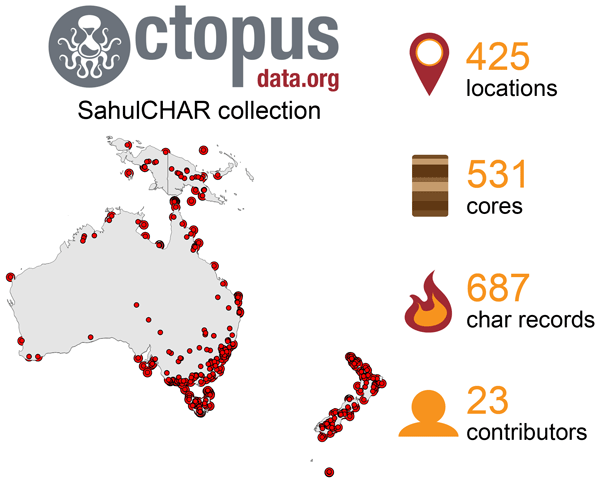
This paper presents SahulCHAR, a new collection of palaeofire (ancient fire) records from Australia, New Guinea, and New Zealand. SahulCHAR version 1 contains 687 records of sedimentary charcoal or black carbon, including digitized data, records from existing databases, and original author-submitted data. SahulCHAR is a much-needed update to past charcoal compilations that will also provide greater representation of records from this region in future global syntheses to understand past fire.
Alexandru T. Codilean, Henry Munack, Wanchese M. Saktura, Tim J. Cohen, Zenobia Jacobs, Sean Ulm, Paul P. Hesse, Jakob Heyman, Katharina J. Peters, Alan N. Williams, Rosaria B. K. Saktura, Xue Rui, Kai Chishiro-Dennelly, and Adhish Panta
Earth Syst. Sci. Data, 14, 3695–3713, https://doi.org/10.5194/essd-14-3695-2022, https://doi.org/10.5194/essd-14-3695-2022, 2022
Short summary
Short summary
OCTOPUS v.2 is a web-enabled database that allows users to visualise, query, and download cosmogenic radionuclide, luminescence, and radiocarbon ages and denudation rates associated with erosional landscapes, Quaternary depositional landforms, and archaeological records, along with ancillary geospatial data layers. OCTOPUS v.2 hosts five major data collections. Supporting data are comprehensive and include bibliographic, contextual, and sample-preparation- and measurement-related information.
Klaus M. Wilcken, Alexandru T. Codilean, Réka-H. Fülöp, Steven Kotevski, Anna H. Rood, Dylan H. Rood, Alexander J. Seal, and Krista Simon
Geochronology, 4, 339–352, https://doi.org/10.5194/gchron-4-339-2022, https://doi.org/10.5194/gchron-4-339-2022, 2022
Short summary
Short summary
Cosmogenic nuclides are now widely applied in the Earth sciences; however, more recent applications often push the analytical limits of the technique. Our study presents a comprehensive method for analysis of cosmogenic 10Be and 26Al samples down to isotope concentrations of a few thousand atoms per gram of sample, which opens the door to new and more varied applications of cosmogenic nuclide analysis.
Christopher T. Halsted, Paul R. Bierman, Alexandru T. Codilean, Lee B. Corbett, and Marc W. Caffee
Geochronology, 7, 213–228, https://doi.org/10.5194/gchron-7-213-2025, https://doi.org/10.5194/gchron-7-213-2025, 2025
Short summary
Short summary
Sediment generation on hillslopes and transport through river networks are complex processes that influence landscape evolution. In this study, we compiled sand from 766 river basins and measured its subtle radioactivity to unravel timelines of sediment routing around the world. With these data, we empirically confirm that sediment from large lowland basins in tectonically stable regions typically experiences long periods of burial, while sediment moves rapidly through small upland basins.
Emma Rehn, Haidee Cadd, Scott Mooney, Tim J. Cohen, Henry Munack, Alexandru T. Codilean, Matthew Adeleye, Kristen K. Beck, Mark Constantine IV, Chris Gouramanis, Johanna M. Hanson, Penelope J. Jones, A. Peter Kershaw, Lydia Mackenzie, Maame Maisie, Michela Mariani, Kia Matley, David McWethy, Keely Mills, Patrick Moss, Nicholas R. Patton, Cassandra Rowe, Janelle Stevenson, John Tibby, and Janet Wilmshurst
Earth Syst. Sci. Data, 17, 2681–2692, https://doi.org/10.5194/essd-17-2681-2025, https://doi.org/10.5194/essd-17-2681-2025, 2025
Short summary
Short summary
This paper presents SahulCHAR, a new collection of palaeofire (ancient fire) records from Australia, New Guinea, and New Zealand. SahulCHAR version 1 contains 687 records of sedimentary charcoal or black carbon, including digitized data, records from existing databases, and original author-submitted data. SahulCHAR is a much-needed update to past charcoal compilations that will also provide greater representation of records from this region in future global syntheses to understand past fire.
Alexandru T. Codilean, Henry Munack, Wanchese M. Saktura, Tim J. Cohen, Zenobia Jacobs, Sean Ulm, Paul P. Hesse, Jakob Heyman, Katharina J. Peters, Alan N. Williams, Rosaria B. K. Saktura, Xue Rui, Kai Chishiro-Dennelly, and Adhish Panta
Earth Syst. Sci. Data, 14, 3695–3713, https://doi.org/10.5194/essd-14-3695-2022, https://doi.org/10.5194/essd-14-3695-2022, 2022
Short summary
Short summary
OCTOPUS v.2 is a web-enabled database that allows users to visualise, query, and download cosmogenic radionuclide, luminescence, and radiocarbon ages and denudation rates associated with erosional landscapes, Quaternary depositional landforms, and archaeological records, along with ancillary geospatial data layers. OCTOPUS v.2 hosts five major data collections. Supporting data are comprehensive and include bibliographic, contextual, and sample-preparation- and measurement-related information.
Klaus M. Wilcken, Alexandru T. Codilean, Réka-H. Fülöp, Steven Kotevski, Anna H. Rood, Dylan H. Rood, Alexander J. Seal, and Krista Simon
Geochronology, 4, 339–352, https://doi.org/10.5194/gchron-4-339-2022, https://doi.org/10.5194/gchron-4-339-2022, 2022
Short summary
Short summary
Cosmogenic nuclides are now widely applied in the Earth sciences; however, more recent applications often push the analytical limits of the technique. Our study presents a comprehensive method for analysis of cosmogenic 10Be and 26Al samples down to isotope concentrations of a few thousand atoms per gram of sample, which opens the door to new and more varied applications of cosmogenic nuclide analysis.
Cited articles
Balco, G.: Technical note: A prototype transparent-middle-layer data management and analysis infrastructure for cosmogenic-nuclide exposure dating, Geochronology, 2, 169–175, https://doi.org/10.5194/gchron-2-169-2020, 2020. a
Balco, G., Stone, J. O., Lifton, N. A., and Dunai, T. J.: A complete and easily accessible means of calculating surface exposure ages or erosion rates from 10Be and 26Al measurements, Quat. Geochronol., 3, 174–195, https://doi.org/10.1016/j.quageo.2007.12.001, 2008. a, b, c, d, e, f, g, h, i, j, k, l, m, n
Charreau, J., Blard, P., Zumaque, J., Martin, L. C., Delobel, T., and Szafran, L.: Basinga: A cell-by-cell GIS toolbox for computing basin average scaling factors, cosmogenic production rates and denudation rates, Earth Surf. Process. Landf., 44, 2349–2365, https://doi.org/10.1002/esp.4649, 2019. a
Chen, Y., Wu, B., Xiong, Z., Zan, J., Zhang, B., Zhang, R., Xue, Y., Li, M., and Li, B.: Evolution of eastern Tibetan river systems is driven by the indentation of India, Commun. Earth Environ., 2, 256, https://doi.org/10.1038/s43247-021-00330-4, 2021. a
Codilean, A. and Munack, H.: OCTOPUS Database v.2.3: The CRN Denudation Global collection [2024], University of Wollongong [data set], https://doi.org/10.71747/uow-r3gk326m.28216865.v1, 2024a. a, b
Codilean, A. and Munack, H.: OCTOPUS Database v.2.3: The CRN Denudation Australian collection [2024], University of Wollongong [data set], https://doi.org/10.71747/uow-r3gk326m.28216919.v1, 2024b. a, b
Codilean, A. and Munack, H.: Supplementary material for: Updated CRN Denudation collections in OCTOPUS v2.3 (Version 1), Zenodo [data set], https://doi.org/10.5281/zenodo.14014985, 2024c. a
Codilean, A., Fülöp, R.-H., Munack, H., Wilcken, K., Cohen, T., Rood, D., Fink, D., Bartley, R., Croke, J., and Fifield, L.: Controls on denudation along the East Australian continental margin, Earth-Sci. Rev., 214, 103543, https://doi.org/10.1016/j.earscirev.2021.103543, 2021. a
Codilean, A. T.: Calculation of the cosmogenic nuclide production topographic shielding scaling factor for large areas using DEMs, Earth Surf. Process. Landf., 31, 785–794, https://doi.org/10.1002/esp.1336, 2006. a
Codilean, A. T., Munack, H., Cohen, T. J., Saktura, W. M., Gray, A., and Mudd, S. M.: OCTOPUS: an open cosmogenic isotope and luminescence database, Earth Syst. Sci. Data, 10, 2123–2139, https://doi.org/10.5194/essd-10-2123-2018, 2018. a, b, c
Codilean, A. T., Munack, H., Saktura, W. M., Cohen, T. J., Jacobs, Z., Ulm, S., Hesse, P. P., Heyman, J., Peters, K. J., Williams, A. N., Saktura, R. B. K., Rui, X., Chishiro-Dennelly, K., and Panta, A.: OCTOPUS database (v.2), Earth Syst. Sci. Data, 14, 3695–3713, https://doi.org/10.5194/essd-14-3695-2022, 2022. a, b, c, d, e
Compo, G. P., Whitaker, J. S., Sardeshmukh, P. D., Matsui, N., Allan, R. J., Yin, X., Gleason, B. E., Vose, R. S., Rutledge, G., Bessemoulin, P., Brönnimann, S., Brunet, M., Crouthamel, R. I., Grant, A. N., Groisman, P. Y., Jones, P. D., Kruk, M. C., Kruger, A. C., Marshall, G. J., Maugeri, M., Mok, H. Y., Nordli, O., Ross, T. F., Trigo, R. M., Wang, X. L., Woodruff, S. D., and Worley, S. J.: The Twentieth Century Reanalysis Project, Q. J. Roy. Meteor. Soc., 137, 1–28, https://doi.org/10.1002/qj.776, 2011. a
Delunel, R., Schlunegger, F., Valla, P. G., Dixon, J., Glotzbach, C., Hippe, K., Kober, F., Molliex, S., Norton, K. P., Salcher, B., Wittmann, H., Akçar, N., and Christl, M.: Late-Pleistocene catchment-wide denudation patterns across the European Alps, Earth-Sci. Rev., 211, 103407, https://doi.org/10.1016/j.earscirev.2020.103407, 2020. a
DiBiase, R. A.: Short communication: Increasing vertical attenuation length of cosmogenic nuclide production on steep slopes negates topographic shielding corrections for catchment erosion rates, Earth Surf. Dynam., 6, 923–931, https://doi.org/10.5194/esurf-6-923-2018, 2018. a
Godard, V. and Tucker, G. E.: Influence of Climate‐Forcing Frequency on Hillslope Response, Geophys. Res. Lett., 48, e2021GL094305, https://doi.org/10.1029/2021gl094305, 2021. a
Halsted, C., Bierman, P., Codilean, A., Corbett, L., and Caffee, M.: Global analysis of in situ cosmogenic 26Al/10Be ratios in fluvial sediments indicates widespread sediment storage and burial during transport, Geochronology Discuss. [preprint], https://doi.org/10.5194/gchron-2024-22, in review, 2024. a, b
Hartmann, J. and Moosdorf, N.: The new global lithological map database GLiM: A representation of rock properties at the Earth surface, Geochem. Geophys. Geosyst., 13, Q12004, https://doi.org/10.1029/2012gc004370, 2012. a
Herbert, A. V., Haberle, S. G., Flantua, S. G. A., Mottl, O., Blois, J. L., Williams, J. W., George, A., and Hope, G. S.: The Indo–Pacific Pollen Database – a Neotoma constituent database, Clim. Past, 20, 2473–2485, https://doi.org/10.5194/cp-20-2473-2024, 2024. a
Lifton, N., Sato, T., and Dunai, T. J.: Scaling in situ cosmogenic nuclide production rates using analytical approximations to atmospheric cosmic-ray fluxes, Earth Planet. Sc. Lett., 386, 149–160, https://doi.org/10.1016/j.epsl.2013.10.052, 2014. a, b
Marrero, S. M., Phillips, F. M., Borchers, B., Lifton, N., Aumer, R., and Balco, G.: Cosmogenic nuclide systematics and the CRONUScalc program, Quat. Geochronol., 31, 160–187, https://doi.org/10.1016/j.quageo.2015.09.005, 2016. a, b, c
Mudd, S. M., Harel, M.-A., Hurst, M. D., Grieve, S. W. D., and Marrero, S. M.: The CAIRN method: automated, reproducible calculation of catchment-averaged denudation rates from cosmogenic nuclide concentrations, Earth Surf. Dynam., 4, 655–674, https://doi.org/10.5194/esurf-4-655-2016, 2016. a, b, c
Mudd, S. M., Clubb, F. J., Grieve, S. W. D., Milodowski, D. T., Gailleton, B., Hurst, M. D., Valters, D. V., Wickert, A. D., and Hutton, E. W. H.: LSDtopotools/LSDTopoTools2: LSDTopoTools2 v0.9, Zenodo [code], https://doi.org/10.5281/zenodo.8076231, 2023. a
Nishiizumi, K.: Preparation of 26Al AMS standards, Nuclear Instruments and Methods in Physics Research Section B: Beam Interactions with Materials and Atoms, 223, 388–392, https://doi.org/10.1016/j.nimb.2004.04.075, 2004. a
Nishiizumi, K., Winterer, E. L., Kohl, C. P., Klein, J., Middleton, R., Lal, D., and Arnold, J. R.: Cosmic ray production rates of 10Be and 26Al in quartz from glacially polished rocks, J. Geophys. Res.-Sol. Ea., 94, 17907–17915, https://doi.org/10.1029/jb094ib12p17907, 1989. a
Nishiizumi, K., Imamura, M., Caffee, M. W., Southon, J. R., Finkel, R. C., and McAninch, J.: Absolute calibration of 10Be AMS standards, Nuclear Instruments and Methods in Physics Research Section B: Beam Interactions with Materials and Atoms, 258, 403–413, https://doi.org/10.1016/j.nimb.2007.01.297, 2007. a
Peters, K. J., Saltré, F., Friedrich, T., Jacobs, Z., Wood, R., McDowell, M., Ulm, S., and Bradshaw, C. J. A.: FosSahul 2.0, an updated database for the Late Quaternary fossil records of Sahul, Sci. Data, 6, 272, https://doi.org/10.1038/s41597-019-0267-3, 2019. a
Peters, K. J., Saltré, F., Friedrich, T., Jacobs, Z., Wood, R., McDowell, M., Ulm, S., and Bradshaw, C. J. A.: Addendum: FosSahul 2.0, an updated database for the Late Quaternary fossil records of Sahul, Sci. Data, 8, 133, https://doi.org/10.1038/s41597-021-00918-7, 2021. a
Phillips, F. M., Argento, D. C., Balco, G., Caffee, M. W., Clem, J., Dunai, T. J., Finkel, R., Goehring, B., Gosse, J. C., Hudson, A. M., Jull, A. T., Kelly, M. A., Kurz, M., Lal, D., Lifton, N., Marrero, S. M., Nishiizumi, K., Reedy, R. C., Schaefer, J., Stone, J. O., Swanson, T., and Zreda, M. G.: The CRONUS-Earth Project: A synthesis, Quat. Geochronol., 31, 119–154, https://doi.org/10.1016/j.quageo.2015.09.006, 2016. a
Raup, B., Racoviteanu, A., Khalsa, S. J. S., Helm, C., Armstrong, R., and Arnaud, Y.: The GLIMS geospatial glacier database: A new tool for studying glacier change, Global Planet. Change, 56, 101–110, https://doi.org/10.1016/j.gloplacha.2006.07.018, 2007. a, b
Rehn, E., Cadd, H., Mooney, S., Cohen, T. J., Munack, H., Codilean, A. T., Adeleye, M., Beck, K. K., Constantine IV, M., Gouramanis, C., Hanson, J. M., Jones, P. J., Kershaw, A. P., Mackenzie, L., Maisie, M., Mariani, M., Mately, K., McWethy, D., Mills, K., Moss, P., Patton, N. R., Rowe, C., Stevenson, J., Tibby, J., and Wilmshurst, J.: The SahulCHAR Collection: A Palaeofire Database for Australia, New Guinea, and New Zealand, Earth Syst. Sci. Data Discuss. [preprint], https://doi.org/10.5194/essd-2024-328, in review, 2024. a
Saktura, W. M., Rehn, E., Linnenlucke, L., Munack, H., Wood, R., Petchey, F., Codilean, A. T., Jacobs, Z., Cohen, T. J., Williams, A. N., and Ulm, S.: SahulArch: A geochronological database for the archaeology of Sahul, Australian Archaeology, 89, 1–13, https://doi.org/10.1080/03122417.2022.2159751, 2023. a
Schaefer, J. M., Codilean, A. T., Willenbring, J. K., Lu, Z.-T., Keisling, B., Fülöp, R.-H., and Val, P.: Cosmogenic nuclide techniques, Nature Reviews Methods Primers, 2, 1–22, https://doi.org/10.1038/s43586-022-00096-9, 2022. a, b
Sternai, P., Sue, C., Husson, L., Serpelloni, E., Becker, T. W., Willett, S. D., Faccenna, C., Giulio, A. D., Spada, G., Jolivet, L., Valla, P., Petit, C., Nocquet, J.-M., Walpersdorf, A., and Castelltort, S.: Present-day uplift of the European Alps: Evaluating mechanisms and models of their relative contributions, Earth-Sci. Rev., 190, 589–604, https://doi.org/10.1016/j.earscirev.2019.01.005, 2019. a
Stone, J. O.: Air pressure and cosmogenic isotope production, J. Geophys. Res.-Sol. Ea., 105, 23753–23759, https://doi.org/10.1029/2000JB900181, 2000. a, b
Tooth, S. D.: Floodouts in Central Australia, in: Varieties of Fluvial Form, edited by: Miller, A. J. and Gupta, A., 219–247, Wiley & Sons, Chichester, ISBN 978-0-471-97351-5, 1999. a
Whipple, K., Adams, B., Forte, A., and Hodges, K.: Eroding the Himalaya: Topographic and Climatic Control of Erosion Rates and Implications for Tectonics, J. Geol., 131, 265–288, https://doi.org/10.1086/731260, 2023. a
Wilner, J. A., Nordin, B. J., Getraer, A., Gregoire, R. M., Krishna, M., Li, J., Pickell, D. J., Rogers, E. R., McDannell, K. T., Palucis, M. C., and Keller, C. B.: Limits to timescale dependence in erosion rates: Quantifying glacial and fluvial erosion across timescales, Sci. Adv., 10, eadr2009, https://doi.org/10.1126/sciadv.adr2009, 2024. a
Zondervan, J. R., Hilton, R. G., Dellinger, M., Clubb, F. J., Roylands, T., and Ogrič, M.: Rock organic carbon oxidation CO2 release offsets silicate weathering sink, Nature, 623, 329–333, https://doi.org/10.1038/s41586-023-06581-9, 2023. a
Short summary
OCTOPUS v2.3 updates CRN Denudation, adding 1311 new river basins to the CRN Global and CRN Australia collections, totalling 5611 basins with recalculated beryllium-10 denudation rates and 561 with aluminium-26 rates. New fields include basin centroid latitude, effective atmospheric pressure, glacier extent, and quartz-bearing lithology percentages, improving data quality and interoperability with online erosion calculators.
OCTOPUS v2.3 updates CRN Denudation, adding 1311 new river basins to the CRN Global and CRN...