
Articles | Volume 8, issue 1
https://doi.org/10.5194/gchron-8-119-2026
© Author(s) 2026. This work is distributed under
the Creative Commons Attribution 4.0 License.
the Creative Commons Attribution 4.0 License.
https://doi.org/10.5194/gchron-8-119-2026
© Author(s) 2026. This work is distributed under
the Creative Commons Attribution 4.0 License.
the Creative Commons Attribution 4.0 License.
Research article
| 
03 Mar 2026
Research article |
| 03 Mar 2026
| 03 Mar 2026
In situ cosmogenic 10Be and 26Al reveal the complex exposure and erosion history of the landscape once covered by the Quebec-Labrador Ice Dome

Rubenstein School for the Environment and Natural Resources, University of Vermont, Burlington, United States
Gund Institute for the Environment, Burlington, United States
Rubenstein School for the Environment and Natural Resources, University of Vermont, Burlington, United States
Gund Institute for the Environment, Burlington, United States
Jeremy D. Shakun
Department of Earth and Environmental Sciences, Boston College, Chestnut Hill, United States
Lee B. Corbett
Rubenstein School for the Environment and Natural Resources, University of Vermont, Burlington, United States
Danielle LeBlanc
Department of Earth and Environmental Sciences, Boston College, Chestnut Hill, United States
Woods Hole Oceanographic Institution, Falmouth, MA, United States
Gillian L. Galford
Rubenstein School for the Environment and Natural Resources, University of Vermont, Burlington, United States
Gund Institute for the Environment, Burlington, United States
Pierre-Olivier Couette
Département de Géographie, Université Laval, Québec, Canada
Institut Terre & Environnement de Strasbourg (ITES), UMR 7063, CNRS, Université de Strasbourg, Strasbourg, France
Jean-Francois Ghienne
Institut Terre & Environnement de Strasbourg (ITES), UMR 7063, CNRS, Université de Strasbourg, Strasbourg, France
Patrick Lajeunesse
Département de Géographie, Université Laval, Québec, Canada
Jérôme van der Woerd
Institut Terre & Environnement de Strasbourg (ITES), UMR 7063, CNRS, Université de Strasbourg, Strasbourg, France
Marc Caffee
PRIME Laboratory, Purdue University, West Lafayette, United States
Related authors
No articles found.
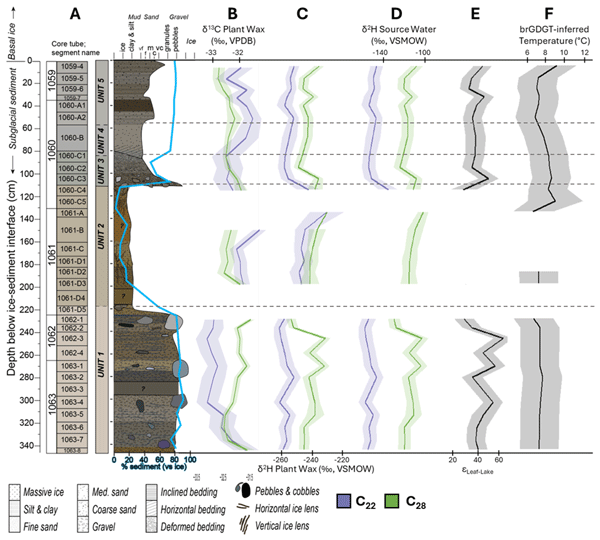
John Michael N. Aguilar, Elizabeth K. Thomas, Diana S. Aga, Paul R. Bierman, Jason P. Briner, Isla S. Castañeda, and Andrew J. Christ
Clim. Past, 22, 1757–1779, https://doi.org/10.5194/cp-22-1757-2026, https://doi.org/10.5194/cp-22-1757-2026, 2026
Short summary
Short summary
As the Arctic warms, the Greenland Ice Sheet is losing mass, with implications for global sea levels. We analyzed biomarkers from sediments beneath 1387 m of ice at Camp Century, Greenland, deposited when the ice sheet was smaller. Reconstructed summer temperature and precipitation isotopes from ~ 400 000 years ago show summers ~ 4.7 °C warmer than today, with more local moisture from reduced ice. This result highlights that both how warm and how long warming lasts matter to reduce ice loss.
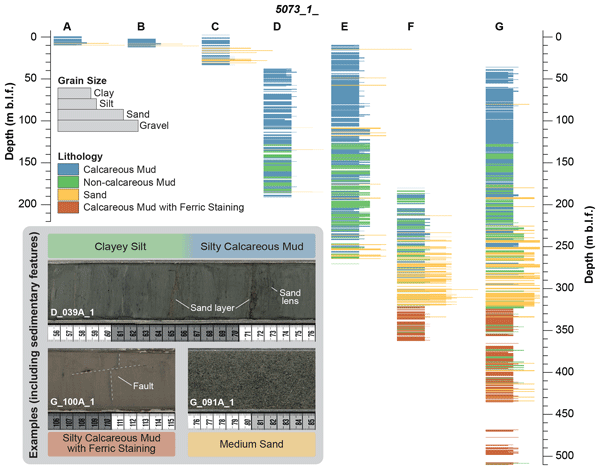
George Tanski, Michael Fritz, Jorien E. Vonk, Jens Strauss, Léo Chassiot, Vladislav Carnero-Bravo, Jade Falardeau, Kostantin Klein, Parick Lajeunesse, Hugues Lantuit, Niek J. Speetjens, Anne de Vernal, Dustin Whalen, and Anna M. Irrgang
EGUsphere, https://doi.org/10.5194/egusphere-2026-2314, https://doi.org/10.5194/egusphere-2026-2314, 2026
Short summary
Short summary
As the Arctic warms, permafrost coasts erode rapidly, flushing carbon from frozen ground into the sea. We studied a lagoon in the western Canadian Arctic, collecting sediments and analyzing organic carbon content, stable isotopes, and grain size, alongside satellite imagery. Carbon content fell by over 50 % from land to open ocean, while erosion rates quintupled since the 1950s. Arctic lagoons bury, degrade, and export terrestrial carbon, acting as coastal reactors whose role will grow.
Marie-Luise Adolph, Junbo Wang, Liping Zhu, Leon J. Clarke, Andrew C. G. Henderson, Hendrik Vogel, Gerhard Daut, Peter Frenzel, Jianting Ju, Qiangqiang Kou, Dierk Michaelis, Olga Schmitz, Anja Schwarz, Volkhard Spiess, Arne Ulfers, Cidan Zhaxi, Daniel Ariztegui, Natasha Barbolini, Thorsten Bauersachs, Erwin Braun, Giulia Ceriotti, Brian Grivna, Marlene Hoehle, Rolf Kipfer, Wilhelmine Klamt, Cindy Kunkel, Aliisa Laakkonen, Minghui Li, Qingfeng Ma, Paul Moser Röggla, Kaja Müller, Anders Noren, Ryan O'Grady, Santiago Otero, Maïlys Picard, Anna Pint, Camille Thomas, Jerome Van der Woerd, Mathias Vinnepand, Claudia Wrozyna, Christian Zeeden, Xinghuan Zhu, and Torsten Haberzettl
Sci. Dril., 35, 99–117, https://doi.org/10.5194/sd-35-99-2026, https://doi.org/10.5194/sd-35-99-2026, 2026
Short summary
Short summary
We drilled deep into sediments beneath a large lake on the Tibetan Plateau, Nam Co, to learn how climate and environments have changed over multiple ice age cycles. The recovered sediments show repeated shifts between major changes in lake conditions, water chemistry, and ecosystems. These findings help clarify how wind systems responded to natural climate cycles and improve understanding of how high mountain regions may react to future climate change and environmental stress.
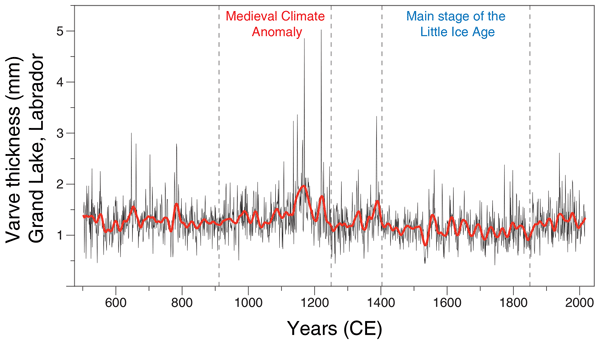
François Lapointe, Antoine Gagnon-Poiré, Pierre Francus, Patrick Lajeunesse, and Clarence Gagnon
Clim. Past, 21, 1595–1610, https://doi.org/10.5194/cp-21-1595-2025, https://doi.org/10.5194/cp-21-1595-2025, 2025
Short summary
Short summary
A new 1500-year-long sediment record made of annual laminations (varves) from Grand Lake, Labrador, reveals past hydroclimatic conditions. The Medieval Climate Anomaly (~1050–1225 CE) had thicker varves indicating more precipitation, while the Little Ice Age (1400–1875 CE) had thinner varves, suggesting a dryer climate. Teleconnections show that Grand Lake is influenced by winter North Atlantic Oscillation (NAO), hence making this record a promising candidate for future NAO reconstructions.
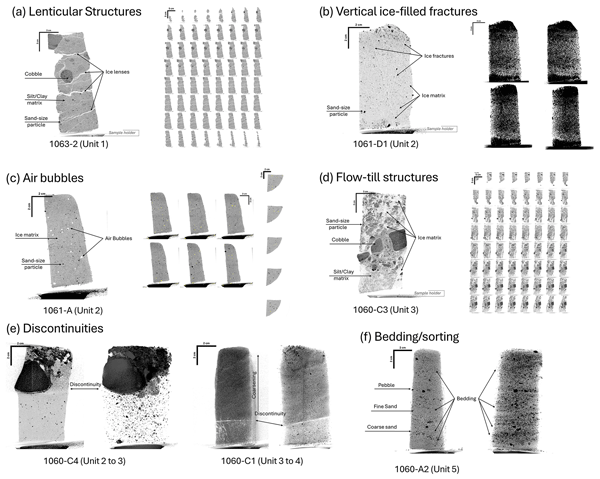
Catherine M. Collins, Nicolas Perdrial, Pierre-Henri Blard, Nynke Keulen, William C. Mahaney, Halley Mastro, Juliana Souza, Donna M. Rizzo, Yves Marrocchi, Paul C. Knutz, and Paul R. Bierman
Clim. Past, 21, 1359–1381, https://doi.org/10.5194/cp-21-1359-2025, https://doi.org/10.5194/cp-21-1359-2025, 2025
Short summary
Short summary
The Camp Century subglacial core stores information about past climates and glacial and interglacial processes in northwestern Greenland. In this study, we investigated the core archive, making large-scale observations using computed tomography (CT) scans and micron-scale observations observing physical and chemical characteristics of individual grains. We find evidence of past ice-free conditions, weathering processes during warmer periods, and past glaciations.
Christopher T. Halsted, Paul R. Bierman, Alexandru T. Codilean, Lee B. Corbett, and Marc W. Caffee
Geochronology, 7, 213–228, https://doi.org/10.5194/gchron-7-213-2025, https://doi.org/10.5194/gchron-7-213-2025, 2025
Short summary
Short summary
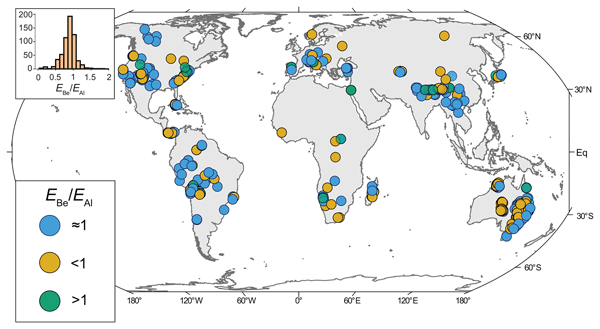
Sediment generation on hillslopes and transport through river networks are complex processes that influence landscape evolution. In this study, we compiled sand from 766 river basins and measured its subtle radioactivity to unravel timelines of sediment routing around the world. With these data, we empirically confirm that sediment from large lowland basins in tectonically stable regions typically experiences long periods of burial, while sediment moves rapidly through small upland basins.
Peter U. Clark, Jeremy D. Shakun, Yair Rosenthal, Chenyu Zhu, Patrick J. Bartlein, Jonathan M. Gregory, Peter Köhler, Zhengyu Liu, and Daniel P. Schrag
Clim. Past, 21, 973–1000, https://doi.org/10.5194/cp-21-973-2025, https://doi.org/10.5194/cp-21-973-2025, 2025
Short summary
Short summary
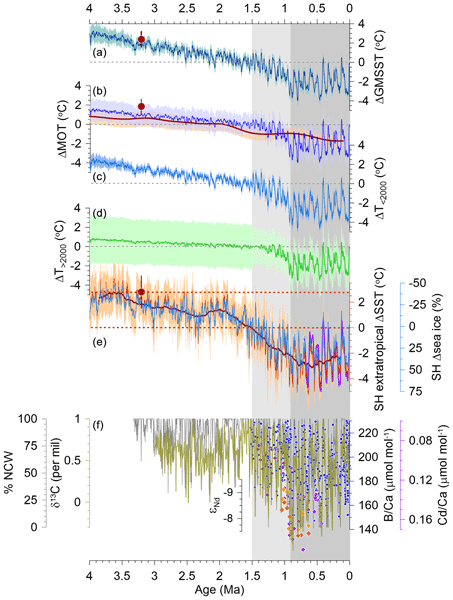
We reconstruct changes in mean ocean temperature (ΔMOT) over the last 4.5 Myr. We find that the ratio of ΔMOT to changes in global mean sea surface temperature was around 0.5 before the Middle Pleistocene transition but was 1 thereafter. We subtract our ΔMOT reconstruction from the global δ18O record to derive the δ18O of seawater. Finally, we develop a theoretical understanding of why the ratio of ΔMOT / ΔGMSST changed over the Plio-Pleistocene.
Richard A. Becker, Aaron M. Barth, Shaun A. Marcott, Basil Tikoff, and Marc W. Caffee
EGUsphere, https://doi.org/10.5194/egusphere-2025-1370, https://doi.org/10.5194/egusphere-2025-1370, 2025
Short summary
Short summary
We report 31 new 10Be and 26 recalculated 36Cl dates from the Sierra Nevada Mountains (USA) and conclude that deglaciation’s final and rapid phase began at 16.4 ± 0.8 ka. In comparing this timing with high-resolution regional paleoclimate proxies, we interpret that rapid deglaciation most likely began at 16.20 ± 0.13 ka, which is indistinguishable in timing from Heinrich Event 1. We interpret that the range’s deglaciation was likely driven by a reunification of the polar jet stream at this time.
Bradley W. Goodfellow, Marc W. Caffee, Greg Chmiel, Ruben Fritzon, Alasdair Skelton, and Arjen P. Stroeven
Solid Earth, 15, 1343–1363, https://doi.org/10.5194/se-15-1343-2024, https://doi.org/10.5194/se-15-1343-2024, 2024
Short summary
Short summary
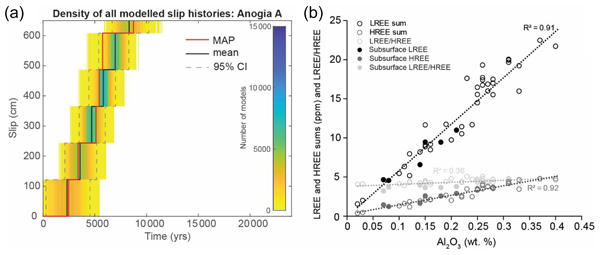
Reconstructions of past earthquakes are useful to assess earthquake hazard risk. We assess a limestone scarp exposed by earthquakes along the Sparta Fault, Greece, using 36Cl and rare-earth elements and yttrium (REE-Y). Our analyses indicate an increase in the average scarp slip rate from 0.8–0.9 mm yr-1 at 6.5–7.7 kyr ago to 1.1–1.2 mm yr-1 up to the devastating 464 BCE earthquake. REE-Y indicate clays in the fault scarp; their potential use in palaeoseismicity would benefit from further study.
Paul R. Bierman, Andrew J. Christ, Catherine M. Collins, Halley M. Mastro, Juliana Souza, Pierre-Henri Blard, Stefanie Brachfeld, Zoe R. Courville, Tammy M. Rittenour, Elizabeth K. Thomas, Jean-Louis Tison, and François Fripiat
The Cryosphere, 18, 4029–4052, https://doi.org/10.5194/tc-18-4029-2024, https://doi.org/10.5194/tc-18-4029-2024, 2024
Short summary
Short summary
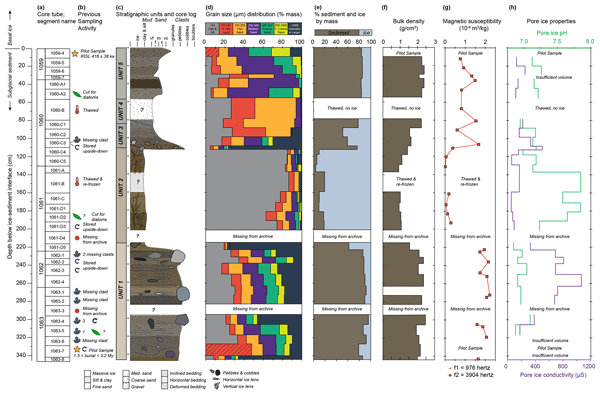
In 1966, the U.S. Army drilled through the Greenland Ice Sheet at Camp Century, Greenland; they recovered 3.44 m of frozen material. Here, we decipher the material’s history. Water, flowing during a warm interglacial when the ice sheet melted from northwest Greenland, deposited the upper material which contains fossil plant and insect parts. The lower material, separated by more than a meter of ice with some sediment, is till, deposited by the ice sheet during a prior cold period.
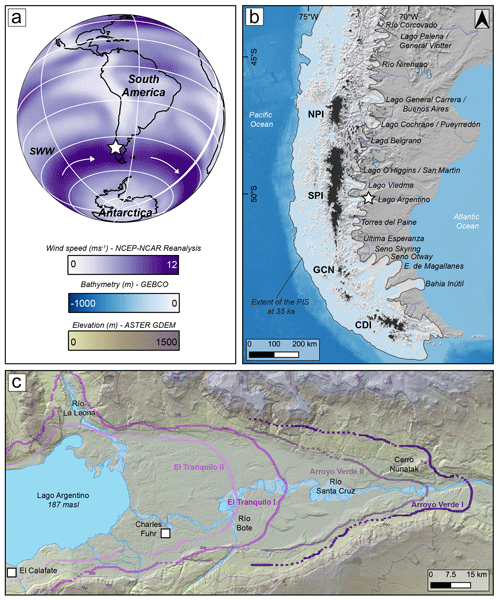
Matias Romero, Shanti B. Penprase, Maximillian S. Van Wyk de Vries, Andrew D. Wickert, Andrew G. Jones, Shaun A. Marcott, Jorge A. Strelin, Mateo A. Martini, Tammy M. Rittenour, Guido Brignone, Mark D. Shapley, Emi Ito, Kelly R. MacGregor, and Marc W. Caffee
Clim. Past, 20, 1861–1883, https://doi.org/10.5194/cp-20-1861-2024, https://doi.org/10.5194/cp-20-1861-2024, 2024
Short summary
Short summary
Investigating past glaciated regions is crucial for understanding how ice sheets responded to climate forcings and how they might respond in the future. We use two independent dating techniques to document the timing and extent of the Lago Argentino glacier lobe, a former lobe of the Patagonian Ice Sheet, during the late Quaternary. Our findings highlight feedbacks in the Earth’s system responsible for modulating glacier growth in the Southern Hemisphere prior to the global Last Glacial Maximum.
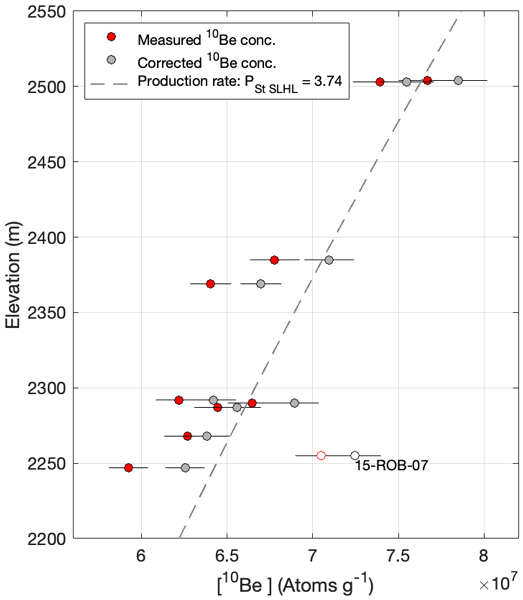
Marie Bergelin, Greg Balco, Lee B. Corbett, and Paul R. Bierman
Geochronology, 6, 491–502, https://doi.org/10.5194/gchron-6-491-2024, https://doi.org/10.5194/gchron-6-491-2024, 2024
Short summary
Short summary
Cosmogenic nuclides, such as 10Be, are rare isotopes produced in rocks when exposed at Earth's surface and are valuable for understanding surface processes and landscape evolution. However, 10Be is usually measured in quartz minerals. Here we present advances in efficiently extracting and measuring 10Be in the pyroxene mineral. These measurements expand the use of 10Be as a dating tool for new rock types and provide opportunities to understand landscape processes in areas that lack quartz.
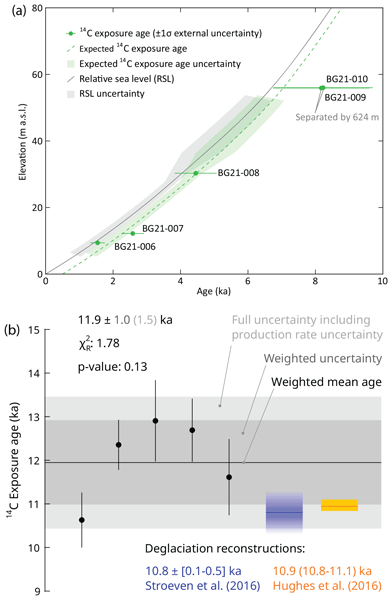
Bradley W. Goodfellow, Arjen P. Stroeven, Nathaniel A. Lifton, Jakob Heyman, Alexander Lewerentz, Kristina Hippe, Jens-Ove Näslund, and Marc W. Caffee
Geochronology, 6, 291–302, https://doi.org/10.5194/gchron-6-291-2024, https://doi.org/10.5194/gchron-6-291-2024, 2024
Short summary
Short summary
Carbon-14 produced in quartz (half-life of 5700 ± 30 years) provides a new tool to date exposure of bedrock surfaces. Samples from 10 exposed bedrock surfaces in east-central Sweden give dates consistent with the timing of both landscape emergence above sea level through postglacial rebound and retreat of the last ice sheet shown in previous reconstructions. Carbon-14 in quartz can therefore be used for dating in landscapes where isotopes with longer half-lives give complex exposure results.
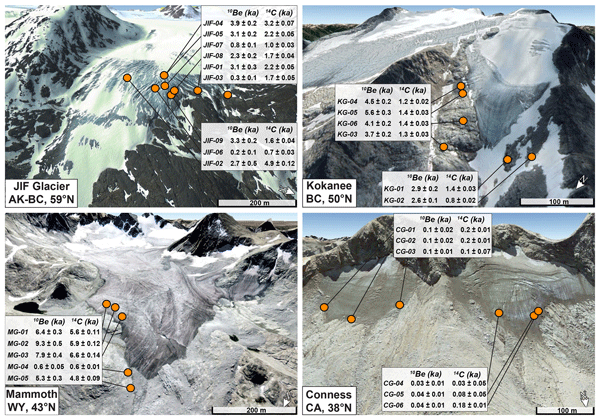
Andrew G. Jones, Shaun A. Marcott, Andrew L. Gorin, Tori M. Kennedy, Jeremy D. Shakun, Brent M. Goehring, Brian Menounos, Douglas H. Clark, Matias Romero, and Marc W. Caffee
The Cryosphere, 17, 5459–5475, https://doi.org/10.5194/tc-17-5459-2023, https://doi.org/10.5194/tc-17-5459-2023, 2023
Short summary
Short summary
Mountain glaciers today are fractions of their sizes 140 years ago, but how do these sizes compare to the past 11,000 years? We find that four glaciers in the United States and Canada have reversed a long-term trend of growth and retreated to positions last occupied thousands of years ago. Notably, each glacier occupies a unique position relative to its long-term history. We hypothesize that unequal modern retreat has caused the glaciers to be out of sync relative to their Holocene histories.
Eric W. Portenga, David J. Ullman, Lee B. Corbett, Paul R. Bierman, and Marc W. Caffee
Geochronology, 5, 413–431, https://doi.org/10.5194/gchron-5-413-2023, https://doi.org/10.5194/gchron-5-413-2023, 2023
Short summary
Short summary
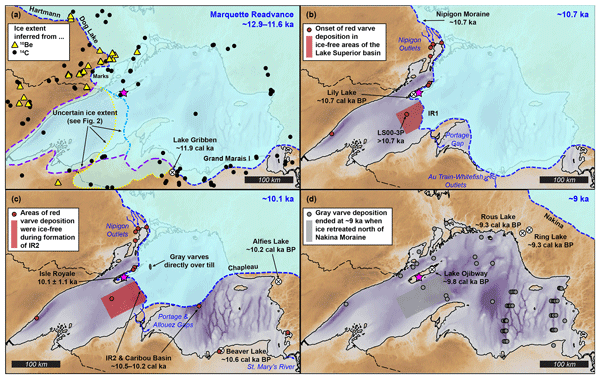
New exposure ages of glacial erratics on moraines on Isle Royale – the largest island in North America's Lake Superior – show that the Laurentide Ice Sheet did not retreat from the island nor the south shores of Lake Superior until the early Holocene, which is later than previously thought. These new ages unify regional ice retreat histories from the mainland, the Lake Superior lake-bottom stratigraphy, underwater moraines, and meltwater drainage pathways through the Laurentian Great Lakes.
Giulia Sinnl, Florian Adolphi, Marcus Christl, Kees C. Welten, Thomas Woodruff, Marc Caffee, Anders Svensson, Raimund Muscheler, and Sune Olander Rasmussen
Clim. Past, 19, 1153–1175, https://doi.org/10.5194/cp-19-1153-2023, https://doi.org/10.5194/cp-19-1153-2023, 2023
Short summary
Short summary
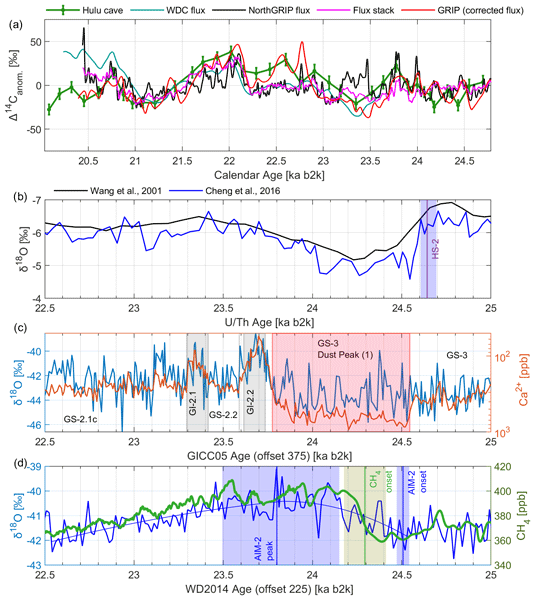
The record of past climate is preserved by several archives from different regions, such as ice cores from Greenland or Antarctica or speleothems from caves such as the Hulu Cave in China. In this study, these archives are aligned by taking advantage of the globally synchronous production of cosmogenic radionuclides. This produces a new perspective on the global climate in the period between 20 000 and 25 000 years ago.
Aaron M. Barth, Elizabeth G. Ceperley, Claire Vavrus, Shaun A. Marcott, Jeremy D. Shakun, and Marc W. Caffee
Geochronology, 4, 731–743, https://doi.org/10.5194/gchron-4-731-2022, https://doi.org/10.5194/gchron-4-731-2022, 2022
Short summary
Short summary
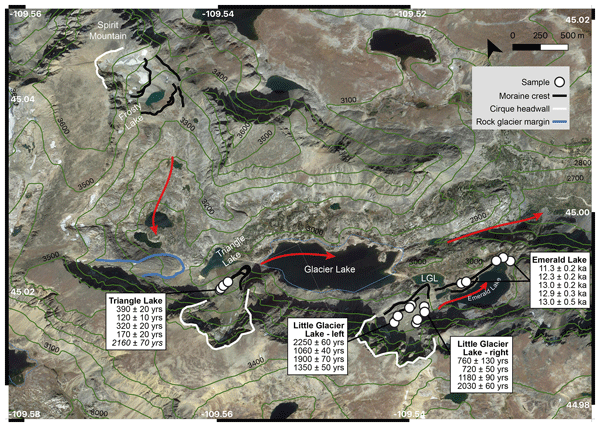
Deposits left behind by past glacial activity provide insight into the previous size and behavior of glaciers and act as another line of evidence for past climate. Here we present new age control for glacial deposits in the mountains of Montana and Wyoming, United States. While some deposits indicate glacial activity within the last 2000 years, others are shown to be older than previously thought, thus redefining the extent of regional Holocene glaciation.
Adrian M. Bender, Richard O. Lease, Lee B. Corbett, Paul R. Bierman, Marc W. Caffee, James V. Jones, and Doug Kreiner
Earth Surf. Dynam., 10, 1041–1053, https://doi.org/10.5194/esurf-10-1041-2022, https://doi.org/10.5194/esurf-10-1041-2022, 2022
Short summary
Short summary
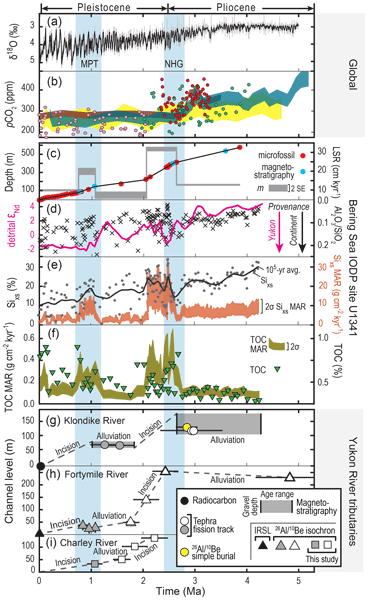
To understand landscape evolution in the mineral resource-rich Yukon River basin (Alaska and Canada), we mapped and cosmogenic isotope-dated river terraces along the Charley River. Results imply widespread Yukon River incision that drove increased Bering Sea sedimentation and carbon sequestration during global climate changes 2.6 and 1 million years ago. Such erosion may have fed back to late Cenozoic climate change by reducing atmospheric carbon as observed in many records worldwide.
Flavienne Bruyant, Rémi Amiraux, Marie-Pier Amyot, Philippe Archambault, Lise Artigue, Lucas Barbedo de Freitas, Guislain Bécu, Simon Bélanger, Pascaline Bourgain, Annick Bricaud, Etienne Brouard, Camille Brunet, Tonya Burgers, Danielle Caleb, Katrine Chalut, Hervé Claustre, Véronique Cornet-Barthaux, Pierre Coupel, Marine Cusa, Fanny Cusset, Laeticia Dadaglio, Marty Davelaar, Gabrièle Deslongchamps, Céline Dimier, Julie Dinasquet, Dany Dumont, Brent Else, Igor Eulaers, Joannie Ferland, Gabrielle Filteau, Marie-Hélène Forget, Jérome Fort, Louis Fortier, Martí Galí, Morgane Gallinari, Svend-Erik Garbus, Nicole Garcia, Catherine Gérikas Ribeiro, Colline Gombault, Priscilla Gourvil, Clémence Goyens, Cindy Grant, Pierre-Luc Grondin, Pascal Guillot, Sandrine Hillion, Rachel Hussherr, Fabien Joux, Hannah Joy-Warren, Gabriel Joyal, David Kieber, Augustin Lafond, José Lagunas, Patrick Lajeunesse, Catherine Lalande, Jade Larivière, Florence Le Gall, Karine Leblanc, Mathieu Leblanc, Justine Legras, Keith Lévesque, Kate-M. Lewis, Edouard Leymarie, Aude Leynaert, Thomas Linkowski, Martine Lizotte, Adriana Lopes dos Santos, Claudie Marec, Dominique Marie, Guillaume Massé, Philippe Massicotte, Atsushi Matsuoka, Lisa A. Miller, Sharif Mirshak, Nathalie Morata, Brivaela Moriceau, Philippe-Israël Morin, Simon Morisset, Anders Mosbech, Alfonso Mucci, Gabrielle Nadaï, Christian Nozais, Ingrid Obernosterer, Thimoté Paire, Christos Panagiotopoulos, Marie Parenteau, Noémie Pelletier, Marc Picheral, Bernard Quéguiner, Patrick Raimbault, Joséphine Ras, Eric Rehm, Llúcia Ribot Lacosta, Jean-François Rontani, Blanche Saint-Béat, Julie Sansoulet, Noé Sardet, Catherine Schmechtig, Antoine Sciandra, Richard Sempéré, Caroline Sévigny, Jordan Toullec, Margot Tragin, Jean-Éric Tremblay, Annie-Pier Trottier, Daniel Vaulot, Anda Vladoiu, Lei Xue, Gustavo Yunda-Guarin, and Marcel Babin
Earth Syst. Sci. Data, 14, 4607–4642, https://doi.org/10.5194/essd-14-4607-2022, https://doi.org/10.5194/essd-14-4607-2022, 2022
Short summary
Short summary
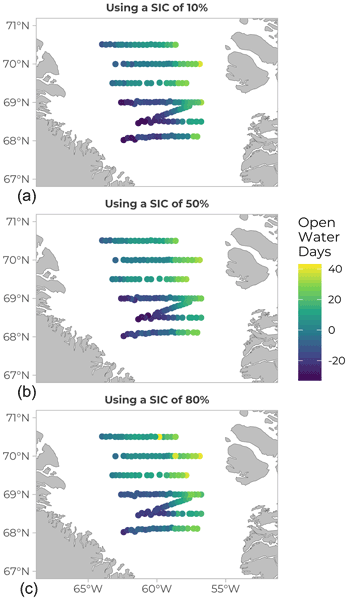
This paper presents a dataset acquired during a research cruise held in Baffin Bay in 2016. We observed that the disappearance of sea ice in the Arctic Ocean increases both the length and spatial extent of the phytoplankton growth season. In the future, this will impact the food webs on which the local populations depend for their food supply and fisheries. This dataset will provide insight into quantifying these impacts and help the decision-making process for policymakers.
Marie Bergelin, Jaakko Putkonen, Greg Balco, Daniel Morgan, Lee B. Corbett, and Paul R. Bierman
The Cryosphere, 16, 2793–2817, https://doi.org/10.5194/tc-16-2793-2022, https://doi.org/10.5194/tc-16-2793-2022, 2022
Short summary
Short summary
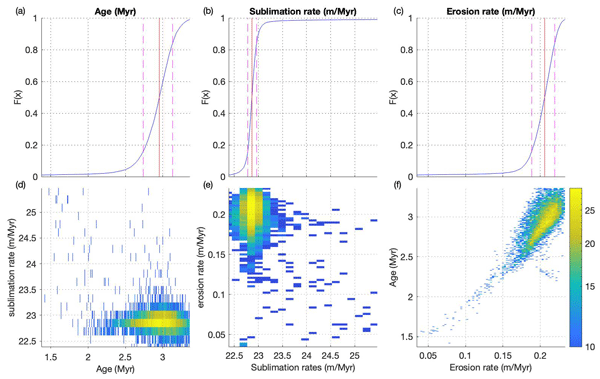
Glacier ice contains information on past climate and can help us understand how the world changes through time. We have found and sampled a buried ice mass in Antarctica that is much older than most ice on Earth and difficult to date. Therefore, we developed a new dating application which showed the ice to be 3 million years old. Our new dating solution will potentially help to date other ancient ice masses since such old glacial ice could yield data on past environmental conditions on Earth.
Mae Kate Campbell, Paul R. Bierman, Amanda H. Schmidt, Rita Sibello Hernández, Alejandro García-Moya, Lee B. Corbett, Alan J. Hidy, Héctor Cartas Águila, Aniel Guillén Arruebarrena, Greg Balco, David Dethier, and Marc Caffee
Geochronology, 4, 435–453, https://doi.org/10.5194/gchron-4-435-2022, https://doi.org/10.5194/gchron-4-435-2022, 2022
Short summary
Short summary
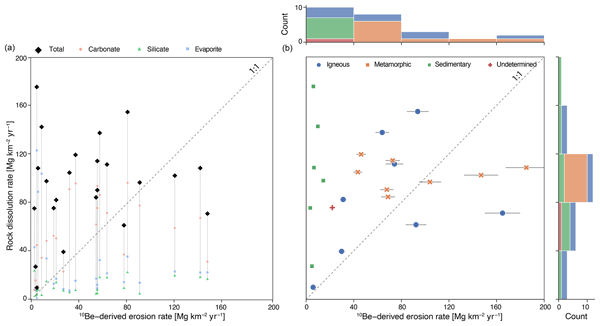
We used cosmogenic radionuclides in detrital river sediment to measure erosion rates of watersheds in central Cuba; erosion rates are lower than rock dissolution rates in lowland watersheds. Data from two different cosmogenic nuclides suggest that some basins may have a mixed layer deeper than is typically modeled and could have experienced significant burial after or during exposure. We conclude that significant mass loss may occur at depth through chemical weathering processes.

Leah A. VanLandingham, Eric W. Portenga, Edward C. Lefroy, Amanda H. Schmidt, Paul R. Bierman, and Alan J. Hidy
Geochronology, 4, 153–176, https://doi.org/10.5194/gchron-4-153-2022, https://doi.org/10.5194/gchron-4-153-2022, 2022
Short summary
Short summary
This study presents erosion rates of the George River and seven of its tributaries in northeast Tasmania, Australia. These erosion rates are the first measures of landscape change over millennial timescales for Tasmania. We demonstrate that erosion is closely linked to a topographic rainfall gradient across George River. Our findings may be useful for efforts to restore ecological health to Georges Bay by determining a pre-disturbance level of erosion and sediment delivery to this estuary.
Brendon J. Quirk, Elizabeth Huss, Benjamin J. C. Laabs, Eric Leonard, Joseph Licciardi, Mitchell A. Plummer, and Marc W. Caffee
Clim. Past, 18, 293–312, https://doi.org/10.5194/cp-18-293-2022, https://doi.org/10.5194/cp-18-293-2022, 2022
Short summary
Short summary
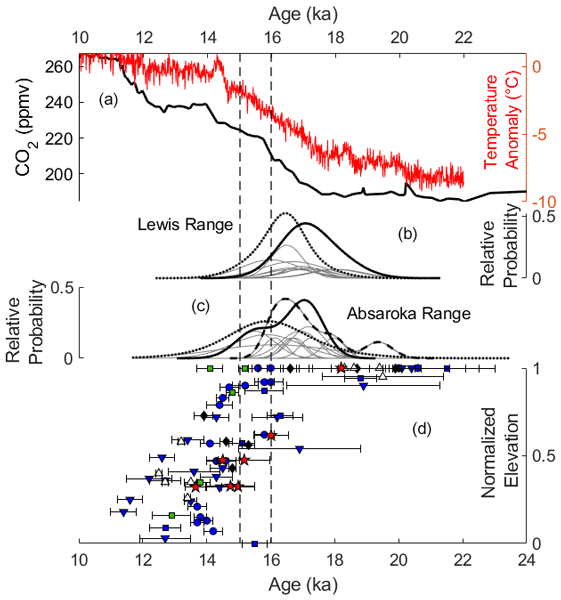
Glaciers in the northern Rocky Mountains began retreating 17 000 to 18 000 years ago, after the end of the most recent global ice volume maxima. Climate in the region during this time was likely 10 to 8.5° colder than modern with less than or equal to present amounts of precipitation. Glaciers across the Rockies began retreating at different times but eventually exhibited similar patterns of retreat, suggesting a common mechanism influencing deglaciation.
Cited articles
Alley, R. B., Cuffey, K. M., and Zoet, L. K.: Glacial erosion: status and outlook, Annals of Glaciology, 60, 1–13, https://doi.org/10.1017/aog.2019.38, 2019.
Amani, M., Mahdavi, S., Afshar, M., Brisco, B., Huang, W., Mohammad Javad Mirzadeh, S., White, L., Banks, S., Montgomery, J., and Hopkinson, C.: Canadian wetland inventory using Google Earth Engine: the first map and preliminary results, Remote Sensing, 11, 842, https://doi.org/10.3390/rs11070842, 2019.
Andrews, J. T. and Tyler, K.: The observed postglacial recovery of Québec and Nouveau-Québec Since 12,000 BP, Géographie physique et Quaternaire, 31, 389–400, https://doi.org/10.7202/1000286ar, 2011.
Balco, G.: Dating Plio-Pleistocene glacial sediments using the cosmic-ray-produced radionuclides 10Be and 26Al, American Journal of Science, 305, 1–41, https://doi.org/10.2475/ajs.305.1.1, 2005.
Balco, G. and Rovey, C. W.: An isochron method for cosmogenic-nuclide dating of buried soils and sediments, American Journal of Science, 308, 1083–1114, https://doi.org/10.2475/10.2008.02, 2008.
Balco, G. and Rovey, C. W.: Absolute chronology for major Pleistocene advances of the Laurentide Ice Sheet, Geology, 38, 795–798, https://doi.org/10.1130/G30946.1, 2010.
Balco, G., Stone, J. O. H., Porter, S. C., and Caffee, M. W.: Cosmogenic-nuclide ages for New England coastal moraines, Martha's Vineyard and Cape Cod, Massachusetts, USA, Quaternary Science Reviews, 21, 2127–2135, https://doi.org/10.1016/S0277-3791(02)00085-9, 2002.
Balco, G., Stone, J. O., Lifton, N. A., and Dunai, T. J.: A complete and easily accessible means of calculating surface exposure ages or erosion rates from 10Be and 26Al measurements, Quaternary Geochronology, 3, 174–195, https://doi.org/10.1016/j.quageo.2007.12.001, 2008.
Balco, G., Briner, J., Finkel, R. C., Rayburn, J. A., Ridge, J. C., and Schaefer, J. M.: Regional beryllium-10 production rate calibration for late-glacial northeastern North America, Quaternary Geochronology, 4, 93–107, https://doi.org/10.1016/j.quageo.2008.09.001, 2009.
Balter-Kennedy, A., Schaefer, J. M., Balco, G., Kelly, M. A., Kaplan, M. R., Schwartz, R., Oakley, B., Young, N. E., Hanley, J., and Varuolo-Clarke, A. M.: The Laurentide Ice Sheet in southern New England and New York during and at the end of the Last Glacial Maximum: a cosmogenic-nuclide chronology, Clim. Past, 20, 2167–2190, https://doi.org/10.5194/cp-20-2167-2024, 2024.
Barth, A. M., Marcott, S. A., Licciardi, J. M., and Shakun, J. D.: Deglacial Thinning of the Laurentide Ice Sheet in the Adirondack Mountains, New York, USA, Revealed by 36Cl Exposure Dating, Paleoceanog. and Paleoclimatol., 34, 946–953, https://doi.org/10.1029/2018PA003477, 2019.
Batchelor, C. L., Margold, M., Krapp, M., Murton, D. K., Dalton, A. S., Gibbard, P. L., Stokes, C. R., Murton, J. B., and Manica, A.: The configuration of Northern Hemisphere ice sheets through the Quaternary, Nat. Commun., 10, 3713, https://doi.org/10.1038/s41467-019-11601-2, 2019.
Beck, H. E., Zimmermann, N. E., McVicar, T. R., Vergopolan, N., Berg, A., and Wood, E. F.: Present and future Köppen-Geiger climate classification maps at 1-km resolution, Sci. Data, 5, 180214, https://doi.org/10.1038/sdata.2018.214, 2018.
Bierman, P. R., Marsella, K. A., Patterson, C., Davis, P. T., and Caffee, M.: Mid-Pleistocene cosmogenic minimum-age limits for pre-Wisconsinan glacial surfaces in southwestern Minnesota and southern Baffin Island: a multiple nuclide approach, Geomorphology, 27, 25–39, https://doi.org/10.1016/S0169-555X(98)00088-9, 1999.
Bierman, P. R., Marsella, K. A., Davis, P. T., and Caffee, M. W.: Response to Discussion by Wolfe et al. on Bierman et al. (Geomorphology 25 (1999) 25–39), Geomorphology, 39, 255–260, https://doi.org/10.1016/S0169-555X(00)00102-1, 2001.
Bierman, P. R., Caffee, M. W., Davis, P. T., Marsella, K., Pavich, M., Colgan, P., Mickelson, D., and Larsen, J.: Rates and Timing of Earth Surface Processes From In Situ-Produced Cosmogenic Be-10, Reviews in Mineralogy and Geochemistry, 50, 147–205, https://doi.org/10.2138/rmg.2002.50.4, 2002.
Bierman, P. R., Davis, P. T., Corbett, L. B., Lifton, N. A., and Finkel, R. C.: Cold-based Laurentide ice covered New England's highest summits during the Last Glacial Maximum, Geology, G37225.1, https://doi.org/10.1130/G37225.1, 2015.
Bierman, P. R., Shakun, J. D., Corbett, L. B., Zimmerman, S. R., and Rood, D. H.: A persistent and dynamic East Greenland Ice Sheet over the past 7.5 million years, Nature, 540, 256–260, https://doi.org/10.1038/nature20147, 2016.
Bierman, P. R., Mastro, H. M., Peteet, D. M., Corbett, L. B., Steig, E. J., Halsted, C. T., Caffee, M. M., Hidy, A. J., Balco, G., Bennike, O., and Rock, B.: Plant, insect, and fungi fossils under the center of Greenland's ice sheet are evidence of ice-free times, Proc. Natl. Acad. Sci. U.S.A., 121, e2407465121, https://doi.org/10.1073/pnas.2407465121, 2024a.
Bierman, P. R., Christ, A. J., Collins, C. M., Mastro, H. M., Souza, J., Blard, P.-H., Brachfeld, S., Courville, Z. R., Rittenour, T. M., Thomas, E. K., Tison, J.-L., and Fripiat, F.: Scientific history, sampling approach, and physical characterization of the Camp Century subglacial material, a rare archive from beneath the Greenland Ice Sheet, The Cryosphere, 18, 4029–4052, https://doi.org/10.5194/tc-18-4029-2024, 2024b.
Blard, P.-H., Protin, M., Tison, J.-L., Fripiat, F., Dahl-Jensen, D., Steffensen, J. P., Mahaney, W. C., Bierman, P. R., Christ, A. J., Corbett, L. B., Debaille, V., Rigaudier, T., Claeys, P., and ASTER Team: Basal debris of the NEEM ice core, Greenland: a window into sub-ice-sheet geology, basal ice processes and ice-sheet oscillations, J. Glaciol., 69, 1011–1029, https://doi.org/10.1017/jog.2022.122, 2023.
Bond, G., Heinrich, H., Broecker, W., Labeyrie, L., McManus, J., Andrews, J., Huon, S., Jantschik, R., Clasen, S., Simet, C., Tedesco, K., Klas, M., Bonani, G., and Ivy, S.: Evidence for massive discharges of icebergs into the North Atlantic ocean during the last glacial period, Nature, 360, 245–249, https://doi.org/10.1038/360245a0, 1992.
Booth, D. B.: Glaciofluvial infilling and scour of the Puget Lowland, Washington, during ice-sheet glaciation, Geol., 22, 695, https://doi.org/10.1130/0091-7613(1994)022<0695:GIASOT>2.3.CO;2, 1994.
Braucher, R., Bourlès, D., Merchel, S., Vidal Romani, J., Fernadez-Mosquera, D., Marti, K., Léanni, L., Chauvet, F., Arnold, M., Aumaître, G., and Keddadouche, K.: Determination of muon attenuation lengths in depth profiles from in situ produced cosmogenic nuclides, Nuclear Instruments and Methods in Physics Research Section B: Beam Interactions with Materials and Atoms, 294, 484–490, https://doi.org/10.1016/j.nimb.2012.05.023, 2013.
Braucher, R., Guillou, V., Bourlès, D. L., Arnold, M., Aumaître, G., Keddadouche, K., and Nottoli, E.: Preparation of ASTER in-house
Briner, J. P. and Swanson, T. W.: Using inherited cosmogenic 36Cl to constrain glacial erosion rates of the Cordilleran ice sheet, Geol., 26, 3, https://doi.org/10.1130/0091-7613(1998)026<0003:UICCTC>2.3.CO;2, 1998.
Briner, J. P., Miller, G. H., Davis, P. T., and Finkel, R. C.: Cosmogenic radionuclides from fiord landscapes support differential erosion by overriding ice sheets, Geological Society of America Bulletin, 118, 406–420, https://doi.org/10.1130/B25716.1, 2006.
Briner, J. P., Goehring, B. M., Mangerud, J., and Svendsen, J. I.: The deep accumulation of 10Be at Utsira, southwestern Norway: Implications for cosmogenic nuclide exposure dating in peripheral ice sheet landscapes, Geophysical Research Letters, 43, 9121–9129, https://doi.org/10.1002/2016GL070100, 2016.
Carlson, A. E., Clark, P. U., Raisbeck, G. M., and Brook, E. J.: Rapid Holocene Deglaciation of the Labrador Sector of the Laurentide Ice Sheet, Journal of Climate, 20, 5126–5133, https://doi.org/10.1175/JCLI4273.1, 2007.
Cavnar, P., Bierman, P., Shakun, J., Corbett, L., Caffe, M., Galford, G., and LeBlanc, D.: Measuring in situ Cosmogenic Beryllium-10 and Aluminum-26 in Deglacial Sediment Reveals Limited Erosion Under the Quebec-Labrador Ice Dome, Canada, 2022–2024, Arctic Data Center [data set], https://doi.org/10.18739/A2X34MT66, 2024.
Christ, A. J., Bierman, P. R., Knutz, P. C., Corbett, L. B., Fosdick, J. C., Thomas, E. K., Cowling, O. C., Hidy, A. J., and Caffee, M. W.: The Northwestern Greenland Ice Sheet during the Early Pleistocene was similar to today, Geophysical Research Letters, 47, https://doi.org/10.1029/2019GL085176, 2020.
Christ, A. J., Bierman, P. R., Schaefer, J. M., Dahl-Jensen, D., Steffensen, J. P., Corbett, L. B., Peteet, D. M., Thomas, E. K., Steig, E. J., Rittenour, T. M., Tison, J.-L., Blard, P.-H., Perdrial, N., Dethier, D. P., Lini, A., Hidy, A. J., Caffee, M. W., and Southon, J.: A multimillion-year-old record of Greenland vegetation and glacial history preserved in sediment beneath 1.4 km of ice at Camp Century, Proc. Natl. Acad. Sci. U.S.A., 118, e2021442118, https://doi.org/10.1073/pnas.2021442118, 2021.
Christ, A. J., Rittenour, T. M., Bierman, P. R., Keisling, B. A., Knutz, P. C., Thomsen, T. B., Keulen, N., Fosdick, J. C., Hemming, S. R., Tison, J.-L., Blard, P.-H., Steffensen, J. P., Caffee, M. W., Corbett, L. B., Dahl-Jensen, D., Dethier, D. P., Hidy, A. J., Perdrial, N., Peteet, D. M., Steig, E. J., and Thomas, E. K.: Deglaciation of northwestern Greenland during Marine Isotope Stage 11, Science, 381, 330–335, https://doi.org/10.1126/science.ade4248, 2023.
Clark, P. U., Brook, E. J., Raisbeck, G. M., Yiou, F., and Clark, J.: Cosmogenic 10Be ages of the Saglek Moraines, Torngat Mountains, Labrador, Geol., 31, 617, https://doi.org/10.1130/0091-7613(2003)031<0617:CBAOTS>2.0.CO;2, 2003.
Colgan, P. M., Bierman, P. R., Mickelson, D. M., and Caffee, M.: Variation in glacial erosion near the southern margin of the Laurentide Ice Sheet, south-central Wisconsin, USA: Implications for cosmogenic dating of glacial terrains, Geological Society of America Bulletin, 114, 1581–1591, https://doi.org/10.1130/0016-7606(2002)114<1581:VIGENT>2.0.CO;2, 2002.
Collins, C. M., Perdrial, N., Blard, P.-H., Keulen, N., Mahaney, W. C., Mastro, H., Souza, J., Rizzo, D. M., Marrocchi, Y., Knutz, P. C., and Bierman, P. R.: Characterization of the 1966 Camp Century subglacial core: a multiscale analysis, Clim. Past, 21, 1359–1381, https://doi.org/10.5194/cp-21-1359-2025, 2025.
Corbett, L. B., Young, N. E., Bierman, P. R., Briner, J. P., Neumann, T. A., Rood, D. H., and Graly, J. A.: Paired bedrock and boulder 10Be concentrations resulting from early Holocene ice retreat near Jakobshavn Isfjord, western Greenland, Quaternary Science Reviews, 30, 1739–1749, https://doi.org/10.1016/j.quascirev.2011.04.001, 2011.
Corbett, L. B., Bierman, P. R., and Rood, D. H.: An approach for optimizing in situ cosmogenic 10Be sample preparation, Quaternary Geochronology, 33, 24–34, https://doi.org/10.1016/j.quageo.2016.02.001, 2016a.
Corbett, L. B., Bierman, P. R., and Rood, D. H.: Constraining multi-stage exposure-burial scenarios for boulders preserved beneath cold-based glacial ice in Thule, northwest Greenland, Earth and Planetary Science Letters, 440, 147–157, https://doi.org/10.1016/j.epsl.2016.02.004, 2016b.
Corbett, L. B., Bierman, P. R., and Davis, P. T.: Glacial history and landscape evolution of southern Cumberland Peninsula, Baffin Island, Canada, constrained by cosmogenic10 Be and26 Al, Geological Society of America Bulletin, 128, 1173–1192, https://doi.org/10.1130/B31402.1, 2016c.
Corbett, L. B., Bierman, P. R., Rood, D. H., Caffee, M. W., Lifton, N. A., and Woodruff, T. E.: Cosmogenic 26Al/10Be surface production ratio in Greenland, Geophysical Research Letters, 44, 1350–1359, https://doi.org/10.1002/2016GL071276, 2017.
Corbett, L. B., Bierman, P. R., Wright, S. F., Shakun, J. D., Davis, P. T., Goehring, B. M., Halsted, C. T., Koester, A. J., Caffee, M. W., and Zimmerman, S. R.: Analysis of multiple cosmogenic nuclides constrains Laurentide Ice Sheet history and process on Mt. Mansfield, Vermont's highest peak, Quaternary Science Reviews, 205, 234–246, https://doi.org/10.1016/j.quascirev.2018.12.014, 2019.
Corbett, L. B., Bierman, P. R., Neumann, T. A., Graly, J. A., Shakun, J. D., Goehring, B. M., Hidy, A. J., and Caffee, M. W.: Measuring multiple cosmogenic nuclides in glacial cobbles sheds light on Greenland Ice Sheet processes, Earth and Planetary Science Letters, 554, 116673, https://doi.org/10.1016/j.epsl.2020.116673, 2021.
Couette, P., Ghienne, J., Lajeunesse, P., and Van Der Woerd, J.: Climatic control on the retreat of the Laurentide Ice Sheet margin in easternmost Québec–Labrador (Canada) revealed by cosmogenic nuclide exposure dating, J. Quaternary Science, 38, 1044–1061, https://doi.org/10.1002/jqs.3525, 2023.
Cowton, T., Nienow, P., Bartholomew, I., Sole, A., and Mair, D.: Rapid erosion beneath the Greenland ice sheet, Geology, 40, 343–346, https://doi.org/10.1130/G32687.1, 2012.
Dalton, A. S., Finkelstein, S. A., Forman, S. L., Barnett, P. J., Pico, T., and Mitrovica, J. X.: Was the Laurentide Ice Sheet significantly reduced during Marine Isotope Stage 3?, Geology, 47, 111–114, https://doi.org/10.1130/G45335.1, 2019.
Dalton, A. S., Margold, M., Stokes, C. R., Tarasov, L., Dyke, A. S., Adams, R. S., Allard, S., Arends, H. E., Atkinson, N., Attig, J. W., Barnett, P. J., Barnett, R. L., Batterson, M., Bernatchez, P., Borns, H. W., Breckenridge, A., Briner, J. P., Brouard, E., Campbell, J. E., Carlson, A. E., Clague, J. J., Curry, B. B., Daigneault, R.-A., Dubé-Loubert, H., Easterbrook, D. J., Franzi, D. A., Friedrich, H. G., Funder, S., Gauthier, M. S., Gowan, A. S., Harris, K. L., Hétu, B., Hooyer, T. S., Jennings, C. E., Johnson, M. D., Kehew, A. E., Kelley, S. E., Kerr, D., King, E. L., Kjeldsen, K. K., Knaeble, A. R., Lajeunesse, P., Lakeman, T. R., Lamothe, M., Larson, P., Lavoie, M., Loope, H. M., Lowell, T. V., Lusardi, B. A., Manz, L., McMartin, I., Nixon, F. C., Occhietti, S., Parkhill, M. A., Piper, D. J. W., Pronk, A. G., Richard, P. J. H., Ridge, J. C., Ross, M., Roy, M., Seaman, A., Shaw, J., Stea, R. R., Teller, J. T., Thompson, W. B., Thorleifson, L. H., Utting, D. J., Veillette, J. J., Ward, B. C., Weddle, T. K., and Wright, H. E.: An updated radiocarbon-based ice margin chronology for the last deglaciation of the North American Ice Sheet Complex, Quaternary Science Reviews, 234, 106223, https://doi.org/10.1016/j.quascirev.2020.106223, 2020.
Dalton, A. S., Stokes, C. R., and Batchelor, C. L.: Evolution of the Laurentide and Innuitian ice sheets prior to the Last Glacial Maximum (115 ka to 25 ka), Earth-Science Reviews, 224, 103875, https://doi.org/10.1016/j.earscirev.2021.103875, 2022.
Dalton, A. S., Dulfer, H. E., Margold, M., Heyman, J., Clague, J. J., Froese, D. G., Gauthier, M. S., Hughes, A. L. C., Jennings, C. E., Norris, S. L., and Stoker, B. J.: Deglaciation of the North American ice sheet complex in calendar years based on a comprehensive database of chronological data: NADI-1, Quaternary Science Reviews, 321, 108345, https://doi.org/10.1016/j.quascirev.2023.108345, 2023.
Davis, P. T., Bierman, P. R., Corbett, L. B., and Finkel, R. C.: Cosmogenic exposure age evidence for rapid Laurentide deglaciation of the Katahdin area, west-central Maine, USA, 16 to 15 ka, Quaternary Science Reviews, 116, 95–105, https://doi.org/10.1016/j.quascirev.2015.03.021, 2015.
Dethier, D. P., Racela, J., and Wieman, S. T.: A contemporary mass-balance approach to small-catchment denudation rates in glaciated New England, GSA Annual Meeting in Indianapolis, Indiana, USA – 2018, 319718, https://doi.org/10.1130/abs/2018AM-319718, 2018.
Dubé-Loubert, H., Roy, M., Schaefer, J. M., and Clark, P. U.: 10Be dating of former glacial Lake Naskaupi (Québec-Labrador) and timing of its discharges during the last deglaciation, Quaternary Science Reviews, 191, 31–40, https://doi.org/10.1016/j.quascirev.2018.05.008, 2018.
Dubé-Loubert, H., Roy, M., Veillette, J. J., Brouard, E., Schaefer, J. M., and Wittmann, H.: The role of glacial dynamics in the development of ice divides and the Horseshoe Intersection Zone of the northeastern Labrador Sector of the Laurentide Ice Sheet, Geomorphology, 387, 107777, https://doi.org/10.1016/j.geomorph.2021.107777, 2021.
Dyke, A. S.: An outline of North American deglaciation with emphasis on central and northern Canada, in: Developments in Quaternary Sciences, vol. 2, Elsevier, 373–424, https://doi.org/10.1016/S1571-0866(04)80209-4, 2004.
Fame, M. L., Owen, L. A., Spotila, J. A., Dortch, J. M., and Caffee, M. W.: Tracking paraglacial sediment with cosmogenic 10Be using an example from the northwest Scottish Highlands, Quaternary Science Reviews, 182, 20–36, https://doi.org/10.1016/j.quascirev.2017.12.017, 2018.
Ganti, V., Von Hagke, C., Scherler, D., Lamb, M. P., Fischer, W. W., and Avouac, J.-P.: Time scale bias in erosion rates of glaciated landscapes, Sci. Adv., 2, e1600204, https://doi.org/10.1126/sciadv.1600204, 2016.
Gauthier, M. S., Hodder, T. J., Dalton, A. S., Brewer, V., Lian, O. B., Finkelstein, S. A., Schaarschmidt, M., and Mereghetti, A.: South-central Laurentide Ice Sheet dynamics and the formation of proglacial Lake Vita during MIS 3, Quat. Res., 1–23, https://doi.org/10.1017/qua.2024.34, 2024.
Goehring, B. M., Kelly, M. A., Schaefer, J. M., Finkel, R. C., and Lowell, T. V.: Dating of raised marine and lacustrine deposits in east Greenland using beryllium-10 depth profiles and implications for estimates of subglacial erosion, J. Quaternary Science, 25, 865–874, https://doi.org/10.1002/jqs.1380, 2010.
Goldthwait, J. W. and Kruger, F. C.: Weathered rock in and under the drift in New Hampshire, Geological Society of America Bulletin, 49, 1183–1198, https://doi.org/10.1130/GSAB-49-1183, 1938.
Granger, D. E.: Cosmogenic Nuclide Burial Dating in Archaeology and Paleoanthropology, in: Treatise on Geochemistry, Elsevier, 81–97, https://doi.org/10.1016/B978-0-08-095975-7.01208-0, 2014.
Granger, D. E. and Muzikar, P. F.: Dating sediment burial with in situ-produced cosmogenic nuclides: theory, techniques, and limitations, Earth and Planetary Science Letters, 188, 269–281, https://doi.org/10.1016/S0012-821X(01)00309-0, 2001.
Hallet, B., Hunter, L., and Bogen, J.: Rates of erosion and sediment evacuation by glaciers: A review of field data and their implications, Global and Planetary Change, 12, 213–235, https://doi.org/10.1016/0921-8181(95)00021-6, 1996.
Halsted, C. T., Bierman, P. R., Shakun, J. D., Davis, P. T., Corbett, L. B., Drebber, J. S., and Ridge, J. C.: A critical re-analysis of constraints on the timing and rate of Laurentide Ice Sheet recession in the northeastern United States, J. Quaternary Science, 39, 54–69, https://doi.org/10.1002/jqs.3563, 2024.
Heisinger, B., Lal, D., Jull, A. J. T., Kubik, P., Ivy-Ochs, S., Knie, K., and Nolte, E.: Production of selected cosmogenic radionuclides by muons: 2. Capture of negative muons, Earth and Planetary Science Letters, 200, 357–369, https://doi.org/10.1016/S0012-821X(02)00641-6, 2002.
Heyman, J., Stroeven, A. P., Harbor, J. M., and Caffee, M. W.: Too young or too old: Evaluating cosmogenic exposure dating based on an analysis of compiled boulder exposure ages, Earth and Planetary Science Letters, 302, 71–80, https://doi.org/10.1016/j.epsl.2010.11.040, 2011.
Hildes, D. H. D., Clarke, G. K. C., Flowers, G. E., and Marshall, S. J.: Subglacial erosion and englacial sediment transport modelled for North American ice sheets, Quaternary Science Reviews, 23, 409–430, https://doi.org/10.1016/j.quascirev.2003.06.005, 2004.
Hodder, T. J., Gauthier, M. S., Ross, M., and Lian, O. B.: Was there a nonglacial episode in the western Hudson Bay Lowland during Marine Isotope Stage 3?, Quat. Res., 116, 148–161, https://doi.org/10.1017/qua.2023.35, 2023.
Hodder, T. J., Gauthier, M. S., Ross, M., Kelley, S. E., Lian, O. B., Dalton, A. S., and Finkelstein, S. A.: Unravelling the fragmented sediment–landform assemblage in an area of thick Quaternary sediment, western Hudson Bay Lowland, Canada, Can. J. Earth Sci., 61, 1156–1183, https://doi.org/10.1139/cjes-2024-0018, 2024.
Hynes, A. and Rivers, T.: Protracted continental collision – evidence from the Grenville Orogen, Can. J. Earth Sci., 47, 591–620, https://doi.org/10.1139/E10-003, 2010.
Jansen, J. D., Knudsen, M. F., Andersen, J. L., Heyman, J., and Egholm, D. L.: Erosion rates in Fennoscandia during the past million years, Quaternary Science Reviews, 207, 37–48, https://doi.org/10.1016/j.quascirev.2019.01.010, 2019.
Jones, R. S., Whitehouse, P. L., Bentley, M. J., Small, D., and Dalton, A. S.: Impact of glacial isostatic adjustment on cosmogenic surface-exposure dating, Quaternary Science Reviews, 212, 206–212, https://doi.org/10.1016/j.quascirev.2019.03.012, 2019.
Klein, J., Giegengack, R., Middleton, R., Sharma, P., Underwood, J. R., and Weeks, R. A.: Revealing Histories of Exposure Using In Situ Produced 26Al and10Be in Libyan Desert Glass, Radiocarbon, 28, 547–555, https://doi.org/10.1017/S0033822200007700, 1986.
Koester, A. J., Shakun, J. D., Bierman, P. R., Davis, P. T., Corbett, L. B., Goehring, B. M., Vickers, A. C., and Zimmerman, S. R.: Laurentide ice sheet thinning and erosive regimes at Mount Washington, New Hampshire, inferred from multiple cosmogenic nuclides, in: Untangling the Quaternary Period – A Legacy of Stephen C. Porter, edited by: Waitt, R. B., Thackray, G. D., and Gillespie, A. R., Geological Society of America, 299–314, https://doi.org/10.1130/2020.2548(15), 2021.
Kohl, C. P. and Nishiizumi, K.: Chemical isolation of quartz for measurement of in-situ -produced cosmogenic nuclides, Geochimica et Cosmochimica Acta, 56, 3583–3587, https://doi.org/10.1016/0016-7037(92)90401-4, 1992.
Koppes, M., Hallet, B., Rignot, E., Mouginot, J., Wellner, J. S., and Boldt, K.: Observed latitudinal variations in erosion as a function of glacier dynamics, Nature, 526, 100–103, https://doi.org/10.1038/nature15385, 2015.
Lajeunesse, P. and Allard, M.: Late Quaternary Deglaciation, Glaciomarine Sedimentation and Glacioisostatic Recovery in the Rivière Nastapoka Area, Eastern Hudson Bay, Northern Québec, Géographie physique et Quaternaire, 57, 65–83, https://doi.org/10.7202/010331ar, 2005.
Larue, F., Royer, A., De Sève, D., Langlois, A., Roy, A., and Brucker, L.: Validation of GlobSnow-2 snow water equivalent over Eastern Canada, Remote Sensing of Environment, 194, 264–277, https://doi.org/10.1016/j.rse.2017.03.027, 2017.
LaSalle, P., De Kimpe, C. R., and Laverdiere, M. R.: Sub-till saprolites in southeastern Quebec and adjacent New England: Erosional, stratigraphic, and climatic significance, in: Geological Society of America Special Papers, vol. 197, Geological Society of America, 13–20, https://doi.org/10.1130/SPE197-p13, 1985.
Lavoie, C., Allard, M., and Duhamel, D.: Deglaciation landforms and C-14 chronology of the Lac Guillaume-Delisle area, eastern Hudson Bay: A report on field evidence, Geomorphology, 159–160, 142–155, https://doi.org/10.1016/j.geomorph.2012.03.015, 2012.
LeBlanc, D. E., Shakun, J. D., Corbett, L. B., Bierman, P. R., Caffee, M. W., and Hidy, A. J.: Laurentide Ice Sheet persistence during Pleistocene interglacials, Geology, 51, 496–499, https://doi.org/10.1130/G50820.1, 2023.
Lefebvre-Fortier, C., Roy, M., Dubé-Loubert, H., Brouard, E., and Schaefer, J. M.: Configuration and timing of the postglacial marine incursion along the eastern Ungava Peninsula (Nunavik, Canada): implications for deglaciation models, J. Quaternary Science, 39, 359–372, https://doi.org/10.1002/jqs.3591, 2024.
Lifton, N., Sato, T., and Dunai, T. J.: Scaling in situ cosmogenic nuclide production rates using analytical approximations to atmospheric cosmic-ray fluxes, Earth and Planetary Science Letters, 386, 149–160, https://doi.org/10.1016/j.epsl.2013.10.052, 2014.
Liverman, D. G. E.: Quaternary geology of the Goose Bay area:, Current Research. Department of Mines and Energy, Geological Survey, Newfoundland and Labrador, Report, https://www.gov.nl.ca/em/files/mines-geoscience-publications-currentresearch-1997-liverman.pdf (last access: 7 December 2025), 1997.
Margold, M., Stokes, C. R., and Clark, C. D.: Reconciling records of ice streaming and ice margin retreat to produce a palaeogeographic reconstruction of the deglaciation of the Laurentide Ice Sheet, Quaternary Science Reviews, 189, 1–30, https://doi.org/10.1016/j.quascirev.2018.03.013, 2018.
Marquette, G. C., Gray, J. T., Gosse, J. C., Courchesne, F., Stockli, L., Macpherson, G., and Finkel, R.: Felsenmeer persistence under non-erosive ice in the Torngat and Kaumajet mountains, Quebec and Labrador, as determined by soil weathering and cosmogenic nuclide exposure dating, Can. J. Earth Sci., 41, 19–38, https://doi.org/10.1139/e03-072, 2004.
Marsella, K. A., Bierman, P. R., Davis, P. T., and Caffee, M. W.: Cosmogenic 10Be and 26Al ages for the Last Glacial Maximum, eastern Baffin Island, Arctic Canada, Geological Society of America Bulletin, 112, 1296–1312, https://doi.org/10.1130/0016-7606(2000)112<1296:CBAAAF>2.0.CO;2, 2000.
Melanson, A., Bell, T., and Tarasov, L.: Numerical modelling of subglacial erosion and sediment transport and its application to the North American ice sheets over the Last Glacial cycle, Quaternary Science Reviews, 68, 154–174, https://doi.org/10.1016/j.quascirev.2013.02.017, 2013.
Merchel, S. and Bremser, W.: First international 26Al interlaboratory comparison – Part I, Nuclear Instruments and Methods in Physics Research Section B: Beam Interactions with Materials and Atoms, 223–224, 393–400, https://doi.org/10.1016/j.nimb.2004.04.076, 2004.
Miller, G., Briner, J., Lifton, N., and Finkel, R.: Limited ice-sheet erosion and complex exposure histories derived from in situ cosmogenic 10Be, 26Al, and 14C on Baffin Island, Arctic Canada, Quaternary Geochronology, 1, 74–85, https://doi.org/10.1016/j.quageo.2006.06.011, 2006.
Miller, G. H. and Andrews, J. T.: Hudson Bay was not deglaciated during MIS-3, Quaternary Science Reviews, 225, 105944, https://doi.org/10.1016/j.quascirev.2019.105944, 2019.
Miller, G. H., Wolfe, A. P., Axford, Y., Briner, J. P., Bueltmann, H., Crump, S., Francis, D., Fréchette, B., Gorbey, D., Kelly, M., McFarlin, J., Osterberg, E., Raberg, J., Raynolds, M., Sepúlveda, J., Thomas, E., and De Wet, G.: Last interglacial lake sediments preserved beneath Laurentide and Greenland Ice sheets provide insights into Arctic climate amplification and constrain 130 ka of ice-sheet history, J. Quaternary Science, 37, 979–1005, https://doi.org/10.1002/jqs.3433, 2022.
Nelson, A. H., Bierman, P. R., Shakun, J. D., and Rood, D. H.: Using in situ cosmogenic 10Be to identify the source of sediment leaving Greenland, Earth Surf. Process. Landforms, 39, 1087–1100, https://doi.org/10.1002/esp.3565, 2014.
Nishiizumi, K.: Preparation of 26Al AMS standards, Nuclear Instruments and Methods in Physics Research Section B: Beam Interactions with Materials and Atoms, 223–224, 388–392, https://doi.org/10.1016/j.nimb.2004.04.075, 2004.
Nishiizumi, K., Imamura, M., Caffee, M. W., Southon, J. R., Finkel, R. C., and McAninch, J.: Absolute calibration of 10Be AMS standards, Nuclear Instruments and Methods in Physics Research Section B: Beam Interactions with Materials and Atoms, 258, 403–413, https://doi.org/10.1016/j.nimb.2007.01.297, 2007.
Occhietti, S., Parent, M., Lajeunesse, P., Robert, F., and Govare, É.: Late Pleistocene–Early Holocene Decay of the Laurentide Ice Sheet in Québec–Labrador, in: Developments in Quaternary Sciences, vol. 15, Elsevier, 601–630, https://doi.org/10.1016/B978-0-444-53447-7.00047-7, 2011.
Patton, H., Hubbard, A., Heyman, J., Alexandropoulou, N., Lasabuda, A. P. E., Stroeven, A. P., Hall, A. M., Winsborrow, M., Sugden, D. E., Kleman, J., and Andreassen, K.: The extreme yet transient nature of glacial erosion, Nat. Commun., 13, 7377, https://doi.org/10.1038/s41467-022-35072-0, 2022.
Patton, H., Alexandropoulou, N., Lasabuda, A. P. E., Knies, J., Andreassen, K., Winsborrow, M., Laberg, J. S., and Hubbard, A.: Glacial erosion and Quaternary landscape development of the Eurasian Arctic, Earth-Science Reviews, 258, 104936, https://doi.org/10.1016/j.earscirev.2024.104936, 2024.
Payette, S., Morneau, C., Sirois, L., and Desponts, M.: Recent Fire History of the Northern Quebec Biomes, Ecology, 70, 656–673, https://doi.org/10.2307/1940217, 1989.
Pelletier, J. D., Broxton, P. D., Hazenburg, P., Zenf, X., Troch, P. A., Niu, G., Williams, Z. C., Brunke, M. A., and Gochis, D.: Global 1-km Gridded Thickness of Soil, Regolith, and Sedimentary Deposit Layers, US NASA [data set], https://doi.org/10.3334/ORNLDAAC/1304, 2016.
Peteet, D. M., Beh, M., Orr, C., Kurdyla, D., Nichols, J., and Guilderson, T.: Delayed deglaciation or extreme Arctic conditions 21–16 cal. kyr at southeastern Laurentide Ice Sheet margin?, Geophysical Research Letters, 39, 2012GL051884, https://doi.org/10.1029/2012GL051884, 2012.
Pico, T., Birch, L., Weisenberg, J., and Mitrovica, J. X.: Refining the Laurentide Ice Sheet at Marine Isotope Stage 3: A data-based approach combining glacial isostatic simulations with a dynamic ice model, Quaternary Science Reviews, 195, 171–179, https://doi.org/10.1016/j.quascirev.2018.07.023, 2018.
Rice, J. M., Ross, M., Paulen, R. C., Kelley, S. E., Briner, J. P., Neudorf, C. M., and Lian, O. B.: Refining the ice flow chronology and subglacial dynamics across the migrating Labrador Divide of the Laurentide Ice Sheet with age constraints on deglaciation, J. Quaternary Science, 34, 519–535, https://doi.org/10.1002/jqs.3138, 2019.
Rice, J. M., Ross, M., Paulen, R. C., Kelley, S. E., and Briner, J. P.: A GIS-based multi-proxy analysis of the evolution of subglacial dynamics of the Quebec–Labrador ice dome, northeastern Quebec, Canada, Earth Surf. Processes. Landf., 45, 3155–3177, https://doi.org/10.1002/esp.4957, 2020.
Schaefer, J. M., Finkel, R. C., Balco, G., Alley, R. B., Caffee, M. W., Briner, J. P., Young, N. E., Gow, A. J., and Schwartz, R.: Greenland was nearly ice-free for extended periods during the Pleistocene, Nature, 540, 252–255, https://doi.org/10.1038/nature20146, 2016.
Schildgen, T. F., Phillips, W. M., and Purves, R. S.: Simulation of snow shielding corrections for cosmogenic nuclide surface exposure studies, Geomorphology, 64, 67–85, https://doi.org/10.1016/j.geomorph.2004.05.003, 2005.
Shakun, J. D., Corbett, L. B., Bierman, P. R., Underwood, K., Rizzo, D. M., Zimmerman, S. R., Caffee, M. W., Naish, T., Golledge, N. R., and Hay, C. C.: Minimal East Antarctic Ice Sheet retreat onto land during the past eight million years, Nature, 558, 284–287, https://doi.org/10.1038/s41586-018-0155-6, 2018.
Simms, A. R., Lisiecki, L., Gebbie, G., Whitehouse, P. L., and Clark, J. F.: Balancing the last glacial maximum (LGM) sea-level budget, Quaternary Science Reviews, 205, 143–153, https://doi.org/10.1016/j.quascirev.2018.12.018, 2019.
Staiger, J., Gosse, J., Little, E., Utting, D., Finkel, R., Johnson, J., and Fastook, J.: Glacial erosion and sediment dispersion from detrital cosmogenic nuclide analyses of till, Quaternary Geochronology, 1, 29–42, https://doi.org/10.1016/j.quageo.2006.06.009, 2006.
Staiger, J. K. W., Gosse, J. C., Johnson, J. V., Fastook, J., Gray, J. T., Stockli, D. F., Stockli, L., and Finkel, R.: Quaternary relief generation by polythermal glacier ice, Earth Surf. Processes. Landf., 30, 1145–1159, https://doi.org/10.1002/esp.1267, 2005.
Stokes, C. R., Tarasov, L., and Dyke, A. S.: Dynamics of the North American Ice Sheet Complex during its inception and build-up to the Last Glacial Maximum, Quaternary Science Reviews, 50, 86–104, https://doi.org/10.1016/j.quascirev.2012.07.009, 2012.
Storrar, R. D., Stokes, C. R., and Evans, D. J. A.: A map of large Canadian eskers from Landsat satellite imagery, Journal of Maps, 9, 456–473, https://doi.org/10.1080/17445647.2013.815591, 2013.
Stroeven, A. P., Fabel, D., Harbor, J., Hättestrand, C., and Kleman, J.: Quantifying the erosional impact of the Fennoscandian Ice Sheet in the Torneträsk–Narvik corridor, northern Sweden, based on cosmogenic radionuclide data, Geografiska Annaler: Series A, Physical Geography, 84, 275–287, https://doi.org/10.1111/j.0435-3676.2002.00182.x, 2002.
Sugden, D. E.: Glacial Erosion by the Laurentide Ice Sheet, J. Glaciol., 20, 367–391, https://doi.org/10.3189/S0022143000013915, 1978.
Tiffney, B. H.: Re-evaluation of the age of the Brandon Lignite (Vermont, USA) based on plant megafossils, Review of Palaeobotany and Palynology, 82, 299–315, https://doi.org/10.1016/0034-6667(94)90081-7, 1994.
Ullman, D. J., Carlson, A. E., Hostetler, S. W., Clark, P. U., Cuzzone, J., Milne, G. A., Winsor, K., and Caffee, M.: Final Laurentide ice-sheet deglaciation and Holocene climate-sea level change, Quaternary Science Reviews, 152, 49–59, https://doi.org/10.1016/j.quascirev.2016.09.014, 2016.
Wilner, J. A., Nordin, B. J., Getraer, A., Gregoire, R. M., Krishna, M., Li, J., Pickell, D. J., Rogers, E. R., McDannell, K. T., Palucis, M. C., and Keller, C.: Limits to timescale dependence in erosion rates: Quantifying glacial and fluvial erosion across timescales, Sci. Adv., 10, eadr2009, https://doi.org/10.1126/sciadv.adr2009, 2024.
Short summary
To investigate the Laurentide Ice Sheet’s erosivity before and during the Last Glacial Maximum, we sampled sand deposited by ice in eastern Canada before final deglaciation. We also sampled modern river sand. The 26Al and 10Be measured in glacial deposited sediments suggests that ice remained during some Pleistocene warm periods and was an inefficient eroder. Similar concentrations of 26Al and 10Be in modern sand suggests that most modern river sediment is sourced from glacial deposits.
To investigate the Laurentide Ice Sheet’s erosivity before and during the Last Glacial Maximum,...


