Articles | Volume 8, issue 1
https://doi.org/10.5194/gchron-8-165-2026
© Author(s) 2026. This work is distributed under
the Creative Commons Attribution 4.0 License.
https://doi.org/10.5194/gchron-8-165-2026
© Author(s) 2026. This work is distributed under
the Creative Commons Attribution 4.0 License.
Analytical and modelling strategies for thermal histories from in situ (U-Th-Sm) ∕ He data of single apatites

Ann-Kathrin Maier
CORRESPONDING AUTHOR
Institute of Seismology, Department of Geosciences and Geography, University of Helsinki, 00014 Helsinki, Finland
Department of Geosciences, University of Tübingen, 72076 Tübingen, Germany
Christoph Glotzbach
Department of Geosciences, University of Tübingen, 72076 Tübingen, Germany
Sarah Falkowski
School of Geographical and Earth Sciences, University of Glasgow, Glasgow, G12 8RZ, UK
Department of Geosciences, University of Tübingen, 72076 Tübingen, Germany
Related authors
No articles found.
Mirjam Schaller, Daniel Peifer, Alexander B. Neely, Thomas Bernard, Christoph Glotzbach, Alexander R. Beer, and Todd A. Ehlers
Earth Surf. Dynam., 13, 571–591, https://doi.org/10.5194/esurf-13-571-2025, https://doi.org/10.5194/esurf-13-571-2025, 2025
Short summary
Short summary
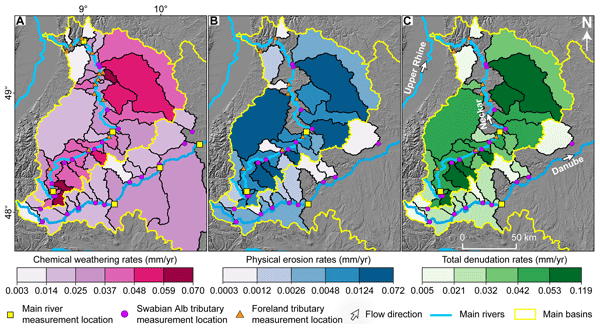
This study reports chemical weathering, physical erosion, and denudation rates from river load data in the Swabian Alb, southwestern Germany. Tributaries to the Neckar River draining to the north show higher rates than tributaries draining to the southeast into the Danube River, causing a retreat of the Swabian Alb escarpment. Observations are discussed in light of anthropogenic impact, lithology, and topography. The data are further compared to other rates over space and time and to global data.
Christoph Glotzbach and Todd A. Ehlers
Geochronology, 6, 697–717, https://doi.org/10.5194/gchron-6-697-2024, https://doi.org/10.5194/gchron-6-697-2024, 2024
Short summary
Short summary
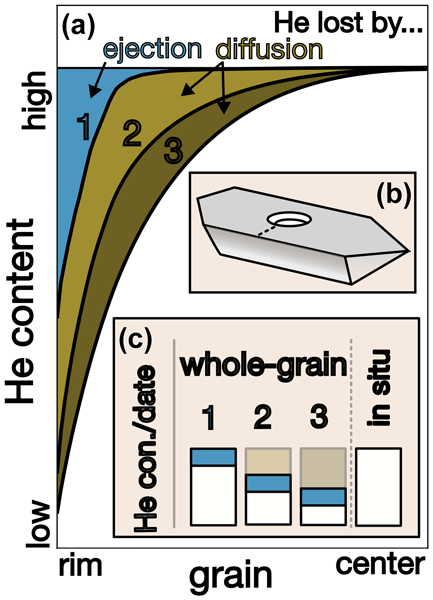
The (U–Th–Sm) / He dating method helps understand the cooling history of rocks. Synthetic modelling experiments were conducted to explore factors affecting in situ vs. whole-grain (U–Th) / He dates. In situ dates are often 30 % older than whole-grain dates, whereas very rapid cooling makes helium loss negligible, resulting in similar whole-grain and in situ dates. In addition, in situ data can reveal cooling histories even from a single grain by measuring helium distributions.
Andrea Madella, Christoph Glotzbach, and Todd A. Ehlers
Geochronology, 4, 177–190, https://doi.org/10.5194/gchron-4-177-2022, https://doi.org/10.5194/gchron-4-177-2022, 2022
Short summary
Short summary
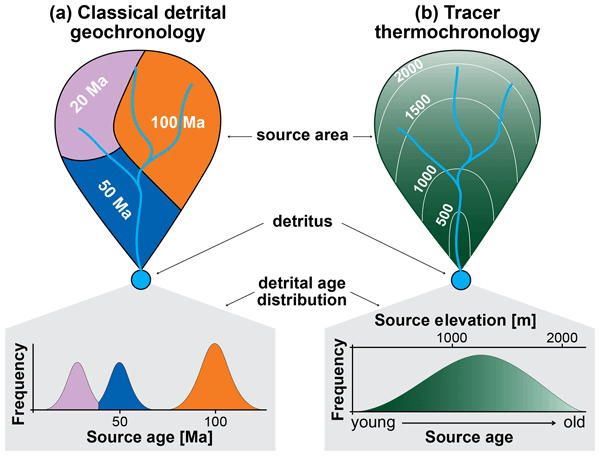
Cooling ages date the time at which minerals cross a certain isotherm on the way up to Earth's surface. Such ages can be measured from bedrock material and river sand. If spatial variations in bedrock ages are known in a river catchment, the spatial distribution of erosion can be inferred from the distribution of the ages measured from the river sand grains. Here we develop a new tool to help such analyses, with particular emphasis on quantifying uncertainties due to sample size.
Hemanti Sharma, Todd A. Ehlers, Christoph Glotzbach, Manuel Schmid, and Katja Tielbörger
Earth Surf. Dynam., 9, 1045–1072, https://doi.org/10.5194/esurf-9-1045-2021, https://doi.org/10.5194/esurf-9-1045-2021, 2021
Short summary
Short summary
We study effects of variable climate–vegetation with different uplift rates on erosion–sedimentation using a landscape evolution modeling approach. Results suggest that regardless of uplift rates, transients in precipitation–vegetation lead to transients in erosion rates in the same direction of change. Vegetation-dependent erosion and sedimentation are influenced by Milankovitch timescale changes in climate, but these transients are superimposed upon tectonically driven uplift rates.
Cited articles
Alexander, E., Mickelson, G., and Lanphere, M.: MMhb-1: a new 40Ar-39Ar dating standard, Short Papers of the Fourth International Conference, Geochronology, Cosmochronology, and Isotope Geology, U.S. Geological Survey, 78, 6–8, 1978.
Anderson, A. J., Hodges, K. V., and van Soest, M. C.: Empirical constraints on the effects of radiation damage on helium diffusion in zircon, Geochimica et Cosmochimica Acta, 218, 308–322, https://doi.org/10.1016/j.gca.2017.09.006, 2017.
Ault, A. K. and Flowers, R. M.: Is apatite U-Th zonation information necessary for accurate interpretation of apatite (U-Th) He thermochronometry data?, Geochimica et Cosmochimica Acta, 79, 60–78, https://doi.org/10.1016/j.gca.2011.11.037, 2012.
Ault, A. K., Gautheron, C., and King, G. E.: Innovations in (U-Th) He, Fission Track, and Trapped Charge Thermochronometry with Applications to Earthquakes, Weathering, Surface-Mantle Connections, and the Growth and Decay of Mountains, Tectonics, 38, 3705–3739, https://doi.org/10.1029/2018TC005312, 2019.
Beucher, R., Brown, R. W., Roper, S., Stuart, F., and Persano, C.: Natural age dispersion arising from the analysis of broken crystals: Part II. Practical application to apatite (U-Th) He thermochronometry, Geochimica et Cosmochimica Acta, 120, 395–416, https://doi.org/10.1016/j.gca.2013.05.042, 2013.
Binder, T., Marks, M. A. W., Gerdes, A., Walter, B. F., Grimmer, J., Beranoaguirre, A., Wenzel, T., and Markl, G.: Two distinct age groups of melilitites, foidites, and basanites from the southern Central European Volcanic Province reflect lithospheric heterogeneity, International Journal of Earth Sciences, 112, 881–905, https://doi.org/10.1007/s00531-022-02278-y, 2023.
Boyce, J. W., Hodges, K. V., Olszewski, W. J., Jercinovic, M. J., Carpenter, B. D., and Reiners, P. W.: Laser microprobe (U-Th) He geochronology, Geochimica et Cosmochimica Acta, 70, 3031–3039, https://doi.org/10.1016/j.gca.2006.03.019, 2006.
Brown, R. W., Beucher, R., Roper, S., Persano, C., Stuart, F., and Fitzgerald, P.: Natural age dispersion arising from the analysis of broken crystals, Part I: Theoretical basis and implications for the apatite (U-Th) He Thermochronometer, Geochimica et Cosmochimica Acta, 122, 478–497, https://doi.org/10.1016/j.gca.2013.05.041, 2013.
Colleps, C. L., van der Beek, P. A., Amalberti, J., Denker, A., Tremblay, M. M., Bernard, M., Dittwald, A. H., and Bundesmann, J.: Improving the Accessibility and Efficiency of Proton Irradiations for 4He 3He Thermochronology, Geochemistry, Geophysics, Geosystems, 25, https://doi.org/10.1029/2023GC011334, 2024
Danišík, M., McInnes, B. I. A., Kirkland, C. L., McDonald, B. J., Evans, N. J., and Becker, T.: Seeing is believing: Visualization of He distribution in zircon and implications for thermal history reconstruction on single crystals, Science Advances, 3, 1–10, https://doi.org/10.1126/sciadv.1601121, 2017.
Djimbi, D. M., Gautheron, C., Roques, J., Tassan-Got, L., Gerin, C., and Simoni, E.: Impact of apatite chemical composition on (U-Th) He thermochronometry: An atomistic point of view, Geochimica et Cosmochimica Acta, 167, 162–176, https://doi.org/10.1016/j.gca.2015.06.017, 2015.
Ehlers, T. A.: Crustal Thermal Processes and the Interpretation of Thermochronometer Data, Reviews in Mineralogy and Geochemistry; 58, 315–350, https://doi.org/10.2138/rmg.2005.58.12, 2005.
Farley, K. A., Wolf, R. A., and Silver, L. T.: The effects of long alpha-stopping distances on (U-Th) He ages, Geochimica et Cosmochimica Acta, 60, 4223–4229, https://doi.org/10.1016/S0016-7037(96)00193-7, 1996.
Farley, K. A.: (U-Th) He Dating: Techniques, Calibrations, and Applications, Mineralogy and Geochemistry, 47, 819–844, https://doi.org/10.2138/rmg.2002.47.18, 2002.
Farley, K. A., Shuster, D. L., Watson, E. B., Wanser, K. H., and Balco, G.: Numerical investigations of apatite 4He 3He thermochronometry, Geochemistry, Geophysics, Geosystems, 11, 1–18, https://doi.org/10.1029/2010GC003243, 2010.
Farley, K. A., Shuster, D. L., and Ketcham, R. A.: U and Th zonation in apatite observed by laser ablation ICPMS, and implications for the (U-Th) He system, Geochimica et Cosmochimica Acta, 75, 4515–4530, https://doi.org/10.1016/j.gca.2011.05.020, 2011.
Fitzgerald, P. G., Baldwin, S. L., Webb, L. E., and O'Sullivan, P. B.: Interpretation of (U-Th) He single grain ages from slowly cooled crustal terranes: A case study from the Transantarctic Mountains of southern Victoria Land, Chemical Geology, 225, 91–120, https://doi.org/10.1016/j.chemgeo.2005.09.001, 2006.
Flowers, R. M.: Exploiting radiation damage control on apatite (U-Th) He dates in cratonic regions, Earth and Planetary Science Letters, 277, 148–155, https://doi.org/10.1016/j.epsl.2008.10.005, 2009.
Flowers, R. M., and Kelley, S. A.: Interpreting data dispersion and “inverted” dates in apatite (U-Th) He and fission-track datasets: An example from the US midcontinent, Geochimica et Cosmochimica Acta, 75, 5169–5186, https://doi.org/10.1016/j.gca.2011.06.016, 2011.
Flowers, R. M., Ketcham, R. A., Shuster, D. L., and Farley, K. A.: Apatite (U-Th) He thermochronometry using a radiation damage accumulation and annealing model, Geochimica et Cosmochimica Acta, 73, 2347–2365, https://doi.org/10.1016/j.gca.2009.01.015, 2009.
Fox, M., Tripathy-Lang, A., and Shuster, D. L.: Improved spatial resolution of elemental maps through inversion of LA-ICP-MS data, Chemical Geology, 467, 30–4, https://doi.org/10.1016/j.chemgeo.2017.07.001, 2017.
Gautheron, C., Tassan-Got, L., Ketcham, R. A., and Dobson, K. J.: Accounting for long alpha-particle stopping distances in (U–Th–Sm) He geochronology: 3D modeling of diffusion, zoning, implantation, and abrasion, Geochimica et Cosmochimica Acta, 96, 44–56, https://doi.org/10.1016/j.gca.2012.08.016, 2012.
Gautheron, C., Pinna-Jamme, R., Derycke, A., Ahadi, F., Sanchez, C., Haurine, F., Monvoisin, G., Barbosa, D., Delpech, G., Maltese, J., Sarda, P., and Tassan-Got, L.: Technical note: Analytical protocols and performance for apatite and zircon (U–Th) He analysis on quadrupole and magnetic sector mass spectrometer systems between 2007 and 2020, Geochronology, 3, 351–370, https://doi.org/10.5194/gchron-3-351-2021, 2021.
Gerin, C., Gautheron, C., Oliviero, E., Bachelet, C., Mbongo Djimbi, D., Seydoux-Guillaume, A. M., Tassan-Got, L., Sarda, P., Roques, J., and Garrido, F.: Influence of vacancy damage on He diffusion in apatite, investigated at atomic to mineralogical scales, Geochimica et Cosmochimica Acta, 197, 87–103, https://doi.org/10.1016/j.gca.2016.10.018, 2017.
Glotzbach, C. and Ehlers, T. A.: Interpreting cooling dates and histories from laser ablation in situ (U–Th–Sm) He thermochronometry: a modelling perspective, Geochronology, 6, 697–717, https://doi.org/10.5194/gchron-6-697-2024, 2024.
Glotzbach, C., Lang, K. A., Avdievitch, N. N., and Ehlers, T. A.: Increasing the accuracy of (U-Th(Sm)) He dating with 3D grain modelling, Chemical Geology, 506, 113–125, https://doi.org/10.1016/j.chemgeo.2018.12.032, 2019.
Guenthner, W. R., Reiners, P. W., Ketcham, R. A., Nasdala, L., and Giester, G.: Helium diffusion in natural zircon: radiation damage, anisotropy, and the interpretation of zircon (U-TH) He thermochronology, American Journal of Science, 313, 145–198, https://doi.org/10.2475/03.2013.01, 2013.
Hansen, P. C. and O'Leary, D. P.: The Use of the L-Curve in the Regularization of Discrete Ill-Posed Problems, SIAM Journal on Scientific Computing, 14, 1487–1503, https://doi.org/10.1137/0914086, 1993.
Horne, A. M., van Soest, M. C., Hodges, K. V., Tripathy-Lang, A., and Hourigan, J. K.: Integrated single crystal laser ablation U Pb and (U-Th) He dating of detrital accessory minerals - Proof-of concept studies of titanites and zircons from the Fish Canyon tuff, Geochimica et Cosmochimica Acta, 178, 106–123, https://doi.org/10.1016/j.gca.2015.11.044, 2016.
Idleman, B. D., Zeitler, P. K., and McDannell, K. T.: Characterization of helium release from apatite by continuous ramped heating, Chemical Geology, 476, 223–232, https://doi.org/10.1016/j.chemgeo.2017.11.019, 2018.
Ketcham, R. A.: Forward and inverse modeling of low-temperature thermochronometry data, Reviews in Mineralogy and Geochemistry, 58, 275–314, https://doi.org/10.2138/rmg.2005.58.11, 2005.
Ketcham, R. A.: Thermal history inversion from thermochronometric data and complementary information: New methods and recommended practices, Chemical Geology, 653, 122042, https://doi.org/10.1016/j.chemgeo.2024.122042, 2024.
Ketcham, R. A., Gautheron, C., and Tassan-Got, L.: Accounting for long alpha-particle stopping distances in (U-Th-Sm) He geochronology: Refinement of the baseline case, Geochimica et Cosmochimica Acta, 75, 7779–7791, https://doi.org/10.1016/j.gca.2011.10.011, 2011.
Ketcham, R. A., Mora, A., and Parra, M.: Deciphering exhumation and burial history with multi-sample down-well thermochronometric inverse modelling, Basin Research, 30, 48–64, https://doi.org/10.1111/bre.12207, 2018.
Maier, A.-K., Glotzbach, C., and Falkowski, S.: Code and data supplement: Analytical and modelling strategies for thermal histories from in situ (U-Th-Sm) He data of single apatites, Zenodo [data set], https://doi.org/10.5281/zenodo.15856623, 2025.
McDowell, F. W., Mcintosh, W. C., and Farley, K. A.: A precise 40Ar–39Ar reference age for the Durango apatite (U–Th) He and fission-track dating standard, Chemical Geology, 214, 249–263, https://doi.org/10.1016/j.chemgeo.2004.10.002, 2005.
McInnes, B. I. A., Evans, N. J., Fu, F. Q., and Garwin, S.: Application of thermochronology to hydrothermal ore deposits, Reviews in Mineralogy and Geochemistry, 58, 467–498, https://doi.org/10.2138/rmg.2005.58.18, 2005.
Paton, C., Woodhead, J. D., Hellstrom, J. C., Hergt, J. M., Greig, A., and Maas, R.: Improved laser ablation U-Pb zircon geochronology through robust downhole fractionation correction, Geochemistry, Geophysics, Geosystems, 11, Q0AA06, https://doi.org/10.1029/2009GC002618, 2010.
Pickering, J., Matthews, W., Enkelmann, E., Guest, B., Sykes, C., and Koblinger, B. M.: Laser ablation (U-Th-Sm) He dating of detrital apatite, Chemical Geology, 548, 119683, https://doi.org/10.1016/j.chemgeo.2020.119683, 2020.
Reiners, P. W. and Farley, K. A.: Influence of crystal size on apatite (U-Th) He thermochronology: An example from the Bighorn Mountains, Wyoming, Earth and Planetary Science Letters, 188, 413–420, https://doi.org/10.1016/S0012-821X(01)00341-7, 2001.
Schoene, B. and Bowring, S. A.: U-Pb systematics of the McClure Mountain syenite: Thermochronological constraints on the age of the 40Ar 39Ar standard MMhb, Contributions to Mineralogy and Petrology, 151, 615–630, https://doi.org/10.1007/s00410-006-0077-4, 2006.
Shan, J., Min, K., and Nouiri, A.: Thermal effects of scanning electron microscopy on He diffusion in apatite : Implications for (U-Th) He dating. Chemical Geology, 345, 113–118, https://doi.org/10.1016/j.chemgeo.2013.03.001, 2013.
Shuster, D. L. and Farley, K. A.: 4He 3He thermochronometry, Earth and Planetary Science Letters, 217, 1–17, https://doi.org/10.1016/S0012-821X(03)00595-8, 2004.
Shuster, D. L., Flowers, R. M., and Farley, K. A.: The influence of natural radiation damage on helium diffusion kinetics in apatite, Earth and Planetary Science Letters, 249, 148–161, https://doi.org/10.1016/j.epsl.2006.07.028, 2006.
Sousa, F. J., Cox, S. E., Rasbury, E. T., Hemming, S. R., Lanzirotti, A., and Newville, M.: U and Th zonation in apatite observed by synchrotron X-ray fluorescence tomography and implications for the (U–Th) He system, Geochronology, 6, 553–570, https://doi.org/10.5194/gchron-6-553-2024, 2024.
Spiegel, C., Kohn, B., Belton, D., Berner, Z., and Gleadow, A.: Apatite (U-Th-Sm) He thermochronology of rapidly cooled samples: The effect of He implantation, Earth and Planetary Science Letters, 285, 105–114, https://doi.org/10.1016/j.epsl.2009.05.045, 2009.
Vamvaka, A., Siebel, W., Chen, F., and Rohrmüller, J.: Apatite fission-track dating and low temperature history of the Bavarian Forest (southern Bohemian Massif), International Journal of Earth Sciences, 103, 103–119, https://doi.org/10.1007/s00531-013-0945-x, 2014.
Vermeesch, P., Seward, D., Latkoczy, C., Wipf, M., Günther, D., and Baur, H.: α-Emitting mineral inclusions in apatite, their effect on (U-Th) He ages, and how to reduce it, Geochimica et Cosmochimica Acta, 71, 1737–1746, https://doi.org/10.1016/j.gca.2006.09.020, 2007.
Vermeesch, P., Sherlock, S. C., Roberts, N. M. W., and Carter, A.: A simple method for in-situ U-Th-He dating, Geochimica et Cosmochimica Acta, 79, 140–147, https://doi.org/10.1016/j.gca.2011.11.042, 2012.
Vermeesch, P., Tian, Y., Schwanethal, J., and Buret, Y.: Technical note: In situ U–Th–He dating by 4He 3He laser microprobe analysis, Geochronology, 5, 323–332, https://doi.org/10.5194/gchron-5-323-2023, 2023.
Wolf, R. A., Farley, K. A., and Silver, L. T.: Helium diffusion and low-temperature thermochronometry of apatite, Geochimica et Cosmochimica Acta, 60, 4231–4240, https://doi.org/10.1016/S0016-7037(96)00192-5, 1996.
Wolf, R. A., Farley, K. A., and Kass, D. M.: Modeling of the temperature sensitivity of the apatite (U-Th) He thermochronometer, Chemical Geology, 148, 105–114, https://doi.org/10.1016/S0009-2541(98)00024-2, 1998.
Zeitler, P. K., Herczeg, A. L., McDougall, I., and Honda, M.: U-Th-He dating of apatite: A potential Thermochronometer, Geochimica et Cosmochimica Acta, 51, 2865–2868, https://doi.org/10.1016/0016-7037(87)90164-5, 1987.
Zeitler, P. K., Enkelmann, E., Thomas, J. B., Watson, E. B., Ancuta, L. D., and Idleman, B. D.: Solubility and trapping of helium in apatite, Geochimica et Cosmochimica Acta, 209, 1–8, https://doi.org/10.1016/j.gca.2017.03.041, 2017
Short summary
(U-Th-Sm)/He dating is a tool to investigate when and how rocks cooled through the upper Earth’s crust. We explore strategies to reconstruct thermal histories of individual apatite crystals by direct measurement of their helium concentration profile and radionuclide distribution. This approach allows for the inclusion of inhomogeneous grains in thermal modelling, which is often problematic in traditional (U-Th-Sm)/He methods.
(U-Th-Sm)/He dating is a tool to investigate when and how rocks cooled through the upper Earth’s...