
the Creative Commons Attribution 4.0 License.
the Creative Commons Attribution 4.0 License.
 | 05 May 2026
Paired 14C–10Be exposure ages from Mount Murphy, West Antarctica: Implications for accurate and precise deglacial chronologies
Jonathan R. Adams
Dylan H. Rood
Klaus Wilcken
Stephen J. Roberts
Joanne S. Johnson
Cosmogenic-nuclide surface exposure ages provide empirical data for validating models simulating the timing and pace of ice-sheet response to a warming climate. Increasing emphasis is being placed on obtaining exposure ages that both accurately constrain Holocene deglaciation and are precise enough to capture ice sheet change at the sub-millennial scale. However, longer-lived nuclides such as 10Be are susceptible to cosmogenic nuclide inheritance often persisting through multiple periods of exposure and burial, which can impact the accuracy of the most recent Holocene exposure history. Shorter-lived in situ cosmogenic 14C (in situ 14C) is largely insensitive to nuclide inheritance pre-dating the last glacial maximum (LGM), and when combined with longer-lived nuclides can be used to constrain complex ice sheet histories over Holocene timescales. Here, we present new in situ 14C exposure ages from nine erratic cobbles from Mount Murphy, West Antarctica. Six of these suggest Mt Murphy deglaciated from 5–3 ka; this is inconsistent with previously measured 10Be ages of the same samples that place deglaciation from 8–6 ka. We investigate potential explanations for the conflicting exposure histories by analysing paired 14C–10Be data of Holocene age presently archived in the informal cosmogenic-nuclide exposure-age database (ICE-D, https://version2.ice-d.org/, last access: 29 March 2024). Our analysis reveals that neither variations in geologic setting nor modelled scenarios of subsurface nuclide production can explain the conflicting Mt Murphy ages. However, replicate in situ 14C measurements indicate that initial in situ 14C concentrations used to calculate the youngest exposure ages (5–3 ka) do not reproduce within stated 2σ uncertainty, whereas measurements used to calculate the older ages (8–6 ka) are reproducible. Furthermore, we observe that in situ 14C concentrations measured in 15 of 31 samples taken from ICE-D do not replicate within their nominal 2σ analytical uncertainty. Together, these results suggest that analytical uncertainty for in situ 14C measurements may currently be underestimated. We provide recommendations for improving measurement precision that will benefit future Holocene deglaciation studies, including analysis and publication of more replicate measurements and the continuation of efforts to quantify and minimise sources of scatter in blank measurements.
- Article
(5121 KB) - Full-text XML
-
Supplement
(5704 KB) - BibTeX
- EndNote


Increasing emphasis is being placed on glacial chronologies that both constrain the timing of ice-surface change during the Holocene epoch and provide validation for model simulations at sub-millennial scale resolution (Hippe, 2017; Johnson et al., 2022; Jones et al., 2022; Nichols et al., 2019). For model validation, cosmogenic radionuclide (e.g., in situ cosmogenic 14C, hereafter in situ 14C, and 10Be) exposure ages must both be accurate and precise. Accurate determination of a Holocene exposure age relies on the assumption that the sample being dated is free from nuclides accumulated during periods of surface exposure that pre-date the LGM (Balco, 2011). The prevalence of cold-based ice and consequent lack of basal erosion, however, often leads to nuclide inheritance where longer-lived nuclides such as 10Be (half-life; 1.387 Myr) persist over multiple glacial cycles (Balco, 2011; Hein et al., 2014). The shorter half-life of in situ 14C (5700±30 years) greatly reduces the impact of any pre-LGM exposure on 14C exposure ages constraining the most recent deglaciation. For instance, a rock surface exposed prior to the LGM for long enough to reach in situ 14C saturation (equilibrium between production and decay), deeply shielded by ice at 25 ka, and re-exposed at 10 ka would contain a pre-LGM in situ 14C inventory that only accounted for ∼6 % of the in situ 14C measured in that rock surface at the present day (Balco et al., 2019). In situ 14C is therefore unique among cosmogenic nuclides for being largely insensitive to pre-LGM exposure, making it ideal for studying Holocene deglacial histories. However, measuring in situ 14C in quartz is extremely challenging and was not routinely possible until relatively recently (Lifton et al., 2001).
Following efforts to develop and improve in situ 14C extraction procedures (Fülöp et al., 2010, 2015, 2019; Goehring et al., 2014, 2019a; Hippe et al., 2009, 2013; Lamp et al., 2019; Lifton et al., 2001, 2015b, 2023; Lifton, 1997; Lupker et al., 2019), the method has been successfully applied to accurately determine Holocene exposure where 10Be inheritance is known or suspected (Briner et al., 2014; Nichols et al., 2019; White et al., 2011). Combining analyses of short-lived in situ 14C with longer-lived 10Be has provided a valuable approach to detecting and quantifying complex exposure histories (Hippe, 2017). If measurement precision of both nuclides is sufficient to resolve past ice sheet behaviour at the sub-millennial timescale, then this method can be a powerful way of identifying and quantifying phases of retreat and readvance in the later Holocene, for which there is emerging evidence (Balco et al., 2023; Kingslake et al., 2018; Venturelli et al., 2020, 2023).
In this study, we present new in situ 14C exposure ages measured in samples from Mt Murphy, a volcano adjacent to Thwaites Glacier in the Amundsen Sea Embayment (Fig. 1a). When compared to previously published 10Be ages (Adams et al., 2022; Johnson et al., 2020), our new in situ 14C ages apparently suggest two conflicting exposure histories at Mount Murphy. Some paired in situ 14C–10Be ages from the same sample are concordant (where the paired 14C–10Be ages agree within uncertainty), indicating the sample experienced a simple post-LGM exposure history. Others are discordant (the paired 14C–10Be ages do not overlap within analytical uncertainty), indicating that a sample experienced burial since post-LGM exposure or that there were changes in the nuclide production rate (Balco et al., 2019).
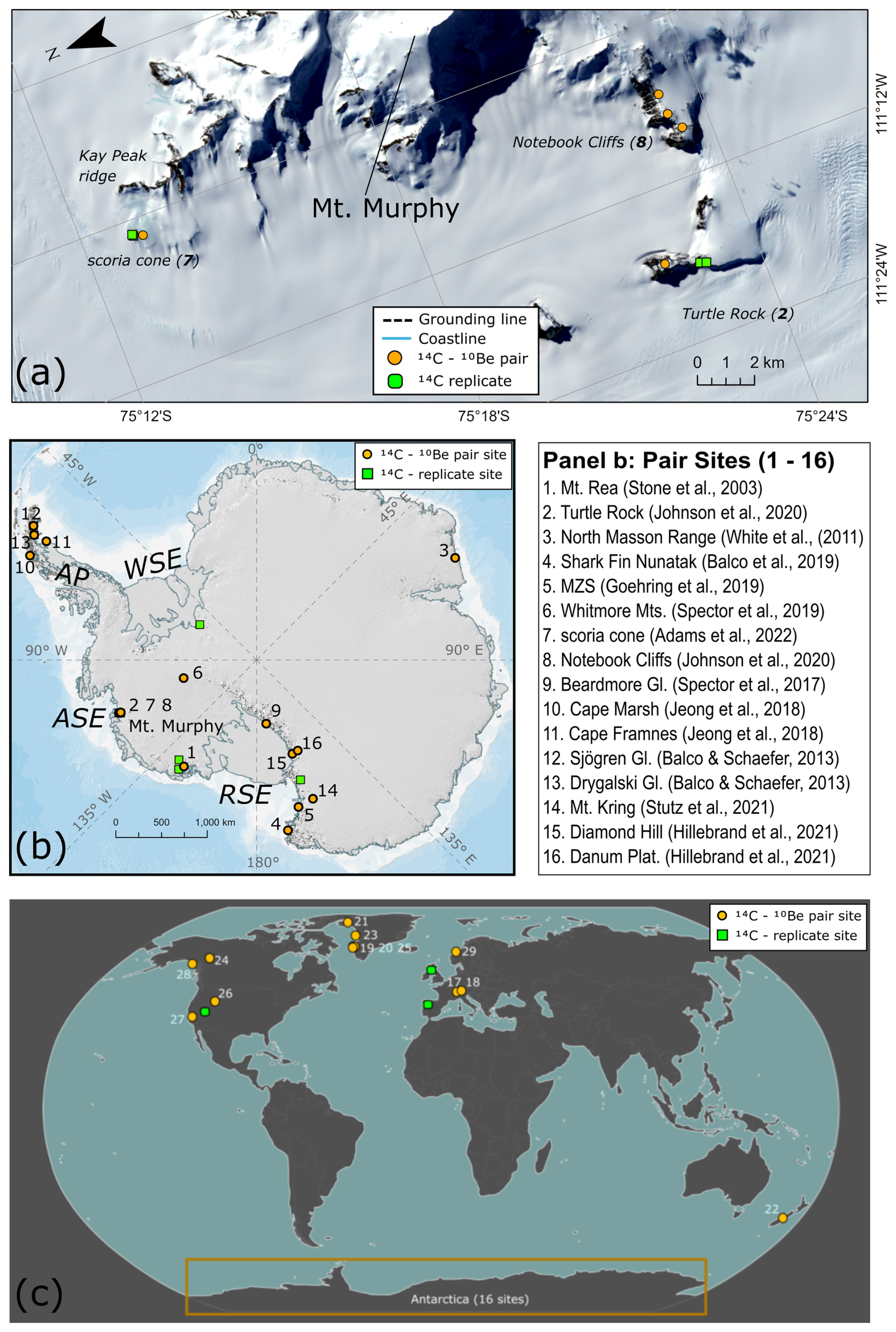
Figure 1Panel (a) a Landsat-9 satellite image of the Turtle Rock, scoria cone and Notebook Cliffs sites at Mt Murphy showing locations of samples with new in situ 14C exposure ages and previously published 10Be exposure ages. Grounding line position uses data from (Milillo et al., 2022) and Antarctic Coastline is from version 7.7 of the Antarctic Digital Database. Panel (b) shows Antarctic and panel (c) global site locations of paired 14C–10Be ages (sites 1–29) where both: (i) apparent 10Be exposure ages are older than apparent 14C exposure ages (ii) 10Be exposure ages are of Holocene age (<11.7 ka) which are relevant to Sect. 4. of this manuscript but introduced here to better contextualise our results from Mt Murphy. Site numbering uses the order of the specific site ID (lowest to highest) that locations have been assigned in ICE-D (Balco, 2020b). Panel (b) Antarctic paired 14C–10Be site locations (1–16) are specified in an inset figure key. Panel (b) abbreviations indicate the Antarctic Peninsula (AP), Amundsen Sea Embayment (ASE), Ross Sea embayment (RSE) and Weddell Sea embayment (WSE). Details of global site locations (17–29) displayed in panel (c) are specified in Results, Table 4. Green squares in panel (c) indicate locations where multiple in situ 14C measurements have been made on the same sample including Lake Bonneville, Utah, Northwest Highlands, Scotland and Leymon High, Northwest Spain (see Fig. 8 and Table S3 in the Supplement). Note in panel (a) the corresponding site number from the global site index (1–29) is specified in bold italics along with the name of the sample site, e.g., Turtle Rock (2). Note in panel (b) paired in situ 14C–10Be sites 2, 7, 11 and 13 also contain replicate in situ 14C measurements but only the paired 14C–10Be symbol (orange circle) is displayed.
Here, we describe an investigation into potential explanations for co-existing concordant and discordant paired 14C–10Be Holocene exposure ages observed at Mt Murphy. We do this by revisiting the data of Johnson et al. (2020) and Adams et al. (2022), and performing a more in-depth examination of sources of uncertainty associated with both in situ 14C and 10Be exposure ages. First, we present a new in situ 14C dataset from Mt Murphy (paired with previously published 10Be measurements) (Fig. 1a) and assess the accuracy and reproducibility of this new dataset. We then perform a sensitivity analysis using blank and CRONUS-A quality control data (Table S5, Balco et al., 2023) and assess its impact on our new in situ 14C data. Finally, we contextualise the new Mt Murphy dataset by analysing available 14C–10Be paired exposure age data that is of Holocene age () from Antarctica (Fig. 1b) and globally (Fig. 1c). These paired 14C–10Be data are primarily sourced from publicly available data archived in the Informal Cosmogenic-nuclide Exposure age Database (Balco, 2020b) (https://version2.ice-d.org/, last access: 29 March 2024). By documenting our rigorous investigation of a challenging paired in situ 14C–10Be dataset from Mt Murphy, West Antarctica, we aim to provide a conceptual framework with which the growing end-user community may better critically test, diagnose, and improve the accuracy and precision of future in situ 14C cosmogenic exposure ages using multinuclide (e.g., in situ 14C–10Be) methods, and identify steps the community could take to consistently produce robust Holocene glacial chronologies.
1.1 Sources of uncertainty that impact in situ 14C and 10Be exposure ages
To provide additional context for our results and discussion, we first outline sources of uncertainty that need to be accounted for when calculating in situ 14C and 10Be exposure ages, and introduce the concept of paired nuclide diagrams (Granger, 2006). Uncertainty impacts both accuracy and precision at all stages of determining an exposure age of a sample and can be divided broadly into three categories: (i) geologic uncertainty (ii) uncertainty incorporated during sample preparation and isotopic analysis to determine a nuclide concentration and (iii) uncertainty sourced from exposure age calculations.
Cosmogenic nuclide practitioners have least control over geologic uncertainty, which is inherent in a sample from its time of collection in the field and rooted in the limited knowledge we have of a sample's true exposure history and any processes that may have modified production of nuclides following exposure (Dunai, 2010). The two main sources of geologic uncertainty are nuclide inheritance (described above) and post depositional disturbance caused by shielding, erosion, and/or rolling of a sample (Balco, 2011; Gosse and Phillips, 2001). Steps commonly taken to reduce their impact include a robust and detailed geologic interpretation of deposits or depositional features being dated (Balco, 2011) and statistical techniques (Heyman et al., 2016; Johnson et al., 2014). Comprehensive summaries of geologic uncertainty and efforts to quantify it can be found in Balco et al., (2011, 2020b).
The second major source of uncertainty comes from our ability to measure the nuclide concentration accurately and precisely within a sample, which represents the internal uncertainty component of an exposure age calculation (Balco, 2020a). Cosmogenic nuclide dating specialists make efforts to minimise contributions to measurement uncertainty particularly from i) uncertainties introduced during sample preparation, and ii) sample measurement by accelerator mass spectrometry (AMS). Measurement of the cosmogenic nuclide 10Be is now relatively well-established and routine following efforts to reduce sources of laboratory sample preparation uncertainty (Corbett et al., 2016, 2022; Kohl and Nishiizumi, 1992) and improve AMS performance (Merchel et al., 2012; Rood et al., 2010, 2013; Wilcken et al., 2022). These efforts have resulted in 10Be measurement precision on typical quartz interlaboratory comparison materials (e.g., CRONUS-A, CoQtz-N) of between (Binnie et al., 2019; Jull et al., 2015; Phillips et al., 2016a). For high in situ 14C concentrations ( internal analytical uncertainty is dominated by AMS counting statistics, with a total measurement uncertainty (combined AMS counting error and blank correction) averaging<2 % (Goehring et al., 2014; Hippe, 2017). For moderate in situ 14C concentrations in the 104 at g−1 range, the uncertainty from AMS counting statistics increases, but typically remains below 10 % and mostly below 5 % (Hippe, 2017). However, for lower in situ 14C concentrations the blank correction increasingly dominates, leading to a rapid increase in total uncertainty (Goehring et al., 2014; Hippe, 2017). These sources of uncertainty have been challenging to quantify despite improvements to in situ 14C extraction from quartz (Fülöp et al., 2010, 2015, 2019; Goehring et al., 2014, 2019a; Hippe et al., 2009, 2013; Lamp et al., 2019; Lifton et al., 2001, 2015b, 2023; Lifton, 1997; Lupker et al., 2019) and the dominance of the blank at lower concentrations illustrates the significant challenges of avoiding contamination from other potential sources of C that impart uncertainty into the final in situ 14C measurement. Laboratory intercomparison reproducibility studies of CRONUS-A (an intercomparison material for cosmogenic nuclides including 14C and 10Be) indicate the coefficient of variation (CoV) of in situ 14C concentration measurements is in the range of 6 %–8 %, and 3 %–4 % for 10Be (Phillips et al., 2016a). There have also been several recent improvements to the in situ 14C extraction process, including identification of potential contaminant sources introduced during quartz purification (Nichols and Goehring, 2019), and automation of 14C extraction lines that reduce risk of atmospheric 14C contamination (Goehring et al., 2019a; Lifton et al., 2015b, 2023; Lupker et al., 2019). Refinements to the stepped heating process to liberate in situ 14C (in the form of CO2) from quartz are also being explored (Lifton et al., 2023) and some extraction facilities now omit the graphitisation stage (that converts CO2 to C) in favour of analysing in situ 14C directly using gas source AMS (e.g., Lamp et al., 2019).
The final major source of uncertainty comes from transforming a measured nuclide concentration into an exposure age. This requires estimating the production rate due to secondary spallation reactions, which accounts for the majority of surface production (Dunai, 2010), and muons (Balco, 2017). Production rate uncertainties have been incrementally reduced via improvements in scaling models, especially more recent models based on particle-physics simulations (Argento et al., 2015a, b; Lifton et al., 2014). Estimates of the 10Be production rate uncertainty from spallation are currently in the range of 6 % (Borchers et al., 2016; Marrero et al., 2016). However, in the case of in situ 14C, a spallogenic production rate uncertainty could not be fitted to calibration data because of scatter in excess of an assumed measurement uncertainty of 7.3 % for in situ 14C concentrations at selected calibration sites (Borchers et al., 2016). Muons account for a much smaller proportion of total cosmogenic nuclide production at the surface than spallation, but this quantity differs between 10Be and in situ 14C. The proportion of 10Be production by muons at the surface is between 1.5 %–2 %, which translates to a maximum scaling uncertainty of only 0.5 % for estimating total 10Be surface production by muons. However, for in situ 14C, production by muons accounts for ∼20 % of total in situ 14C nuclide production at the surface (Lupker et al., 2015). Therefore, for in situ 14C the same 10 %–25 % uncertainty on computing a production rate by muons equates to between a 2 % and maximum 5 % uncertainty on the total surface production rate estimate (Balco, 2017).
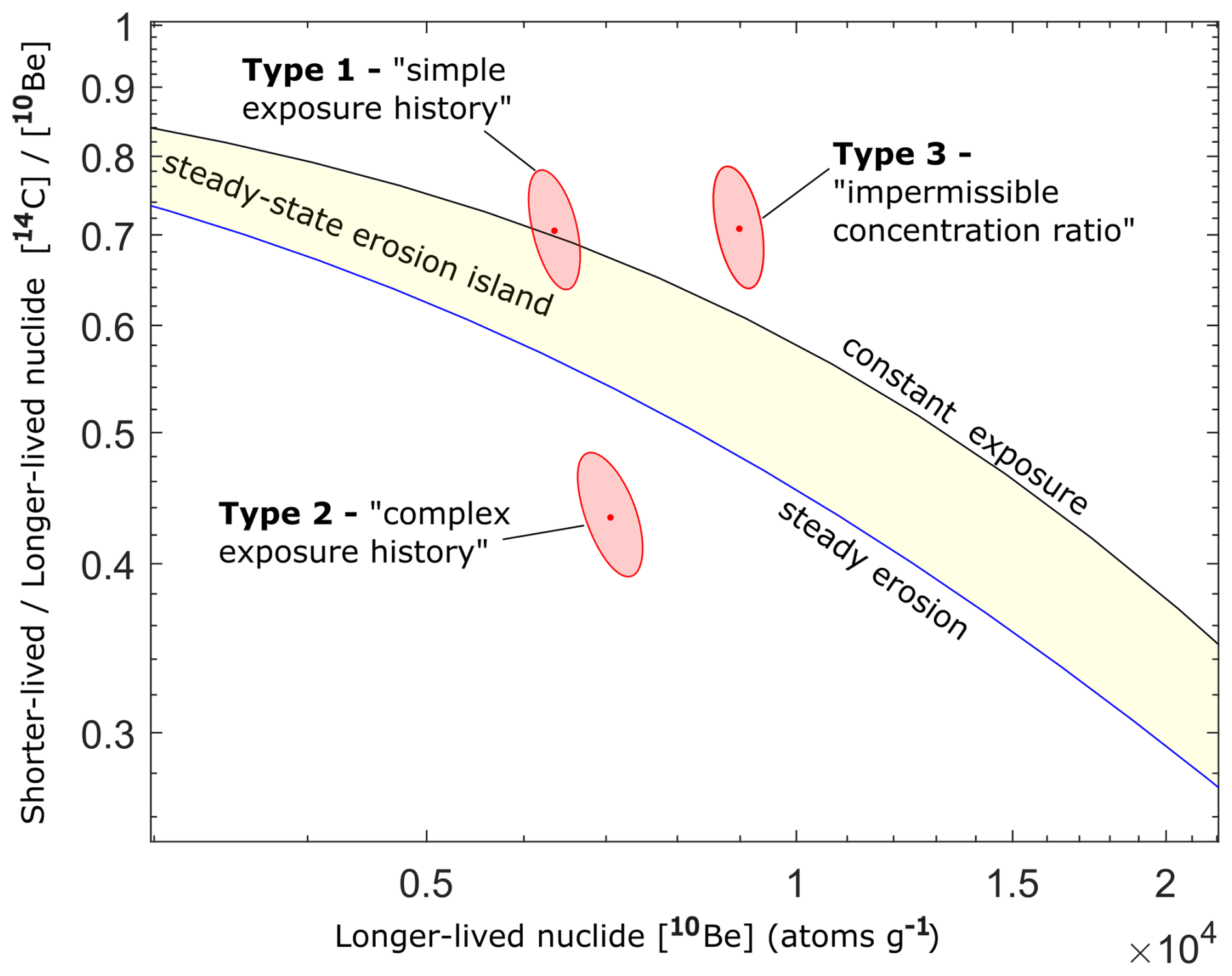
Figure 2Paired nuclide diagram with key features labelled. Note that the x-axis includes the concentration of the longer-lived nuclide, in this case 10Be, and the y-axis is the ratio of the concentration of the shorter- to longer-lived nuclide, in this case 14C–10Be. Both axes are normalised to the local nuclide production rate at each sample location using the LSDn scaling model. Uncertainty ellipses (68 % confidence) are plotted using code from the online calculators formerly known as the CRONUS-Earth online calculators (Balco et al., 2008). Constant exposure line (upper black), steady erosion line (lower blue), and steady-state erosion island (yellow shaded) are labelled on the figure. Paired nuclide diagram terminology from (Granger, 2006).
Due to the inherently different systematics of production and radioactive decay of in situ 14C and 10Be, paired nuclide diagrams (Fig. 2) represent a useful method of visualizing and interpreting exposure/burial histories, and can help to identify or explain uncertainty and scatter in a dataset (see Granger, 2006 for a detailed description of paired nuclide diagrams). Paired nuclide plots generated from exposure age pairs (including 14C–10Be pairs) can be classed into three distinct types: Type 1 for samples with simple exposure history (only one period of exposure), Type 2 for samples with a complex exposure history (multiple periods of exposure and burial), and Type 3 for samples with an impermissible concentration ratio (where an ellipse plots above the line of constant exposure in the “impermissible” zone). The Type 3 scenario can indicate analytical inconsistencies, for example, 14C contamination increasing in situ 14C concentrations (Nichols and Goehring, 2019) or could reflect application of an incorrect production rate to one or both nuclides. In certain cases, a Type 3 nuclide ratio may be explained geologically because the constant exposure line assumes a surface production rate rather than subsurface production. However, because the cosmogenic nuclide production rate by muons as a proportion of total surface production is an order of magnitude higher for in situ 14C than for 10Be, the 14C–10Be production ratio increases with depth below the surface (Hippe, 2017). For example, a sample that is buried under a thin layer of rock, ice, till or other material and then rapidly exhumed by plucking can, therefore, exhibit seemingly “impermissible” paired 14C–10Be concentrations due to differences in the 14C–10Be total production ratio at the surface versus at depth (Hippe, 2017; Rand and Goehring, 2019).
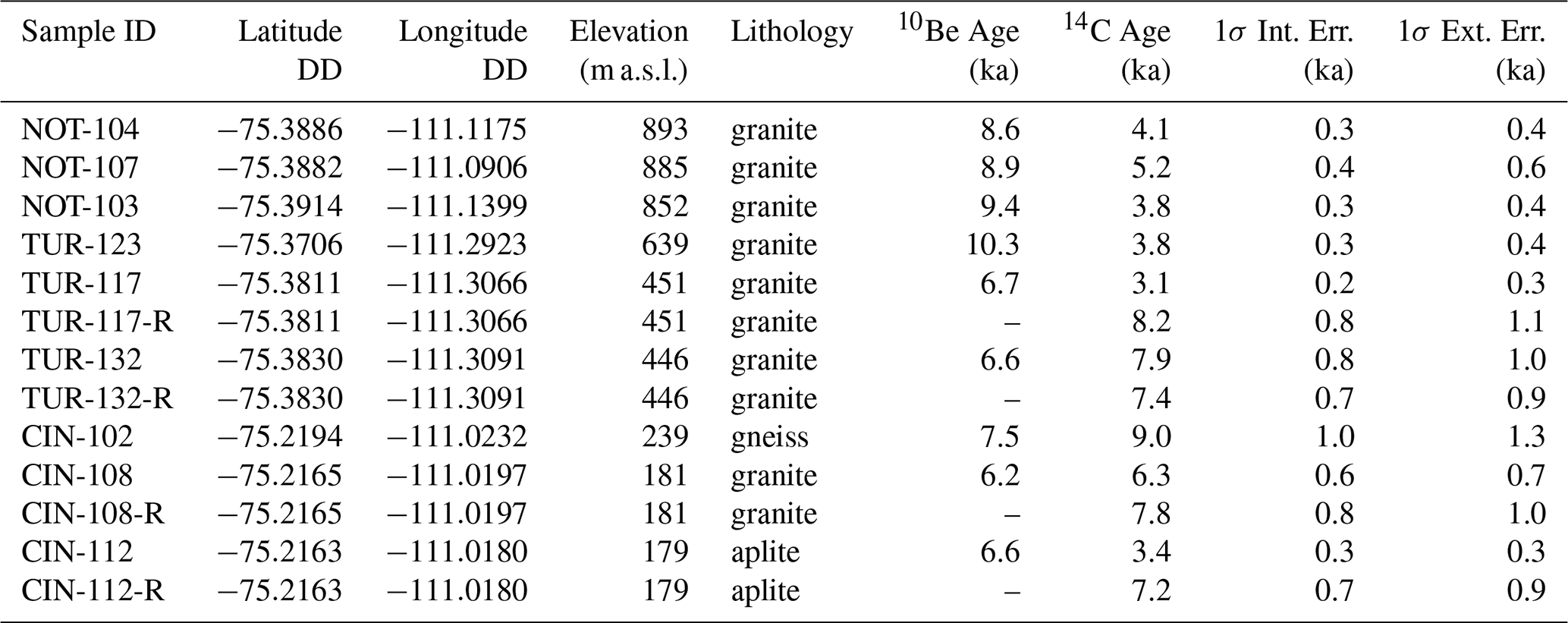
Table 1New in situ 14C exposure ages from sites at Mt Murphy: Notebook Cliffs (NOT), Turtle Rock (TUR) and scoria cone (CIN). Exposure ages were calculated based on the blank correction reported from the Tulane CNL of for initial 14C measurements (n=9) and for replicate measurements using the LSDn scaling scheme. A nominal 6 % measurement uncertainty based on reproducibility of CRONUS-A reported from Tulane CNL of at g−1 (n=10) (Goehring et al., 2019a) is assigned to 1σ internal 14C uncertainties and propagated into 1σ external uncertainties. Sample IDs appended with R denote repeat measurements. See Table S1 for full in situ 14C AMS dataset. Previously published 10Be ages measured from the same sample (Adams et al., 2022; Johnson et al., 2020) are included to facilitate comparison.
In summary, sources of geologic, sample preparation, and exposure age calculation uncertainty impact the accuracy and precision of Holocene deglaciation chronologies. An increase in paired 14C–10Be measurements in the recent ∼5 years, driven by greater 14C extraction throughput (Goehring et al., 2019a; Lifton et al., 2015b, 2023) provide many new data to make an assessment of the application of both nuclides and investigate sources of uncertainty, particularly of in situ 14C. In the following sections, we investigate the cause of concordant and discordant paired in situ 14C–10Be exposure ages at Mt Murphy and potential causes for the large amounts of scatter in reported in situ 14C measurements using new in situ 14C data from Mt Murphy and existing paired in situ 14C–10Be data extracted from ICE-D.
2.1 Site description and sample selection
Mount Murphy is a large volcanic edifice adjacent to Thwaites Glacier in the Amundsen Sea Embayment (Fig. 1a). Along its western flank, adjacent to Pope Glacier, there are several smaller nunataks, many of which host erratic cobbles and boulders that are well-rounded and of exotic lithology, indicating transport to the site by ice. We selected nine samples from erratics (Table 1) for in situ 14C analysis. These had previously been measured for 10Be (Adams et al., 2022; Johnson et al., 2020), with the resultant thinning history implying exposure during the Holocene. We selected four of the nine samples for repeat in situ 14C measurements to determine if measurement uncertainty may have contributed to conflicting exposure histories suggested by initial in situ 14C concentrations from our samples.
We ensured that paired 10Be and 14C exposure ages cover a wide elevation range by selecting samples from three different locations around the Mt Murphy massif (Notebook Cliffs, samples collected from 893–834 m a.s.l. (metres above sea level), Turtle Rock, 696–438 m a.s.l., and a scoria cone adjacent to Kay Peak, 239–178 m a.s.l.). Notebook Cliffs comprises basaltic lava flows overlying thick sequences of hyaloclastite (Adams et al., 2025; Smellie, 2001). A few granite erratics and SSE–NNW trending bedrock striations are present, indicating past ice-cover (Johnson et al., 2020). Turtle Rock, situated adjacent to Pope Glacier, is primarily composed of hyaloclastite and consists of a broad flat lower terrace (438–452 m a.s.l.), which hosts the highest number of erratics observed at Mt Murphy (Johnson et al., 2020). Turtle Rock rises at its northern end to ∼710 m a.s.l. and consists of several superimposed sequences of basalt and hyaloclastite, with erratics collected from three smaller terraces up to 696 m a.s.l. (Johnson et al., 2008, 2020). The scoria cone is located>15 km downstream of Notebook Cliffs and Turtle Rock and is less than 1 km from the grounding line of Pope Glacier. The site consists of two small outcrops comprised of rubbly oxidised scoria bounded on one side by a moraine (Adams et al., 2022; Nichols et al., 2024). Cobbles deposited on the outcrops are generally well-rounded suggesting long distance transport (Adams et al., 2022). Detailed geological and geomorphological descriptions of these sites are provided by Johnson et al. (2020) and Smellie (2001). Geomorphic descriptions and supporting information of the nine samples with paired 14C–10Be measurements are provided in Sect. S1 and Table S2 in the Supplement.
2.2 In situ 14C analysis of Mt Murphy samples
We obtained purified quartz necessary for in situ 14C extraction of initial and replicate samples by performing mineral separation on our whole rock samples in the CosmIC Laboratory at Imperial College London (UK), largely following methods specified in Corbett et al. (2016). We omitted the froth flotation step (used to separate feldspars and quartz) following recommendations made by Nichols and Goehring (2019) and instead performed 3×1 % HF/HNO3 etches to isolate the quartz (Kohl and Nishiizumi, 1992). Quartz purity was determined using Inductively Coupled Plasma Optical Emission Spectrometry (ICP-OES), after which ∼10 g of purified quartz from each sample was sent to Tulane University Cosmogenic Nuclides Laboratory (Tulane CNL, New Orleans, USA) for in situ 14C extraction. Extraction of in situ 14C was performed using the fully automated Tulane University Carbon Extraction and Graphitisation System (TU-CEGS) following methods presented in Balco et al. (2023), modified from Goehring et al. (2019a). Sample aliquots of purified quartz ranging from 3–5 g were loaded into platinum crucibles and fused with lithium metaborate (LIBO2) flux to ensure sample dissolution and complete liberation of in situ 14C (Lifton et al., 2001). The sample was heated in a stable high purity O2 atmosphere for 30 min at 500 °C to remove atmospheric 14C and organic contaminants. Following evacuation of the furnace and addition of new high purity O2, the sample was further heated to 1100 °C for 3 h to completely dissolve the quartz and liberate in situ 14C (in the form of CO2). Liberated CO2 was cryogenically purified before being collected in a measurement chamber, quantified monometrically and diluted with 14C-free CO2 to ensure a measurable sample size (Goehring et al., 2019a). CO2 was graphitized using standard H2 reduction methods over an Fe catalyst (Santos et al., 2004, 2007; Southon, 2007). Several changes were made to the configuration of the TU-CEGS prior to the replicate measurements (n=4). Alterations included the introduction of a new compact borosilicate coil trap held at liquid nitrogen temperature (−196 °C) for trapping evolved CO2 following quartz dissolution (Lifton et al., 2015b, 2023, 2001; Pigati et al., 2010), which replaced the previously installed variable temperature trap (Goehring et al., 2019a). A new mullite tube was also used for 14C extraction due to failure of the previous tube; mullite tubes at Tulane CNL have previously been observed to undergo a “break in” period, during which initial 14C blanks are higher but often fall with continued use (Goehring et al., 2019a). 14C/12C isotope ratios were measured by AMS at the National Ocean Sciences Accelerator Mass Spectrometry Facility (NOSAMS) (Woods Hole, USA) using the methods described in Longworth et al. (2015). A small aliquot of 2–3 µg of C was removed for δ13C analysis at the University of California Davis Stable Isotope Facility (see Table S1 in the Supplement). Data reduction to convert 14C/12C ratios to 14CCtotal followed methods outlined in Hippe and Lifton, (2014). We applied the blank correction reported from the Tulane CNL of for initial 14C measurements (n=9) and for replicate measurements (n=4, Table S1), respectively, to total measured in situ 14C concentrations. Prior to calculating exposure ages, we assigned a 6 % (1σ) uncertainty to each in situ 14C measurement concentration reported by AMS. This 6 % uncertainty exceeds the reported analytical uncertainty for all in situ 14C measurements made for this study and reflects the reproducibility of replicate measurements of CRONUS-A extracted at Tulane CNL, which is reported as at g−1 (n=10) (Goehring et al., 2019a). This 6 % uncertainty has been routinely applied by studies where in situ 14C extraction was carried out at Tulane CNL, e.g., (Nichols et al., 2019).
We calculated exposure ages for the new in situ 14C measurements, as well as for the published 10Be measurements, using version 3 of the online calculators (https://hess.ess.washington.edu/math/v3/v3_age_in.html, last access: 10 September 2025) with the “LSDn” production rate scaling method for neutrons, protons, and muons (following Lifton et al., 2014 and summarised in Balco, 2017). For 10Be, exposure ages were calculated based on the CRONUS-Earth primary production rate calibration data set of Borchers et al. (2016). For in situ 14C, we used the long-term CRONUS-A measurements from extractions performed at Tulane CNL presented in Goehring et al. (2019a) for production rate calibration. When comparing in situ 14C and 10Be exposure ages at Mt Murphy, we used the external uncertainty, which includes the 6 % (1σ) measurement uncertainty propagated in quadrature with the production rate and scaling scheme uncertainties. We report all exposure ages assuming no erosion or snow cover (making them “apparent” exposure ages) and a sample density of 2.7 g cm−3 to maintain consistency with Johnson et al. (2020) and Adams et al. (2022). In situ 14C AMS data and corresponding calculated exposure ages are available from the NERC UK Polar Data Centre, https://doi.org/10.5285/dbb30962-bbf3-434a-9f27-6de2f61a86e2 (Adams et al., 2024).
3.1 In situ 14C exposure ages from Mt Murphy
Thirteen in situ 14C measurements (including four replicate measurements) were performed on nine erratic samples recovered from Notebook Cliffs, Turtle Rock, and the unnamed scoria cone (all from surfaces situated between 179 and 893 m a.s.l.). Exposure ages calculated from nuclide concentrations (Table 1) are reported with 1σ internal uncertainties unless otherwise stated. Initial in situ 14C exposure ages from the nine samples range from 9.0±1.0 ka to 3.1±0.2 ka (Table 1 and Fig. S9 in the Supplement), with an average exposure age of 6.0±2.1 ka (mean and standard deviation). At the unnamed scoria cone, in situ 14C exposure ages exhibit considerable scatter over a small elevation range (180–240 m a.s.l.) with ages ranging from 9.0±1.0 ka to 3.4±0.3 ka. The spread of in situ 14C exposure ages calculated from initial measured in situ 14C concentrations is ∼6 kyr, and some samples at higher elevations yield younger exposure ages than samples from lower elevations, which is the inverse of the expected age-elevation pattern associated with ice-sheet thinning through time. Apparent exposure ages from Notebook Cliffs (850–900 m a.s.l.) are 2 kyr younger than those from the scoria cone (180–240 m a.s.l.).
Repeat in situ 14C measurements (n=4) were made on samples TUR-117 and TUR-132 from Turtle Rock (450–650 m a.s.l.), and samples CIN-108, and CIN-112 from scoria cone (180–240 m a.s.l.) to determine if measurement reproducibility contributed to the two conflicting exposure histories suggested by initial in situ 14C concentrations. Exposure ages calculated from the four repeat measurements range from 8.2±0.8 ka to 7.2±0.7 ka (Table 1). Only one exposure age derived from replicate measurements reproduce within internal measurement uncertainties (at 1σ), whilst three do not. Ages from TUR-117 and CIN-112 do not reproduce within internal uncertainty at 1σ (Table 1) or indeed 2σ, with ages calculated from initial 14C concentrations resulting in ages 5–3 kyr younger than those calculated from replicate in situ 14C measurements. In other words, TUR-117-R and CIN-112-R are 165 % and 112 % older, respectively, than initial ages from the same samples, and exhibit significant scatter in excess of their internal uncertainties. CIN-108-R (7.8±0.8 ka) is 24 % older than CIN-108 (6.3±0.6 ka) and does not reproduce within 1σ internal uncertainty. TUR-132-R does, however, reproduce within 1σ internal uncertainty. Neither Turtle Rock nor scoria cone sites show a systematic bias in terms of reproducibility, with each site yielding one unreproducible in situ 14C exposure age. There is no correlation between sample lithology and in situ 14C reproducibility, as ages derived from both granite and gneiss samples do not reproduce within internal uncertainties. Notably, initial analyses of samples from Notebook Cliff (n=3) and TUR-123 from all yield younger ages than those obtained from repeat measurements on samples below 500 m a.s.l.; this is inconsistent with the expected age-elevation pattern associated with ice thinning.
Published 10Be exposure ages and initial in situ 14C exposure ages from samples TUR-132, CIN-102 and CIN-108 overlap within their respective 1σ external uncertainties making them concordant (Fig. 3a). However, most of the paired 14C–10Be ages (n=6, including all Notebook Cliff samples, TUR-117, TUR-123, and CIN-112) are discordant and have apparent exposure ages that are mid-late Holocene (5–3 ka). Where in situ 14C and 10Be ages are concordant, the in situ 14C age is systematically older and early- to mid- Holocene (9–6 ka). Ages calculated from three of four replicate measurements overlap at 1σ external uncertainty with the corresponding 10Be exposure ages (Fig. 3b). However, the exposure age calculated from the in situ 14C concentration of sample CIN-108-R is discordant with the 10Be exposure age from the same sample. We note the initial in situ 14C measurement of CIN-108 (6.3±0.7 ka), and average of the two in situ 14C measurements of CIN-108 (7.1±0.9 ka, n=2) resulted in a concordant 14C–10Be exposure age pair.
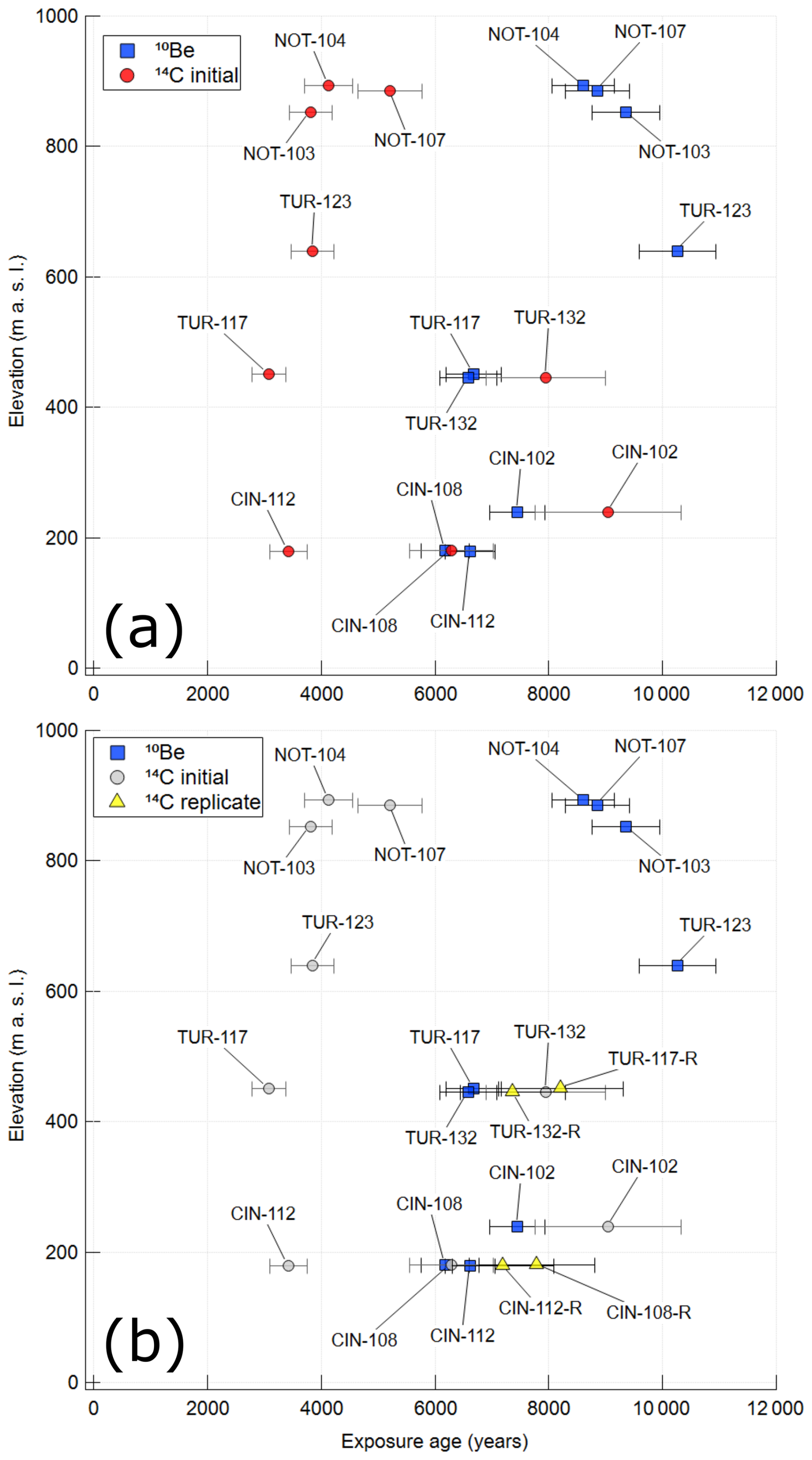
Figure 3Mt Murphy paired 14C–10Be exposure age versus elevation plots (a) calculated using initial in situ 14C concentrations and (b) using both initial (greyed-out) and replicate in situ 14C concentrations. In situ 14C exposure ages plotted with 1σ external uncertainties following application of nominal 6 % in situ 14C measurement uncertainties. We report exposure ages with 1σ external uncertainties when comparing exposure ages calculated from in situ 14C and 10Be concentrations measured in the same sample (see Methods Sect. 2.2).
Based on their initial in situ 14C concentrations, the samples from Notebook Cliffs, Turtle Rock, and scoria cone (Fig. 4a) can be classified as Type 1 and Type 2 nuclide ratios on a paired nuclide diagram (see Sect. 1.1). TUR-132, CIN-102 and CIN-108 plot within the steady-state erosion island (Type 1) and display concordant in situ 14C and 10Be exposure ages (Fig. 4a). The remaining samples (NOT-103, NOT-104, TUR-123, TUR-117, and CIN-112) yield paired 14C and 10Be nuclide concentrations that plot below the steady state erosion line, suggesting complex exposure histories (Type 2). Samples plotting below the steady erosion line (n=6) include all the young in situ 14C ages, which are discordant with respect to the 10Be exposure age from the same sample. Conversely, all in situ 14C concentrations measured in replicates result in older 14C exposure ages and yield 14C–10Be ratios which plot within the steady state erosion island (Fig. 4b), suggesting samples CIN-112 and TUR-117 instead experienced a simple (Type 1) rather than complex (Type 2) exposure history. The 14C–10Be ratio of CIN-108-R, and to some extent TUR-117-R, CIN-102 and TUR-132, suggest Type 1 exposure but border on an impermissible Type 3 exposure history (see Fig. 2).
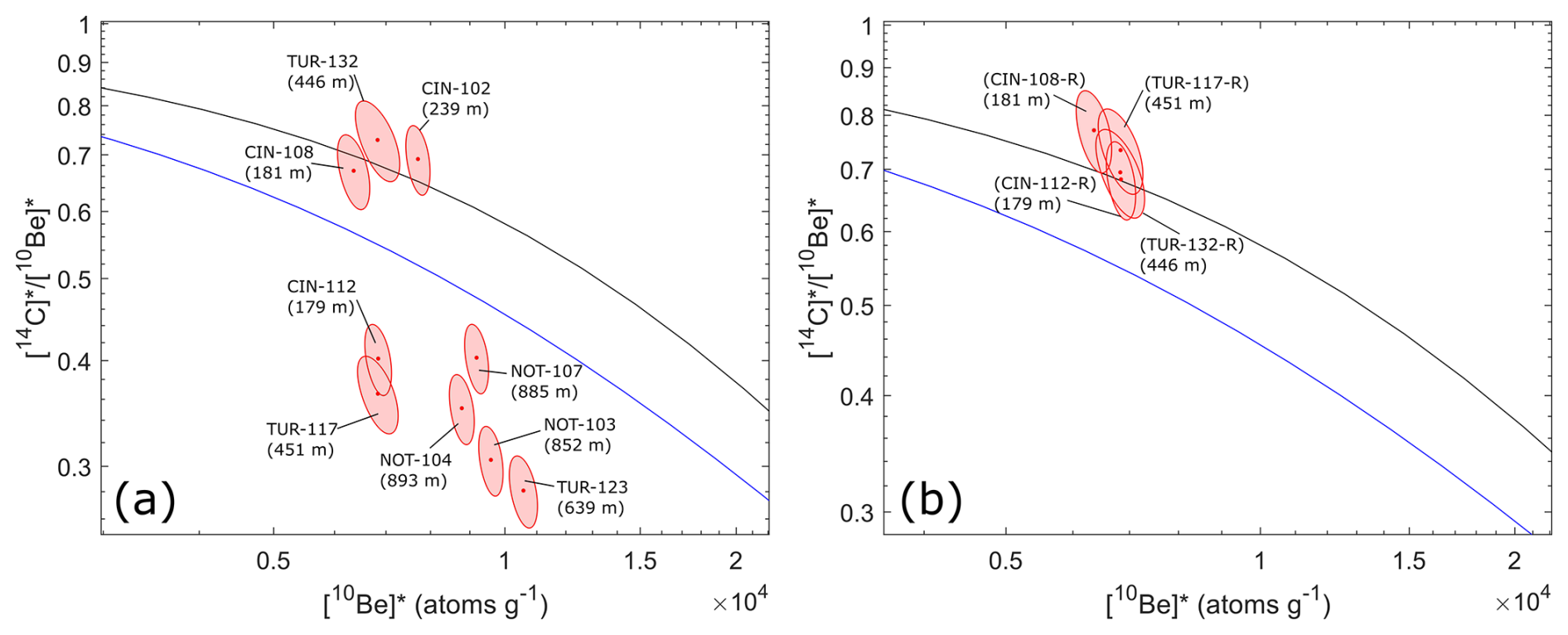
Figure 4Paired 14C–10Be nuclide diagrams using new in situ 14C concentrations from Mt Murphy samples. Panel (a) shows 14C–10Be nuclide ratios using initial in situ 14C concentrations and panel (b) shows 14C–10Be ratios using in situ 14C concentrations from repeat measurements. The x-axis represents the 10Be concentration normalised to its production rate () and the y-axis represents the ratio of the concentration of 14C, the shorter half-life nuclide, normalised by its production rate to 10Be – the longer-lived nuclide. All paired 14C–10Be concentration ratios are normalised to the sample-specific production rate using the LSDn scaling scheme and plotted as ellipses at 68 % confidence (Lifton et al., 2014) using the CRONUS-Earth calibration dataset for 10Be (Borchers et al., 2016) and measurements of CRONUS-A at Tulane CNL for in situ 14C (Goehring et al., 2019a). The asterisk indicates that the respective nuclide concentrations have been normalized to their respective production rates.
4.1 Key observations from the Mt Murphy paired 14C–10Be exposure ages
Three of the four replicate in situ 14C measurements yielded exposure ages that do not overlap within internal uncertainty (1σ). TUR-117-R and CIN-112-R also do not overlap at 2σ internal uncertainty with the corresponding initial 14C exposure ages, and are also discordant with 10Be exposure ages from the same samples. The six systematically young initial in situ 14C exposure ages measured in samples ranging from 150–900 m a.s.l. appear to contradict previous interpretations of ice surface lowering to at Mt Murphy by 6 ka (Adams et al., 2022; Johnson et al., 2020). In addition, the young discordant in situ 14C exposure ages from higher elevations (Notebook Cliffs and Turtle Rock upper terrace; TUR-123) and older reproducible in situ 14C ages from lower elevations (scoria cone; CIN-102, CIN-108) contradict the age-elevation pattern expected with ice thinning. The two samples measured for in situ 14C that did reproduce within their uncertainties at 2σ (TUR-132 and CIN-108) were also concordant with respect to 10Be exposure ages from the same sample (Fig. 3b). From the Mt Murphy replicate measurements (n=4), the two young in situ 14C ages are not reproducible at 2σ internal uncertainty, but both older exposure ages are reproducible at 2σ internal uncertainty. In summary, Mt Murphy paired 14C–10Be exposure ages display both concordance and discordance across multiple sites. Concordant exposure ages are consistent with Type 1 14C–10Be ratios and discordant exposure ages consistent with Type 2 14C–10Be ratios. Concordant 14C–10Be exposure ages exhibit in situ 14C ages which are reproducible at 2σ internal uncertainty whereas discordant 14C–10Be exposure ages do not. This lack of reproducibility suggests the stated 6 % (1σ) measurement uncertainty (based on replicability measurements of CRONUS-A at the in situ 14C extraction laboratory) that is assigned to in situ 14C concentrations prior to calculating an exposure age may be underestimated for our study.
A bootstrap linear regression analysis (see Sect. S3 in the Supplement) of in situ 14C and 10Be exposure age datasets from the scoria cone adjacent to Kay Peak indicate that the chronologies derived from each dataset are broadly similar with respect to the timing of deglaciation, implying they are equally accurate (see Fig. S14 in the Supplement). There is, however, excess scatter of ∼1849 years in the in situ 14C ages (Sect. S3, Table S6 in the Supplement) that cannot be accounted for by the nominal 6 % 1σ internal measurement uncertainty for in situ 14C that has been adopted in many studies (Balco et al., 2019; Nichols et al., 2019). Together, our new in situ 14C exposure ages, the existing 10Be exposure data and the corresponding 14C–10Be ratios from Mt Murphy (Figs. 3 and 4) raise two questions: (1) Is there a way to explain why 3 of the 4 replicate in situ 14C analyses from Mt Murphy do not reproduce at 1σ internal uncertainties? and (2) Is there a geological explanation for the coexistence, often at the same elevation, of concordant and discordant paired in situ 14C and 10Be exposure ages? We discuss answers to these questions in the following sections.
4.2 Reanalysis of Mt Murphy in situ 14C exposure ages using quality control data
First, we explore if discordant paired in situ 14C–10Be ages and in situ 14C concentrations that do not reproduce within reported uncertainties can be explained by a comprehensive examination of blank and CRONUS-A data. For this, we describe results of a series of sensitivity analyses using quality control data from Tulane CNL (Balco et al., 2023).
For initial in situ 14C concentrations, we apply a new blank correction of (n=6, cf. Table S5 Balco et al., 2023) calculated from the mean and standard deviation of process blanks reported from 2 March–10 April 2021, which brackets the extraction dates of initial in situ 14C measurements. For replicate in situ 14C concentrations (extracted week beginning 19 April 2022), we apply a revised blank correction of , which is the same as reported from Tulane CNL. We also propagate a larger blank uncertainty of 35 043 atoms based on the standard deviation of all process blanks measured at Tulane CNL from 2019–2021 (Table S5, Balco et al., 2023). The blank uncertainty we use for the in situ 14C replicate analyses is an order of magnitude larger than the blank uncertainty of ∼3000 atoms originally reported by Tulane CNL. See Sect. S2 in the Supplement, for a further sensitivity analysis using an alternative blank correction of (n=5).
Prior to calculating in situ 14C exposure ages, we also assign a 10 % (1σ) uncertainty to in situ 14C concentrations calculated from the standard deviation of in situ 14C measured in CRONUS-A extracted at Tulane CNL from 22 December 2015–12 March 2021 (, n=18, cf. Table S5 Balco et al., 2023). For three in situ 14C measurements, the 10 % value is exceeded by our combined AMS and recalculated blank uncertainty, which we use instead for the 14C exposure age calculations (see Table 2 and Table S4 in the Supplement). The 10 % uncertainty we assign to in situ 14C concentrations from the Mt. Murphy samples includes more recent measurements of CRONUS-A from Tulane CNL and is larger than the 6 % typically assigned to in situ 14C measurements from that laboratory in other studies (e.g., Balco et al., 2019, Nichols at al., 2019, Rand et al., 2025).
Table 2In situ 14C concentration data measured in Mt Murphy samples. In situ 14C concentrations are calculated from the mean and standard deviation of process blank data from Table S5 Balco et al. (2023), see Table S4 in the Supplement. The final column displays a 10 % assigned uncertainty for in situ 14C concentrations based on the standard deviation of CRONUS-A measurements reported at Tulane CNL from 2019–2021 (n=18, cf. Table S5 Balco et al., 2023). The 10 % uncertainty is assigned to situ 14C concentrations prior to exposure age calculations when it exceeds the combined uncertainty calculated from 14C AMS measurements and process blanks.
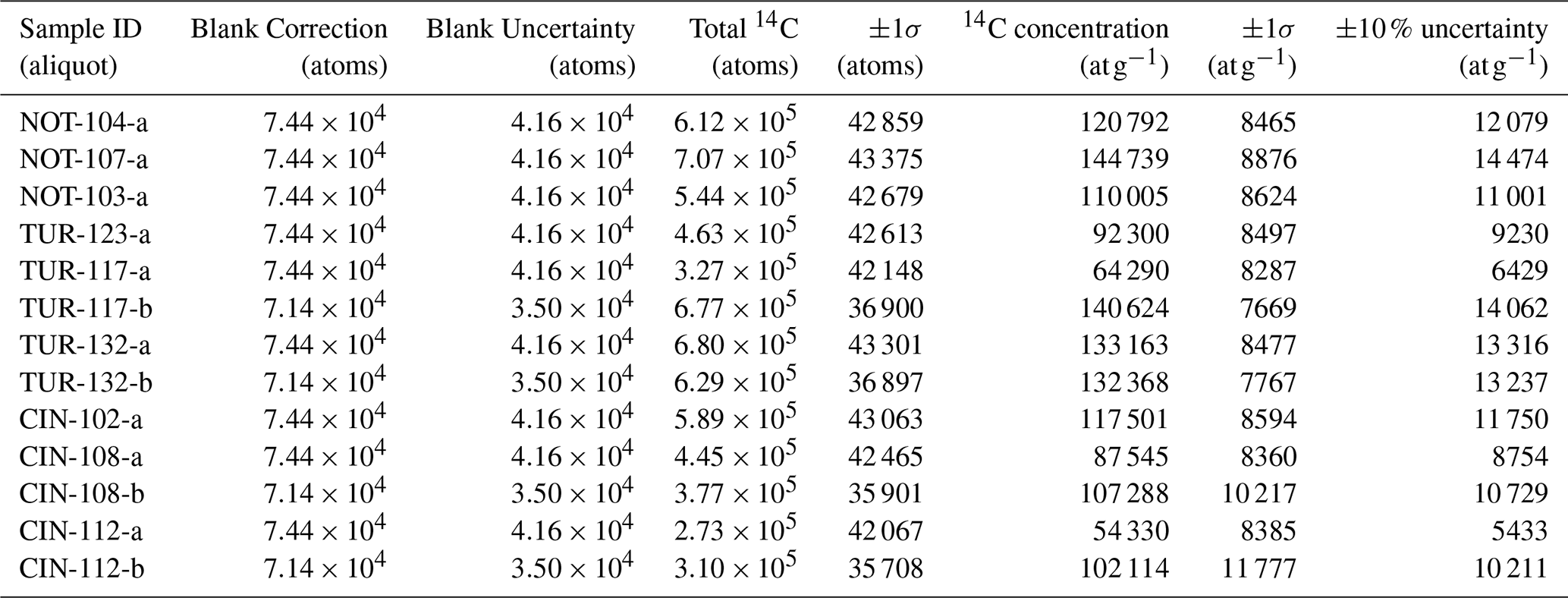
Using different blank corrections (Table 2) to calculate the in situ 14C exposure ages results in some improvements in reproducibility. Older initial in situ 14C ages and replicate in situ 14C ages in the range now all reproduce at 1σ and are concordant with previously published 10Be ages. However, young initial in situ 14C ages spanning from (n=6) do not reproduce at 1σ (or 2σ) and remain discordant with published 10Be ages (Fig. 5). The mean value of all initial in situ 14C exposure ages lowers from 5.2±2.1 ka to 4.8±2.0 ka when the larger blank correction is applied ( atoms). This shift to younger in situ 14C ages increases the mismatch between TUR-117 and TUR-117R by 6.8 %, and CIN-108 and CIN-108-R by 10 %.
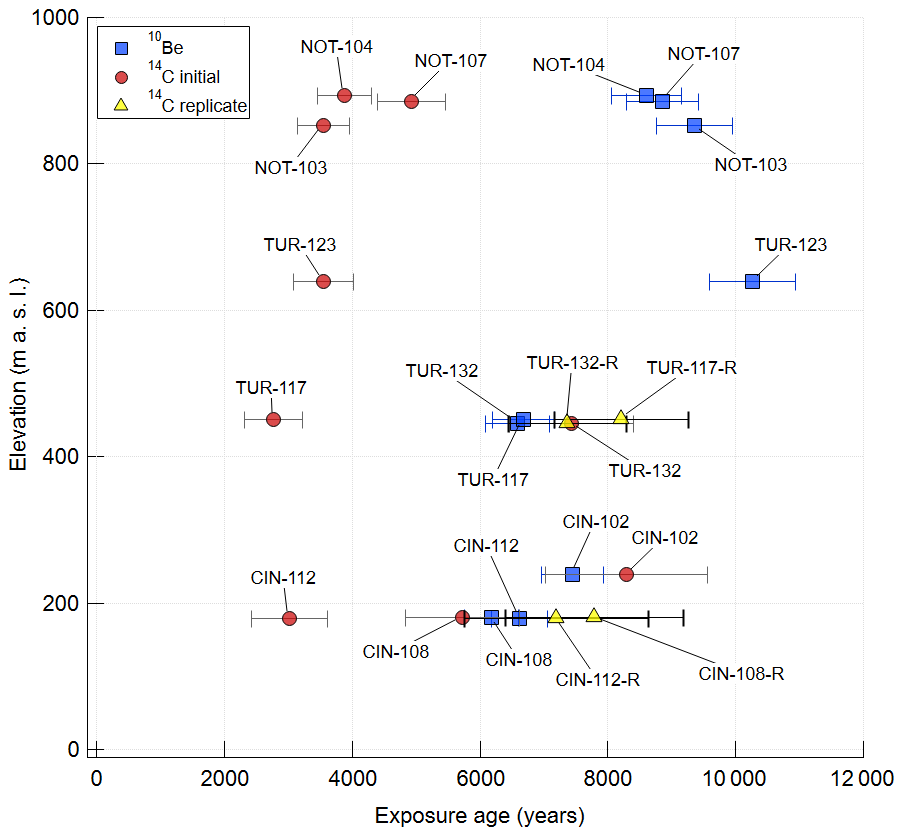
Figure 5Mt Murphy paired 14C–10Be exposure age versus elevation plot showing 10Be exposure ages and new in situ 14C exposure ages calculated from initial and replicate in situ 14C concentrations. Initial in situ 14C concentrations use a blank correction of which brackets 14C extraction dates from 2 March 2021–10 April 2021. Replicate in situ 14C concentrations (yellow triangles) are calculated from the blank correction supplied by Tulane CNL for the samples of . We report exposure ages with 1σ external uncertainties when comparing exposure ages calculated from in situ 14C and 10Be concentrations measured in the same sample (see Methods Sect. 2.2). Our 1σ external uncertainty includes propagation of a 10 % uncertainty for in situ 14C concentrations based on the standard deviation of CRONUS-A measurements reported at Tulane CNL from 2015–2021 (n=18, cf. Table S5, Balco et al., 2023). The propagated AMS and blank uncertainties exceed 10 % for three in situ 14C concentrations (see Table 2) and were used to calculate exposure age uncertainties for those samples.
4.2.1 CRONUS-A normalization – sensitivity test
We conduct a further sensitivity test by normalizing our recalculated in situ 14C concentrations (Table 3) using two different CRONUS-A datasets from Tulane (Table S5, Balco et al., 2023). First, we normalize the recalculated in situ 14C concentrations (Table 2) using a CRONUS-A value of (n=18) – calculated from the mean of all CRONUS-A from Tulane CNL – which is 4 % lower than the value reported in Goehring et al. (2019a). Second, we normalize Mt Murphy in situ 14C concentrations to a CRONUS-A value of , which is 16 % higher. We select the higher value of firstly because it is the CRONUS-A value reported from Tulane CNL closest in time (12 March 2021) to the extraction of initial in situ 14C measurements (2 March–10 April 2021), and secondly because it is the last CRONUS-A data published from Tulane CNL. In addition, it aligns more closely to the CRONUS-A value reported from other in situ 14C extraction laboratories (see Table 5). The results of our sensitivity analyses are presented in Table 3, and Fig. S11 in the Supplement.
Table 3Comparison of recalculated in situ 14C exposure ages from sites at Mt Murphy: Notebook Cliffs (NOT), Turtle Rock (TUR) and scoria cone (CIN). 14C age (4th column) are the same values as in Table 1. The initial in situ 14C concentrations used to calculate “Recalc. 14C Age” use a new blank correction of and replicate in situ 14C concentrations are again calculated from the blank correction supplied by Tulane CNL (7.14×10⁴ atoms), but with an uncertainty calculated from the standard deviation of process blanks measured at Tulane CNL from 2019–2021 (). Additional sensitivity analyses that normalize our recalculated in situ 14C concentrations by different CRONUS-A values are presented in column “S1 14C Age” (CRONUS-A; (n=18)) and column “S2 14C Age” (CRONUS-A; ), respectively. Sample IDs appended with R denote repeat measurements. See Table S1 for full in situ 14C AMS results and Table S4 for calculations using Tulane CNL quality control data. The 1σ internal and external uncertainties for the S1 14C age and S2 14C age columns can also be found in Table S4, Sheet 4.
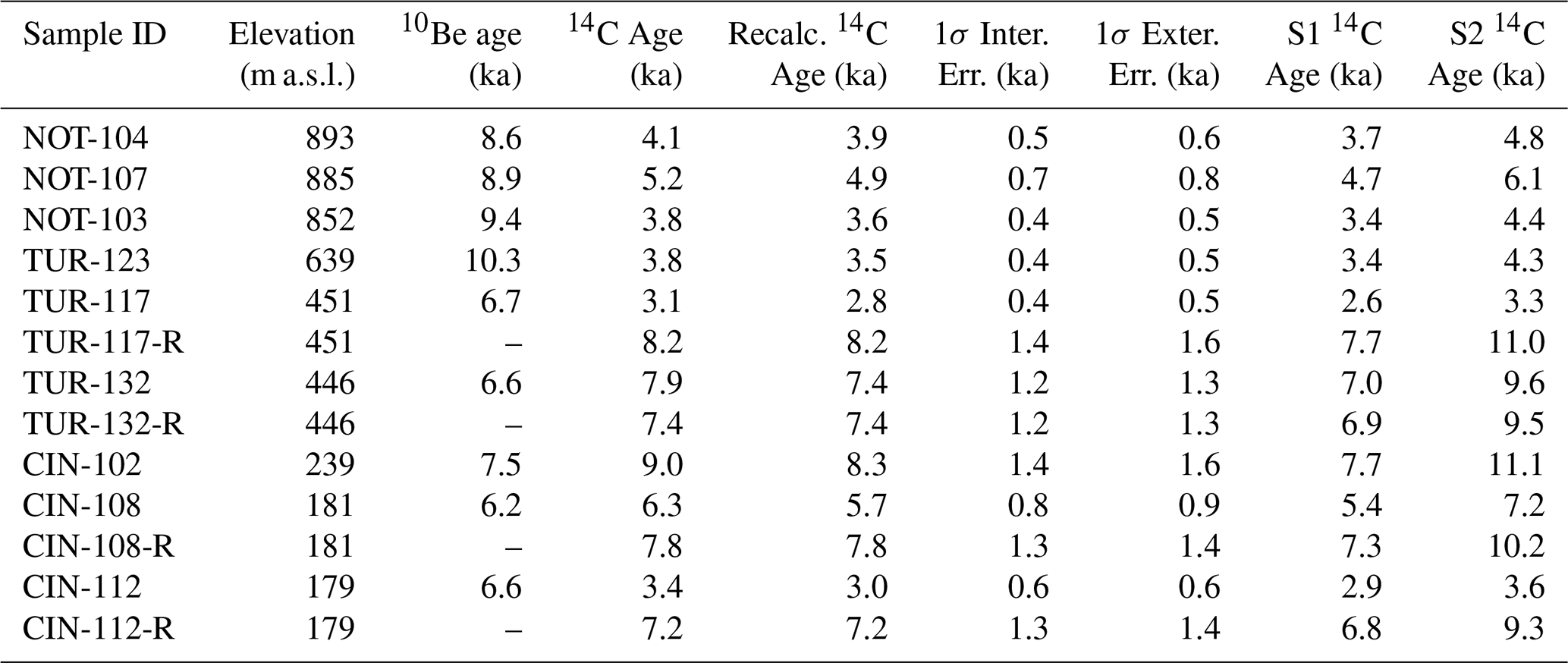
Normalizing our in situ 14C concentrations by a CRONUS-A value of (Fig. S11a) results in the young discordant in situ 14C ages becoming an average of 12 % younger (n=6) than those calculated using the original blank and normalized to the CRONUS-A value of (Table 1 and Sect. 3.1). Young 14C ages are between 6.3 % (TUR-123) and 14.3 % (CIN-112) more discordant when compared with the corresponding 10Be ages; however, the concordance and in situ 14C reproducibility of the three older in situ 14C ages improves, with CIN-108 and CIN-108-R overlapping within 1σ internal uncertainty. Normalizing in situ 14C concentrations by a CRONUS-A value of has the opposite effect, with young discordant in situ 14C ages becoming between 6.6 % (TUR-117) and 24.3 % (NOT-107) closer to the published 10Be ages. Nevertheless, all the young in situ 14C ages remain discordant with the 10Be ages at 1σ and 2σ uncertainty. Furthermore, the older in situ 14C ages and replicates are now also discordant with 10Be exposure ages (Fig. S11b).
Normalizing initial in situ 14C concentrations by the CRONUS-A value of and replicate in situ 14C concentrations by the CRONUS-A value of does not improve reproducibility of the young discordant in situ 14C ages. In addition, the older initial in situ 14C ages (n=3) also do not reproduce at 1σ when this value is used (Fig. S11c). In summary, using the quality control data from Tulane and different blank corrections, assigning a larger uncertainty of 10 % to our in situ 14C concentrations and normalizing them to a CRONUS-A value of do slightly improve reproducibility of the older in situ 14C ages. They also increase concordance with the 10Be ages. However, neither a reasonable range of blank corrections nor normalization to a range of plausible CRONUS-A values can explain the lack of reproducibility associated with the six anomalously young initial in situ 14C ages.
4.3 Potential sources of geological uncertainty
Instances of concordant and discordant 10Be and 14C exposure ages (Balco et al., 2019) or seemingly impermissible 14C–10Be concentration ratios have been explained in previous studies by invoking geological processes (Balco et al., 2019; Rand and Goehring, 2019). First, we examine the Notebook Cliffs, Turtle Rock, and scoria cone sites (see Figs. S1–S5 in the Supplement) to determine if localised glacial-geological changes at Mt Murphy permit the existence of paired in situ 14C–10Be discordant exposure ages at the same elevation as paired in situ 14C–10Be concordant exposure ages. A USGS trimetrogon aerial (TMA) photograph shows that in 1966, in contrast to today, the lower scoria cone outcrop was almost completely buried by ice (see Fig. S7 of Nichols et al., 2024). This finding indicates that samples CIN-112 and CIN-108 were shielded by ice for a non-zero time between 6.4 ka and present (Adams et al., 2022; Balco et al., 2023). A discordant initial in situ 14C age for CIN-112 (3.4±0.3 ka, 179 m a.s.l.) that is younger than the 10Be exposure age (6.6±0.4) from the same sample and other in situ 14C ages from higher elevation scoria cone samples supports the interpretation that such burial occurred during the late Holocene. The in situ 14C replicate measurement, CIN-112-R, however, yielded an exposure age of 7.2±0.9 ka, which is in agreement with the corresponding 10Be age. Both in situ 14C exposure ages determined from measurements of sample CIN-108 (collected from the same outcrop and elevation as CIN-112) are early-mid Holocene (CIN-108 – 6.3±0.7 ka; CIN-108-R – 7.8±1.0 ka). With the exception of the initial 14C exposure age from sample CIN-112, all exposure ages from the lower scoria cone outcrop (Adams et al., 2022) suggest that ice cover during the late Holocene was short-lived.
At both Turtle Rock and Notebook Cliffs, there is little evidence to suggest prolonged cover or burial of samples. At Turtle Rock, discordant in situ 14C–10Be exposure ages of TUR-117 and TUR-123 could be due to individual samples being partially shielded by till or ice debris cover during the Holocene, but the preferential sampling of topographic highs makes this less likely (Johnson et al., 2020). Furthermore, the in situ 14C exposure age of TUR-117-R (8.2±1.1 ka) agrees with the sample's existing 10Be exposure age. There is no geological explanation for measurements of the same nuclide (in situ 14C) on the same two samples (TUR-117, CIN-112) yielding different exposure ages. At Notebook Cliffs, all in situ 14C exposure ages (n=3) are late Holocene and discordant with existing 10Be ages, implying inheritance in 10Be and prolonged burial of all three samples. The three Notebook Cliffs in situ 14C exposure ages contradict evidence from lower elevations of Mt Murphy that indicate early to mid-Holocene deglaciation from 9–6 ka (Adams et al., 2022; Balco et al., 2023; Johnson et al., 2020). In situ 14C ages from Notebook Cliffs could be reconciled with the currently accepted Mt Murphy deglaciation history if a localised ice dome had persisted atop Notebook Cliffs, shielding samples until the late Holocene. The flat top of the Notebook Cliffs site would favour persistence of a post-glacial ice dome; however, there is no physical evidence for this having occurred (Johnson et al., 2020)
Except for late Holocene ice cover of samples CIN-108 and CIN-112 at the lower scoria cone outcrop, evidence for localised geological and topographical drivers of repeated burial and exposure of samples at Mt Murphy are lacking. Instead, differing exposure and transport histories of erratics prior to deposition might explain the concordant and discordant paired 14C–10Be ages observed at the same elevation at Mt Murphy. A similar mechanism, whereby some erratics are initially exposed at higher elevation (and thus subjected to a higher nuclide production rate) has been used to explain the presence of concordant older 14C–10Be ages and discordant young 14C ages at comparable elevations at another site, Shark Fin Nunatak, adjacent to Tucker Glacier in the Ross Sea Embayment (Balco et al., 2019). This hypothesis is supported by both extensive weathering of older samples at Shark Fin Nunatak, and the presence of cliffs of the same lithology upstream, from which erratics could have originated (Balco et al., 2019). However, exposed outcrops with lithologies matching the aplite, granite, and gneiss lithologies of erratics observed at Mt Murphy and surrounding nunataks (Adams et al., 2022; Johnson et al., 2020) are absent in the near vicinity. The nearest outcrop upstream, Mt Takahe (Figs. S6 and S7a in the Supplement) ∼100 km to the south, is composed of mafic extrusive rock (Ohio State Polar Rock Repository; https://prr.osu.edu/collection/, last access: 15 February 2024). Such prior exposure and transport of erratics from nunataks with the same lithologies as those found at Mt Murphy would necessitate dramatic past ice flow re-organization, for which there is no evidence (see Supplement S1 and Figs. S6–S8 in the Supplement).
4.3.1 Identifying sites with paired 14C–10Be nuclide systematics resembling those of Mt Murphy samples
Paired 14C–10Be nuclide ratios measured in samples from Shark Fin Nunatak all indicate a simple exposure history (Table 4 and Sect. S5 – Site 4 in the Supplement), which contrasts with paired 14C–10Be nuclide ratios obtained from Mt Murphy. The sites at Mt Murphy instead exhibit a mixture of Type 1 (simple), Type 2 (complex), and a few borderline Type 3 (impermissible) exposure histories (see Figs. 2 and 4). To determine if any other sites in Antarctica, or elsewhere, display similar paired 14C–10Be nuclide diagram systematics to Mt Murphy, we used an SQL search filter implemented in MATLAB (Balco, 2020b) to extract from the informal online database ICE-D (https://version2.ice-d.org/antarctica/, last access: 29 March 2024) sites with 14C–10Be exposure age pairs that meet the following criteria: (1) the ratio of the 10Be exposure age to the 14C exposure age is and (2) the 10Be apparent exposure age is <11.7 ka (indicating the sample was exposed during the Holocene). We applied these filters to remove 10Be apparent exposure ages older than the Holocene because 10Be inheritance and its impact on measurement accuracy is well-documented, especially in Antarctica, where limited erosion often results in 10Be nuclide inventories which encapsulate more than one glacial cycle. A summary of all sites with paired in situ 14C–10Be exposure ages compiled from ICE-D that satisfy our search criteria (n=29) is provided in Table 4 and numbered in Fig. 1. Age-elevation plots and paired nuclide diagrams for samples from each site can be found in Supplement S5.
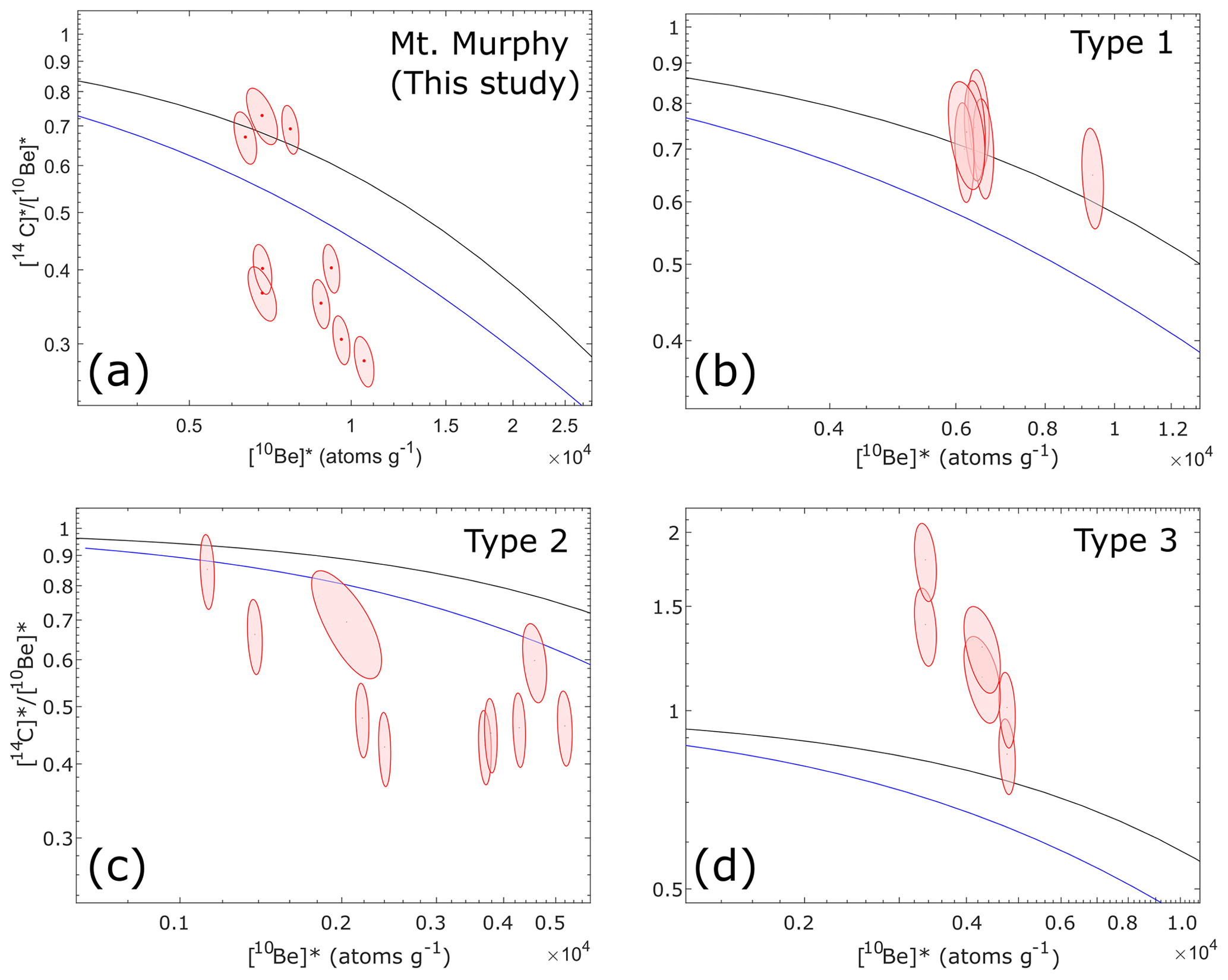
Figure 6Paired in situ 14C–10Be nuclide concentrations from (a) Mount Murphy (this study), and paired 14C–10Be concentration data from other sites extracted from ICE-D including: (b) Kangiata Nunata Sermia (KNS), Greenland (Type 1, dominated by concordant ages), (c) Rhône Glacier, Switzerland, (Type 2, complex exposure – burial history) and (d) Sjögren Glacier, Antarctic Peninsula (Type 3 – impermissible exposure history-dominated dataset). NB: Other paired 14C–10Be datasets classified using the same system are displayed in Table 4. All paired 14C–10Be concentration ratios are normalised to the sample-specific production rate using the LSDn scaling scheme and plotted as ellipses at 68 % confidence (Lifton et al., 2014) using the CRONUS-Earth calibration dataset for 10Be (Borchers et al., 2016) and measurements of CRONUS-A at Tulane University for in situ 14C (Goehring et al., 2019a). Note different in situ 14C production rate calibration datasets would be more suitable for generating paired nuclide diagrams presented in panel (b) (Young et al., 2014) and panel (c) (Goehring et al., 2011), but do not change the type classification for each dataset. For further information on paired nuclide diagrams and type classification scheme, see Sect. 1.2.
Table 4Full list of paired in situ 14C–10Be surface exposure ages extracted from ICE-D, as described in the text. Paired nuclide ratio type refers to the dominant position of paired 14C–10Be ratio ellipses on a paired nuclide diagram (Fig. 2). Paired nuclide diagrams from each site are listed as the dominant type(s), with instances of the less common types denoted in brackets. Abbreviations for AMS and in situ 14C extraction laboratories are as follows: CEREGE (Centre Européen de Recherche et d’Enseignement des Géosciences de l’Environnement), France; ETH Zurich (Swiss Federal Institute of Technology in Zurich), Switzerland; KIST (Korean Institute of Science and Technology), South Korea; LDEO (Lamont-Doherty Earth Observatory), USA; LLNL (Lawrence Livermore National Laboratory), USA; NOSAMS (National Ocean Sciences Accelerator Mass Spectrometry Laboratory at the Woods Hole Oceanographic Institution), USA; and SUERC (Scottish Universities Environmental Research Centre), UK. Shark Fin nunatak 10Be ages are >11.7 ka, so do not meet one of our search criteria, but those samples are included here due to their similarities in age versus elevation profile to Mt Murphy. Note in the “14C–10Be Ratio Type” column the most prevalent 14C–10Be ratio observed in samples from that site is indicated first and unbracketed, e.g. 1, and if the site also exhibits a minority of a different type the minority is indicated in brackets, e.g. 1(2).
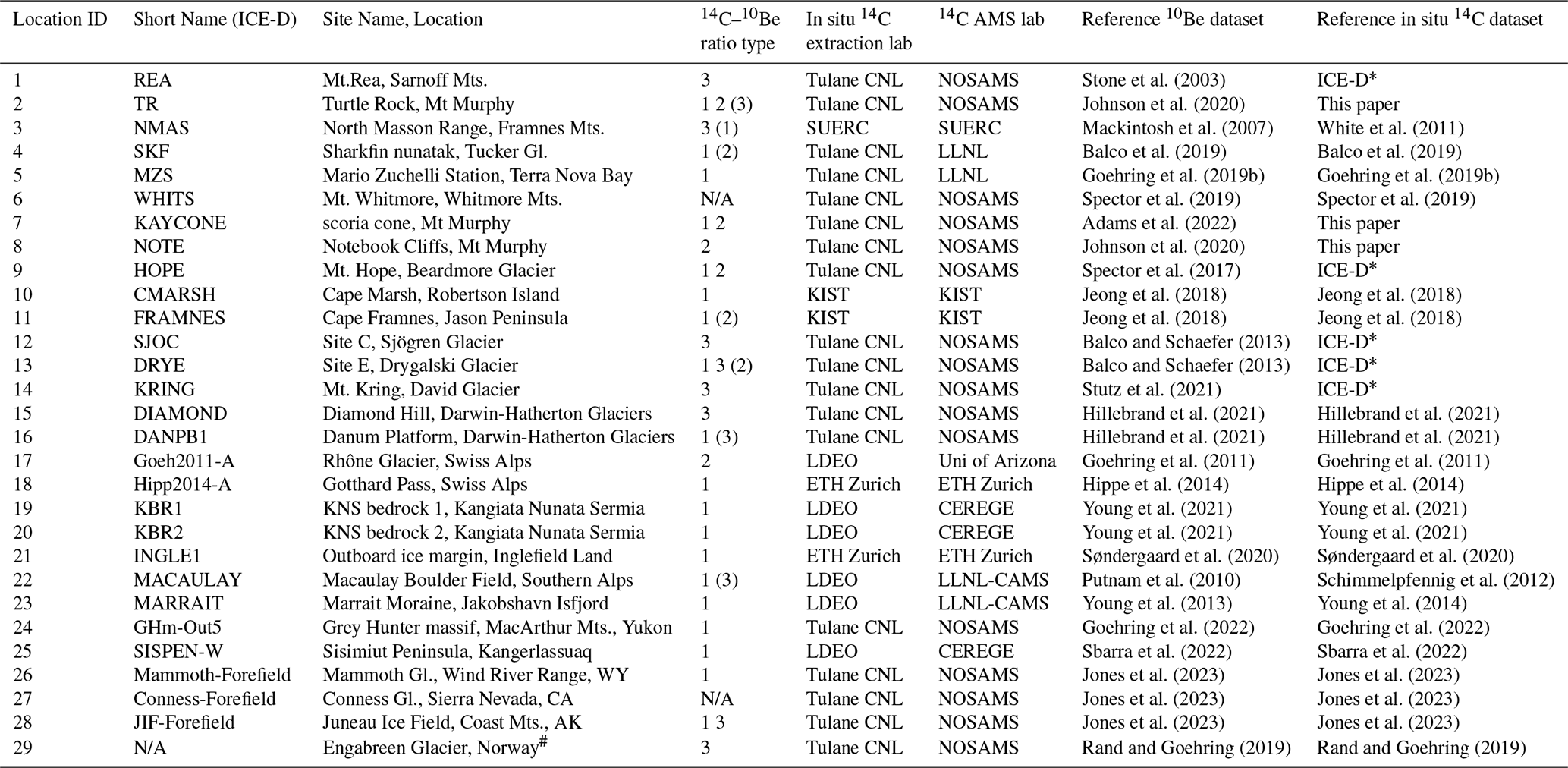
# Engabreen glacier paired in situ 14C–10Be data are not archived in ICE-D but are included to demonstrate a geological solution to a “Type 3” dataset.
∗ Unpublished in situ 14C data; these data are freely available in ICE-D under the public release requirements of the National Science Foundation (NSF) U.S. Antarctic Program.
An examination of the paired 14C–10Be nuclide diagrams from the twenty-nine sites returned from our search of the ICE-D database which includes data from Mt Murphy (Table 4) indicate samples that exhibit paired 14C–10Be concentrations consistent with a Type 1 simple exposure history are the most prevalent at over half of sites (n=15), e.g., Kangiata Nunata Sermia, Greenland (Young et al., 2021; Fig. 6b). There are two sites where samples exhibiting a Type 2 complex exposure history are dominant, including Rhône Glacier forefield in the European Alps (Goehring et al., 2011, Fig. 6c). A total of six sites exhibit Type 3 14C–10Be ratios (indicative of impermissible exposure histories), but many of these datasets contain just one sample. An exception is Sjögren Glacier (Figs. 6d and 7) on the Antarctic Peninsula where numerous samples exhibit impermissible 14C–10Be nuclide ratios (Balco and Schaefer, 2013). Notably only scoria cone, Turtle Rock and Mt Hope, Beardmore Glacier (Site 9) display an equal distribution of both simple (Type 1) and complex (Type 2) exposure histories. An interrogation of the geologic setting of these endmember sites, which consist of multiple samples of the same type, did not provide information that could help explain the concordant and discordant exposure ages or the mixture of Type 1, Type 2 and borderline Type 3 paired 14C–10Be nuclide ratios at Mt Murphy (Fig. 6a). For a detailed account of our geological interrogation and comparison of endmember sites to the Mt Murphy dataset, see Sect. S1.2 in the Supplement.
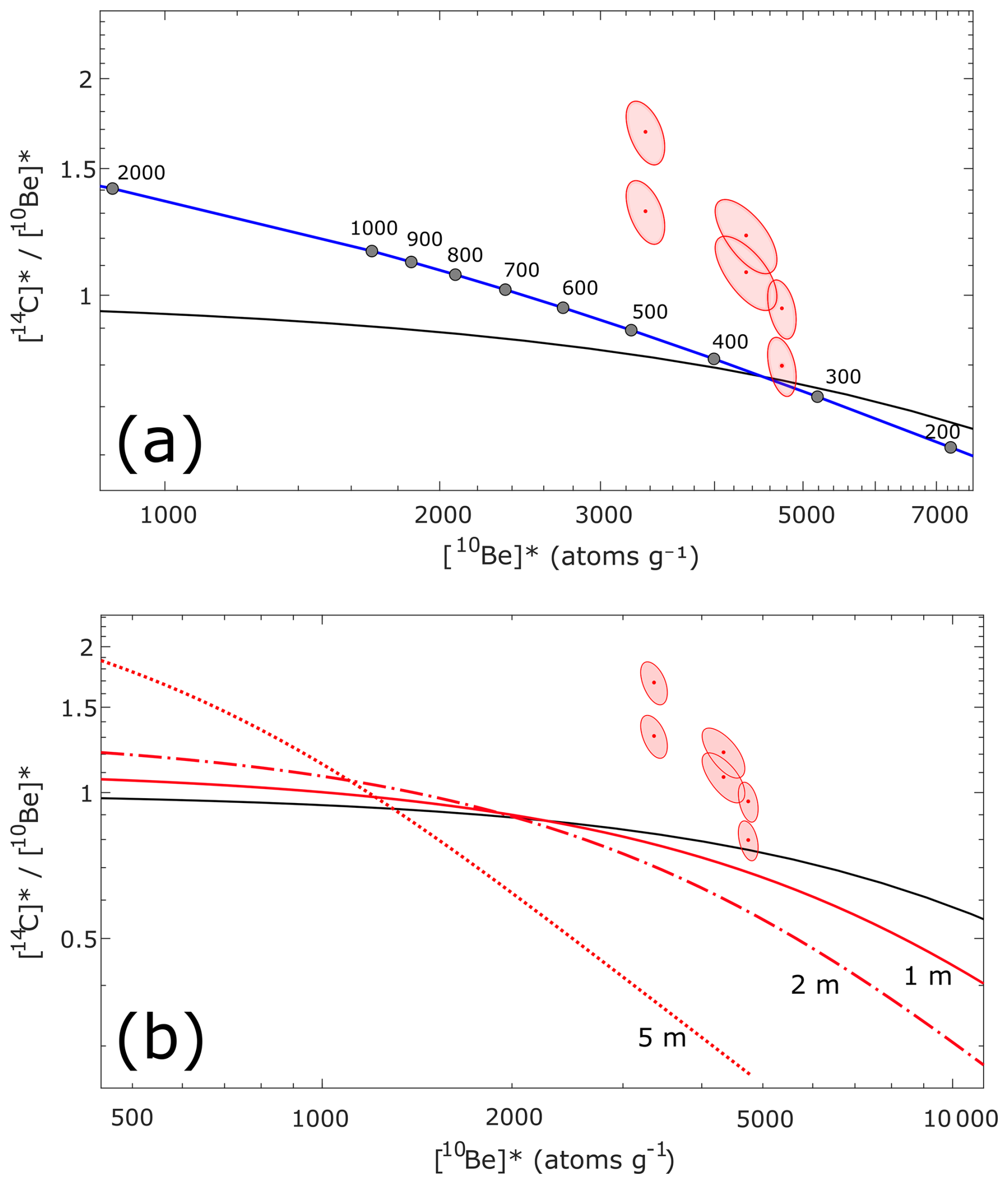
Figure 7Plots showing modelled subsurface production scenarios that lead to a higher in situ 14C relative to 10Be ratio than typical for the surface. Panel (a) shows in situ 14C–10Be nuclide ratios as a function of glacial exhumation rate integrated over a time t, assuming both 10Be and in situ 14C nuclide concentrations are zero at the LGM (t=20 000 years). The black line represents the constant exposure line and blue line the steady erosion line including muon production. Grey dots indicate modelled in situ 14C–10Be nuclide concentration ratios for an erosion rate which is specified above each dot (mm kyr−1). Panel (b) shows modelled in situ 14C–10Be nuclide concentrations as a function of burial under different ice thicknesses over Holocene timescales (plotted as isolines). The black line represents the constant exposure line, but we omit the steady erosion line to improve legibility. On both plots red ellipses indicate in situ 14C–10Be concentration ratios measured in samples from Sjögren Glacier, Site C (68 % confidence). Plots are generated using the surface and subsurface production rate estimating code from (Balco et al., 2023).
The impermissible (Type 3) paired nuclide 14C–10Be ratios from Sjögren Glacier (Site 12 in Table 4) present an opportunity to attempt to identify the cause of high in situ 14C–10Be ratios such as those observed in samples CIN-108-R (Fig. 4). As well as several replicate in situ 14C measurements having been made on samples from there, Sjögren Glacier Site C bears a close geomorphic resemblance to the scoria cone site at Mt Murphy making it a useful comparison with our dataset. To investigate possible causes of borderline Type 3 ratios at Mt Murphy, we modelled scenarios where samples from Sjögren Glacier were subject to either rapid exhumation from ice (Fig. 7a) or prolonged burial under ice (Fig. 7b), both of which would lead to higher in situ 14C production relative to 10Be production in the subsurface (see Sect. 1.1). In these scenarios, in situ 14C nuclide concentration is therefore expected to increase relative to 10Be and may explain impermissible Type 3 14C–10Be concentration ratios. However, we observed ratios of in situ 14C–10Be relative to 10Be concentrations at Sjögren Glacier that cannot be reconciled by either of these processes. In both scenarios, if the concentration of 10Be atoms is , which is very low, we observe high modelled 14C–10Be ratios comparable to the in situ 14C–10Be concentration ratios in Sjögren Glacier samples. However, as soon as 10Be nuclide concentrations exceed 1000–2000 at g−1, we no longer observe high 14C–10Be ratios due to high erosion rates rapidly removing accumulated nuclides or faster decay of in situ 14C relative to 10Be offsetting the higher 14C–10Be subsurface production ratio. In addition, all measured in situ 14C nuclide concentrations from Sjögren Glacier Site C appear to be systematically offset by approximately 5000 extra 14C atoms, suggesting a potential source of contaminant in situ 14C. A high proportion of those samples consist of vein quartz (see Table S3), and it is possible that impermissible (Type 3) 14C–10Be ratios observed at Sjögren Glacier are due to an additional carbon source present in the quartz or incorporated during in situ 14C extraction instead of being geologically caused (Nichols and Goehring, 2019).
Overall, neither our comparison of the geomorphic setting of the Mt Murphy site with other locations (Sect. 4.1 and Supplement 1), our interrogation of paired 14C–10Be ratios from the ICE-D database (including those from sites with Holocene 14C–10Be exposure ages), nor our efforts to model seemingly impermissible high 14C–10Be concentration ratios (Sects. 4.3 and S1.3) could provide a plausible geological explanation for the in situ 14C–10Be dataset from Mt Murphy. In contrast, the sensitivity analysis of the Mt Murphy data (Sect. 4.2) did improve reproducibility of the older in situ 14C exposure ages, suggesting that the explanation for the young discordant in situ 14C ages is likely related to sample preparation.
4.4 In situ 14C reproducibility assessment
To investigate potential sources of sample preparation uncertainty, we focus on evaluating in situ 14C measurement reproducibility using both our new data from Mt Murphy and existing datasets from the ICE-D database for samples where two or more measurements had been made, excluding measurements of laboratory intercomparison materials such as CRONUS-A. In addition to the Mt Murphy results, a further 25 samples with repeat in situ 14C measurements are available in ICE-D, and we present a further two samples with replicate in situ 14C measurements from the Leymon High Core (Lupker et al., 2015) bringing the total number of samples with replicate in situ 14C measurements to 31. The majority of replicate measurements are reported from samples sourced from the Antarctic Peninsula (Balco and Schaefer, 2013), Weddell Sea Embayment (Nichols et al., 2019), Promontory Point (Pleistocene Lake Bonneville), Utah (Lifton et al., 2015a), and the Northwest Highlands, Scotland (Borchers et al., 2016). To each in situ 14C concentration, we assign a measurement uncertainty of 6 % of the total concentration reported from AMS measurements for each replicate. Using a 6 % uncertainty is appropriate here because the majority of replicate measurements presently in the ICE-D database were measured at Tulane and 6 % is the published, and conventionally used, measurement uncertainty from that laboratory based on reproducibility of in situ 14C measured in CRONUS-A from 2015–2018 (Goehring et al., 2019a) cited in numerous studies (e.g., Balco et al., 2019, Nichols et al., 2019, Rand et al., 2025). In cases where in situ 14C replicates were reported from a different extraction laboratory, and that laboratory reports measurement uncertainty exceeding 6 %, we assign the larger value to each in situ 14C concentration.
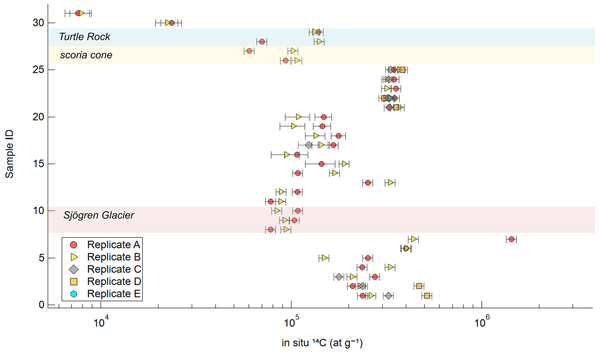
From our reproducibility assessment of 31 replicate samples, 18 display one or more in situ 14C measurements that do not replicate within 6 % (1σ) measurement uncertainty (Fig. 8). There is a slight increase in reproducibility at 2σ, but 15 samples still exhibit one or more in situ 14C measurements that are not reproducible (Fig. S13 in the Supplement). These results include the 3 out of 4 in situ 14C concentrations reported from Mt Murphy which do not replicate within the 6 % (1σ) measurement uncertainty, and 2 of 4 in situ 14C concentrations do not replicate at 2σ (see Sect. 3.1). Notably, replicate measurements included in our Holocene filter analysis from the Antarctic Peninsula (Sjögren and Drygalski Glaciers, n=5; see Sect. 4.3.1 and Fig. 8) also yielded many impermissible paired 14C–10Be ratios, suggesting a possible link between in situ 14C reproducibility and Type 3 14C–10Be concentration ratios. However, the lack of an apparent geologic explanation for irreproducibility of in situ 14C measurements from field samples (see Sect. 4.3) suggests that the assumed measurement uncertainty may be too low. Such an issue has been noted previously by Borchers et al. (2016) where scatter of in situ 14C concentrations from calibration sites (including the Northwest Highlands) exceeded stated measurement uncertainties.
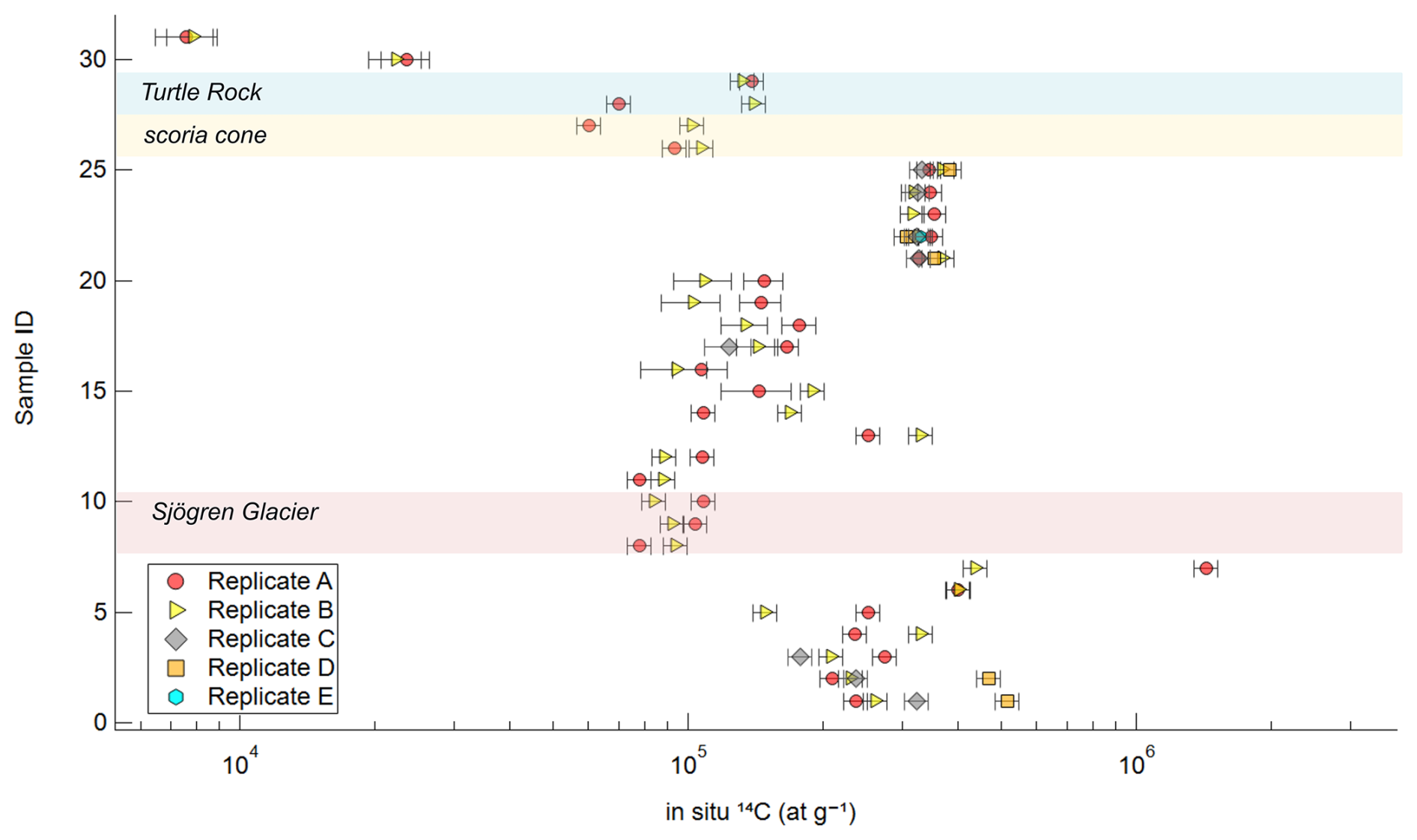
Figure 8In situ 14C concentrations in ICE-D with one or more replicate measurements from the same sample (n=31). To enable comparison with the Mt Murphy dataset, in situ 14C concentration error bars represent a 6 % measurement uncertainty based on repeatability of CRONUS-A measured at Tulane CNL (Goehring et al., 2019a). The graph displays all samples with repeat in situ 14C concentrations uploaded to ICE-D as of 29 March 2024 as well as repeat in situ 14C measurements from Mt Murphy samples (this study) and Leymon High bedrock core samples (Lupker et al., 2015). We use the measurement uncertainty reported with a particular study when this value exceeds the nominal 6 % (1σ) uncertainty. Replicate in situ 14C measurements discussed in the text, including Turtle Rock, scoria cone, and Sjögren Glacier, are indicated by shaded bars. See Table S3 for full list of sample details.
4.4.1 In situ 14C reproducibility – CRONUS-A and blank data
The long-term average in situ 14C concentration measured in CRONUS-A reported from different in situ 14C extraction facilities ranges from for Tulane CNL to at ETH Zurich (Lupker et al., 2019). The CRONUS-A value reported from Tulane CNL, (Goehring et al., 2019a), is 5 %–10 % lower than other in situ 14C extraction laboratories and below the consensus interlaboratory value (n=23) of of (Jull et al., 2015). In addition, the long-term CRONUS-A value suggested by all CRONUS-A measurements reported from Tulane CNL is even lower; (n=18) from 22 December 2016–12 March 2021 (Table S5, Balco et al., 2023). LDEO report a higher than average – and 15.8 % higher than Tulane CNL – value for CRONUS-A (n=13) of for graphitised samples (Lamp et al., 2019; Young et al., 2021). Interlaboratory comparison of CRONUS-A in situ 14C values, therefore, is consistent with findings from our within laboratory sensitivity tests in Sect. 4.2 that suggest a 6 % in situ 14C measurement uncertainty is too low (Jull et al., 2015).
Table 5Summary of CRONUS-A intercomparison material and long-term blank values reported from different in situ 14C extraction facilities. Note: Tulane CNL and LDEO are examined more closely over several measurement cycles because in situ 14C measured from Mt Murphy samples was extracted at both facilities. The latest AixMICADAS gas ion source AMS measurements reported by LDEO highlight how gas ion source AMS in situ 14C measurements have reduced 14C background levels reported by LDEO by removing a potential source of 14C contamination from graphitisation.
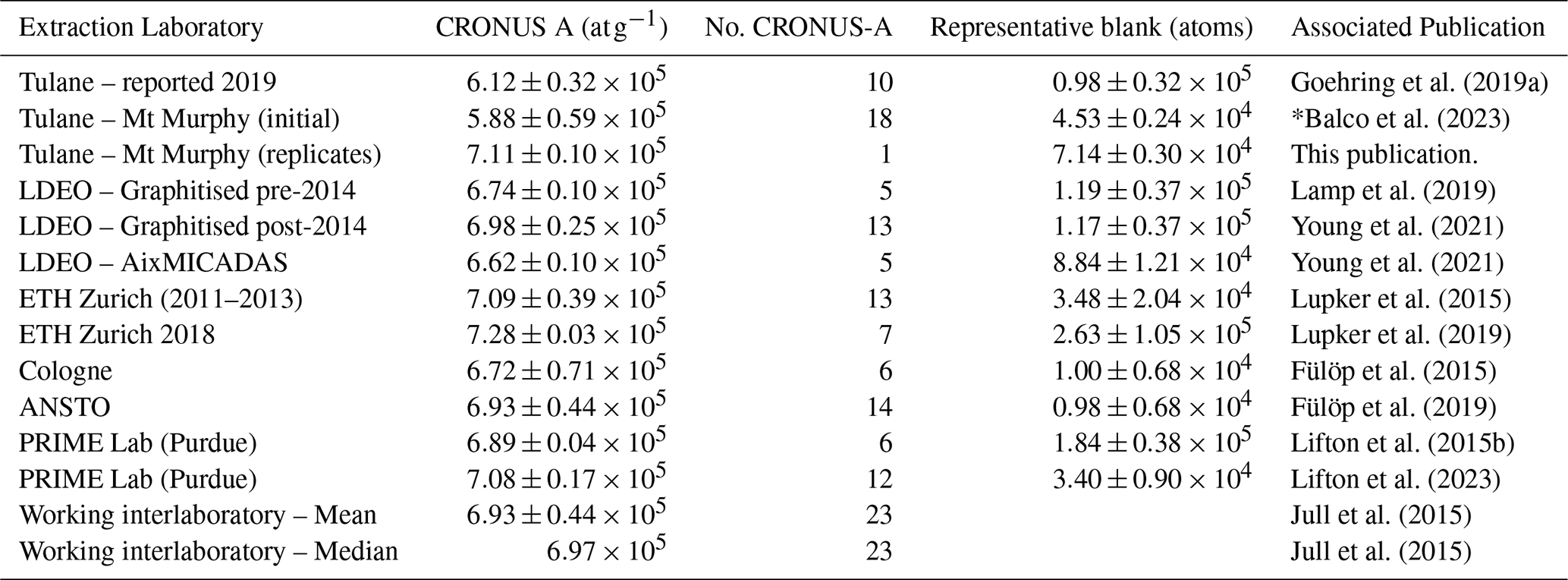
* In Balco et al. (2023), long-term blank values for Tulane CNL surface sample measurements presented in our present study are not reported, but blank variability at Tulane CNL
spanning the same time period is discussed at length.
Inconsistencies in the interlaboratory reproducibility of CRONUS-A and corresponding underestimation of in situ 14C measurement uncertainty have been documented in previous studies. These highlight that laboratories uniformly underestimated the magnitude by which empirical coefficients of variation exceeded average reported analytical uncertainties for all nuclides (Jull et al., 2015; Phillips et al., 2016a). However, the underestimation in the reported analytical uncertainty exceeds 300 % for 14C on the CRONUS-A material (Phillips et al., 2016b), although subsequent analyses of CRONUS-A reproducibility following the CRONUS-Earth Project (e.g., Fülöp et al., 2019b; Goehring et al., 2019a; Lamp et al., 2019; Lifton et al., 2023) may alter this value.
The CRONUS-A intercomparison material is derived from a high elevation site (1612 m) in Antarctica with millions of years of constant exposure, making it saturated with respect to 14C (mean , Jull et al., 2015). Reproducibility estimates from CRONUS-A are, therefore, only representative for high concentration samples, for which AMS counting errors and blank contributions are typically low (Hippe, 2017). Achieving the same level of measurement precision in a sample with a lower concentration of in situ 14C is more challenging, and a typical sample exposed during the Holocene will yield an in situ 14C concentration lower than CRONUS-A. For instance, sample TUR-132 from Turtle Rock (7.4±1.2 ka, 446 m a.s.l.) has a mean in situ 14C concentration of (n=2). Samples exposed during the Holocene, and particularly those at low elevations such as the scoria cone and Kay Peak, are therefore more sensitive than CRONUS-A to blank correction.
For our samples, the blank correction reported from Tulane CNL for in situ 14C repeat measurements was higher than that of the initial 14C measurements (Table 5). The differences in in situ 14C concentrations may be explained, in part, by several changes made to the extraction line at Tulane CNL between the two sets of extractions, including the addition of a new coil trap (Lifton et al., 2023) and a new mullite tube which was previously observed to increase background 14C (see Methods, Sect. 2.2). However, our sensitivity analyses indicate that applying different blank corrections based on the long-term blank data from Tulane CNL (cf. Table S5, Balco et al., 2023) neither reconcile young initial in situ 14C ages with discordant 10Be ages or older replicate in situ 14C ages (see Sect. 4.2) nor the in situ 14C concentrations from our Mt Murphy dataset that do not reproduce.
In an additional effort to identify a potential cause for lack of in situ 14C reproducibility, we investigated if heterogeneities in quartz mineral separates could yield notably different in situ 14C concentrations in the same sample (see Sect. S4, Tables S7 and Table S8 in the Supplement). Impurities in quartz mineral separates have previously been evidenced to negatively impact the reproducibility of 10Be (Corbett et al., 2022). However, we found no link between abundance of impurities in quartz mineral separates and in situ 14C reproducibility in the Mt Murphy samples.
4.5 Summary and suggestions for future work
The findings presented in this paper suggest that routine laboratory uncertainties reported with our samples from Mt Murphy likely underestimated the true measurement uncertainty of in situ 14C for our dataset. This result is consistent with previous findings from the CRONUS-Earth Project (Borchers et al., 2016; Phillips et al., 2016a) and other studies (Hippe, 2017; Jull et al., 2015) where issues regarding the interlaboratory variation in reported CRONUS-A in situ 14C concentrations (∼15 %) and in situ 14C blank variability were shown to impact the accuracy and precision of in situ 14C measurements. A seemingly isolated issue associated with the initial in situ 14C extractions likely resulted in systematically young ages inconsistent with both the replicate measurements and previously published 10Be exposure ages from Mt Murphy, as well as with records of the deglacial history of the Amundsen Sea Embayment more widely. The nature of the apparent loss of in situ 14C from most of our samples during the initial extractions is not understood and is atypical of the considerable number of in situ 14C measurements reported from Tulane CNL. Nevertheless, complexities in our dataset highlight the value of routinely conducting replicate analyses not just for in situ 14C, but for all cosmogenic nuclides, especially if a dataset displays systematic offsets that cannot be accounted for by reported uncertainties. Ongoing developments, including automation of in situ 14C extraction (Goehring et al., 2019a; Lifton et al., 2023; Lupker et al., 2019), will help facilitate analysis of the additional replicates and process blanks needed to improve the precision of in situ 14C measurements. With a focus on improving in situ 14C analytical reproducibility and precision, we therefore make the following suggestions for future work, which will ultimately contribute to the provision of robust combined 14C–10Be chronologies:
-
Routinely undertake and report more in situ 14C replicate measurements. This will provide a check on quality control.
-
Conduct an in situ 14C interlaboratory comparison study using additional intercomparison materials (e.g., CoQtz-N, CRONUS-R) to determine if apparent interlaboratory offsets reported for in situ 14C measurements of CRONUS-A are specific to CRONUS-A or are replicated for other samples. If interlaboratory offsets for in situ 14C measurements of CRONUS-A are consistent across other intercomparison materials, a standardization consensus value can be established, facilitating comparison of exposure age data generated by different in situ 14C extraction facilities.
In this study, we presented new in situ 14C ages from Mt Murphy, West Antarctica and compared them with published 10Be ages, identifying numerous conflicting exposure histories. Young in situ 14C ages from high elevations that are discordant with 10Be measured in the same sample appear to have deglaciated after concordant paired 14C–10Be exposure ages from lower elevations with simple exposure histories. There is no plausible geological explanation for divergent concordant-discordant exposure histories or excess scatter observed within the in situ 14C dataset. Instead, we find that most of the replicate in situ 14C measurements performed on samples from Mt Murphy do not reproduce within a 6 % 1σ internal measurement uncertainty. Furthermore, concordant 14C–10Be pairs at Mt Murphy with simple exposure histories exhibit reproducible in situ 14C concentrations, but discordant in situ 14C exposure ages suggestive of complex exposure are not reproducible. A subsequent sensitivity analysis applying a larger non-standard 10 % uncertainty to in situ 14C concentrations improved the reproducibility of one of the replicate in situ 14C measurements; however, despite the larger assigned measurement uncertainty, half the in situ 14C concentrations still did not reproduce. These observations from Mt Murphy are reflected in archived in situ 14C concentrations extracted from the informal cosmogenic-nuclide exposure-age database (ICE-D), where replicate concentrations measured in 18 of 31 samples fail to reproduce within the 6 % 1σ measurement uncertainty (15 of 31 at 2σ).
In summary, the results of our analysis of in situ 14C–10Be exposure ages from ICE-D are consistent with the interpretation that discordant in situ 14C–10Be exposure ages from Mt Murphy are a result of isolated issues with in situ 14C reproducibility at the Tulane Cosmogenic Nuclide Laboratory (Tulane CNL), while concordant 14C–10Be pairs are consistent with deglaciation (between 9–6 ka) identified by previous studies. Tulane CNL has produced a comparatively large number of in situ 14C replicate measurements; having access to this laboratory's quality control data enabled us to identify inconsistencies in our dataset that crucially prevented us from drawing incorrect conclusions regarding Mt Murphy's deglacial history. We attribute the new discordant in situ 14C exposure ages reported from Mt Murphy that do not reproduce at 1σ and 2σ to an unexplained issue with some of the initial in situ 14C measurements, which appears to have been rectified for the replicates. Our results highlight the need to perform replicate analyses when measuring in situ 14C concentrations, and to fully investigate and quantify scatter in in situ 14C datasets.
Several factors may contribute to the low in situ 14C reproducibility observed in this study and require further investigation. These include long term blank variability within in situ 14C extraction facilities and differences in CRONUS-A measurements between in situ 14C extraction laboratories. Quantifying the excess scatter in in situ 14C measurements observed in this study is important because, if used in isolation, in situ 14C exposure ages appear to currently lack the precision needed to reconstruct Holocene deglacial histories at sub-millennial resolution.
Some of the in situ 14C data examined in this study were obtained from the informal cosmogenic-nuclide exposure age database (ICE-D) and remain unpublished. These data are, however, freely available in ICE-D under the public release requirements of the National Science Foundation (NSF) U.S. Antarctic Program which requires data be made publicly available 2 years after collection. In situ 14C AMS and exposure age data shown in Table 1 are publicly accessible in the UK Polar Data Centre https://doi.org/10.5285/dbb30962-bbf3-434a-9f27-6de2f61a86e2 (Adams et al., 2024).
The supplement related to this article is available online at https://doi.org/10.5194/gchron-8-255-2026-supplement.
The author contributions, following the CRediT authorship guidelines, are as follows – conceptualization: JRA, DHR, JSJ; methodology: JRA, DHR; validation: JRA, DHR; analysis: JRA, DHR; investigation: JRA, DHR, JSJ; resources: DHR, SJR, JSJ: data curation: JRA, DHR; original draft: JRA, DHR; review and editing: JRA, DHR, KW, SJR, JSJ: visualization: JRA; supervision: DHR, SJR, JSJ; administration: JRA, DHR, JSJ; funding acquisition: DHR, JSJ.
The contact author has declared that none of the authors has any competing interests.
Publisher's note: Copernicus Publications remains neutral with regard to jurisdictional claims made in the text, published maps, institutional affiliations, or any other geographical representation in this paper. The authors bear the ultimate responsibility for providing appropriate place names. Views expressed in the text are those of the authors and do not necessarily reflect the views of the publisher.
This work is from the “Geological History Constraints” GHC project, a component of the International Thwaites Glacier Collaboration (ITGC). Support was from National Science Foundation (NSF: grant OPP-1738989) and Natural Environment Research Council (NERC: grant NE/S006710/1, NE/S006753/1, NE/K011278/1 and NE/K012088/1). Logistics were provided by NSF-U.S. Antarctic Program and NERC-British Antarctic Survey. We acknowledge Mark Evans for assistance with rock sample preparation, Ryan Venturelli and Brent Goehring for performing the in situ 14C extractions at Tulane Cosmogenic Nuclide Laboratory and Greg Balco for assistance with subsurface in situ 14C–10Be production rate modelling and helpful advice on the manuscript. We also thank Keir Nichols for helpful advice on the manuscript. We would also like to thank the anonymous reviewers for their thorough assessments and helpful suggestions that have strengthened the manuscript. JRA would also like to credit his PhD examiners Derek Fabel and Yves Plancherel for thoughtful and encouraging discussions regarding this research. This is ITGC contribution No. ITGC-163.
This research has been supported by the Natural Environment Research Council (grant nos. NE/S006710/1, NE/S006753/1, NE/K012088/1, and NE/K011278/1) and the Directorate for Geosciences (grant no. OPP-1738989).
This paper was edited by Philippa Ascough and reviewed by four anonymous referees.
Adams, J. R., Johnson, J. S., Roberts, S. J., Mason, P. J., Nichols, K. A., Venturelli, R. A., Wilcken, K., Balco, G., Goehring, B., Hall, B., Woodward, J., and Rood, D. H.: New 10Be exposure ages improve Holocene ice sheet thinning history near the grounding line of Pope Glacier, Antarctica, The Cryosphere, 16, 4887–4905, https://doi.org/10.5194/tc-16-4887-2022, 2022.
Adams, J. R., Venturelli, R. A., Goehring, B. M., Johnson, J. S., Roberts, S. J., and Rood, D. H.: Cosmogenic in situ 14C data and calculated surface exposure ages for 9 erratic cobbles collected from Mount Murphy, West Antarctica, UK Polar Data Centre [data set], https://doi.org/10.5285/dbb30962-bbf3-434a-9f27-6de2f61a86e2, 2024.
Adams, J. R., Mason, P. J., Roberts, S. J., Rood, D. H., Smellie, J. L., Nichols, K. A., Woodward, J., and Johnson, J. S.: Remote Mapping of Bedrock for Future Cosmogenic Nuclide Exposure Dating Studies in Unvisited Areas of Antarctica, Remote Sens.-Basel, 17, https://doi.org/10.3390/rs17020314, 2025.
Argento, D. C., Stone, J. O., Reedy, R. C., and O'Brien, K.: Physics-based modeling of cosmogenic nuclides part I – Radiation transport methods and new insights, Quat. Geochronol., 26, 29–43, https://doi.org/10.1016/j.quageo.2014.09.004, 2015a.
Argento, D. C., Stone, J. O., Reedy, R. C., and O'Brien, K.: Physics-based modeling of cosmogenic nuclides part II – Key aspects of in-situ cosmogenic nuclide production, Quat. Geochronol., 26, 44–55, https://doi.org/10.1016/j.quageo.2014.09.005, 2015b.
Balco, G.: Contributions and unrealized potential contributions of cosmogenic-nuclide exposure dating to glacier chronology, 1990–2010, Quaternary Sci. Rev., 30, 3–27, https://doi.org/10.1016/j.quascirev.2010.11.003, 2011.
Balco, G.: Production rate calculations for cosmic-ray-muon-produced 10Be and 26Al benchmarked against geological calibration data, Quat. Geochronol., 39, 150–173, https://doi.org/10.1016/j.quageo.2017.02.001, 2017.
Balco, G.: Glacier Change and Paleoclimate Applications of Cosmogenic-Nuclide Exposure Dating, Annu. Rev. Earth Pl. Sc., 48, https://doi.org/10.1146/annurev-earth-081619-052609, 2020a.
Balco, G.: Technical note: A prototype transparent-middle-layer data management and analysis infrastructure for cosmogenic-nuclide exposure dating, Geochronology, 2, 169–175, https://doi.org/10.5194/gchron-2-169-2020, 2020b.
Balco, G. and Schaefer, J. M.: Exposure-age record of Holocene ice sheet and ice shelf change in the northeast Antarctic Peninsula, Quaternary Sci. Rev., 59, 101–111, https://doi.org/10.1016/j.quascirev.2012.10.022, 2013.
Balco, G., Stone, J. O., Lifton, N. A., and Dunai, T. J.: A complete and easily accessible means of calculating surface exposure ages or erosion rates from 10Be and 26Al measurements, Quat. Geochronol., 3, 174–195, https://doi.org/10.1016/j.quageo.2007.12.001, 2008.
Balco, G., Todd, C., Goehring, B. M., Moening-Swanson, I., and Nichols, K.: Glacial geology and cosmogenic-nuclide exposure ages from the Tucker Glacier – Whitehall Glacier confluence, Northern Victoria Land, Antarctica, Am. J. Sci., 319, 255–286, https://doi.org/10.2475/04.2019.01, 2019.
Balco, G., Brown, N., Nichols, K., Venturelli, R. A., Adams, J., Braddock, S., Campbell, S., Goehring, B., Johnson, J. S., Rood, D. H., Wilcken, K., Hall, B., and Woodward, J.: Reversible ice sheet thinning in the Amundsen Sea Embayment during the Late Holocene, The Cryosphere, 17, 1787–1801, https://doi.org/10.5194/tc-17-1787-2023, 2023.
Binnie, S. A., Dewald, A., Heinze, S., Voronina, E., Hein, A., Wittmann, H., von Blanckenburg, F., Hetzel, R., Christl, M., Schaller, M., Léanni, L., ASTER Team, Hippe, K., Vockenhuber, C., Ivy-Ochs, S., Maden, C., Fülöp, R. H., Fink, D., Wilcken, K. M., Fujioka, T., Fabel, D., Freeman, S. P. H. T., Xu, S., Fifield, L. K., Akçar, N., Spiegel, C., and Dunai, T. J.: Preliminary results of CoQtz-N: A quartz reference material for terrestrial in-situ cosmogenic 10Be and 26Al measurements, Nucl. Instrum. Meth. B, 456, 203–212, https://doi.org/10.1016/j.nimb.2019.04.073, 2019.
Borchers, B., Marrero, S., Balco, G., Caffee, M., Goehring, B., Lifton, N., Nishiizumi, K., Phillips, F., Schaefer, J., and Stone, J.: Geological calibration of spallation production rates in the CRONUS-Earth project, Quat. Geochronol., 31, 188–198, https://doi.org/10.1016/j.quageo.2015.01.009, 2016.
Briner, J. P., Lifton, N. A., Miller, G. H., Refsnider, K., Anderson, R., and Finkel, R.: Using in situ cosmogenic 10Be, 14C, and 26Al to decipher the history of polythermal ice sheets on Baffin Island, Arctic Canada, Quat. Geochronol., 19, 4–13, https://doi.org/10.1016/j.quageo.2012.11.005, 2014.
Corbett, L. B., Bierman, P. R., and Rood, D. H.: An approach for optimizing in situ cosmogenic 10Be sample preparation, Quat. Geochronol., 33, 24–34, https://doi.org/10.1016/j.quageo.2016.02.001, 2016.
Corbett, L. B., Bierman, P. R., Brown, T. A., Caffee, M. W., Fink, D., Freeman, S. P. H. T., Hidy, A. J., Rood, D. H., Wilcken, K. M., and Woodruff, T. E.: Clean quartz matters for cosmogenic nuclide analyses: An exploration of the importance of sample purity using the CRONUS-N reference material, Quat. Geochronol., 73, 101403, https://doi.org/10.1016/j.quageo.2022.101403, 2022.
Dunai, T. J.: Cosmogenic Nuclides: Principles, Concepts and Applications in the Earth Surface Sciences, Cambridge University Press, https://doi.org/10.1017/CBO9780511804519, 2010.
Fülöp, R., Wacker, L., and Dunai, T. J.: Progress report on a novel in situ 14C extraction scheme at the University of Cologne, Nucl. Instrum. Meth. B, 361, 20–24, https://doi.org/10.1016/j.nimb.2015.02.023, 2015.
Fülöp, R. H., Naysmith, P., Cook, G. T., Fabel, D., Xu, S., and Bishop, P.: Update on the performance of the SUERC in situ 14C extraction line, Radiocarbon, 52, 1288–1294, 2010.
Fülöp, R.-H., Fink, D., Yang, B., Codilean, A. T., Smith, A., Wacker, L., Levchenko, V., and Dunai, T. J.: The ANSTO – University of Wollongong in-situ 14C extraction laboratory, Nucl. Instrum. Meth. B, 438, 207–213, https://doi.org/10.1016/j.nimb.2018.04.018, 2019.
Goehring, B. M., Schaefer, J. M., Schluechter, C., Lifton, N. A., Finkel, R. C., Jull, A. J. T., Akçar, N., and Alley, R. B.: The Rhone Glacier was smaller than today for most of the Holocene, Geology, 39, 679–682, https://doi.org/10.1130/G32145.1, 2011.
Goehring, B. M., Schimmelpfennig, I., and Schaefer, J. M.: Capabilities of the lamont-doherty earth observatory in situ 14C extraction laboratory updated, Quat. Geochronol., 19, 194–197, https://doi.org/10.1016/j.quageo.2013.01.004, 2014.
Goehring, B. M., Wilson, J., and Nichols, K.: A fully automated system for the extraction of in situ cosmogenic carbon-14 in the Tulane University cosmogenic nuclide laboratory, Nucl. Instrum. Meth. B, 455, 284–292, https://doi.org/10.1016/j.nimb.2019.02.006, 2019a.
Goehring, B. M., Balco, G., Todd, C., Moening-Swanson, I., and Nichols, K.: Late-glacial grounding line retreat in the northern Ross Sea, Antarctica, Geology, 47, 291–294, https://doi.org/10.1130/G45413.1, 2019b.
Goehring, B. M., Menounos, B., Osborn, G., Hawkins, A., and Ward, B.: Reconciling the apparent absence of a Last Glacial Maximum alpine glacial advance, Yukon Territory, Canada, through cosmogenic beryllium-10 and carbon-14 measurements, Geochronology, 4, 311–322, https://doi.org/10.5194/gchron-4-311-2022, 2022.
Gosse, J. C. and Phillips, F. M.: Terrestrial in situ cosmogenic nuclides: Theory and application, Quaternary Sci. Rev., 20, 1475–1560, https://doi.org/10.1016/S0277-3791(00)00171-2, 2001.
Granger, D. E.: A review of burial dating methods using 26Al and 10Be, Special Paper of the Geological Society of America, 415, 1–16, https://doi.org/10.1130/2006.2415(01), 2006.
Hein, A. S., Fogwill, C. J., Sugden, D. E., and Xu, S.: Geological scatter of cosmogenic-nuclide exposure ages in the Shackleton Range, Antarctica: Implications for glacial history, Quat. Geochronol., 19, 52–66, https://doi.org/10.1016/j.quageo.2013.03.008, 2014.
Heyman, J., Applegate, P. J., Blomdin, R., Gribenski, N., Harbor, J. M., and Stroeven, A. P.: Boulder height – exposure age relationships from a global glacial 10Be compilation, Quat. Geochronol., 34, 1–11, https://doi.org/10.1016/j.quageo.2016.03.002, 2016.
Hillebrand, T. R., Stone, J. O., Koutnik, M., King, C., Conway, H., Hall, B., Nichols, K., Goehring, B., and Gillespie, M. K.: Holocene thinning of Darwin and Hatherton glaciers, Antarctica, and implications for grounding-line retreat in the Ross Sea, The Cryosphere, 15, 3329–3354, https://doi.org/10.5194/tc-15-3329-2021, 2021.
Hippe, K.: Constraining processes of landscape change with combined in situ cosmogenic 14C–10Be analysis, Quaternary Sci. Rev., 173, 1–19, https://doi.org/10.1016/j.quascirev.2017.07.020, 2017.
Hippe, K. and Lifton, N. A.: Calculating Isotope Ratios and Nuclide Concentrations for In Situ Cosmogenic 14C Analyses, Radiocarbon, 56, 1167–1174, https://doi.org/10.2458/56.17917, 2014.
Hippe, K., Kober, F., Baur, H., Ruff, M., Wacker, L., and Wieler, R.: The current performance of the in situ 14C extraction line at ETH, Quat. Geochronol., 4, 493–500, https://doi.org/10.1016/j.quageo.2009.06.001, 2009.
Hippe, K., Kober, F., Wacker, L., Fahrni, S. M., Ivy-Ochs, S., Akçar, N., Schlüchter, C., and Wieler, R.: An update on in situ cosmogenic 14C analysis at ETH Zürich, Nucl. Instrum. Meth. B, 294, 81–86, https://doi.org/10.1016/j.nimb.2012.06.020, 2013.
Hippe, K., Ivy-Ochs, S., Kober, F., Zasadni, J., Wieler, R., Wacker, L., Kubik, P. W., and Schlüchter, C.: Chronology of Lateglacial ice flow reorganization and deglaciation in the Gotthard Pass area, Central Swiss Alps, based on cosmogenic 10Be and in situ 14C, Quat. Geochronol., 19, 14–26, https://doi.org/10.1016/j.quageo.2013.03.003, 2014.
Jeong, A., Il, J., Bae, Y., Balco, G., Yoo, K., Il, H., Domack, E., Hee, H., and Yong, B.: Late Quaternary deglacial history across the Larsen B embayment, Antarctica, Quaternary Sci. Rev., 189, 134–148, https://doi.org/10.1016/j.quascirev.2018.04.011, 2018.
Johnson, J. S., Bentley, M. J., and Gohl, K.: First exposure ages from the Amundsen Sea Embayment, West Antarctica: The Late Quaternary context for recent thinning of Pine Island, Smith, and Pope Glaciers, Geology, 36, 223–226, https://doi.org/10.1130/G24207A.1, 2008.
Johnson, J. S., Bentley, M. J., Smith, J. A., Finkel, R. C., Rood, D. H., Gohl, K., Balco, G., Larter, R. D., and Schaefer, J. M.: Rapid thinning of Pine Island glacier in the early Holocene, Science, 343, 999–1001, https://doi.org/10.1126/science.1247385, 2014.
Johnson, J. S., Roberts, S. J., Rood, D. H., Pollard, D., Schaefer, J. M., Whitehouse, P. L., Ireland, L. C., Lamp, J. L., Goehring, B. M., Rand, C., and Smith, J. A.: Deglaciation of Pope Glacier implies widespread early Holocene ice sheet thinning in the Amundsen Sea sector of Antarctica, Earth Planet. Sc. Lett., 548, 116–501, https://doi.org/10.1016/j.epsl.2020.116501, 2020.
Johnson, J. S., Venturelli, R. A., Balco, G., Allen, C. S., Braddock, S., Campbell, S., Goehring, B. M., Hall, B. L., Neff, P. D., Nichols, K. A., Rood, D. H., Thomas, E. R., and Woodward, J.: Review article: Existing and potential evidence for Holocene grounding line retreat and readvance in Antarctica, The Cryosphere, 16, 1543–1562, https://doi.org/10.5194/tc-16-1543-2022, 2022.
Jones, A. G., Marcott, S. A., Gorin, A. L., Kennedy, T. M., Shakun, J. D., Goehring, B. M., Menounos, B., Clark, D. H., Romero, M., and Caffee, M. W.: Four North American glaciers advanced past their modern positions thousands of years apart in the Holocene, The Cryosphere, 17, 5459–5475, https://doi.org/10.5194/tc-17-5459-2023, 2023.
Jones, R. S., Johnson, J. S., Lin, Y., Mackintosh, A. N., Sefton, J. P., Smith, J. A., Thomas, E. R., and Whitehouse, P. L.: Stability of the Antarctic Ice Sheet during the pre-industrial Holocene, Nature Reviews Earth and Environment, 3, 500–515, https://doi.org/10.1038/s43017-022-00309-5, 2022.
Jull, A. J. T., Scott, E. M., and Bierman, P.: The CRONUS-Earth inter-comparison for cosmogenic isotope analysis, Quat. Geochronol., 26, 3–10, https://doi.org/10.1016/j.quageo.2013.09.003, 2015.
Kingslake, J., Scherer, R. P., Albrecht, T., Coenen, J., Powell, R. D., Reese, R., Stansell, N. D., Tulaczyk, S., Wearing, M. G., and Whitehouse, P. L.: Extensive retreat and re-advance of the West Antarctic Ice Sheet during the Holocene, Nature, 558, 430–434, https://doi.org/10.1038/s41586-018-0208-x, 2018.
Kohl, C. P. and Nishiizumi, K.: Chemical isolation of quartz for measurement of in-situ-produced cosmogenic nuclides, Geochim. Cosmochim. Ac., 56, 3583–3587, https://doi.org/10.1016/0016-7037(92)90401-4, 1992.
Lamp, J. L., Young, N. E., Koffman, T., Schimmelpfennig, I., Tuna, T., Bard, E., and Schaefer, J. M.: Update on the cosmogenic in situ 14C laboratory at the Lamont-Doherty Earth Observatory, Nucl. Instrum. Meth. B, 456, 157–162, https://doi.org/10.1016/j.nimb.2019.05.064, 2019.
Lifton, N. A.: A new extraction technique and production rate estimate for in situ carbon-14 in quartz, Ph.D thesis, The University of Arizona, http://hdl.handle.net/10150/289000 (last access: 11 September 2025), 1997.
Lifton, N. A., Jull, A. J. T., and Quade, J.: A new extraction technique and production rate estimate for in situ cosmognic 14C in quartz, Geochim. Cosmochim. Ac., 65, 1953–1969, https://doi.org/10.1016/S0016-7037(01)00566-X, 2001.
Lifton, N., Sato, T., and Dunai, T. J.: Scaling in situ cosmogenic nuclide production rates using analytical approximations to atmospheric cosmic-ray fluxes, Earth Planet. Sc. Lett., 386, 149–160, https://doi.org/10.1016/j.epsl.2013.10.052, 2014.
Lifton, N., Caffee, M., Finkel, R., Marrero, S., Nishiizumi, K., Phillips, F. M., Goehring, B., Gosse, J., Stone, J., Schaefer, J., Theriault, B., Jull, A. J. T., and Fifield, K.: In situ cosmogenic nuclide production rate calibration for the CRONUS-Earth project from lake Bonneville, Utah, shoreline features, Quat. Geochronol., 26, 56–69, https://doi.org/10.1016/j.quageo.2014.11.002, 2015a.
Lifton, N., Goehring, B., Wilson, J., Kubley, T., and Caffee, M.: Nucl. Instrum. Meth. B, Progress in automated extraction and purification of in situ from quartz: Results from the Purdue in situ 14C laboratory, Nucl. Instrum Meth. B, 361, 381–386, https://doi.org/10.1016/j.nimb.2015.03.028, 2015b.
Lifton, N., Wilson, J., and Koester, A.: Technical note: Studying lithium metaborate fluxes and extraction protocols with a new, fully automated in situ cosmogenic 14C processing system at PRIME Lab, Geochronology, 5, 361–375, 2023.
Longworth, B. E., Von Reden, K. F., Long, P., and Roberts, M. L.: A high output, large acceptance injector for the NOSAMS Tandetron AMS system, Nucl. Instrum. Meth. B, 361, 211–216, https://doi.org/10.1016/j.nimb.2015.04.005, 2015.
Lupker, M., Hippe, K., Wacker, L., Kober, F., Maden, C., Braucher, R., Bourlès, D., Romani, J. R. V., and Wieler, R.: Depth-dependence of the production rate of in situ 14C in quartz from the Leymon High core, Spain, Quat. Geochronol., 28, 80–87, https://doi.org/10.1016/j.quageo.2015.04.004, 2015.
Lupker, M., Hippe, K., Wacker, L., Steinemann, O., Tikhomirov, D., Maden, C., Haghipour, N., and Synal, H. A.: In-situ cosmogenic 14C analysis at ETH Zürich: Characterization and performance of a new extraction system, Nucl. Instrum. Meth. B, 457, 30–36, https://doi.org/10.1016/J.NIMB.2019.07.028, 2019.
Mackintosh, A., White, D., Fink, D., Gore, D. B., Pickard, J., and Fanning, P. C.: Exposure ages from mountain dipsticks in Mac. Robertson Land, East Antarctica, indicate little change in ice-sheet thickness since the Last Glacial Maximum, Geology, 35, 551–554, https://doi.org/10.1130/G23503A.1, 2007.
Marrero, S. M., Phillips, F. M., Borchers, B., Lifton, N., Aumer, R., and Balco, G.: Cosmogenic nuclide systematics and the CRONUScalc program, Quat. Geochronol., 31, 160–187, https://doi.org/10.1016/j.quageo.2015.09.005, 2016.
Merchel, S., Bremser, W., Akhmadaliev, S., Arnold, M., Aumaître, G., Bourlès, D. L., Braucher, R., Caffee, M., Christl, M., Fifield, L. K., Finkel, R. C., Freeman, S. P. H. T., Ruiz-Gómez, A., Kubik, P. W., Martschini, M., Rood, D. H., Tims, S. G., Wallner, A., Wilcken, K. M., and Xu, S.: Quality assurance in accelerator mass spectrometry: Results from an international round-robin exercise for 10Be, Nucl. Instrum. Meth. B, 289, 68–73, https://doi.org/10.1016/j.nimb.2012.07.038, 2012.
Milillo, P., Rignot, E., Rizzoli, P., Scheuchl, B., Mouginot, J., Bueso-Bello, J. L., Prats-Iraola, P., and Dini, L.: Rapid glacier retreat rates observed in West Antarctica, Nat. Geosci., 15, 48–53, https://doi.org/10.1038/S41561-021-00877-Z, 2022.
Nichols, K. A. and Goehring, B. M.: Isolation of quartz for cosmogenic in situ 14C analysis, Geochronology, 1, 43–52, https://doi.org/10.5194/gchron-1-43-2019, 2019.
Nichols, K. A., Goehring, B. M., Balco, G., Johnson, J. S., Hein, A. S., and Todd, C.: New Last Glacial Maximum ice thickness constraints for the Weddell Sea Embayment, Antarctica, The Cryosphere, 13, 2935–2951, https://doi.org/10.5194/tc-13-2935-2019, 2019.
Nichols, K. A., Adams, J. R., Brown, K., Creel, R. C., McKenzie, M. A., Venturelli, R. A., Johnson, J. S., Rood, D. H., Wilcken, K., Woodward, J., and Roberts, S. J.: Direct Geologic Constraints on the Timing of Late Holocene Ice Thickening in the Amundsen Sea Embayment, Antarctica, Geophys. Res. Lett., 51, https://doi.org/10.1029/2024GL110350, 2024.
Phillips, F. M., Argento, D. C., Balco, G., Caffee, M. W., Clem, J., Dunai, T. J., Finkel, R., Goehring, B., Gosse, J. C., Hudson, A. M., Jull, A. J. T., Kelly, M. A., Kurz, M., Lal, D., Lifton, N., Marrero, S. M., Nishiizumi, K., Reedy, R. C., Schaefer, J., Stone, J. O. H., Swanson, T., and Zreda, M. G.: The CRONUS-Earth Project: A synthesis, Quat. Geochronol., 31, 119–154, https://doi.org/10.1016/j.quageo.2015.09.006, 2016a.
Phillips, F. M., Argento, D. C., Bourlès, D. L., Caffee, M. W., Dunai, T. J., Goehring, B., Gosse, J. C., Hudson, A. M., Jull. A. J. T., Kelly, M. A., Lifton, N., Marrero, S. M., Nishiizumi, K., Reedy, R. C., and Stone, J. O. H.: Where now? Reflections on future directions for cosmogenic nuclide research from the CRONUS Projects, Quaternary Geochronol., 31, 155–159, https://doi.org/10.1016/j.quageo.2015.04.010, 2016b.
Pigati, J. S., Lifton, N. A., Timothy Jull, A. J., and Quade, J.: A simplified In Situ cosmogenic 14C extraction system, Radiocarbon, 52, 1236–1243, https://doi.org/10.1017/S0033822200046324, 2010.
Putnam, A. E., Schaefer, J. M., Barrell, D. J. A., Vandergoes, M., Denton, G. H., Kaplan, M. R., Finkel, R. C., Schwartz, R., Goehring, B. M., and Kelley, S. E.: In situ cosmogenic 10Be production-rate calibration from the Southern Alps, New Zealand, Quat. Geochronol., 5, 392–409, https://doi.org/10.1016/j.quageo.2009.12.001, 2010.
Rand, C. and Goehring B. M.: The distribution and magnitude of subglacial erosion on millennial timescales at Engabreen, Norway. Ann. Glaciol., 60, 73–81, https://doi.org/10.1017/aog.2019.42, 2019.
Rand, C., Jones, R. S., Mackintosh, A. N., Goehring, B., and Lilly, K.: A thicker-than-present East Antarctic Ice Sheet plateau during the Last Glacial Maximum, The Cryosphere, 19, 3681–3691, https://doi.org/10.5194/tc-19-3681-2025, 2025.
Rood, D. H., Hall, S., Guilderson, T. P., Finkel, R. C., and Brown, T. A.: Challenges and opportunities in high-precision Be-10 measurements at CAMS, Nucl. Instrum. Meth. B, 268, 730–732, https://doi.org/10.1016/j.nimb.2009.10.016, 2010.
Rood, D. H., Brown, T. A., Finkel, R. C., and Guilderson, T. P.: Poisson and non-Poisson uncertainty estimations of 10Be/9Be measurements at LLNL-CAMS, Nucl. Instrum. Meth. B, 294, 426–429, https://doi.org/10.1016/j.nimb.2012.08.039, 2013.
Santos, G. M., Southon, J. R., Druffel-Rodriguez, K. C., Griffin, S., and Mazon, M.: Magnesium Perchlorate as an Alternative Water Trap in AMS Graphite Sample Preparation: A Report On Sample Preparation at Kccams at the University of California, Irvine, Radiocarbon, 46, 165–173, https://doi.org/10.1017/S0033822200039485, 2004.
Santos, G. M., Mazon, M., Southon, J. R., Rifai, S., and Moore, R.: Evaluation of iron and cobalt powders as catalysts for 14C-AMS target preparation, Nucl. Instrum. Meth. B, 259, 308–315, https://doi.org/10.1016/j.nimb.2007.01.220, 2007.
Sbarra, C. M., Briner, J. P., Graham, B. L., Poinar, K., Thomas, E. K., and Young, N. E.: Evidence for a more extensive Greenland Ice Sheet in southwestern Greenland during the Last Glacial Maximum, Geosphere, 18, 1316–1329, https://doi.org/10.1130/GES02432.1, 2022.
Schimmelpfennig, I., Schaefer, J. M., Goehring, B. M., Lifton, N., Putnam, A. E., and Barrell, D. J. A.: Calibration of the in situ cosmogenic 14C production rate in New Zealand's Southern Alps, J. Quaternary Sci., 27, 671–674, https://doi.org/10.1002/jqs.2566, 2012.
Smellie, J. L.: Lithofacies Architecture and Construction of Volcanoes Erupted in Englacial Lakes: Icefall Nunatak, Mount Murphy, Eastern Marie Byrd Land, Antarctica, in: Volcaniclastic Sedimentation in Lacustrine Settings, John Wiley & Sons, Ltd., 7–34, https://doi.org/10.1002/9781444304251.ch2, 2001.
Søndergaard, A. S., Larsen, N. K., Steinemann, O., Olsen, J., Funder, S., Egholm, D. L., and Kjær, K. H.: Glacial history of Inglefield Land, north Greenland from combined in situ 10Be and 14C exposure dating, Clim. Past, 16, 1999–2015, https://doi.org/10.5194/cp-16-1999-2020, 2020.
Southon, J.: Graphite reactor memory – Where is it from and how to minimize it?, Nucl. Instrum. Meth. B, 259, 288–292, https://doi.org/10.1016/j.nimb.2007.01.251, 2007.
Spector, P., Stone, J., Cowdery, S. G., Hall, B., Conway, H., and Bromley, G.: Rapid early-Holocene deglaciation in the Ross Sea, Antarctica, Geophys. Res. Lett., 44, 7817–7825, https://doi.org/10.1002/2017GL074216, 2017.
Spector, P., Stone, J., and Goehring, B.: Thickness of the divide and flank of the West Antarctic Ice Sheet through the last deglaciation, The Cryosphere, 13, 3061–3075, https://doi.org/10.5194/tc-13-3061-2019, 2019.
Stone, J. O., Balco, G. A., Sugden, D. E., Caffee, M. W., Sass, L. C., Cowdery, S. G., and Siddoway, C.: Holocene deglaciation of Marie Byrd Land, West Antarctica, Science, 299, 99–102, https://doi.org/10.1126/science.1077998, 2003.
Stutz, J., Mackintosh, A., Norton, K., Whitmore, R., Baroni, C., Jamieson, S. S. R., Jones, R. S., Balco, G., Salvatore, M. C., Casale, S., Lee, J. I., Seong, Y. B., McKay, R., Vargo, L. J., Lowry, D., Spector, P., Christl, M., Ivy Ochs, S., Di Nicola, L., Iarossi, M., Stuart, F., and Woodruff, T.: Mid-Holocene thinning of David Glacier, Antarctica: chronology and controls, The Cryosphere, 15, 5447–5471, https://doi.org/10.5194/tc-15-5447-2021, 2021.
Venturelli, R. A., Siegfried, M. R., Roush, K. A., Li, W., Burnett, J., Zook, R., Fricker, H. A., Priscu, J. C., Leventer, A., and Rosenheim, B. E.: Mid-Holocene Grounding Line Retreat and Readvance at Whillans Ice Stream, West Antarctica, Geophys. Res. Lett., 47, https://doi.org/10.1029/2020GL088476, 2020.
Venturelli, R. A., Boehman, B., Davis, C., Hawkings, J. R., Johnston, S. E., Gustafson, C. D., Michaud, A. B., Mosbeux, C., Siegfried, M. R., Vick-Majors, T. J., Galy, V., Spencer, R. G. M., Warny, S., Christner, B. C., Fricker, H. A., Harwood, D. M., Leventer, A., Priscu, J. C., and Rosenheim, B. E.: Constraints on the Timing and Extent of Deglacial Grounding Line Retreat in West Antarctica, AGU Advances, 4, 1–15, https://doi.org/10.1029/2022AV000846, 2023.
White, D., Fülöp, R. H., Bishop, P., Mackintosh, A., and Cook, G.: Can in-situ cosmogenic 14C be used to assess the influence of clast recycling on exposure dating of ice retreat in Antarctica?, Quat. Geochronol., 6, 289–294, https://doi.org/10.1016/j.quageo.2011.03.004, 2011.
Wilcken, K. M., Codilean, A. T., Fülöp, R.-H., Kotevski, S., Rood, A. H., Rood, D. H., Seal, A. J., and Simon, K.: Technical note: Accelerator mass spectrometry of 10Be and 26Al at low nuclide concentrations, Geochronology, 4, 339–352, https://doi.org/10.5194/gchron-4-339-2022, 2022.
Young, N. E., Schaefer, J. M., Briner, J. P., and Goehring, B. M.: A 10Be production-rate calibration for the Arctic, J. Quaternary Sci., 28, 515–526, https://doi.org/10.1002/jqs.2642, 2013.
Young, N. E., Schaefer, J. M., Goehring, B., Lifton, N., Schimmelpfennig, I., and Briner, J. P.: West Greenland and global in situ 14C production-rate calibrations, J. Quaternary Sci., 29, 401–406, https://doi.org/10.1002/jqs.2717, 2014.
Young, N. E., Lesnek, A. J., Cuzzone, J. K., Briner, J. P., Badgeley, J. A., Balter-Kennedy, A., Graham, B. L., Cluett, A., Lamp, J. L., Schwartz, R., Tuna, T., Bard, E., Caffee, M. W., Zimmerman, S. R. H., and Schaefer, J. M.: In situ cosmogenic 10Be–14C–26Al measurements from recently deglaciated bedrock as a new tool to decipher changes in Greenland Ice Sheet size, Clim. Past, 17, 419–450, https://doi.org/10.5194/cp-17-419-2021, 2021.