
Articles | Volume 8, issue 3
https://doi.org/10.5194/gchron-8-567-2026
© Author(s) 2026. This work is distributed under
the Creative Commons Attribution 4.0 License.
the Creative Commons Attribution 4.0 License.
https://doi.org/10.5194/gchron-8-567-2026
© Author(s) 2026. This work is distributed under
the Creative Commons Attribution 4.0 License.
the Creative Commons Attribution 4.0 License.
Research article
| 
15 Sep 2026
Research article |
| 15 Sep 2026
| 15 Sep 2026
In situ apatite U-Pb, fission track and (U-Th) ∕ He triple dating using a simple embedding approach
Christoph Glotzbach
CORRESPONDING AUTHOR

Department of Geosciences, University of Tuebingen, Germany
Alexander Neely
Arizona Geological Survey, Tucson, Arizona, USA
Todd Alan Ehlers
School of Geographical and Earth Sciences, University of Glasgow, Scotland, UK
Related authors
Ann-Kathrin Maier, Christoph Glotzbach, and Sarah Falkowski
Geochronology, 8, 165–189, https://doi.org/10.5194/gchron-8-165-2026, https://doi.org/10.5194/gchron-8-165-2026, 2026
Short summary
Short summary
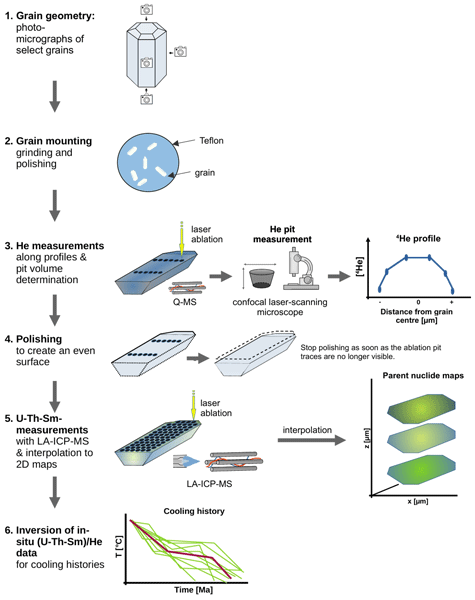
(U-Th-Sm)/He dating is a tool to investigate when and how rocks cooled through the upper Earth’s crust. We explore strategies to reconstruct thermal histories of individual apatite crystals by direct measurement of their helium concentration profile and radionuclide distribution. This approach allows for the inclusion of inhomogeneous grains in thermal modelling, which is often problematic in traditional (U-Th-Sm)/He methods.
Mirjam Schaller, Daniel Peifer, Alexander B. Neely, Thomas Bernard, Christoph Glotzbach, Alexander R. Beer, and Todd A. Ehlers
Earth Surf. Dynam., 13, 571–591, https://doi.org/10.5194/esurf-13-571-2025, https://doi.org/10.5194/esurf-13-571-2025, 2025
Short summary
Short summary
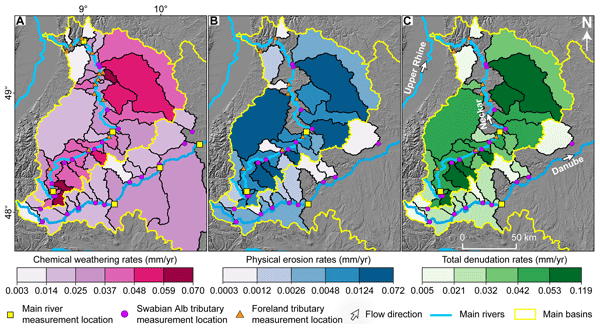
This study reports chemical weathering, physical erosion, and denudation rates from river load data in the Swabian Alb, southwestern Germany. Tributaries to the Neckar River draining to the north show higher rates than tributaries draining to the southeast into the Danube River, causing a retreat of the Swabian Alb escarpment. Observations are discussed in light of anthropogenic impact, lithology, and topography. The data are further compared to other rates over space and time and to global data.
Christoph Glotzbach and Todd A. Ehlers
Geochronology, 6, 697–717, https://doi.org/10.5194/gchron-6-697-2024, https://doi.org/10.5194/gchron-6-697-2024, 2024
Short summary
Short summary
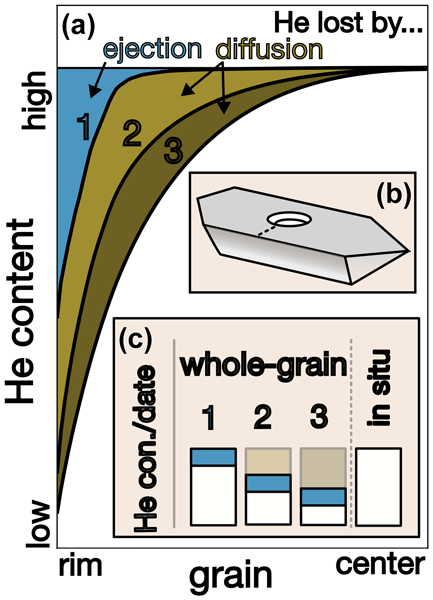
The (U–Th–Sm) / He dating method helps understand the cooling history of rocks. Synthetic modelling experiments were conducted to explore factors affecting in situ vs. whole-grain (U–Th) / He dates. In situ dates are often 30 % older than whole-grain dates, whereas very rapid cooling makes helium loss negligible, resulting in similar whole-grain and in situ dates. In addition, in situ data can reveal cooling histories even from a single grain by measuring helium distributions.
Andrea Madella, Christoph Glotzbach, and Todd A. Ehlers
Geochronology, 4, 177–190, https://doi.org/10.5194/gchron-4-177-2022, https://doi.org/10.5194/gchron-4-177-2022, 2022
Short summary
Short summary
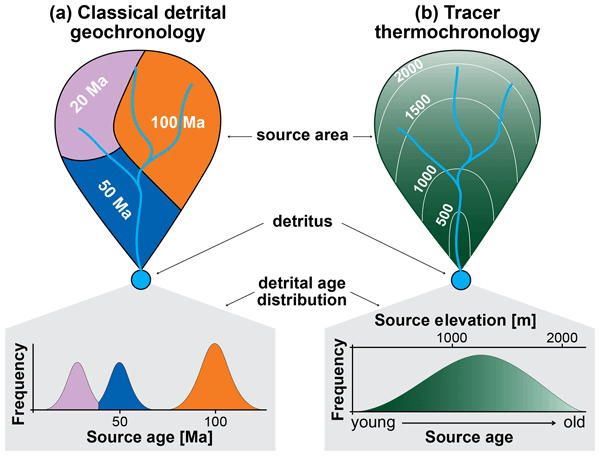
Cooling ages date the time at which minerals cross a certain isotherm on the way up to Earth's surface. Such ages can be measured from bedrock material and river sand. If spatial variations in bedrock ages are known in a river catchment, the spatial distribution of erosion can be inferred from the distribution of the ages measured from the river sand grains. Here we develop a new tool to help such analyses, with particular emphasis on quantifying uncertainties due to sample size.
Ann-Kathrin Maier, Christoph Glotzbach, and Sarah Falkowski
Geochronology, 8, 165–189, https://doi.org/10.5194/gchron-8-165-2026, https://doi.org/10.5194/gchron-8-165-2026, 2026
Short summary
Short summary
(U-Th-Sm)/He dating is a tool to investigate when and how rocks cooled through the upper Earth’s crust. We explore strategies to reconstruct thermal histories of individual apatite crystals by direct measurement of their helium concentration profile and radionuclide distribution. This approach allows for the inclusion of inhomogeneous grains in thermal modelling, which is often problematic in traditional (U-Th-Sm)/He methods.
Mirjam Schaller, Daniel Peifer, Alexander B. Neely, Thomas Bernard, Christoph Glotzbach, Alexander R. Beer, and Todd A. Ehlers
Earth Surf. Dynam., 13, 571–591, https://doi.org/10.5194/esurf-13-571-2025, https://doi.org/10.5194/esurf-13-571-2025, 2025
Short summary
Short summary
This study reports chemical weathering, physical erosion, and denudation rates from river load data in the Swabian Alb, southwestern Germany. Tributaries to the Neckar River draining to the north show higher rates than tributaries draining to the southeast into the Danube River, causing a retreat of the Swabian Alb escarpment. Observations are discussed in light of anthropogenic impact, lithology, and topography. The data are further compared to other rates over space and time and to global data.
Christoph Glotzbach and Todd A. Ehlers
Geochronology, 6, 697–717, https://doi.org/10.5194/gchron-6-697-2024, https://doi.org/10.5194/gchron-6-697-2024, 2024
Short summary
Short summary
The (U–Th–Sm) / He dating method helps understand the cooling history of rocks. Synthetic modelling experiments were conducted to explore factors affecting in situ vs. whole-grain (U–Th) / He dates. In situ dates are often 30 % older than whole-grain dates, whereas very rapid cooling makes helium loss negligible, resulting in similar whole-grain and in situ dates. In addition, in situ data can reveal cooling histories even from a single grain by measuring helium distributions.
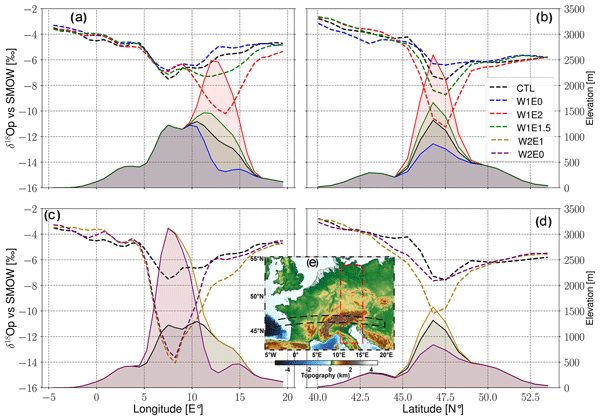
Daniel Boateng, Sebastian G. Mutz, Armelle Ballian, Maud J. M. Meijers, Katharina Methner, Svetlana Botsyun, Andreas Mulch, and Todd A. Ehlers
Earth Syst. Dynam., 14, 1183–1210, https://doi.org/10.5194/esd-14-1183-2023, https://doi.org/10.5194/esd-14-1183-2023, 2023
Short summary
Short summary
We present model-based topographic sensitivity experiments that provide valuable constraints for interpreting past proxies and records of climate and tectonic processes. The study uses a climate model to quantify the response of regional climate and oxygen isotopic composition of precipitation to diachronous surface uplift scenarios across the European Alps. The results suggest that isotopic signal changes can be measured in geologic archives using stable isotope paleoaltimetry.
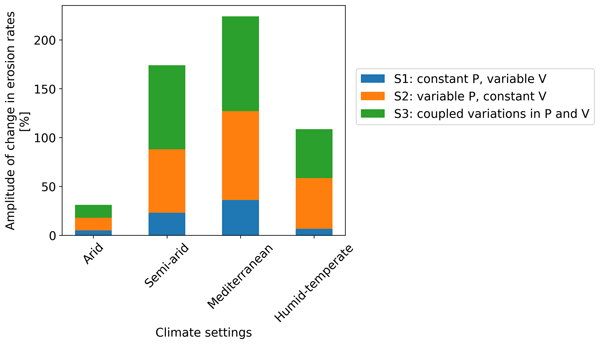
Hemanti Sharma and Todd A. Ehlers
Earth Surf. Dynam., 11, 1161–1181, https://doi.org/10.5194/esurf-11-1161-2023, https://doi.org/10.5194/esurf-11-1161-2023, 2023
Short summary
Short summary
Seasonality in precipitation (P) and vegetation (V) influences catchment erosion (E), although which factor plays the dominant role is unclear. In this study, we performed a sensitivity analysis of E to P–V seasonality through numerical modeling. Our results suggest that P variations strongly influence seasonal variations in E, while the effect of seasonal V variations is secondary but significant. This is more pronounced in moderate and least pronounced in extreme environmental settings.
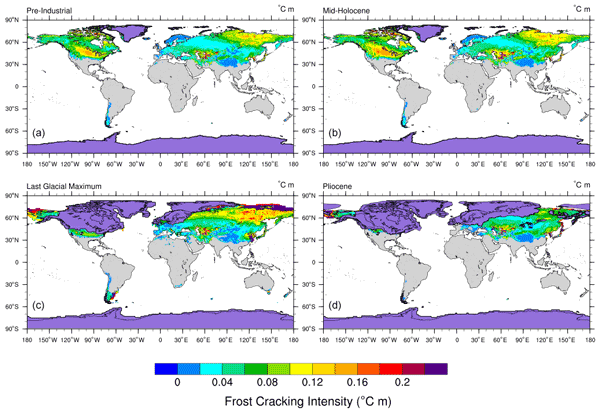
Hemanti Sharma, Sebastian G. Mutz, and Todd A. Ehlers
Earth Surf. Dynam., 10, 997–1015, https://doi.org/10.5194/esurf-10-997-2022, https://doi.org/10.5194/esurf-10-997-2022, 2022
Short summary
Short summary
We estimate global changes in frost cracking intensity (FCI) using process-based models for four time slices in the late Cenozoic ranging from the Pliocene (∼ 3 Ma) to pre-industrial (∼ 1850 CE, PI). For all time slices, results indicate that FCI was most prevalent in middle to high latitudes and high-elevation lower-latitude areas such as Tibet. Larger deviations (relative to PI) were observed in colder (LGM) and warmer climates (Pliocene) due to differences in temperature and glaciation.

Astrid Oetting, Emma C. Smith, Jan Erik Arndt, Boris Dorschel, Reinhard Drews, Todd A. Ehlers, Christoph Gaedicke, Coen Hofstede, Johann P. Klages, Gerhard Kuhn, Astrid Lambrecht, Andreas Läufer, Christoph Mayer, Ralf Tiedemann, Frank Wilhelms, and Olaf Eisen
The Cryosphere, 16, 2051–2066, https://doi.org/10.5194/tc-16-2051-2022, https://doi.org/10.5194/tc-16-2051-2022, 2022
Short summary
Short summary
This study combines a variety of geophysical measurements in front of and beneath the Ekström Ice Shelf in order to identify and interpret geomorphological evidences of past ice sheet flow, extent and retreat.
The maximal extent of grounded ice in this region was 11 km away from the continental shelf break.
The thickness of palaeo-ice on the calving front around the LGM was estimated to be at least 305 to 320 m.
We provide essential boundary conditions for palaeo-ice-sheet models.
Andrea Madella, Christoph Glotzbach, and Todd A. Ehlers
Geochronology, 4, 177–190, https://doi.org/10.5194/gchron-4-177-2022, https://doi.org/10.5194/gchron-4-177-2022, 2022
Short summary
Short summary
Cooling ages date the time at which minerals cross a certain isotherm on the way up to Earth's surface. Such ages can be measured from bedrock material and river sand. If spatial variations in bedrock ages are known in a river catchment, the spatial distribution of erosion can be inferred from the distribution of the ages measured from the river sand grains. Here we develop a new tool to help such analyses, with particular emphasis on quantifying uncertainties due to sample size.
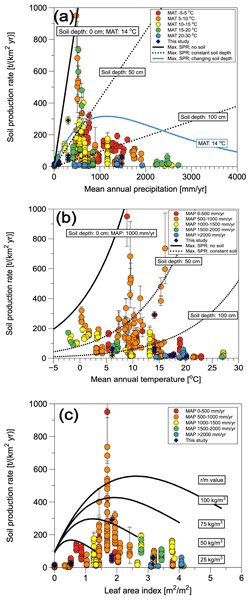
Mirjam Schaller and Todd A. Ehlers
Earth Surf. Dynam., 10, 131–150, https://doi.org/10.5194/esurf-10-131-2022, https://doi.org/10.5194/esurf-10-131-2022, 2022
Short summary
Short summary
Soil production, chemical weathering, and physical erosion rates from the large climate and vegetation gradient of the Chilean Coastal Cordillera (26 to 38° S) are investigated. Rates are generally lowest in the sparsely vegetated and arid north, increase southward toward the Mediterranean climate, and then decrease slightly, or possible stay the same, further south in the temperate humid zone. This trend is compared with global data from similar soil-mantled hillslopes in granitic lithologies.
Emilija Krsnik, Katharina Methner, Marion Campani, Svetlana Botsyun, Sebastian G. Mutz, Todd A. Ehlers, Oliver Kempf, Jens Fiebig, Fritz Schlunegger, and Andreas Mulch
Solid Earth, 12, 2615–2631, https://doi.org/10.5194/se-12-2615-2021, https://doi.org/10.5194/se-12-2615-2021, 2021
Short summary
Short summary
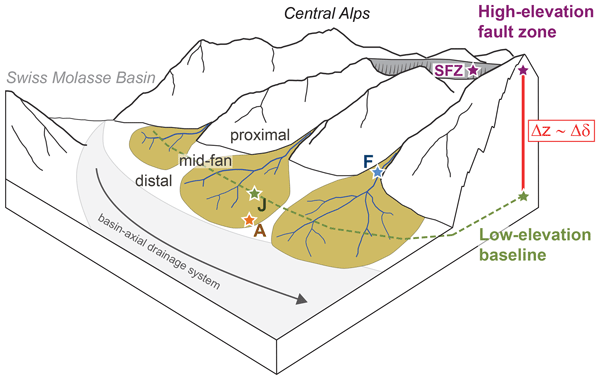
Here we present new surface elevation constraints for the middle Miocene Central Alps based on stable and clumped isotope geochemical analyses. Our reconstructed paleoelevation estimate is supported by isotope-enabled paleoclimate simulations and indicates that the Miocene Central Alps were characterized by a heterogeneous and spatially transient topography with high elevations locally exceeding 4000 m.
Kirstin Übernickel, Jaime Pizarro-Araya, Susila Bhagavathula, Leandro Paulino, and Todd A. Ehlers
Biogeosciences, 18, 5573–5594, https://doi.org/10.5194/bg-18-5573-2021, https://doi.org/10.5194/bg-18-5573-2021, 2021
Short summary
Short summary
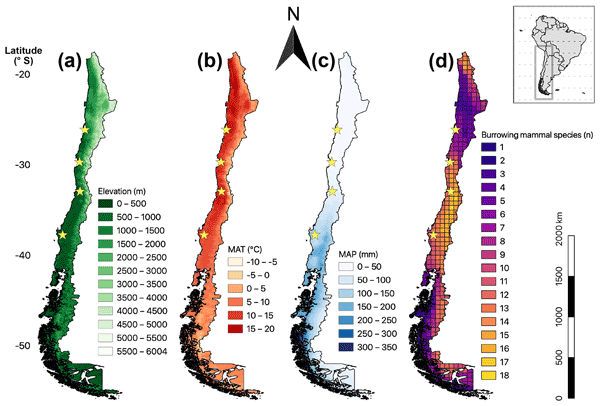
Animal burrowing is important because it impacts the physical and chemical evolution of Earth’s surface. However, most studies are species specific, and compilations of animal community effects are missing. We present an inventory of the currently known 390 burrowing species for all of Chile along its climate gradient. We observed increasing amounts of excavated material from an area with dry conditions along a gradient towards more humid conditions.
Cited articles
Abdullin, F., Solari, L. A., Solé, J., and Ortega-Obregón, C.: Technical note: LA–ICP-MS U–Pb dating of unetched and etched apatites, Geochronology, 3, 59–65, https://doi.org/10.5194/gchron-3-59-2021, 2021.
Bedoya, A., Glorie, S., Hand, M., Kirkland, C. L., Kelsey, D. E., Nixon, A., and Fraser, G.: Apatite Triple Dating (Lu–Hf, U–Pb, FT) Constrains Deformation and Cooling in the Coompana and Madura Provinces, Western Australia, Lithosphere, 2023, https://doi.org/10.2113/2023/lithosphere_2023_292, 2024.
Binder, T., Marks, M. A. W., Gerdes, A., Walter, B. F., Grimmer, J., Beranoaguirre, A., Wenzel, T., and Markl, G.: Two distinct age groups of melilitites, foidites, and basanites from the southern Central European Volcanic Province reflect lithospheric heterogeneity, Int. J. Earth Sci., 112, 881–905, https://doi.org/10.1007/s00531-022-02278-y, 2023.
Boyce, J. W., Hodges, K. V., Olszewski, W. J., Jercinovic, M. J., Carpenter, B. D., and Reiners, P. W.: Laser microprobe (U–Th)
Carrapa, B., DeCelles, P. G., Reiners, P. W., Gehrels, G. E., and Sudo, M.: Apatite triple dating and white mica
Cherniak, D. J.: Diffusion in accessory minerals: zircon, titanite, apatite, monazite and xenotime, Rev. Miner. Geochem., 72, 827–869, https://doi.org/10.2138/rmg.2010.72.18, 2010.
Chew, D. M., Donelick, R. A., Donelick, M. B., Kamber, B. S., and Stock, M. J.: Apatite Chlorine Concentration Measurements byLA‐ICP‐MS, Geostand. Geoanal. Re., 38, 23–35, https://doi.org/10.1111/j.1751-908x.2013.00246.x, 2014.
Chew, D. M., Babechuk, M. G., Cogné, N., Mark, C., O'Sullivan, G. J., Henrichs, I. A., Doepke, D., and McKenna, C. A.: (LA,Q)-ICPMS trace-element analyses of Durango and McClure Mountain apatite and implications for making natural LA-ICPMS mineral standards, Chem. Geol., 435, https://doi.org/10.1016/j.chemgeo.2016.03.028, 2016.
Christoph, G., Ehlers, T., and Neely, A.: In situ apatite U-Pb, fission track and (U-Th)
Danišík, M., Shane, P., Schmitt, A. K., Hogg, A., Santos, G. M., Storm, S., Evans, N. J., Fifield, L. K., Lindsay, J. M.: Re-anchoring the late Pleistocene tephrochronology of New Zealand based on concordant radiocarbon ages and combined 238U/230Th disequilibrium and (U–Th)
Donelick, R. A., O'Sullivan, P. B., and Ketcham, R. A.: Apatite Fission-Track Analysis, Reviews in Mineralogy and Geochemistry, 58, 49–94, https://doi.org/10.2138/rmg.2005.58.3, 2005.
Ehlers, T. A., Szameitat, A., Enkelmann, E., Yanites, B. J., and Woodsworth, G. J.: Identifying spatial variations in glacial catchment erosion with detrital thermochronology, J. Geophys. Res.-Earth Surf., 120, 1023–1039, https://doi.org/10.1002/2014JF003432, 2015.
Evans, N. J., McInnes, B. I. A., McDonald, B., Danišík, M., Becker, T., Vermeesch, P., Shelley, M., Marillo-Sialer, E., and Patterson, D. B.: An in situ technique for (U–Th–Sm)/He and U–Pb double dating, J. Anal. At. Spectrom., 30, 1636–1645, https://doi.org/10.1039/C5JA00085H, 2015.
Farley, K. A.: Helium diffusion from apatite: General behavior as illustrated by Durango fluorapatite, J. Geophys. Res.-Sol. Ea., 105, 2903–2914, https://doi.org/10.1029/1999jb900348, 2000.
Flowers, R. M., Ketcham, R. A., Shuster, D. L., and Farley, K. A.: Apatite (U-Th)/He thermochronometry using a radiation damage accumulation and annealing model, Geochim. Cosmochim. Ac., 73, https://doi.org/10.1016/j.gca.2009.01.015, 2009.
Flowers, R. M., Zeitler, P. K., Danišík, M., Reiners, P. W., Gautheron, C., Ketcham, R. A., Metcalf, J. R., Stockli, D. F., Enkelmann, E., and Brown, R. W.: (U-Th)
Glotzbach, C. and Ehlers, T. A.: Interpreting cooling dates and histories from laser ablation in situ (U–Th–Sm)
Harrison, T., Duncan, I., and McDougall, I.: Diffusion of 40Ar in biotite: Temperature, pressure and compositional effects, Geochim. Cosmochim. Ac., 49, 2461–2468, https://doi.org/10.1016/0016-7037(85)90246-7, 1985.
Holder, R. M., Yakymchuk, C., and Viete, D. R.: Accessory Mineral Eu Anomalies in Suprasolidus Rocks: Beyond Feldspar, Geochem. Geophys. Geosyst., 21, e2020GC009052, https://doi.org/10.1029/2020GC009052, 2020.
Horne, A. M., van Soest, M. C., Hodges, K. V., Tripathy-Lang, A., and Hourigan, J. K.: Integrated single crystal laser ablation U/Pb and (U–Th)
Horne, A. M., van Soest, M. C., and Hodges, K. V.: U
Iwano, H., Danhara, T., Danhara, Y., Hirabayashi, S., Nakajima, T., Sakai, H., and Hirata, T.: Zircon fission‐track and U–Pb double dating using femtosecond laser ablation–inductively coupled plasma–mass spectrometry: A technical note, Island Arc, 29, https://doi.org/10.1111/iar.12348, 2020.
Jochum, K. P., Weis, U., Stoll, B., Kuzmin, D., Yang, Q., Raczek, I., Jacob, D. E., Stracke, A., Birbaum, K., Frick, D. A., Günther, D., and Enzweiler, J.: Determination of Reference Values for NIST SRM 610–617 Glasses Following ISO Guidelines, Geostand. Geoanal. Res., 35, 397–429, https://doi.org/10.1111/j.1751-908x.2011.00120.x, 2011.
Ketcham, R. A.: Forward and Inverse Modeling of Low-Temperature Thermochronometry Data, Reviews in Mineralogy and Geochemistry, 58, 275–314, https://doi.org/10.2138/rmg.2005.58.11, 2005.
Ketcham, R. A., Donelick, R. A., and Carlson, W. D.: Variability of apatite fission-track annealing kinetics: III. Extrapolation to geological time scales, Am. Mineral., 84, 1235–1255, https://doi.org/10.2138/am-1999-0903, 1999.
Ketcham, R. A., Carter, A., Donelick, R. A., Barbarand, J., and Hurford, A. J.: Improved modeling of fission-track annealing in apatite, Am. Mineral., 92, 799–810, https://doi.org/10.2138/am.2007.2281, 2007.
Kreuzer, H. and Harre, W.: K/Ar-Altersbestimmung an Hornblenden und Biotiten des Kristallinen Odenwaldes, Aufschluss, 27, 71–77, 1975.
Larsen, R. B.: The distribution of rate-earth elements in K-feldspar as an indicator of petrogenetic processes in granitic pegmatites: examples from two pegmatite fields in southern Norway, The Canadian Mineralogist, 40, 137–151, 2002.
Longerich, H. P., Jackson, S. E., and Gunther, D.: Laser ablation inductively coupled plasma mass spectrometric transient signal data acquistion and analyte concentration calculation, J. Anal. Atom. Spectrom., 11, 899–904, https://doi.org/10.1039/JA9961100899, 1996.
Lukens, C. E., Riebe, C. S., Sklar, L. S., and Shuster, D. L.: Sand, gravel, cobbles, and boulders: Detrital thermochronology shows that one size does not tell all, J. Geophys. Res.-Earth Surf., 128, e2023JF007192, https://doi.org/10.1029/2023JF007192, 2023.
Madella, A., Glotzbach, C., and Ehlers, T. A.: How many grains are needed for quantifying catchment erosion from tracer thermochronology?, Geochronology, 4, 177–190, https://doi.org/10.5194/gchron-4-177-2022, 2022.
Maier, A.-K., Glotzbach, C., and Falkowski, S.: Analytical and modelling strategies for thermal histories from in situ (U-Th-Sm)
McDowell, F. W., McIntosh, W. C., and Farley, K. A.: A precise 40Ar–39Ar reference age for the Durango apatite (U–Th)
Meesters, A. G. C. A. and Dunai, T. J.: A noniterative solution of the (U-Th)/He age equation, Geochem. Geophys. Geosyst., 6, Q04002, https://doi.org/10.1029/2004GC000834, 2005.
Mezger, K., Hanson, G. N., and Bohlen, S. R.: High-precision UPb ages of metamorphic rutile: application to the cooling history of high-grade terranes, Earth Planet. Sc. Lett., 96, 106–118, https://doi.org/10.1016/0012-821x(89)90126-x, 1989.
O'Sullivan, G., Chew, D., Kenny, G., Henrichs, I., and Mulligan, D.: The trace element composition of apatite and its application to detrital provenance studies, Earth-Sci. Rev., 201, 103044, https://doi.org/10.1016/J.earscirev.2019.103044, 2020.
Paton, C., Woodhead, J. D., Hellstrom, J. C., Hergt, J. M., Greig, A., and Maas, R.: Improved laser ablation U‐Pb zircon geochronology through robust downhole fractionation correction, Geochem. Geophys. Geosyst., 11, 2009GC002618, https://doi.org/10.1029/2009GC002618, 2010.
Paul, A. N., Spikings, R. A., Chew, D. and Daly, J. S.: The effect of intro-crystal uranium zonation on apatite U-Pb thermochronology: A combined ID-TIMS and LA-MC-ICP-MS study, Geochim. Cosmochim. Ac., 251, 15–35, https://doi.org/10.1016/j.gca.2019.02.013, 2019.
Paul, A. N., Spikings, R. A., and Gaynor, S. P.: U-Pb ID-TIMS reference ages and initial Pb isotope compositions for Durango and Wilberforce apatites, Chem. Geol., 586, 120604, https://doi.org/10.1016/j.chemgeo.2021.120604, 2021.
Pickering, J., Matthews, W., Enkelmann, E., Guest, B., Sykes, C., and Koblinger, B. M.: Laser ablation (U-Th)
Pujols, E. J. and Stockli, D. F.: Zircon (U-Th)/(He-Pb) double-dating constraints on the interplay between thrust deformation and foreland basin architecture, Sevier foreland basin, Utah, Geosphere, 17, 1890–1913, https://doi.org/10.1130/GES02372.1, 2021.
Reiners, P. W., Campbell, I. H., Nicolescu, S., Allen, C. M., Hourigan, J. K., Garver, J. I., Mattinson, J. M., and Cowan, D. S.: (U-Th)/(He-Pb) double dating of detrital zircons, Am. J. Sci., 305, 259–311, https://doi.org/10.2475/ajs.305.4.259, 2005.
Schmitt, A. K, Marks, M., Nebor, A. W., and Markl, G.: The onset and origin of differential Rhine Graben volcanism based on U-Pb ages and oxygen isotopic composition of zircon, Eur. J. Mineral., 19, 849–857, https://doi.org/10.1127/0935-1221/2007/0019-1776, 2007.
Stacey, J. S. and Kramers, J. D.: Approximation of terrestrial lead isotope evolution by a two-stage model, Earth Planet. Sc. Lett., 26, 207–221, 1975.
Stein, E. and Dietl, C.: Hornblende thermobarometry of granitoids from the Central Odenwald (Germany) and their implications for the geotectonic development of the Odenwald, Miner. Petrol., 72, 185–207, 2001.
Stock, G. M., Ehlers, T. A., and Farley, K. A.: Where does sediment come from? Quantifying catchment erosion with detrital apatite (U-Th)
Timar-Geng, Z., Fügenschuh, B., Wetzel, A., and Dresmann, H.: The low-temperature thermal history of northern Switzerland as revealed by fission track analysis and inverse thermal modelling, Eclogae Geol. Helv., 99, 255–270, https://doi.org/10.1007/s00015-006-1191-z, 2006.
Tripathy-Lang, A., Hodges, K. V., Monteleone, B. D., and van Soest, M. C.: Laser (U-Th)
Wagner, G. A.: Spuren der spontanen Kernspaltung des 238Urans als Mittel der Datierung von Apatiten und ein Beitrag zur Geochronologie des Odenwaldes, N. Jb. Miner. Abh., 110, 252–286, 1969.
Will, T. M., Schmädicke, E., Ling, X.-X., Li, X.-H., and Li, Q.-L.: Geochronology, geochemistry and tectonic implications of Variscan granitic and dioritic rocks from the Odenwald-Spessart basement, Germany, Lithos, 404–405, 106454, https://doi.org/10.1016/j.lithos.2021.106454, 2021.
Williams, I. S.: U–Th–Pb geochronology by ion microprobe, in: Applications of microanalytical techniques to understanding mineralizing processes, edited by: McKibben, M. A., Shanks III, W. C., and Ridley, W. I., Rev. Econ. Geol., 7, 1–35, 1998.
Zattin, M., Andreucci, B., Thomson, S. N., Reiners, P. W., and Talarico, F. M.: New constraints on the provenance of the ANDRILL AND-2A succession (western Ross Sea, Antarctica) from apatite triple dating: APATITE TRIPLE DATING IN ANTARCTICA, Geochem. Geophys. Geosyst., 13, https://doi.org/10.1029/2012GC004357, 2012.
Ziegler, P. A.: Geological Altas of Western and Central Europe, 239 pp., Shell Int. Pet. Maatschappij, Geol. Soc. Publ. House, Bath, UK, ISBN 10 0903317613, 1990.
Short summary
We present a simple, robust method for triple dating (U–Pb, fission track, and in-situ (U–Th)/He) of apatite using Teflon mounts. The approach increases analytical throughput and ensures data quality via a decision matrix. Validation with Durango apatite and application to the Odenwald demonstrates its reliability and the ability to resolve complex thermal histories.
We present a simple, robust method for triple dating (U–Pb, fission track, and in-situ...


