
the Creative Commons Attribution 4.0 License.
the Creative Commons Attribution 4.0 License.
 | 29 Oct 2026
Analytical strategies for 207Pb ∕ 235U carbonate geochronology
Dawid Szymanowski

Marcel Guillong
Pieter Vermeesch
Philip J. Hopley
In carbonate U–Pb geochronology, unknown initial 234U 238U disequilibria can be debilitating for the accuracy of dates relying on the 206Pb 238U clock. Even if residual 234U 238U disequilibrium can be measured precisely and accurately enough to perform a correction, beyond ca. 1.5 Ma (depending on the magnitude of initial excess/deficit of 234U) the expansion of uncertainties due to the disequilibrium correction may make carbonate 206Pb 238U isochron dates and Tera-Wasserburg intercept dates prohibitively imprecise. An alternative approach utilising only the 207Pb 235U system is in principle more accurate, however the lower abundance of 235U and 207Pb relative to 238U and 206Pb inevitably results in larger analytical data-point uncertainties. Here we explore analytical strategies that maximise the potential of the 207Pb 235U system for carbonate geochronology. ID-TIMS and LA-ICPMS are considered the most useful, and complementary, techniques. ID-TIMS offers the ultimate precision and accuracy combined with the ability to filter data for contamination using 208Pb 204Pb, but it requires mg-sized samples that limit the spatial resolution and the spread of data along the isochron. Optimised LA-ICPMS with large spot sizes may be a quick alternative with better spatial control and enhanced spread of data along the isochron, but 208Pb normalisation imposed by the difficulty of accurately analysing 204Pb may add noise to the results. Overall, precise 207Pb 235U carbonate geochronology is feasible and with minor analytical adjustments it can be adopted broadly instead of the 238U-based methods. Future work on carbonates should obtain additional compositional information that will allow robust identification of domains contaminated with extraneous Pb.
- Article
(2691 KB) - Full-text XML
-
Supplement
(433 KB) - BibTeX
- EndNote


Carbonate rocks, ubiquitous in low-temperature settings, contain archives of Earth's climate and environment, which makes them exciting targets for geochronology. Even though their U content rarely exceeds several parts per million, it is sufficiently high to conduct 230Th U dating in young (< ca. 600 ka) samples that are out of U-series secular equilibrium (Kaufman and Broecker, 1965). Geochronology of older samples requires the use of U–Pb methods characterised by longer half-lives. Carbonate U–Pb geochronology most commonly relies on the Tera-Wasserburg (TW; 238U 206Pb vs 207Pb 206Pb) concordia intercepts (Rasbury and Cole, 2009; Roberts et al., 2020) or, less often, on 206Pb 238U isochrons (Walker et al., 2006; Pickering et al., 2010). Both of these approaches derive their resolution from the 206Pb 238U system which is easier to constrain analytically than 207Pb 235U, a result of the disparity between the decay constants of 238U and 235U and their 138-fold difference in abundance in present-day rocks.
However, the 238U-based methods face a significant limitation. 234U, an intermediate daughter in the 238U decay chain, is frequently fractionated from its parent in low-temperature environments (Porcelli and Swarzenski, 2003), which results in common excesses or deficits of the ultimate daughter 206Pb once the system returns to secular equilibrium. The impact of this effect varies with the initial 234U 238U disequilibrium value (activity ratio marked with square brackets, [234U 238U] = (λ234 234U) (λ238 238U) throughout) and with age, because the same absolute bias becomes relatively less important in older samples. In modern seawater, the observed variation in [234U 238U] is limited, with an average value of ca. 1.14 (Chen et al., 1986). Conversely, [234U 238U] activity ratios in freshwater may be as high as 12 (Kronfeld et al., 1994; Vaks et al., 2020) which can make the raw 206Pb 238U or TW concordia dates inaccurate by as much as 4 Myr (Vermeesch et al., 2025). This problem is particularly acute for young freshwater carbonates such as those dated to produce climate and landscape reconstructions beyond ca. 600 ka, or to calibrate early hominin evolution (Pickering et al., 2019; Woodhead et al., 2019; Engel et al., 2020; Vaks et al., 2020). Here, the necessary correction may be as much as 80 % of the raw date (Fig. 1a).
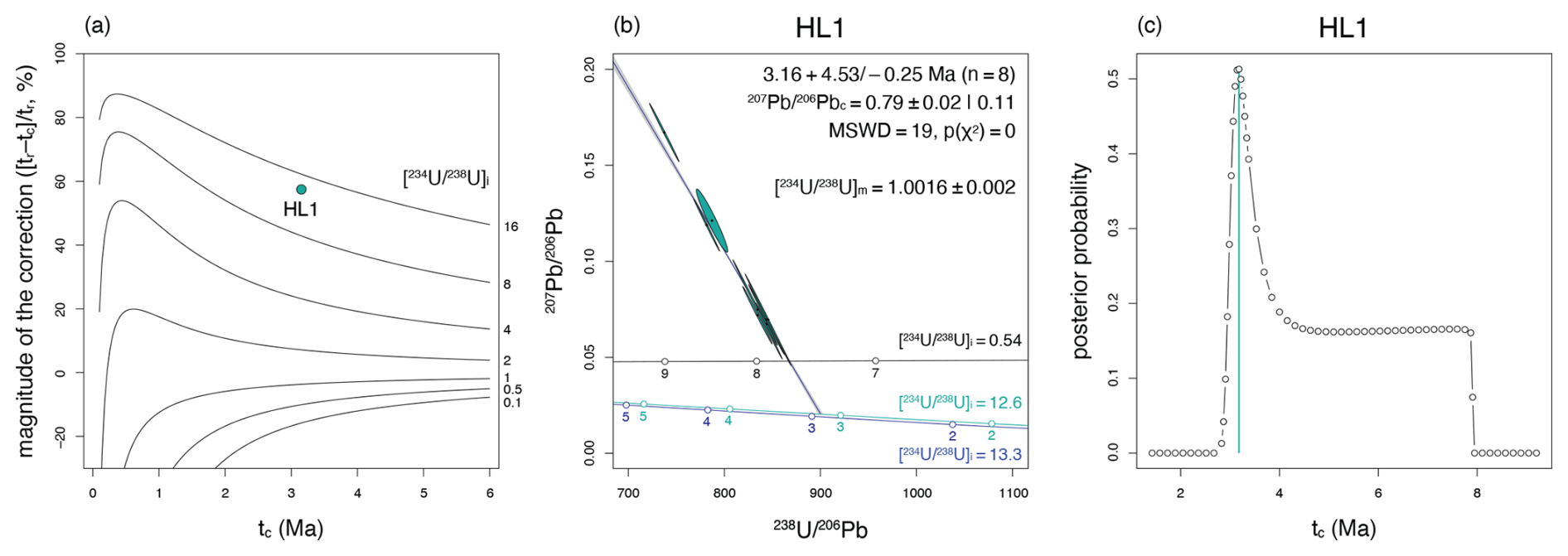
Figure 1234U disequilibrium correction in young carbonates. (a) Nomogram of the relative magnitude of the correction vs. corrected date for different values of [234U 238U]i; tr is the uncorrected date, assuming secular equilibrium, tc is the corrected date. (b) Disequilibrium-corrected U–Pb data of Hoogland sample HL1 from Pickering et al. (2019), using a measured present-day 234U 238U activity ratio [234U 238U]m=1.0016 with nominal 1 ‰ uncertainty (1σ); three concordia lines are shown, for the maximum likelihood solution (tc=3.16 Ma, corresponding to an inferred initial activity ratio [234U 238U]i=12.6), the lower age limit (tl=2.91 Ma with [234U 238U]i=13.3) and upper age limit (tu=7.69 Ma with [234U 238U]i=0.54), respectively. (c) Posterior distribution of the corrected date, using a uniform prior for [234U 238U]i from 0 to 20; tl and tu correspond to the 2.5 and 97.5 percentiles of this distribution respectively; tc is marked by a vertical line.
Corrections for initial 234U 238U disequilibrium can be implemented either by using a nominal, independently estimated initial [234U 238U] value (e.g. average modern seawater, or local to regional groundwater composition), or by estimating it based on direct analyses of any residual disequilibrium in the sample. In freshwater samples, independent estimates are often not reliable as [234U 238U] can be variable locally (Kronfeld et al., 1994; Chen et al., 2016; Vaks et al., 2020), although there are some exceptionally well-characterised contexts (e.g. Chaldekas et al., 2021). The second method is in principle more robust and has been employed in a range of young samples (Wendt and Carl, 1985; Richards et al., 1998; Woodhead et al., 2006), commonly using a Monte Carlo approach that simultaneously finds a best-fitting date and initial [234U 238U] (e.g. Pollard et al., 2023). Vermeesch et al. (2025) have shown theoretically that such corrections are robust for samples not older than about 1.5 Ma. Even so, as currently applied, this approach faces three major challenges: (1) analytically obtaining accurate [234U 238U]m (measured) values, (2) applying the measured [234U 238U]m values to the U Pb analyses, (3) accurately modelling and propagating uncertainty. We will illustrate these issues with literature data from the Hoogland basal speleothem (South Africa) where the existing method has led to a particularly pronounced bias of the interpreted age (Fig. 1).
First, accurate analyses of small residual deviations from 234U 238U secular equilibrium are challenging due to the very large dynamic range of the analysis (238U 234U at equilibrium is ca. 18 200). There is a range of related analytical effects that must be accurately corrected or monitored to obtain accurate [234U 238U]m values, including e.g. ion counter yield, dead time, non-linearity, as well as interferences and peak tailing on U masses (e.g. Hu et al., 2025). If the “natural” 238U 235U is used for mass bias correction, its value will also have an influence on accuracy if it deviates (Stirling et al., 2007; Pollard et al., 2025) from the commonly assumed values (Steiger and Jäger, 1977; Hiess et al., 2012). In samples > 1 Ma, the residual [234U 238U]m is generally close to 1, so small inaccuracies in its determination may easily result in reversing the direction of the age correction (e.g. upward instead of downward) for the same nominal U–Pb data. This highlights how accurate [234U 238U]m is critical to the success of this approach.
The second issue concerns appropriate matching of U Pb and [234U 238U]m analyses. Many applications of the method have used a single blanket [234U 238U]m value per rock sample, applied across all aliquots of material analysed for U Pb (Wendt and Carl, 1985; Richards et al., 1998; Woodhead et al., 2006; Pickering et al., 2019). The reason is that a precise [234U 238U] analysis by solution MC-ICPMS (or by alpha spectrometry) requires a larger mass of material than a U Pb one. However, in examples where multiple [234U 238U] analyses were conducted within what was visually considered one speleothem layer (Walker et al., 2006; Dirks et al., 2010; Chaldekas et al., 2021), the [234U 238U]m data were not always equivalent within uncertainty. Thus, to account for any potential variability within a sample, the two analyses should ideally be obtained from the exact same volume of material, accompanied by a mathematical formulation of an aliquot-based disequilibrium correction.
Third, application of the disequilibrium correction to samples with residual [234U 238U]m close to 1 results in greatly expanded uncertainties. Recently, Vermeesch et al. (2025) showed that previously applied disequilibrium correction algorithms tended to underestimate uncertainty. For example, Pickering et al. (2019)'s Hoogland HL1 data define a trend in Tera-Wasserburg concordia space with a concordia intercept age of 7.407 ± 0.080 Ma (Fig. 1b). Using a single [234U 238U]m value of 1.0016 ± 0.001, this was corrected to 3.145 ± 0.243 Ma; i.e. a 60 % reduction in age with a reported uncertainty of only 7.7 % at 2σ. The corresponding initial [234U 238U] activity ratio is 12.879 ± 1.728, an extreme value even for South African speleothems (Kronfeld et al., 1994). Vermeesch et al. (2025) introduced an alternative deterministic Bayesian uncertainty-estimation procedure. Applying this new algorithm to Pickering et al. (2019)'s 206Pb 238U data yields the same date but a much larger, asymmetric 95 % credible interval ranging from 2.94 to 7.69 Ma, corresponding to a range of 150 % relative to the corrected date (Fig. 1c). Similarly, the 95 % credible interval for [234U 238U]i ranges from 0.54 to 13.3. Clearly, this magnitude of analytical uncertainty on the 206Pb 238U dates limits the interpretability of the results.
A potential solution to the above problems is offered by using only the 207Pb 235U method which does not require a correction for initial 234U 238U disequilibrium (Vermeesch et al., 2025). The only long-lived intermediate daughter in the 235U decay chain is 231Pa, and 231Pa 235U disequilibrium is easily corrected once the extremely low solubility of Pa in water is considered (i.e., initial [231Pa 235U] is safely assumed to be zero). Even if this assumption is wrong, the maximum bias of an inaccurate 231Pa correction is most likely < 50 ka (Vermeesch et al., 2025). The main disadvantage of the 207Pb 235U method (and the reason why the TW concordia and the 206Pb 238U method have historically been more widely used for carbonate U–Pb dating) is the poorer analytical precision of the underlying mass-spectrometric measurements. Here we explore analytical implementations of the 207Pb 235U method in carbonates and use several reference materials and a Hoogland flowstone sample to demonstrate avenues to obtain precise and accurate 207Pb 235U dates.
Carbonate samples suitable for U–Pb geochronology may have 0.1–100 ppm U, 0.1 ppb–10 ppm Pb, and generally negligible amounts of Th (Rasbury and Cole, 2009; Roberts et al., 2020). Most samples are heterogeneous in U Pb ratios and concentrations, so the most promising domains need to be identified prior to analysis. This is generally achieved via preliminary LA-ICPMS analyses (mapping, line scans, spot analyses), phosphor imaging, or XRF mapping (Rasbury et al., 2021), which is followed by final analysis. Alternatively, entire LA-ICPMS maps may be used to extract sub-domain dates in post-processing (Drost et al., 2018; Hoareau et al., 2021; Hoareau et al., 2025). Carbonates can have a significant component of non-radiogenic (initial, or inherited) Pb, which generally precludes calculation of single-analysis dates. Instead, we must rely on the isochron approach where a suite of cogenetic carbonate samples of variable U Pb are used to calculate one common isochron date. The variations in U Pb result from variations in the initial U content or in the amount of non-radiogenic Pb between the analyses. Greater spread of data along the isochron is desired as it leads to a better-defined isochron with smaller uncertainties on the isochron date.
For a 207Pb 235U isochron construction, we need to know 235U, 207Pb, and one of 208Pb or 204Pb which can both serve as time-independent proxies for initial Pb (Vermeesch et al., 2025). 204Pb is a stable non-radiogenic isotope, while the measured 208Pb represents a mix of initial 208Pb and any radiogenic 208Pb* formed by the decay of 232Th. However, with the low Th solubility in water and the long 232Th half-life of ca. 14 Gyr, 208Pb* is effectively absent in most clean carbonate samples (Walker et al., 2006; Mason et al., 2013; Parrish et al., 2018; Mason et al., 2022). If that is not the case, it can be easily age-corrected if 232Th is analysed (Vermeesch, 2020). Thus, the analytical routine may also include 232Th, as well as 206Pb and 238U to obtain an independent date for comparison.
In deciding which analytical method to use for U–Pb in carbonates, we need to consider (1) sampling size and (2) the non-radiogenic Pb masses (208Pb or 204Pb) that can be analysed accurately. Both factors will affect the precision and accuracy of the isochron date. Sampling size affects the variability of U Pb ratio in a group of analyses: smaller sampling volumes should result in greater variability and greater spread along the isochron, likely leading to a more precise isochron date (Fig. 2). Conversely, larger sampling sizes, even if they homogenise the obtained compositions to a greater degree, will result in smaller data-point uncertainties because they can be analysed at higher mass spectrometer intensities. In parallel, since it is not known a priori whether the sample is homogenous in its initial Pb isotopic composition, whether 208Pb or 204Pb is used as normalisation mass may affect precision and accuracy of the isochron date.
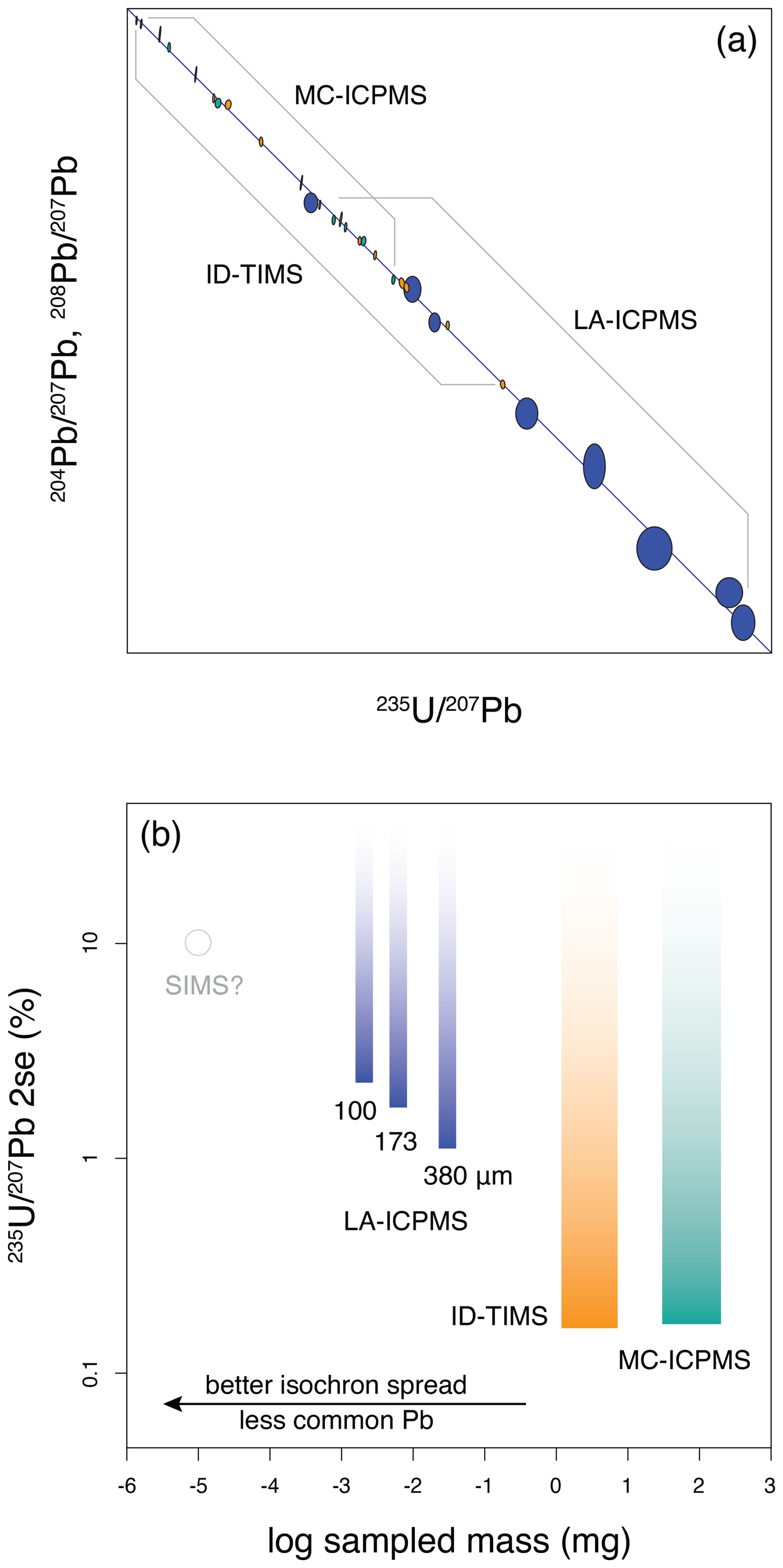
Figure 2Schematic illustration of 207Pb 235U isochron data spread and precision expected from various analytical methods in a hypothetical radiogenic carbonate sample. (a) Inverse isochron view (204Pb- or 208Pb-based) showing how sampling characteristics affect the position of data along the isochron. In situ data have the greatest spread and reach the highest U Pb; solution data have more initial Pb. Their spread should roughly follow the sample mass. (b) Relationship between the achievable data-point uncertainty for 235U 207Pb and sampled mass (based on new and literature data). LA-ICPMS fields are marked with laser beam diameters in µm. The precision of a theoretical SIMS analysis is a guess.
The available methods are mainly distinguished by how the sample is introduced into the mass spectrometer:
-
Solution-based methods. Here, fragments of the sample are dissolved in acid, homogenised with an enriched isotope tracer, purified to isolate U and Pb, and analysed by high-precision mass spectrometry, either thermal ionisation mass spectrometry (TIMS, also called ID-TIMS to highlight the isotope dilution aspect) or multicollector inductively coupled plasma mass spectrometry (MC-ICPMS). A variation of this method that does not include U and Pb purification has also been applied to clean speleothem samples (Mason et al., 2022). Solution-based methods require relatively large samples to produce sufficiently high intensity and to avoid sensitivity to blank corrections related to sample handling and reagents. Sample mass depends on U and Pb concentrations but has typically been in the range of 1–10 mg for ID-TIMS and tens to hundreds mg for MC-ICPMS. Because chemical separation is involved, for simplicity both methods are typically focused on U and Pb and do not include Th. 204Pb and 208Pb can be accurately analysed by ID-TIMS. 208Pb is also easily analysed by MC-ICPMS; however, reliable 204Pb analyses by ICPMS have been challenging due to a common interference from 204Hg found in Ar gas (Hirata and Nesbitt, 1995; White et al., 2000). This effect is variable but historically has led to a distrust in 204Pb analysed by ICPMS in small samples (Woodhead et al., 2006) and a focus on dates obtained in the 238U 206Pb–207Pb 206Pb space (Pickering et al., 2019) or using 208Pb as the non-radiogenic Pb proxy (Mason et al., 2022; Vaks et al., 2025). The ability to analyse 204Pb by ICPMS may improve by employing a reaction gas (Gilbert and Glorie, 2020) but this approach has not been widely adopted thus far. Consequently, 204Pb normalisation of carbonate MC-ICPMS U–Pb results has been the exception (Dirks et al., 2010; Pickering et al., 2010) rather than the rule. Until 204Pb analysis can be demonstrated to be accurate at the sample size of interest, MC-ICPMS applications must rely on 208Pb as the proxy for non-radiogenic Pb.
-
In situ methods. In these methods a surface layer of the specimen is sampled with a laser beam (laser ablation (LA)-ICPMS) or an ion beam (secondary ion mass spectrometry, SIMS) to obtain highly spatially resolved compositions on much smaller sample volumes. The standard laser beam size for carbonate U–Pb geochronology ranges from 40 to > 100 µm (0.3–2.5 µg sample mass) (Roberts et al., 2020) but it could be expanded up to over 350 µm (ca. 25 µg) in some setups. In SIMS, beam sizes are generally smaller and sampled pits shallower, corresponding to sample masses in the ng range. While we are not aware of successful applications of SIMS to carbonate U–Pb geochronology, LA-ICPMS has recently become the main analytical tool for TW concordia dating of older carbonates (Roberts et al., 2020). This technique is capable of quickly producing large amounts of data at lower data-point precision than offered by the solution methods. Due to the superior isochron spread resulting from smaller sampling sizes, it is however possible to obtain isochron dates that may approach the precision of solution methods, particularly in the youngest samples. Finally, a typical LA-ICPMS setup generally cannot provide reliable 204Pb data due to the Hg interference issue described above, so it must rely on 208Pb normalisation, but the analytical routine can include Th as well as other elements.
Our compilation in Fig. 2 shows that the best achievable precision on 235U 207Pb in a single analysis is on the order of 0.2 % for the solution methods, and > 1 % for LA-ICPMS; this is a clear consequence of sampling size. However, the expected spread of data along the isochron is of equal or greater importance to isochron date calculation. LA-ICPMS facilitates avoiding contamination (by visual selection), as well as shifting and expanding the range of data towards higher U Pb, theoretically improving the precision of regression dates when datasets become large. Even so, the precision of in situ methods is ultimately limited by the reference materials used, while the long-term reproducibility is unlikely to be better than 1 %–2 % (Guillong et al., 2024). Solution methods are less flexible when it comes to eliminating contaminants, so their results tend to skew towards more common Pb-rich compositions. In detail, solution MC-ICPMS sampling sizes are 1–2 orders of magnitude larger than in ID-TIMS so it should be expected that the former delivers a more restricted spread of data. Thus, given the lower expected spreads at similar data-point uncertainties (Fig. 2) there seems to be no advantage to using solution MC-ICPMS over ID-TIMS, especially considering that 204Pb may be difficult to analyse by ICPMS. Solution MC-ICPMS remains an acceptable analytical tool (e.g. Vaks et al., 2020; Vaks et al., 2025), but without 204Pb, it remains inferior to ID-TIMS.
Taking these variables into account, we conclude that 207Pb 235U carbonate geochronology is best conducted by LA-ICPMS for quick, high-throughput analyses at lower precision, or by ID-TIMS for the most precise and accurate, but labour-intensive analyses. Below we describe attempts to optimise analyses using the two methods and demonstrate their suitability. First, we provide new and reprocessed ID-TIMS data to explore the potential for the most precise 207Pb 235U results. We then explore adaptations of the LA-ICPMS analytical strategy that allow us to produce accurate in situ 207Pb 235U isochron dates at a useful precision.
3.1 Samples
We used carbonate reference materials: the ca. 3 Ma ASH15 (D + K) speleothem (Nuriel et al., 2021) and the ca. 322 Ma RA138 marine calcite (Guillong et al., 2024). While they were not specifically analysed to obtain 207Pb 235U dates, the existing ID-TIMS data for these samples could be reprocessed to provide 207Pb 235U isochrons and 208Pb 204Pb ratios. We also newly analysed a South African speleothem from the Hoogland paleocave (X4). This sample, previously dated by ID-TIMS by Hopley et al. (2019), comes from the same basal flowstone as sample HL1 dated by solution MC-ICPMS by Pickering et al. (2019) and should be directly comparable (Fig. 1). For laser ablation analyses, we additionally used the ca. 43 Ma calcite breccia B6 (Pagel et al., 2018).
3.2 ID-TIMS
Hoogland speleothem X4 was cut to yield a 2 cm wide section perpendicular to layering, which was polished and scanned on a desktop scanner. LA-ICPMS analyses were then conducted to obtain compositional profiles across the polished sample surface (Fig. 3). The layer with the highest U Pb was isolated from the section with a diamond wire saw to yield a 2 mm thick slice (Fig. 3). The slice was then subdivided into sub-mm pieces with a scalpel. The focus was on internal domains of the slice, avoiding outside surfaces previously exposed to saws and the related contamination. Pieces suitable for analysis were chosen in the mass range of 1.5–6 mg and were, as much as possible, free of visible surface impurities of non-carbonate material. Before washing and dissolution, they were weighed on a microbalance.
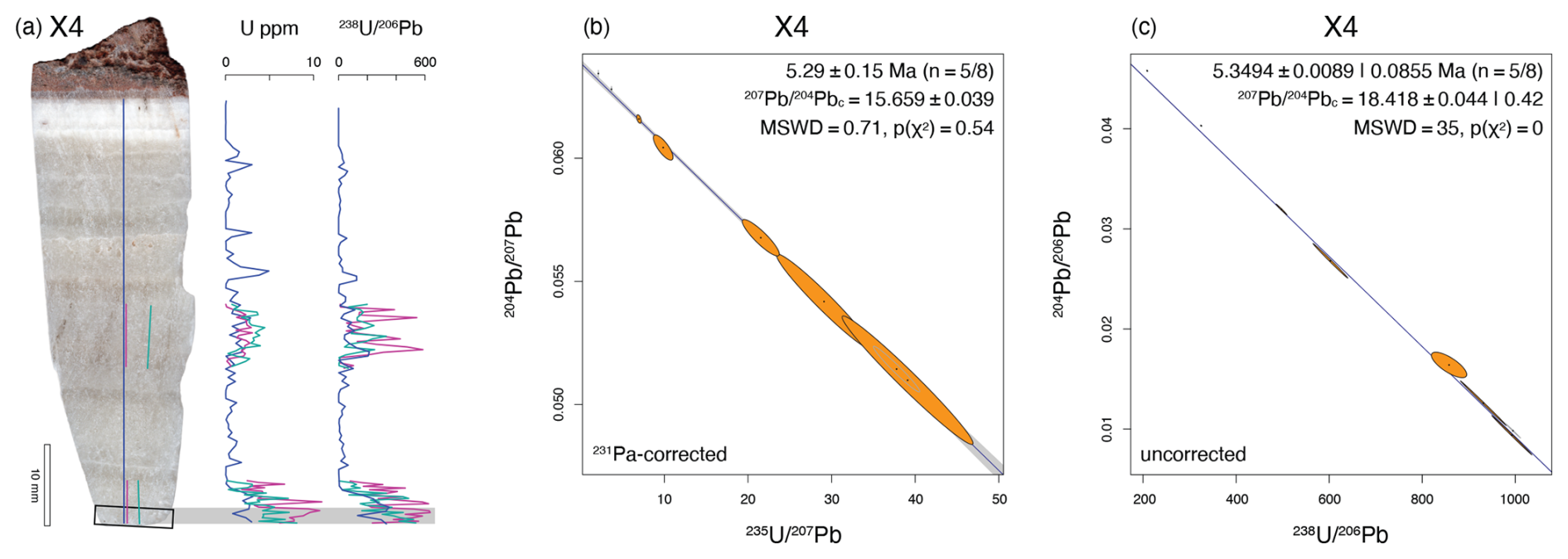
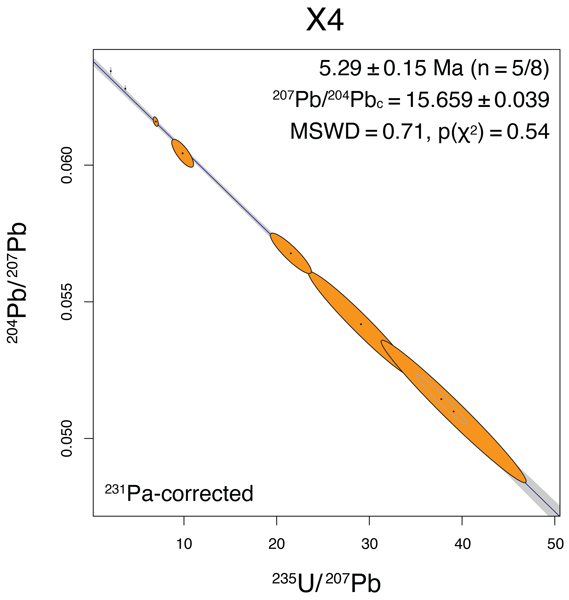
Figure 3ID-TIMS U–Pb geochronology of Hoogland basal flowstone X4. (a) Sample scan and location of traverses analysed for U concentration and U Pb ratio. Black box marks the slice selected for ID-TIMS analyses. (b) 207Pb–235U isochron corrected with initial [231Pa 235U] = 0. (c) 206Pb–238U isochron uncorrected for U-series disequilibria.
Single carbonate pieces were sonicated in acetone and ultrapure water, then transferred to individual 3 mL screw-top PFA vials. After an additional rinse in ultrapure water, they were dissolved in ca. 150 µL 6 M HCl. Following dissolution, 5–9 mg of the EARTHTIME 205Pb–233U–235U (ET535) tracer solution (Condon et al., 2015; McLean et al., 2015) was added to each vial. Samples were equilibrated with the tracer for 2 h on a 100 °C hotplate and subsequently dried to chloride salts. For U–Pb separation, samples were redissolved in 1 M HBr and loaded onto 50 µL columns filled with AG1-X8 ion exchange resin. Pb and U were isolated from the solutions in a two-step, HBr and HCl-based ion exchange procedure. Uranium and Pb fractions were collected in separate 7 mL PFA vials and dried down with trace H3PO4.
Samples were then dissolved in a silica-gel emitter (modified from Gerstenberger and Haase, 1997) and loaded on single, outgassed, zone-refined Re filaments for analysis on a Thermo Triton Plus thermal ionisation mass spectrometer (TIMS). Both Pb and UO2 analyses were performed using static multicollection in Faraday cups connected to 1013 Ω resistors (von Quadt et al., 2016) except cases of low Pb intensity where 204Pb was collected in the axial secondary electron multiplier. Electronic Faraday baselines were acquired for 1 h twice daily. 18O 16O in the UO2 analyses was determined online by monitoring mass 272 (Wotzlaw et al., 2017) when sufficient intensity was available, otherwise a value of 18O 16O = 0.00205 ± 2 (1σ) was applied to correct for interferences.
All isotopic ratios were processed in Tripoli (Bowring et al., 2011) and a spreadsheet following the equations of Schmitz and Schoene (2007) modified to include 208Pb 204Pb quantification. Instrumental mass fractionation in Pb isotope analyses was corrected with a value of 0.072 ± 0.025 (1σ) %/amu based on a long-term compilation of Faraday Pb analyses performed with a double-Pb spike. For U, instrumental mass fractionation was determined using the known 233U 235U of the tracer and assuming that the samples had 238U 235U of 137.818 ± 0.045 (2σ; Hiess et al., 2012). Departures in 238U 235U of up to 0.5 ‰ have been documented in some speleothems (Pollard et al., 2025) but such values have no discernible effect on U–Pb sample age at the current precision level. Measured isotope ratios were corrected for laboratory blank where mass and isotopic composition were estimated based on analyses of 12 total procedural blanks run alongside unknowns, yielding a Pb blank mass of 0.74 ± 0.32 (1σ) pg with a composition of 206Pb 204Pb = 18.28 ± 1.3 %, 207Pb 204Pb = 15.66 ± 0.8 %, and 208Pb 204Pb = 38.11 ± 1.2 %, (all 1σ), and U blank of 0.39 ± 0.07 (1σ) pg (assuming isotopic composition identical to sample). Data pertinent to 207Pb 235U geochronology are shown in Table 1 while all sample isotopic compositions are reported in the Supplement. Isochron ages were calculated using decay constants of Jaffey et al. (1971) for 235U and Audi et al. (2003) for 231Pa. Corrections for 231Pa disequilibrium assumed initial [231Pa 235U] = 0.
Table 1New ID-TIMS 207Pb 235U data for Hoogland speleothem sample X4.

All sample ratios and concentrations are corrected for fractionation, spike, and blank. Pb* and Pbi represent radiogenic and initial Pb, respectively. Analyses in bold type have coherent 208Pb 204Pb ratios and were included in the “filtered” isochron construction.
3.3 LA-ICPMS
Laser ablation analyses were performed using an ASI RESOlution LR 193 nm excimer ArF laser ablation system coupled to a Thermo Element XR single-collector sector field ICP-MS following a workflow modified from Guillong et al. (2024) collecting 202Hg, 204Pb, 206Pb, 207Pb, 208Pb, 232Th, 235U, and 238U. For LA-ICPMS data, we use the inverse 235U 207Pb–208Pb 207Pb isochron construction (Fig. 2) so the primary focus is on accurate analyses of 207Pb, 208Pb, and 235U. Preliminary analyses showed that the standard 100 µm spot size leads to unacceptably large uncertainties for the youngest samples (e.g. ASH15) so we adopted the largest available spot size of 380 µm to maximise ion yield. We used static spot ablation at 5 Hz and an energy density of ∼ 2 J cm−2. To improve precision for small ion beams, the counting times were extended to 100 ms for 207Pb, to 50 ms for 208Pb, and to 20 ms for 235U, while other isotopes were analysed for 11 ms, resulting in a sweep time of 0.243 s.
All isotopic ratios and intensities were corrected following an adaptation of the standard procedure used in TW carbonate geochronology (Roberts et al., 2017; Guillong et al., 2020). Initial processing was done in Iolite 4 (Paton et al., 2011) and included selection of integration intervals, gas blank subtraction, and the correction of the 235U 207Pb ratio for laser-induced elemental fractionation using the U–Pb data reduction scheme (Paton et al., 2010) with NIST SRM 614 glass (Jochum et al., 2011) as the primary reference material. Further treatment was implemented in an Excel spreadsheet. First, fractionation-corrected 235U 207Pb ratios were corrected for drift using NIST614. Raw 208Pb 207Pb was calculated from the two intensities (ratio of intensity) and corrected to the known value for NIST614 (208Pb 207Pb = 2.4125 estimated from values available in GeoReM, Jochum et al., 2005). Corrected ratios for RA138 were then used to calculate a 207Pb 235U isochron date; the comparison of this date with the isochron date obtained by ID-TIMS gave a correction factor applied to all unknown 235U 207Pb ratios throughout the sequence. Propagated uncertainties include those resulting from counting statistics and from the RA138 correction, but do not include systematic uncertainties which are likely > 1.5 % as determined for TW dates on RA138 (Guillong et al., 2024). Detailed description of the instrumental setup and methodology used, and all results are included in the Supplement.
4.1 ID-TIMS geochronology
Our new (Table 1) and reprocessed ID-TIMS results demonstrate the ability of this method to generate usefully precise 207Pb 235U dates. For ID-TIMS data, we use the inverse 235U 207Pb–204Pb 207Pb isochron construction (Figs. 3, 4). The Hoogland X4 sample returned 207Pb 235U isochron dates of 5.29 ± 0.15 Ma (filtered, , details of filtering in Sect. 4.3 below) and 5.35 ± 0.13 Ma (). Both dates are consistent with the ID-TIMS 207Pb 235U isochron date of 4.9 ± 1.9 Ma of Hopley et al. (2019) obtained on the same sample X4, and are indistinguishable from our uncorrected 206Pb 238U isochron date of 5.349 ± 0.085 Ma (Fig. 3c, ), indicating that initial 234U 238U disequilibrium was likely negligibly small. Our X4 dates are also consistent with the Tera-Wasserburg intercept date of Pickering et al. (2019) for the same speleothem when corrected using the Vermeesch et al. (2025) algorithm (Fig. 1c), but not when the original correction is applied.
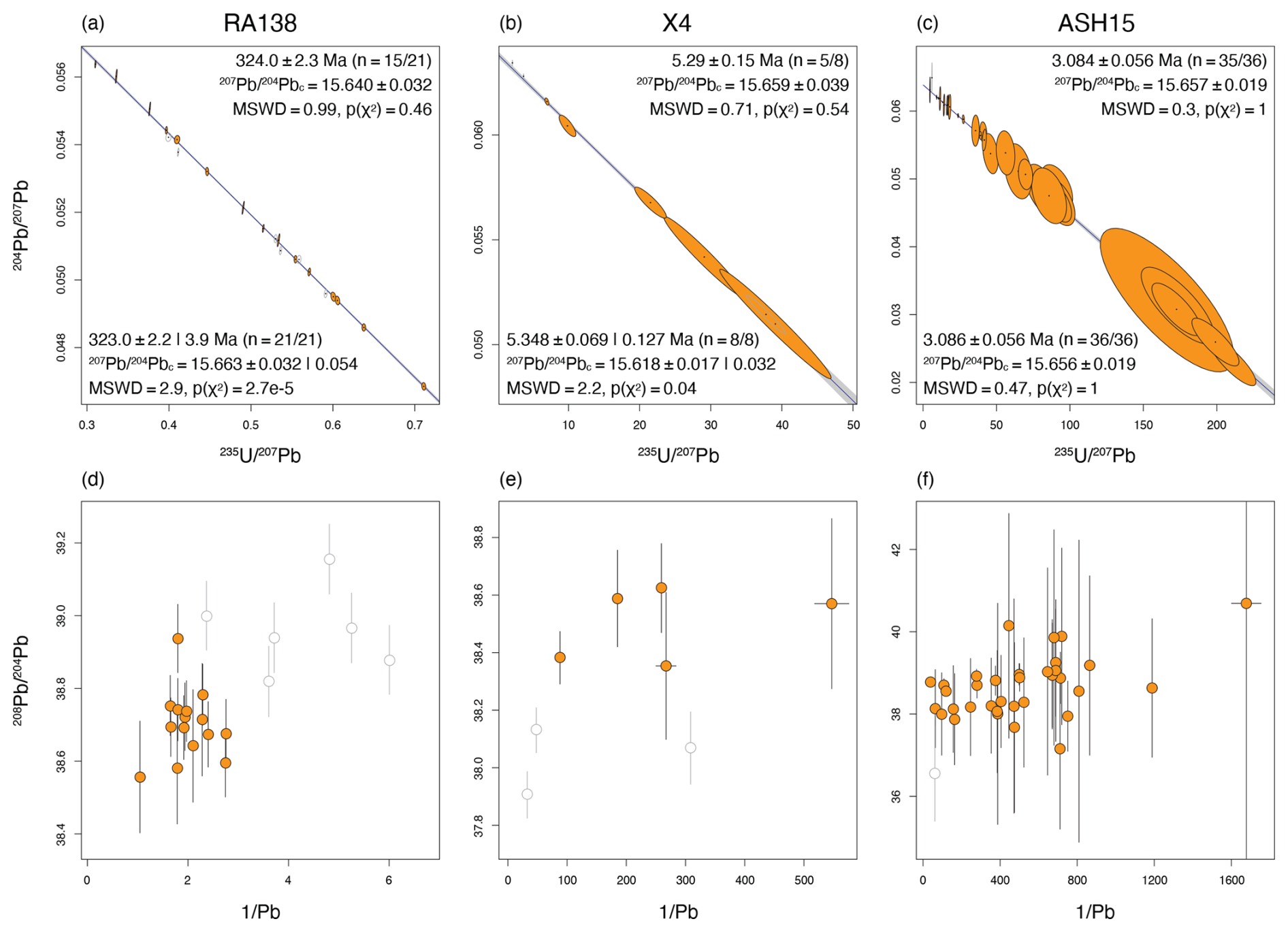
Figure 4Utility of 208Pb 204Pb in carbonates as a tracer of contamination, and its effect on age interpretation. (a–c) 208Pb-filtered (text near top and coloured ellipses) and unfiltered (bottom text, coloured and empty ellipses), 231Pa-corrected ID-TIMS 207Pb 235U isochron dates for RA138, X4, and ASH15. (d–f) corresponding measured 208Pb 204Pb vs. 1 (Pb ppm) systematics and suggested exclusion of outliers (empty symbols).
Reprocessed RA138 data (Fig. 4) gave 207Pb 235U isochron dates of 324.0 ± 2.3 Ma () and 323.0 ± 3.9 Ma (), both indistinguishable from the uncorrected Tera-Wasserburg intercept dates of 321.99 ± 0.65 Ma () and 320.8 ± 1.3 Ma () presented by Guillong et al. (2024). This result is also consistent with the uncorrected 206Pb 238U isochron dates for the same data of 321.4 ± 1.4 Ma () and 321.4 ± 1.1 Ma (). Reprocessed ASH15 data returned 207Pb 235U isochron dates of 3.084 ± 0.056 Ma () and 3.086 ± 0.056 Ma (), which is older than the uncorrected Tera-Wasserburg intercept date of 2.965 ± 0.011 Ma (, Nuriel et al., 2021) and the uncorrected 206Pb 238U isochron date of 2.974 ± 0.015 Ma () but consistent with minor amounts of initial disequilibrium determined in Ashalim speleothems by Vaks et al. (2010). In the three presented cases, the uncertainty of 207Pb 235U isochron dates is a factor of 1.5–6 larger than that of the respective uncorrected 206Pb 238U isochron or Tera-Wasserburg concordia intercept date, but in each case the dispersion of 207Pb 235U data is consistent with a single age population, while 206Pb 238U data are overdispersed.
4.2 Pb blank correction in ID-TIMS
At the sample sizes employed here, the key variable governing the size and shape of uncertainty envelopes in the 207Pb 235U isochron diagram is the Pb blank correction. This is because in some cases sample 207Pb is low enough that a large fraction of the measured 207Pb comes from the laboratory blank. In most cases, the blank Pb isotopic composition is indistinguishable from the composition of the initial Pb in the sample (there may be some exceptions; see Szymanowski et al., 2025 for a compilation of TIMS lab Pb blank compositions). Consequently, the blank correction will shift data along the isochron and away from the common Pb intercept, expanding data-point uncertainty and turning positive error correlations into strongly negative ones. In cases where the two compositions are different, the correction might add scatter to the data, which highlights the importance of correctly accounting for blank mass and isotopic composition. In the dataset presented here, the mass ratio of sample to blank Pb was generally < 100 (and often < 10) in ASH15 and X4, and it was on the order of 100–1000 for RA138. Young or small samples similar to ASH15 or X4 may be very sensitive to the blank correction parameters. For example, X4 has relatively more correlated errors than ASH15 at similar sample sizes and U Pb ratios (Fig. 4), which is a consequence of a 3× larger relative uncertainty on the Pb blank mass used in reducing the X4 data. In cases of significant sensitivity, it might be worthwhile to increase the sample size to improve data-point uncertainties; however, this may come at the cost of decreased spread in the isochron diagram. Old/radiogenic samples such as RA138 will be less affected by blank corrections but such considerations are an important part of planning how much material to dissolve for ID-TIMS analyses.
4.3 Identifying contamination in U–Pb results with 208Pb 204Pb
In carbonate U–Pb geochronology, sample characteristics dictate that we rely on the isochron approach, where a suite of cogenetic samples of variable U Pb are used to calculate one isochron date. The variations in (blank-corrected) U Pb and Pb isotopic ratios, and the position along the isochron, result from variable mixing between U-bearing domains of the sample containing radiogenic Pb, and initial Pb-bearing domains. By definition, an isochron is a mixing line between domains of the same age and the same, single initial Pb component. It follows that for a sample of homogeneous age, a real isochron can only accommodate mixing with one isotopic endmember of initial Pb. A violation of this requirement may manifest in the form of obvious excess scatter of data about the isochron but it may also bias the date in ways that are invisible to common statistics describing the quality of isochron fits such as MSWD. Thus, it would be advantageous to isochron age determination if extraneous initial Pb components could be identified and excluded from calculation, thereby satisfying the basic principle of the isochron and improving the accuracy of age interpretation.
In Fig. 4 we illustrate a method to use the measured (blank-corrected) 208Pb 204Pb as a provenance index of initial Pb that expands upon the suggestion of Engel et al. (2019). 204Pb is a stable, non-radiogenic isotope, while the measured 208Pb will represent a mix of initial 208Pb and the generally negligible radiogenic 208Pb*. In Th-free carbonates (as well as any 208Pb*-corrected Th-rich samples), both 208Pb and 204Pb should remain invariant after the closure of the system and so a sample's 208Pb 204Pb ratio should only depart from the initial value in cases of mixing with extraneous Pb sources. An anomalous 208Pb 204Pb of an analysed aliquot is a reason to suspect that the aliquot violates the initial Pb homogeneity requirement of the isochron approach, which may introduce bias to its 204Pb 207Pb and 235U 207Pb systematics.
To apply any exclusion criteria, we need enough analyses to identify any trends in the data, while the data-point uncertainties need to be sufficiently small to distinguish trends with confidence. The simplest approach would be to eliminate statistical outliers in 208Pb 204Pb (Engel et al., 2019), but ideally one may strengthen the interpretations by developing an understanding of the geochemistry of the possible mixing endmembers. These may include, for example, detrital material included in the sampled volume whose Pb isotopic composition may be known or estimated, younger alteration, contamination at the sampling site or in processing. Detrital components of different age may have very different Pb isotopic compositions that are to some extent predictable.
We plot 208Pb 204Pb in our three ID-TIMS datasets against the reciprocal of Pb concentration, which can visualise straight-line mixing trends (Fig. 4). We suggest a possible approach to data filtering that is not exhaustive – it is only meant to illustrate the potential of the method. In the case of Hoogland speleothem X4, we find five indistinguishable main-group analyses and three that trend toward a high-Pb, low-208Pb 204Pb endmember. The Hoogland cave was developed within the Archean–Proterozoic Malmani Subgroup dolomite. Similar old U-poor dolomites in the Transvaal craton can have 208Pb 204Pb values as low as 35.0–35.6 (Bau et al., 1999). Low 208Pb 204Pb values thus likely represent contamination with similar old, non-radiogenic material. In contrast, among the data for RA138 one can identify a low-Pb, high-208Pb 204Pb endmember that may be more easily explained with a younger (i.e. not Archean) rock contaminant or a modern lab-derived component. The analyses of RA138 were conducted on powders resulting from the drilling of one specific type of marine cement out of a total of four carbonate generations in the rock (Guillong et al., 2024), so it is conceivable that some analyses included a fraction of Pb derived from a different carbonate generation. The ASH15 data come with large uncertainties on 208Pb 204Pb which are expected from small samples of initial Pb-poor carbonate. Here, we only identify one potential high-Pb, low-208Pb 204Pb outlier.
Applying our exclusion criteria results in improving the goodness of fit of the isochrons for RA138 and X4, with a negligible effect on ASH15 (Fig. 4). Thus, the suggested approach appears promising for identifying data skewing the 204Pb 207Pb–235U 207Pb systematics that may go otherwise unnoticed, and it provides a geology-based outlier detection tool that is superior to outlier rejection based purely on poor statistical fit, i.e. “cherry picking” for the sake of improving isochron statistics (Vermeesch, 2026). Finally, the variability of 208Pb 204Pb illustrated here (Fig. 4) has two important consequences for selecting the optimal analytical strategy for 207Pb 235U geochronology: (1) variations in 208Pb 204Pb in Th-poor carbonates imply that 208Pb is not ideal as a normalisation isotope for 207Pb 235U isochrons, (2) analytical setups that can produce precise and accurate 204Pb data (ID-TIMS, rarely ICPMS) offer a big advantage over those that do not (most literature solution and laser ablation ICPMS data).
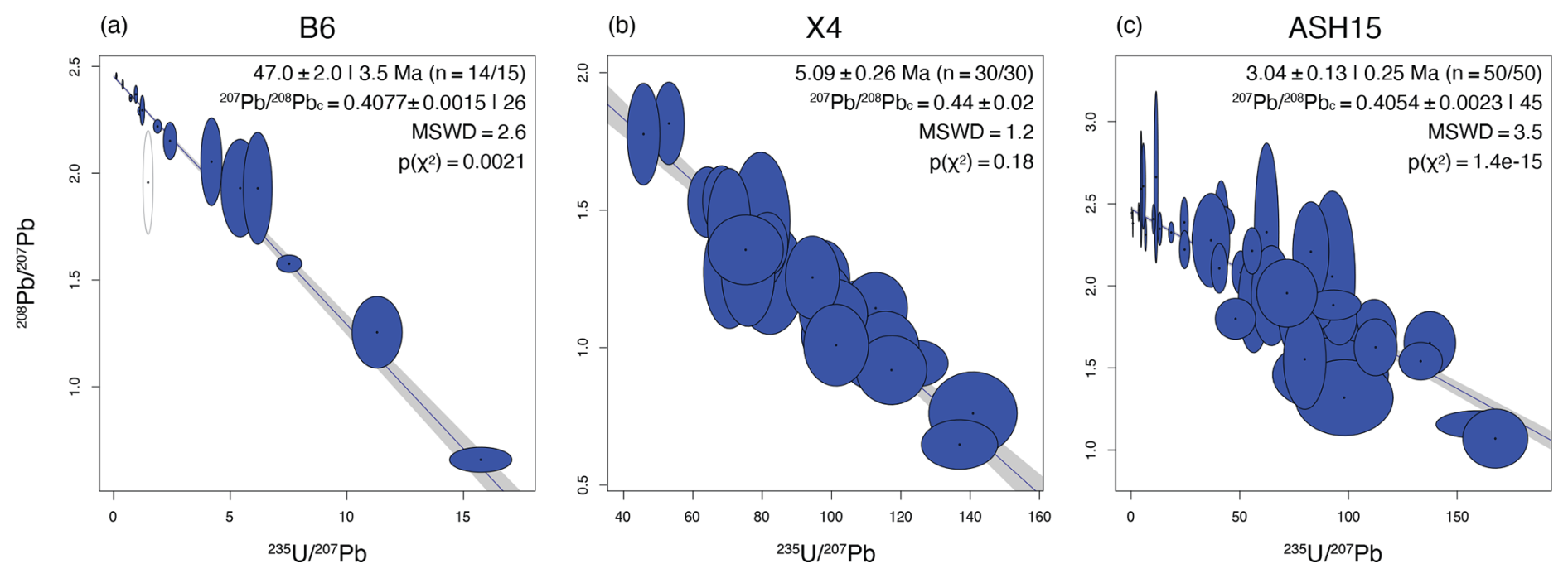
Figure 5LA-ICPMS results for B6, X4, and ASH15 obtained with the 207Pb 235U method using a 380 µm diameter laser spot. All isochron dates are disequilibrium-corrected with initial [231Pa 235U] = 0.
4.4 LA-ICPMS geochronology
For LA-ICPMS, we use the inverse 235U 207Pb–208Pb 207Pb isochron construction (Fig. 5). In the three investigated samples, data describe clear linear arrays, apart from several anomalous analyses of ASH15 which will be discussed below. We can evaluate the accuracy of the LA-ICPMS data by reference to 207Pb 235U ID-TIMS isochrons in Fig. 4. The 207Pb 235U data for B6 are slightly overdispersed (MSWD = 2.6) yielding an isochron date of 47.0 ± 3.5 Ma (, excluding one low-intensity analysis). B6 does not have an ID-TIMS reference age, but its age is expected to be ca. 43 ± 1 Ma based on LA-ICPMS TW data (Pagel et al., 2018). Results for X4 (5.09 ± 0.26 Ma, MSWD = 1.2, ) are in excellent agreement with the ID-TIMS 207Pb 235U isochron date of 5.29 ± 0.15 Ma. Interestingly, the 235U 207Pb ratios returned by LA-ICPMS for X4 (ranging from 45 to 140) are all larger than those obtained for solutions (2–39), which underscores the capacity of laser ablation sampling to avoid visible contamination. Finally, data for ASH15 were slightly overdispersed (MSWD = 3.5, ) and resulted in an isochron date of 3.04 ± 0.25 Ma, in agreement with the ID-TIMS date (Fig. 4). Here, the range of U Pb ratios was more restricted than for solution data, suggesting that common Pb in this sample is not hosted in any major “hotspots” (that may be more easily picked up by solution analyses but avoided by laser sampling) but that it is distributed within the lattice. The precision of our LA-ICPMS 207Pb 235U isochron dates is 3–6 times lower than the corresponding Tera-Wasserburg concordia intercept dates, which is comparable to the result obtained for ID-TIMS.
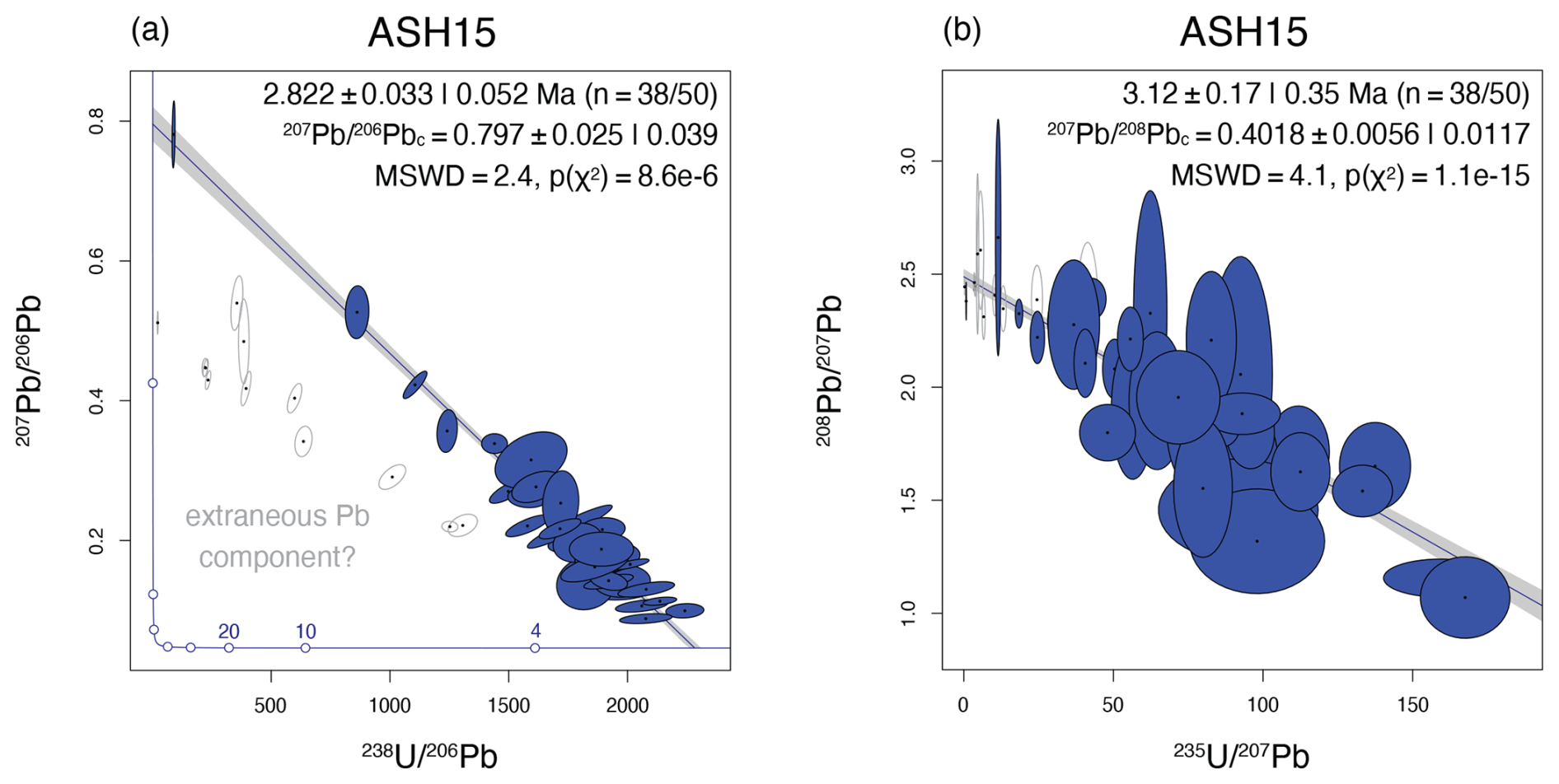
Figure 6Filtered LA-ICPMS results for ASH15. (a) Tera-Wasserburg diagram illustrating an array of data projecting towards an anomalous 207Pb 206Pb ratio. (b) Filtered 207Pb 235U isochron excluding 12 points identified as outliers in panel (a).
The consistency of our LA-ICPMS data with the ID-TIMS isochron dates for X4 and ASH15 suggests that at least in these two cases, using 208Pb as the numerator in the y-axis ratio does not have major adverse effects. One explanation is that there was no heterogeneity in 208Pb 204Pb at the scale of laser sampling, another possibility is that it was masked by lower analytical precision. Notwithstanding the general consistency of isochron dates, the relatively large scatter of the LA-ICPMS ASH15 data suggests that the ASH15 sample analysed by LA-ICPMS may have some amount of heterogeneity in the initial Pb isotopiccomposition that was undetectable in the ID-TIMS 208Pb 204Pb data due to large uncertainties in this Pb-poor sample (Fig. 4). In fact, this is supported by two distinct arrays in the Tera–Wasserburg diagram with very different apparent common Pb intercepts (Fig. 6a). Some of the data in the lower-207Pb 206Pb array are also enriched in Th up to 1 ppb, suggesting a detrital component. This is in contrast to previous LA-ICPMS data on ASH15 (Nuriel et al., 2021) which scattered around a single isochron, and may be specific to the newly mounted material prepared specifically for this study utilising large laser spots. Irrespective of the reason, this behaviour is an opportunity which may be used in a fashion similar to 208Pb 204Pb filtering: identifying outliers in Tera-Wasserburg space or in Th concentration which may contribute to improving the 207Pb 235U isochron date interpretation. In the case of ASH15, excluding 12 low-207Pb 206Pb data points results in no improvement of the scatter on the 207Pb 235U isochron (Fig. 6b). However, this does illustrate the benefit of analysing 206Pb and 238U as part of the LA-ICPMS routine.
The main challenge encountered in implementing LA-ICPMS carbonate 207Pb 235U geochronology in young samples was the low signal intensity for all involved isotopes, which may make the analyses particularly sensitive to outlier (“spike”) rejection. Such spikes in the time-resolved signal are often expressed as increased counts for a single mass spectrometer sweep, and they likely reflect the detection of single larger particles mobilised from the ablation cell, sample, or transfer tubing. The spikes are not representative of the sample composition, but they may skew a low (tens to hundreds cps) intensity signal in a major way, creating biases in the resulting ratios. In this case, we performed spike elimination on the 208Pb and 207Pb signals separately (2 SD outlier rejection) before calculating a ratio from the means of the two signals (ratio of intensities) to increase chances of success compared to doing this using the time-resolved 208Pb 207Pb signal (mean of ratios). However, ten analyses in the ASH15 dataset were particularly spiky, so the Iolite routine could not remove the spikes correctly, leading to large biases to the 208Pb 207Pb ratio. This was not a problem for X4, which was measured at similar < 1000 cps intensities, suggesting that this behaviour is sample-specific. In ASH15, this affected a fraction of analyses which could be excluded from consideration, but any implementations of this method should carefully monitor for this effect.
We have shown here why it is advantageous to turn to 207Pb 235U geochronology to date carbonates whose initial 234U 238U disequilibria are not directly constrained – i.e., all carbonates beyond ca. 1.5 Ma. We have then demonstrated that such analyses are feasible by both solution-based and in situ techniques, arguing that ID-TIMS and LA-ICPMS are the best tools for this application. ID-TIMS offers the ultimate accuracy through the use of an isotopic tracer, and it is the most precise technique available, particularly for older radiogenic samples. Instead, optimised LA-ICPMS can quickly provide large quantities of data that result in comparable isochron date precision in some very young samples, but its precision is ultimately limited to several percent. A key factor to consider in choosing the analytical method is contamination with extraneous Pb components, which may bias the obtained date. While ID-TIMS provides generally precise analyses of 204Pb that can be used to filter the data using 208Pb 204Pb, LA-ICPMS (and solution MC-ICPMS) may not offer this option. Deviations seen in the corresponding Tera-Wasserburg data space, in Th content or other isotopic space may fill this role for some (LA-)ICPMS datasets. In any case, collecting additional compositional information (such as trace elements, e.g. Woodhead et al., 2012) from the sampled material might be a worthwhile effort leading to improved accuracy of age interpretation. This could involve adding more elements to the LA-ICPMS analytical routine or analysing trace elements or other isotopic ratios in an aliquot of the dissolved material.
Since in many cases initial 234U 238U disequilibria are unconstrained or impossible to correct while maintaining useful precision, we recommend the 207Pb 235U method for all applications where meteoric water was involved in carbonate formation. While we do not find evidence for large initial disequilibria in either of the speleothem datasets presented here, measurements of groundwaters and of young speleothems globally provide evidence that the disequilibria may be overwhelming for 206Pb 238U geochronology. Marine carbonates, where seawater [234U 238U] is relatively better constrained, might be more permissive to the use of the 238U-based methods if appropriate uncertainty is assigned to the initial [234U 238U] value to account for past seawater changes (Chutcharavan et al., 2018); however, high-accuracy applications are still better served by the 207Pb 235U method.
All original and reprocessed data presented in the paper are available in the Supplement.
The supplement related to this article is available online at https://doi.org/10.5194/gchron-8-679-2026-supplement.
DS and MG developed the analytical methods and conducted the analyses. DS recalculated previously published ID-TIMS data. PV developed algorithms for Bayesian disequilibrium correction and uncertainty propagation and reassessed existing analytical data for the Hoogland speleothem. PJH provided sample X4. DS prepared the manuscript with contributions from all co-authors.
At least one of the (co-)authors is a member of the editorial board of Geochronology. The peer-review process was guided by an independent editor, and the authors also have no other competing interests to declare.
Publisher's note: Copernicus Publications remains neutral with regard to jurisdictional claims made in the text, published maps, institutional affiliations, or any other geographical representation in this paper. The authors bear the ultimate responsibility for providing appropriate place names. Views expressed in the text are those of the authors and do not necessarily reflect the views of the publisher.
We thank Dr. Tavazzani for help in obtaining compositional profiles across sample X4. Ariela Mazoz and an anonymous reviewer are acknowledged for thorough reviews that helped improve the presentation of this work.
Dawid Szymanowski was partly supported by an ETH Career Seed Award.
This paper was edited by Sandra Kamo and reviewed by Ariela Mazoz and one anonymous referee.
Audi, G., Bersillon, O., Blachot, J., and Wapstra, A. H.: The Nubase evaluation of nuclear and decay properties, Nucl. Phys. A, 729, 3–128, https://doi.org/10.1016/j.nuclphysa.2003.11.001, 2003.
Bau, M., Romer, R. L., Lüders, V., and Beukes, N. J.: Pb, O, and C isotopes in silicified Mooidraai dolomite (Transvaal Supergroup, South Africa): implications for the composition of Paleoproterozoic seawater and `dating' the increase of oxygen in the Precambrian atmosphere, Earth Planet. Sc. Lett., 174, 43–57, https://doi.org/10.1016/S0012-821X(99)00261-7, 1999.
Bowring, J. F., McLean, N. M., and Bowring, S. A.: Engineering cyber infrastructure for U–Pb geochronology: Tripoli and U–Pb_Redux, Geochem. Geophy. Geosy., 12, Q0AA19, https://doi.org/10.1029/2010GC003479, 2011.
Chaldekas, O., Vaks, A., Haviv, I., Gerdes, A., and Albert, R.: U–Pb speleothem geochronology reveals a major 6 Ma uplift phase along the western margin of Dead Sea Transform, Geol. Soc. Am. Bull., 134, 1571–1584, https://doi.org/10.1130/B36051.1, 2021.
Chen, J. H., Edwards, R. L., and Wasserburg, G. J.: 238U, 234U and 232Th in seawater, Earth Planet. Sc. Lett., 80, 241–251, https://doi.org/10.1016/0012-821X(86)90108-1, 1986.
Chen, T., Robinson, L. F., Beasley, M. P., Claxton, L. M., Andersen, M. B., Gregoire, L. J., Wadham, J., Fornari, D. J., and Harpp, K. S.: Ocean mixing and ice-sheet control of seawater 234U 238U during the last deglaciation, Science, 354, 626–629, https://doi.org/10.1126/science.aag1015, 2016.
Chutcharavan, P. M., Dutton, A., and Ellwood, M. J.: Seawater 234U 238U recorded by modern and fossil corals, Geochim. Cosmochim. Ac., 224, 1–17, https://doi.org/10.1016/j.gca.2017.12.017, 2018.
Condon, D. J., Schoene, B., McLean, N. M., Bowring, S. A., and Parrish, R. R.: Metrology and traceability of U–Pb isotope dilution geochronology (EARTHTIME Tracer Calibration Part I), Geochim. Cosmochim. Ac., 164, 464–480, https://doi.org/10.1016/j.gca.2015.05.026, 2015.
Dirks, P. H. G. M., Kibii, J. M., Kuhn, B. F., Steininger, C., Churchill, S. E., Kramers, J. D., Pickering, R., Farber, D. L., Mériaux, A.-S., Herries, A. I. R., King, G. C. P., and Berger, L. R.: Geological setting and age of Australopithecus sediba from southern Africa, Science, 328, 205–208, https://doi.org/10.1126/science.1184950, 2010.
Drost, K., Chew, D., Petrus, J. A., Scholze, F., Woodhead, J. D., Schneider, J. W., and Harper, D. A.: An image mapping approach to U-Pb LA-ICP-MS carbonate dating and applications to direct dating of carbonate sedimentation, Geochem. Geophy. Geosys., 19, 4631–4648, https://doi.org/10.1029/2018GC007850, 2018.
Engel, J., Woodhead, J., Hellstrom, J., Maas, R., Drysdale, R., and Ford, D.: Corrections for initial isotopic disequilibrium in the speleothem U–Pb dating method, Quat. Geochronol., 54, 101009, https://doi.org/10.1016/j.quageo.2019.101009, 2019.
Engel, J., Woodhead, J., Hellstrom, J., White, S., White, N., and Green, H.: Using speleothems to constrain late Cenozoic uplift rates in karst terranes, Geology, 48, 755–760, https://doi.org/10.1130/g47466.1, 2020.
Gerstenberger, H. and Haase, G.: A highly effective emitter substance for mass spectrometric Pb isotope ratio determinations, Chem. Geol., 136, 309–312, https://doi.org/10.1016/S0009-2541(96)00033-2, 1997.
Gilbert, S. E. and Glorie, S.: Removal of Hg interferences for common Pb correction when dating apatite and titanite by LA-ICP-MS/MS, J. Anal. Atom. Spectrom., 35, 1472–1481, https://doi.org/10.1039/D0JA00224K, 2020.
Guillong, M., Wotzlaw, J.-F., Looser, N., and Laurent, O.: Evaluating the reliability of U–Pb laser ablation inductively coupled plasma mass spectrometry (LA-ICP-MS) carbonate geochronology: matrix issues and a potential calcite validation reference material, Geochronology, 2, 155–167, https://doi.org/10.5194/gchron-2-155-2020, 2020.
Guillong, M., Samankassou, E., Müller, I. A., Szymanowski, D., Looser, N., Tavazzani, L., Merino-Tomé, Ó., Bahamonde, J. R., Buret, Y., and Ovtcharova, M.: Technical note: RA138 calcite U–Pb LA-ICP-MS primary reference material, Geochronology, 6, 465–474, https://doi.org/10.5194/gchron-6-465-2024, 2024.
Hiess, J., Condon, D. J., McLean, N., and Noble, S. R.: 238U 235U systematics in terrestrial uranium-bearing minerals, Science, 335, 1610–1614, https://doi.org/10.1126/science.1215507, 2012.
Hirata, T. and Nesbitt, R. W.: U–Pb isotope geochronology of zircon: evaluation of the laser probe-inductively coupled plasma mass spectrometry technique, Geochim. Cosmochim. Ac., 59, 2491–2500, https://doi.org/10.1016/0016-7037(95)00144-1, 1995.
Hoareau, G., Claverie, F., Pecheyran, C., Paroissin, C., Grignard, P.-A., Motte, G., Chailan, O., and Girard, J.-P.: Direct U–Pb dating of carbonates from micron-scale femtosecond laser ablation inductively coupled plasma mass spectrometry images using robust regression, Geochronology, 3, 67–87, https://doi.org/10.5194/gchron-3-67-2021, 2021.
Hoareau, G., Claverie, F., Pecheyran, C., Barbotin, G., Perk, M., Beaudoin, N. E., Lacroix, B., and Rasbury, E. T.: The virtual-spot approach: a simple method for image U–Pb carbonate geochronology by high-repetition-rate LA-ICP-MS, Geochronology, 7, 387–407, https://doi.org/10.5194/gchron-7-387-2025, 2025.
Hopley, P. J., Reade, H., Parrish, R., De Kock, M., and Adams, J. W.: Speleothem evidence for C3 dominated vegetation during the Late Miocene (Messinian) of South Africa, Rev. Palaeobot. Palyno., 264, 75–89, https://doi.org/10.1016/j.revpalbo.2019.02.006, 2019.
Hu, H.-M., Shen, C.-C., Cheng, H., Woodhead, J. D., Edwards, R. L., Zhao, J.-X., Huang, C.-Y., Lu, P.-Y., Chien, W.-Y., Wang, J., Jia, X., Yokoyama, Y., Cai, Y., and Zachariáš, J.: Sub-epsilon natural 234U 238U measurements refine the 234U half-life and U–Th geochronology, Science Advances, 11, eadu8117, https://doi.org/10.1126/sciadv.adu8117, 2025.
Jaffey, A. H., Flynn, K. F., Glendenin, L. E., Bentley, W. C., and Essling, A. M.: Precision measurement of half-lives and specific activities of 235U and 238U, Phys. Rev. C, 4, 1889–1906, https://doi.org/10.1103/PhysRevC.4.1889, 1971.
Jochum, K. P., Nohl, U., Herwig, K., Lammel, E., Stoll, B., and Hofmann, A. W.: GeoReM: a new geochemical database for reference materials and isotopic standards, Geostand. Geoanal. Res., 29, 333–338, https://doi.org/10.1111/j.1751-908X.2005.tb00904.x, 2005.
Jochum, K. P., Weis, U., Stoll, B., Kuzmin, D., Yang, Q., Raczek, I., Jacob, D. E., Stracke, A., Birbaum, K., Frick, D. A., Günther, D., and Enzweiler, J.: Determination of Reference Values for NIST SRM 610-617 Glasses Following ISO Guidelines, Geostand. Geoanal. Res., 35, 397–429, 10.1111/j.1751-908X.2011.00120.x, 2011.
Kaufman, A. and Broecker, W.: Comparison of Th230 and C14 ages for carbonate materials from lakes Lahontan and Bonneville, J. Geophys. Res., 70, 4039–4054, https://doi.org/10.1029/JZ070i016p04039, 1965.
Kronfeld, J., Vogel, J. C., and Talma, A. S.: A new explanation for extreme 234U 238U disequilibria in a dolomitic aquifer, Earth Planet. Sc. Lett., 123, 81–93, https://doi.org/10.1016/0012-821X(94)90259-3, 1994.
Mason, A. J., Henderson, G. M., and Vaks, A.: An acetic acid-based extraction protocol for the recovery of U, Th and Pb from calcium carbonates for U-(Th)-Pb geochronology, Geostand. Geoanal. Res., 37, 261–275, https://doi.org/10.1111/j.1751-908X.2013.00219.x, 2013.
Mason, A. J., Vaks, A., Breitenbach, S. F. M., Hooker, J. N., and Henderson, G. M.: A simplified isotope dilution approach for the U–Pb dating of speleogenic and other low-232Th carbonates by multi-collector ICP-MS, Geochronology, 4, 33–54, https://doi.org/10.5194/gchron-4-33-2022, 2022.
McLean, N. M., Condon, D. J., Schoene, B., and Bowring, S. A.: Evaluating uncertainties in the calibration of isotopic reference materials and multi-element isotopic tracers (EARTHTIME Tracer Calibration Part II), Geochim. Cosmochim. Ac., 164, 481–501, https://doi.org/10.1016/j.gca.2015.02.040, 2015.
Nuriel, P., Wotzlaw, J.-F., Ovtcharova, M., Vaks, A., Stremtan, C., Šala, M., Roberts, N. M. W., and Kylander-Clark, A. R. C.: The use of ASH-15 flowstone as a matrix-matched reference material for laser-ablation U − Pb geochronology of calcite, Geochronology, 3, 35–47, https://doi.org/10.5194/gchron-3-35-2021, 2021.
Pagel, M., Bonifacie, M., Schneider, D. A., Gautheron, C., Brigaud, B., Calmels, D., Cros, A., Saint-Bezar, B., Landrein, P., and Sutcliffe, C.: Improving paleohydrological and diagenetic reconstructions in calcite veins and breccia of a sedimentary basin by combining Δ47 temperature, δ18Owater and U–Pb age, Chem. Geol., 481, 1–17, https://doi.org/10.1016/j.chemgeo.2017.12.026, 2018.
Parrish, R. R., Parrish, C. M., and Lasalle, S.: Vein calcite dating reveals Pyrenean orogen as cause of Paleogene deformation in southern England, J. Geol. Soc., 175, 425–442, https://doi.org/10.1144/jgs2017-107, 2018.
Paton, C., Woodhead, J. D., Hellstrom, J. C., Hergt, J. M., Greig, A., and Maas, R.: Improved laser ablation U-Pb zircon geochronology through robust downhole fractionation correction, Geochem. Geophy. Geosy., 11, https://doi.org/10.1029/2009GC002618, 2010.
Paton, C., Hellstrom, J., Paul, B., Woodhead, J., and Hergt, J.: Iolite: Freeware for the visualisation and processing of mass spectrometric data, J. Anal. Atom. Spectrom., 26, 2508–2518, https://doi.org/10.1039/c1ja10172b, 2011.
Pickering, R., Kramers, J. D., Partridge, T., Kodolanyi, J., and Pettke, T.: U–Pb dating of calcite–aragonite layers in speleothems from hominin sites in South Africa by MC-ICP-MS, Quat. Geochronol., 5, 544–558, https://doi.org/10.1016/j.quageo.2009.12.004, 2010.
Pickering, R., Herries, A. I. R., Woodhead, J. D., Hellstrom, J. C., Green, H. E., Paul, B., Ritzman, T., Strait, D. S., Schoville, B. J., and Hancox, P. J.: U–Pb-dated flowstones restrict South African early hominin record to dry climate phases, Nature, 565, 226–229, https://doi.org/10.1038/s41586-018-0711-0, 2019.
Pollard, T., Woodhead, J., Hellstrom, J., Engel, J., Powell, R., and Drysdale, R.: DQPB: software for calculating disequilibrium U–Pb ages, Geochronology, 5, 181–196, https://doi.org/10.5194/gchron-5-181-2023, 2023.
Pollard, T. J., Woodhead, J. D., Drysdale, R. N., Edwards, R. L., Li, X., Wainwright, A. N., Pythoud, M., Cheng, H., Hellstrom, J. C., Isola, I., Regattieri, E., Zanchetta, G., and Parmenter, D. S.: Radiometric dating of Middle Pleistocene carbonates: assessing consistency and performance of the U–Th and U–Pb dating methods, Geochronology, 7, 335–355, https://doi.org/10.5194/gchron-7-335-2025, 2025.
Porcelli, D. and Swarzenski, P. W.: The behavior of U- and Th-series nuclides in groundwater, Rev. Min. Geochem., 52, 317–361, https://doi.org/10.2113/0520317, 2003.
Rasbury, E. T. and Cole, J. M.: Directly dating geologic events: U-Pb dating of carbonates, Rev. Geophys., 47, https://doi.org/10.1029/2007RG000246, 2009.
Rasbury, E. T., Present, T. M., Northrup, P., Tappero, R. V., Lanzirotti, A., Cole, J. M., Wooton, K. M., and Hatton, K.: Tools for uranium characterization in carbonate samples: case studies of natural U–Pb geochronology reference materials, Geochronology, 3, 103–122, https://doi.org/10.5194/gchron-3-103-2021, 2021.
Richards, D. A., Bottrell, S. H., Cliff, R. A., Ströhle, K., and Rowe, P. J.: U–Pb dating of a speleothem of Quaternary age, Geochim. Cosmochim. Ac., 62, 3683–3688, https://doi.org/10.1016/S0016-7037(98)00256-7, 1998.
Roberts, N. M. W., Rasbury, E. T., Parrish, R. R., Smith, C. J., Horstwood, M. S. A., and Condon, D. J.: A calcite reference material for LA-ICP-MS U–Pb geochronology, Geochem. Geophy. Geosy., 18, 2807–2814, https://doi.org/10.1002/2016GC006784, 2017.
Roberts, N. M. W., Drost, K., Horstwood, M. S. A., Condon, D. J., Chew, D., Drake, H., Milodowski, A. E., McLean, N. M., Smye, A. J., Walker, R. J., Haslam, R., Hodson, K., Imber, J., Beaudoin, N., and Lee, J. K.: Laser ablation inductively coupled plasma mass spectrometry (LA-ICP-MS) U–Pb carbonate geochronology: strategies, progress, and limitations, Geochronology, 2, 33–61, https://doi.org/10.5194/gchron-2-33-2020, 2020.
Schmitz, M. D. and Schoene, B.: Derivation of isotope ratios, errors, and error correlations for U–Pb geochronology using 205Pb–235U–(233U)-spiked isotope dilution thermal ionization mass spectrometric data, Geochem. Geophy. Geosy., 8, Q08006, https://doi.org/10.1029/2006gc001492, 2007.
Steiger, R. H. and Jäger, E.: Subcommission on geochronology: Convention on the use of decay constants in geo- and cosmochronology, Earth Planet. Sc. Lett., 36, 359–362, https://doi.org/10.1016/0012-821X(77)90060-7, 1977.
Stirling, C. H., Andersen, M. B., Potter, E.-K., and Halliday, A. N.: Low-temperature isotopic fractionation of uranium, Earth Planet. Sc. Lett., 264, 208–225, https://doi.org/10.1016/j.epsl.2007.09.019, 2007.
Szymanowski, D., Wotzlaw, J.-F., Ovtcharova, M., Schoene, B., Schaltegger, U., Schmitz, M. D., Ickert, R. B., Chelle-Michou, C., Chamberlain, K. R., Crowley, J. L., Davies, J. H. F. L., Eddy, M. P., Gaynor, S. P., Käßner, A., Mohr, M. T., Paul, A. N., Ramezani, J., Tapster, S., Tichomirowa, M., von Quadt, A., and Wall, C. J.: Interlaboratory reproducibility of ID-TIMS U–Pb geochronology evaluated with a pre-spiked natural zircon solution, Geochronology, 7, 409–425, https://doi.org/10.5194/gchron-7-409-2025, 2025.
Vaks, A., Bar-Matthews, M., Matthews, A., Ayalon, A., and Frumkin, A.: Middle-Late Quaternary paleoclimate of northern margins of the Saharan-Arabian Desert: reconstruction from speleothems of Negev Desert, Israel, Quaternary Sci. Rev., 29, 2647–2662, https://doi.org/10.1016/j.quascirev.2010.06.014, 2010.
Vaks, A., Mason, A. J., Breitenbach, S. F. M., Kononov, A. M., Osinzev, A. V., Rosensaft, M., Borshevsky, A., Gutareva, O. S., and Henderson, G. M.: Palaeoclimate evidence of vulnerable permafrost during times of low sea ice, Nature, 577, 221–225, https://doi.org/10.1038/s41586-019-1880-1, 2020.
Vaks, A., Mason, A., Breitenbach, S. F. M., Giesche, A., Osinzev, A., Adrian, I., Kononov, A., Umbo, S., Lechleitner, F. A., Rosensaft, M., and Henderson, G. M.: Arctic speleothems reveal nearly permafrost-free Northern Hemisphere in the late Miocene, Nat. Commun., 16, 5483, https://doi.org/10.1038/s41467-025-60381-5, 2025.
Vermeesch, P.: Unifying the U–Pb and Th–Pb methods: joint isochron regression and common Pb correction, Geochronology, 2, 119–131, https://doi.org/10.5194/gchron-2-119-2020, 2020.
Vermeesch, P.: Too good to be true: Underdispersion in geochronology, EGUsphere [preprint], https://doi.org/10.5194/egusphere-2026-2783, 2026.
Vermeesch, P., McLean, N., Vaks, A., Golan, T., Breitenbach, S. F. M., and Parrish, R.: Carbonate 206Pb 238U problems and potential 207Pb 235U fixes, Geochronology, 7, 459–473, https://doi.org/10.5194/gchron-7-459-2025, 2025.
von Quadt, A., Wotzlaw, J. F., Buret, Y., Large, S. J. E., Peytcheva, I., and Trinquier, A.: High-precision zircon U Pb geochronology by ID-TIMS using new 1013 ohm resistors, J. Anal. Atom. Spectrom., 31, 658–665, https://doi.org/10.1039/c5ja00457h, 2016.
Walker, J., Cliff, R. A., and Latham, A. G.: U–Pb isotopic age of the StW 573 hominid from Sterkfontein, South Africa, Science, 314, 1592–1594, https://doi.org/10.1126/science.1132916, 2006.
Wendt, I. and Carl, C.: U Pb dating of discordant 0.1 Ma old secondary U minerals, Earth Planet. Sc. Lett., 73, 278–284, https://doi.org/10.1016/0012-821X(85)90076-7, 1985.
White, W. M., Albarède, F., and Télouk, P.: High-precision analysis of Pb isotope ratios by multi-collector ICP-MS, Chem. Geol., 167, 257–270, https://doi.org/10.1016/S0009-2541(99)00182-5, 2000.
Woodhead, J., Hellstrom, J., Maas, R., Drysdale, R., Zanchetta, G., Devine, P., and Taylor, E.: U–Pb geochronology of speleothems by MC-ICPMS, Quat. Geochronol., 1, 208–221, https://doi.org/10.1016/j.quageo.2006.08.002, 2006.
Woodhead, J., Hellstrom, J., Pickering, R., Drysdale, R., Paul, B., and Bajo, P.: U and Pb variability in older speleothems and strategies for their chronology, Quat. Geochronol., 14, 105–113, https://doi.org/10.1016/j.quageo.2012.02.028, 2012.
Woodhead, J. D., Sniderman, J. M. K., Hellstrom, J., Drysdale, R. N., Maas, R., White, N., White, S., and Devine, P.: The antiquity of Nullarbor speleothems and implications for karst palaeoclimate archives, Sci. Rep., 9, 603, https://doi.org/10.1038/s41598-018-37097-2, 2019.
Wotzlaw, J. F., Buret, Y., Large, S. J. E., Szymanowski, D., and von Quadt, A.: ID-TIMS U–Pb geochronology at the 0.1‰ level using 1013 Ω resistors and simultaneous U and 18O/16O isotope ratio determination for accurate UO2 interference correction, J. Anal. Atom. Spectrom., 32, 579–586, https://doi.org/10.1039/c6ja00278a, 2017.