
Articles | Volume 8, issue 4
https://doi.org/10.5194/gchron-8-679-2026
© Author(s) 2026. This work is distributed under
the Creative Commons Attribution 4.0 License.
the Creative Commons Attribution 4.0 License.
https://doi.org/10.5194/gchron-8-679-2026
© Author(s) 2026. This work is distributed under
the Creative Commons Attribution 4.0 License.
the Creative Commons Attribution 4.0 License.
Research article
| 
29 Oct 2026
Research article |
| 29 Oct 2026
| 29 Oct 2026
Analytical strategies for 207Pb ∕ 235U carbonate geochronology
Dawid Szymanowski
CORRESPONDING AUTHOR

Department of Earth and Planetary Sciences, ETH Zurich, 8092 Zurich, Switzerland
Marcel Guillong
Department of Earth and Planetary Sciences, ETH Zurich, 8092 Zurich, Switzerland
Pieter Vermeesch
Department of Earth Sciences, University College London, London WC1E 6BT, United Kingdom
Philip J. Hopley
School of Natural Sciences, Birkbeck, University of London, London WC1E 7HX, United Kingdom
Related authors

Dawid Szymanowski, Jörn-Frederik Wotzlaw, Maria Ovtcharova, Blair Schoene, Urs Schaltegger, Mark D. Schmitz, Ryan B. Ickert, Cyril Chelle-Michou, Kevin R. Chamberlain, James L. Crowley, Joshua H. F. L. Davies, Michael P. Eddy, Sean P. Gaynor, Alexandra Käßner, Michael T. Mohr, André N. Paul, Jahandar Ramezani, Simon Tapster, Marion Tichomirowa, Albrecht von Quadt, and Corey J. Wall
Geochronology, 7, 409–425, https://doi.org/10.5194/gchron-7-409-2025, https://doi.org/10.5194/gchron-7-409-2025, 2025
Short summary
Short summary
We present the first community-wide evaluation of the reproducibility of U–Pb zircon geochronology by isotope dilution thermal ionisation mass spectrometry (ID-TIMS). Eleven labs analysed aliquots of the same, homogenised, pre-spiked solution of natural zircon, which removed geological bias inherent to using heterogeneous natural zircon grain populations. We discuss remaining sources of inter-lab bias and propose areas of improvement to analytical procedures.

Chetan Nathwani, Dawid Szymanowski, Lorenzo Tavazzani, Sava Markovic, Adrianna L. Virmond, and Cyril Chelle-Michou
Geochronology, 7, 15–33, https://doi.org/10.5194/gchron-7-15-2025, https://doi.org/10.5194/gchron-7-15-2025, 2025
Short summary
Short summary
We performed a statistical analysis of high-precision U–Pb zircon age distributions. This reveals that volcanic and porphyry zircon age distributions are skewed to younger ages, whereas plutonic age distributions are skewed to older ages. We show that this is caused by truncation of zircon crystallisation by magma evacuation rather than differences in magmatic flux. Our contribution has key implications for modelling of magma dynamics and eruption ages using zircon age distributions.

Sava Markovic, Jörn-Frederik Wotzlaw, Dawid Szymanowski, Joakim Reuteler, Peng Zeng, and Cyril Chelle-Michou
Geochronology, 6, 621–638, https://doi.org/10.5194/gchron-6-621-2024, https://doi.org/10.5194/gchron-6-621-2024, 2024
Short summary
Short summary
We present a pioneering method for high-precision U–Pb dating of individual growth zones in zircon. These micrometer zones in single grains can record key geological processes from magma priming prior to eruptions to planetary formation, yet dating them at high precision has so far been technically challenging. Our method employs two cutting-edge microbeam techniques to microsample these growth zones for high-precision dating, allowing us to tackle a number of outstanding research questions.

Marcel Guillong, Elias Samankassou, Inigo A. Müller, Dawid Szymanowski, Nathan Looser, Lorenzo Tavazzani, Óscar Merino-Tomé, Juan R. Bahamonde, Yannick Buret, and Maria Ovtcharova
Geochronology, 6, 465–474, https://doi.org/10.5194/gchron-6-465-2024, https://doi.org/10.5194/gchron-6-465-2024, 2024
Short summary
Short summary
RA138 is a new reference material for U–Pb dating of carbonate samples via laser ablation inductively coupled plasma mass spectrometry. RA138 exhibits variable U–Pb ratios and consistent U content, resulting in a precise isochron with low uncertainty. Isotope dilution thermal ionization mass spectrometry analyses fix a reference age of 321.99 ± 0.65 Ma. This research advances our ability to date carbonate samples accurately, providing insights into geological processes and historical timelines.

Alyssa J. McKanna, Blair Schoene, and Dawid Szymanowski
Geochronology, 6, 1–20, https://doi.org/10.5194/gchron-6-1-2024, https://doi.org/10.5194/gchron-6-1-2024, 2024
Short summary
Short summary
Acid leaching is used to remove radiation-damaged portions of zircon crystals prior to U–Pb dating to improve the accuracy of datasets. We test how the temperature and duration of acid leaching affect geochronological and geochemical outcomes. We build a framework that relates radiation damage, zircon solubility, and Pb loss.
Matthew Fox, Adam G. G. Smith, Pieter Vermeesch, Kerry Gallagher, and Andrew Carter
Geochronology, 8, 463–474, https://doi.org/10.5194/gchron-8-463-2026, https://doi.org/10.5194/gchron-8-463-2026, 2026
Short summary
Short summary
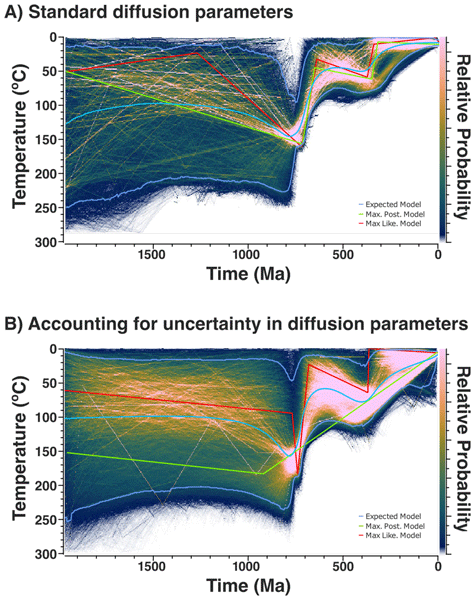
The ability to reconstruct thermal histories from thermochronometric data is determined by kinetic parameters. The Great Unconformity represents an enormous amount of time lost from the sedimentary record and has been explored with zircon (U–Th)/He ages. Here we explore the uncertainty associated with the radiation damage model and show how this limits our ability to resolve the origin of the Great Unconformity.
Pieter Vermeesch
EGUsphere, https://doi.org/10.5194/egusphere-2026-2783, https://doi.org/10.5194/egusphere-2026-2783, 2026
Short summary
Short summary
This paper warns that geochronological data can sometimes look "too good to be true". While scientists usually worry about data being too scattered, overly tidy results may come from over-zealous outlier rejection. A new diagnostic plot helps reveal this hidden problem in published datasets. A survey shows underdispersion is common and can give false confidence in precise ages, reducing accuracy and masking real geological complexity.
Pieter Vermeesch, Tim Band, Jiangping He, Rex Galbraith, and Andrew Carter
Geochronology, 8, 109–118, https://doi.org/10.5194/gchron-8-109-2026, https://doi.org/10.5194/gchron-8-109-2026, 2026
Short summary
Short summary
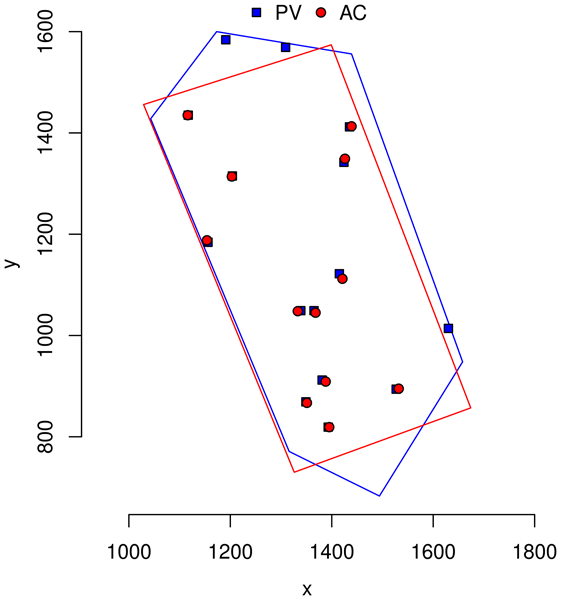
geochron@home is a free and open-source platform that makes fission track dating more transparent and reliable. It combines a virtual microscope with an online database to share images and data openly, following FAIR principles. Researchers can analyse tracks privately, archive data for peer review, teach students, or involve citizen scientists. By improving data access and reproducibility, geochron@home helps build trust and supports future advances in Earth science.
Zoe Moser, Marcel Guillong, Chetan Nathwani, Kurumi Iwahashi, Razvan-Gabriel Popa, and Olivier Bachmann
Geochronology, 8, 63–84, https://doi.org/10.5194/gchron-8-63-2026, https://doi.org/10.5194/gchron-8-63-2026, 2026
Short summary
Short summary
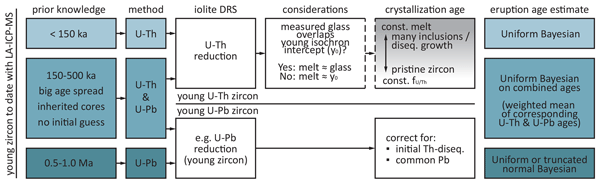
To improve U-Th zircon dating, we optimized a U-Th-Pb double-dating strategy for young zircon (150–300 ka). We found that the overall U-Th age spectrum is consistent whether assuming a constant melt composition or constant U/Th fractionation between zircon and melt, but testing the representability of the measured glass with the youngest isochron intercept proved essential. A Bayesian model with a uniform prior distribution gave the most accurate estimates of eruption timing for U-Th datasets.
Pieter Vermeesch, Noah McLean, Anton Vaks, Tzahi Golan, Sebastian F. M. Breitenbach, and Randall Parrish
Geochronology, 7, 459–473, https://doi.org/10.5194/gchron-7-459-2025, https://doi.org/10.5194/gchron-7-459-2025, 2025
Short summary
Short summary
U–Pb dating of cave sediments has provided important new time constraints on the evolution of cave-dwelling organisms (including early humans) and of Earth's climate during the past 5 Myr. This paper shows that the most common type of U–Pb dating, which uses 238U and 206Pb, can be inaccurate beyond ca. 2 Myr ago. It proposes an alternative type of U–Pb dating, using 235U and 207Pb, as a more accurate alternative.
Dawid Szymanowski, Jörn-Frederik Wotzlaw, Maria Ovtcharova, Blair Schoene, Urs Schaltegger, Mark D. Schmitz, Ryan B. Ickert, Cyril Chelle-Michou, Kevin R. Chamberlain, James L. Crowley, Joshua H. F. L. Davies, Michael P. Eddy, Sean P. Gaynor, Alexandra Käßner, Michael T. Mohr, André N. Paul, Jahandar Ramezani, Simon Tapster, Marion Tichomirowa, Albrecht von Quadt, and Corey J. Wall
Geochronology, 7, 409–425, https://doi.org/10.5194/gchron-7-409-2025, https://doi.org/10.5194/gchron-7-409-2025, 2025
Short summary
Short summary
We present the first community-wide evaluation of the reproducibility of U–Pb zircon geochronology by isotope dilution thermal ionisation mass spectrometry (ID-TIMS). Eleven labs analysed aliquots of the same, homogenised, pre-spiked solution of natural zircon, which removed geological bias inherent to using heterogeneous natural zircon grain populations. We discuss remaining sources of inter-lab bias and propose areas of improvement to analytical procedures.
Chetan Nathwani, Dawid Szymanowski, Lorenzo Tavazzani, Sava Markovic, Adrianna L. Virmond, and Cyril Chelle-Michou
Geochronology, 7, 15–33, https://doi.org/10.5194/gchron-7-15-2025, https://doi.org/10.5194/gchron-7-15-2025, 2025
Short summary
Short summary
We performed a statistical analysis of high-precision U–Pb zircon age distributions. This reveals that volcanic and porphyry zircon age distributions are skewed to younger ages, whereas plutonic age distributions are skewed to older ages. We show that this is caused by truncation of zircon crystallisation by magma evacuation rather than differences in magmatic flux. Our contribution has key implications for modelling of magma dynamics and eruption ages using zircon age distributions.
Sava Markovic, Jörn-Frederik Wotzlaw, Dawid Szymanowski, Joakim Reuteler, Peng Zeng, and Cyril Chelle-Michou
Geochronology, 6, 621–638, https://doi.org/10.5194/gchron-6-621-2024, https://doi.org/10.5194/gchron-6-621-2024, 2024
Short summary
Short summary
We present a pioneering method for high-precision U–Pb dating of individual growth zones in zircon. These micrometer zones in single grains can record key geological processes from magma priming prior to eruptions to planetary formation, yet dating them at high precision has so far been technically challenging. Our method employs two cutting-edge microbeam techniques to microsample these growth zones for high-precision dating, allowing us to tackle a number of outstanding research questions.
Marcel Guillong, Elias Samankassou, Inigo A. Müller, Dawid Szymanowski, Nathan Looser, Lorenzo Tavazzani, Óscar Merino-Tomé, Juan R. Bahamonde, Yannick Buret, and Maria Ovtcharova
Geochronology, 6, 465–474, https://doi.org/10.5194/gchron-6-465-2024, https://doi.org/10.5194/gchron-6-465-2024, 2024
Short summary
Short summary
RA138 is a new reference material for U–Pb dating of carbonate samples via laser ablation inductively coupled plasma mass spectrometry. RA138 exhibits variable U–Pb ratios and consistent U content, resulting in a precise isochron with low uncertainty. Isotope dilution thermal ionization mass spectrometry analyses fix a reference age of 321.99 ± 0.65 Ma. This research advances our ability to date carbonate samples accurately, providing insights into geological processes and historical timelines.
Pieter Vermeesch
Geochronology, 6, 397–407, https://doi.org/10.5194/gchron-6-397-2024, https://doi.org/10.5194/gchron-6-397-2024, 2024
Short summary
Short summary
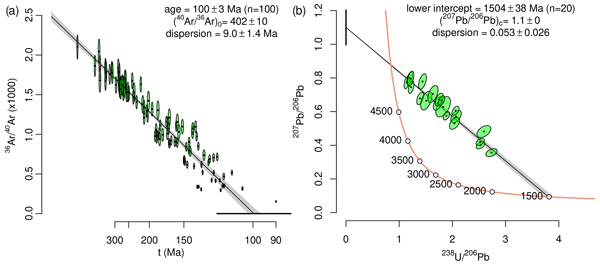
The age of some geological materials can be estimated from the ratio of certain radiogenic "daughter" isotopes to their radioactive "parent". However, in many cases, the age estimation process is complicated by the presence of an inherited component of non-radiogenic daughter isotopes. This paper presents an improved algorithm to estimate the radiogenic and non-radiogenic components, either separately or jointly.
Alyssa J. McKanna, Blair Schoene, and Dawid Szymanowski
Geochronology, 6, 1–20, https://doi.org/10.5194/gchron-6-1-2024, https://doi.org/10.5194/gchron-6-1-2024, 2024
Short summary
Short summary
Acid leaching is used to remove radiation-damaged portions of zircon crystals prior to U–Pb dating to improve the accuracy of datasets. We test how the temperature and duration of acid leaching affect geochronological and geochemical outcomes. We build a framework that relates radiation damage, zircon solubility, and Pb loss.
Pieter Vermeesch, Yuntao Tian, Jae Schwanethal, and Yannick Buret
Geochronology, 5, 323–332, https://doi.org/10.5194/gchron-5-323-2023, https://doi.org/10.5194/gchron-5-323-2023, 2023
Short summary
Short summary
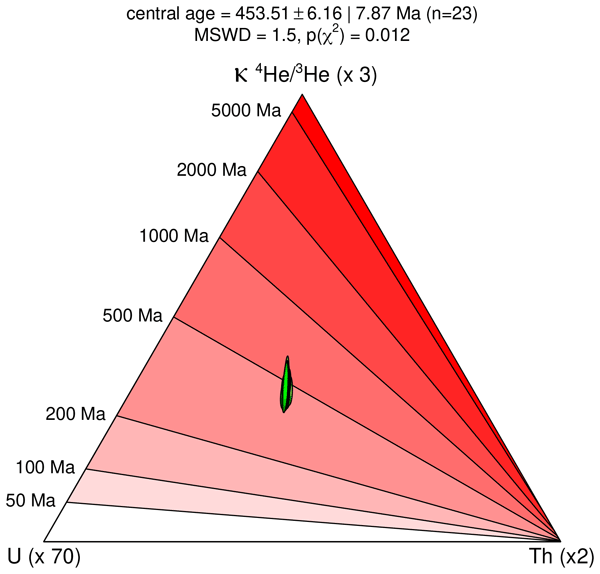
The U–Th–He method is a technique to determine the cooling history of minerals. Traditional approaches to U–Th–He dating are time-consuming and require handling strong acids and radioactive solutions. This paper presents an alternative approach in which samples are irradiated with protons and subsequently analysed by laser ablation mass spectrometry. Unlike previous in situ U–Th–He dating attempts, the new method does not require any absolute concentration measurements of U, Th, or He.
Alex Lipp and Pieter Vermeesch
Geochronology, 5, 263–270, https://doi.org/10.5194/gchron-5-263-2023, https://doi.org/10.5194/gchron-5-263-2023, 2023
Short summary
Short summary
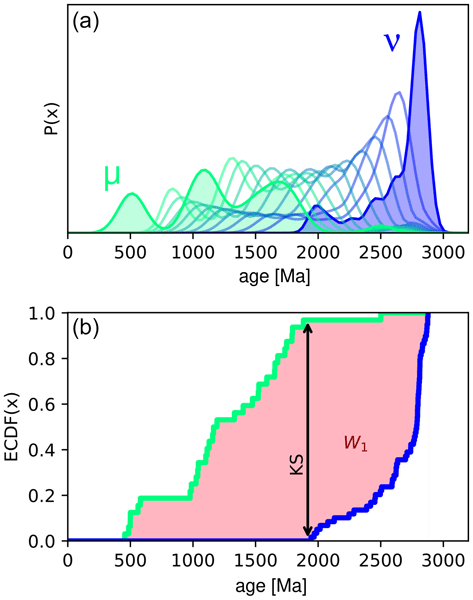
We propose using the Wasserstein-2 distance (W2) as an alternative to the widely used Kolmogorov–Smirnov (KS) statistic for analysing distributional data in geochronology. W2 measures the horizontal distance between observations, while KS measures vertical differences in cumulative distributions. Using case studies, we find that W2 is preferable in scenarios where the absolute age differences in observations provide important geological information. W2 has been added to the R package IsoplotR.
Pieter Vermeesch
Geochronology, 4, 561–576, https://doi.org/10.5194/gchron-4-561-2022, https://doi.org/10.5194/gchron-4-561-2022, 2022
Short summary
Short summary
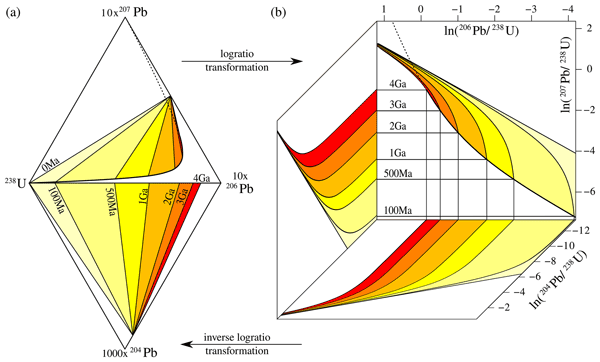
Secondary ion mass spectrometry (SIMS) is the oldest and most sensitive analytical technique for in situ U–Pb geochronology. This paper introduces a new algorithm for SIMS data reduction that treats data as
compositional data, which means that the relative abundances of 204Pb, 206Pb, 207Pb, and 238Pb are processed within a tetrahedral data space or
simplex. The new method is implemented in an eponymous computer programme that is compatible with the two dominant types of SIMS instruments.
Cited articles
Audi, G., Bersillon, O., Blachot, J., and Wapstra, A. H.: The Nubase evaluation of nuclear and decay properties, Nucl. Phys. A, 729, 3–128, https://doi.org/10.1016/j.nuclphysa.2003.11.001, 2003.
Bau, M., Romer, R. L., Lüders, V., and Beukes, N. J.: Pb, O, and C isotopes in silicified Mooidraai dolomite (Transvaal Supergroup, South Africa): implications for the composition of Paleoproterozoic seawater and `dating' the increase of oxygen in the Precambrian atmosphere, Earth Planet. Sc. Lett., 174, 43–57, https://doi.org/10.1016/S0012-821X(99)00261-7, 1999.
Bowring, J. F., McLean, N. M., and Bowring, S. A.: Engineering cyber infrastructure for U–Pb geochronology: Tripoli and U–Pb_Redux, Geochem. Geophy. Geosy., 12, Q0AA19, https://doi.org/10.1029/2010GC003479, 2011.
Chaldekas, O., Vaks, A., Haviv, I., Gerdes, A., and Albert, R.: U–Pb speleothem geochronology reveals a major 6 Ma uplift phase along the western margin of Dead Sea Transform, Geol. Soc. Am. Bull., 134, 1571–1584, https://doi.org/10.1130/B36051.1, 2021.
Chen, J. H., Edwards, R. L., and Wasserburg, G. J.: 238U, 234U and 232Th in seawater, Earth Planet. Sc. Lett., 80, 241–251, https://doi.org/10.1016/0012-821X(86)90108-1, 1986.
Chen, T., Robinson, L. F., Beasley, M. P., Claxton, L. M., Andersen, M. B., Gregoire, L. J., Wadham, J., Fornari, D. J., and Harpp, K. S.: Ocean mixing and ice-sheet control of seawater 234U
Chutcharavan, P. M., Dutton, A., and Ellwood, M. J.: Seawater 234U
Condon, D. J., Schoene, B., McLean, N. M., Bowring, S. A., and Parrish, R. R.: Metrology and traceability of U–Pb isotope dilution geochronology (EARTHTIME Tracer Calibration Part I), Geochim. Cosmochim. Ac., 164, 464–480, https://doi.org/10.1016/j.gca.2015.05.026, 2015.
Dirks, P. H. G. M., Kibii, J. M., Kuhn, B. F., Steininger, C., Churchill, S. E., Kramers, J. D., Pickering, R., Farber, D. L., Mériaux, A.-S., Herries, A. I. R., King, G. C. P., and Berger, L. R.: Geological setting and age of Australopithecus sediba from southern Africa, Science, 328, 205–208, https://doi.org/10.1126/science.1184950, 2010.
Drost, K., Chew, D., Petrus, J. A., Scholze, F., Woodhead, J. D., Schneider, J. W., and Harper, D. A.: An image mapping approach to U-Pb LA-ICP-MS carbonate dating and applications to direct dating of carbonate sedimentation, Geochem. Geophy. Geosys., 19, 4631–4648, https://doi.org/10.1029/2018GC007850, 2018.
Engel, J., Woodhead, J., Hellstrom, J., Maas, R., Drysdale, R., and Ford, D.: Corrections for initial isotopic disequilibrium in the speleothem U–Pb dating method, Quat. Geochronol., 54, 101009, https://doi.org/10.1016/j.quageo.2019.101009, 2019.
Engel, J., Woodhead, J., Hellstrom, J., White, S., White, N., and Green, H.: Using speleothems to constrain late Cenozoic uplift rates in karst terranes, Geology, 48, 755–760, https://doi.org/10.1130/g47466.1, 2020.
Gerstenberger, H. and Haase, G.: A highly effective emitter substance for mass spectrometric Pb isotope ratio determinations, Chem. Geol., 136, 309–312, https://doi.org/10.1016/S0009-2541(96)00033-2, 1997.
Gilbert, S. E. and Glorie, S.: Removal of Hg interferences for common Pb correction when dating apatite and titanite by LA-ICP-MS/MS, J. Anal. Atom. Spectrom., 35, 1472–1481, https://doi.org/10.1039/D0JA00224K, 2020.
Guillong, M., Wotzlaw, J.-F., Looser, N., and Laurent, O.: Evaluating the reliability of U–Pb laser ablation inductively coupled plasma mass spectrometry (LA-ICP-MS) carbonate geochronology: matrix issues and a potential calcite validation reference material, Geochronology, 2, 155–167, https://doi.org/10.5194/gchron-2-155-2020, 2020.
Guillong, M., Samankassou, E., Müller, I. A., Szymanowski, D., Looser, N., Tavazzani, L., Merino-Tomé, Ó., Bahamonde, J. R., Buret, Y., and Ovtcharova, M.: Technical note: RA138 calcite U–Pb LA-ICP-MS primary reference material, Geochronology, 6, 465–474, https://doi.org/10.5194/gchron-6-465-2024, 2024.
Hiess, J., Condon, D. J., McLean, N., and Noble, S. R.: 238U
Hirata, T. and Nesbitt, R. W.: U–Pb isotope geochronology of zircon: evaluation of the laser probe-inductively coupled plasma mass spectrometry technique, Geochim. Cosmochim. Ac., 59, 2491–2500, https://doi.org/10.1016/0016-7037(95)00144-1, 1995.
Hoareau, G., Claverie, F., Pecheyran, C., Paroissin, C., Grignard, P.-A., Motte, G., Chailan, O., and Girard, J.-P.: Direct U–Pb dating of carbonates from micron-scale femtosecond laser ablation inductively coupled plasma mass spectrometry images using robust regression, Geochronology, 3, 67–87, https://doi.org/10.5194/gchron-3-67-2021, 2021.
Hoareau, G., Claverie, F., Pecheyran, C., Barbotin, G., Perk, M., Beaudoin, N. E., Lacroix, B., and Rasbury, E. T.: The virtual-spot approach: a simple method for image U–Pb carbonate geochronology by high-repetition-rate LA-ICP-MS, Geochronology, 7, 387–407, https://doi.org/10.5194/gchron-7-387-2025, 2025.
Hopley, P. J., Reade, H., Parrish, R., De Kock, M., and Adams, J. W.: Speleothem evidence for C3 dominated vegetation during the Late Miocene (Messinian) of South Africa, Rev. Palaeobot. Palyno., 264, 75–89, https://doi.org/10.1016/j.revpalbo.2019.02.006, 2019.
Hu, H.-M., Shen, C.-C., Cheng, H., Woodhead, J. D., Edwards, R. L., Zhao, J.-X., Huang, C.-Y., Lu, P.-Y., Chien, W.-Y., Wang, J., Jia, X., Yokoyama, Y., Cai, Y., and Zachariáš, J.: Sub-epsilon natural 234U
Jaffey, A. H., Flynn, K. F., Glendenin, L. E., Bentley, W. C., and Essling, A. M.: Precision measurement of half-lives and specific activities of 235U and 238U, Phys. Rev. C, 4, 1889–1906, https://doi.org/10.1103/PhysRevC.4.1889, 1971.
Jochum, K. P., Nohl, U., Herwig, K., Lammel, E., Stoll, B., and Hofmann, A. W.: GeoReM: a new geochemical database for reference materials and isotopic standards, Geostand. Geoanal. Res., 29, 333–338, https://doi.org/10.1111/j.1751-908X.2005.tb00904.x, 2005.
Jochum, K. P., Weis, U., Stoll, B., Kuzmin, D., Yang, Q., Raczek, I., Jacob, D. E., Stracke, A., Birbaum, K., Frick, D. A., Günther, D., and Enzweiler, J.: Determination of Reference Values for NIST SRM 610-617 Glasses Following ISO Guidelines, Geostand. Geoanal. Res., 35, 397–429, 10.1111/j.1751-908X.2011.00120.x, 2011.
Kaufman, A. and Broecker, W.: Comparison of Th230 and C14 ages for carbonate materials from lakes Lahontan and Bonneville, J. Geophys. Res., 70, 4039–4054, https://doi.org/10.1029/JZ070i016p04039, 1965.
Kronfeld, J., Vogel, J. C., and Talma, A. S.: A new explanation for extreme 234U
Mason, A. J., Henderson, G. M., and Vaks, A.: An acetic acid-based extraction protocol for the recovery of U, Th and Pb from calcium carbonates for U-(Th)-Pb geochronology, Geostand. Geoanal. Res., 37, 261–275, https://doi.org/10.1111/j.1751-908X.2013.00219.x, 2013.
Mason, A. J., Vaks, A., Breitenbach, S. F. M., Hooker, J. N., and Henderson, G. M.: A simplified isotope dilution approach for the U–Pb dating of speleogenic and other low-232Th carbonates by multi-collector ICP-MS, Geochronology, 4, 33–54, https://doi.org/10.5194/gchron-4-33-2022, 2022.
McLean, N. M., Condon, D. J., Schoene, B., and Bowring, S. A.: Evaluating uncertainties in the calibration of isotopic reference materials and multi-element isotopic tracers (EARTHTIME Tracer Calibration Part II), Geochim. Cosmochim. Ac., 164, 481–501, https://doi.org/10.1016/j.gca.2015.02.040, 2015.
Nuriel, P., Wotzlaw, J.-F., Ovtcharova, M., Vaks, A., Stremtan, C., Šala, M., Roberts, N. M. W., and Kylander-Clark, A. R. C.: The use of ASH-15 flowstone as a matrix-matched reference material for laser-ablation U − Pb geochronology of calcite, Geochronology, 3, 35–47, https://doi.org/10.5194/gchron-3-35-2021, 2021.
Pagel, M., Bonifacie, M., Schneider, D. A., Gautheron, C., Brigaud, B., Calmels, D., Cros, A., Saint-Bezar, B., Landrein, P., and Sutcliffe, C.: Improving paleohydrological and diagenetic reconstructions in calcite veins and breccia of a sedimentary basin by combining Δ47 temperature, δ18Owater and U–Pb age, Chem. Geol., 481, 1–17, https://doi.org/10.1016/j.chemgeo.2017.12.026, 2018.
Parrish, R. R., Parrish, C. M., and Lasalle, S.: Vein calcite dating reveals Pyrenean orogen as cause of Paleogene deformation in southern England, J. Geol. Soc., 175, 425–442, https://doi.org/10.1144/jgs2017-107, 2018.
Paton, C., Woodhead, J. D., Hellstrom, J. C., Hergt, J. M., Greig, A., and Maas, R.: Improved laser ablation U-Pb zircon geochronology through robust downhole fractionation correction, Geochem. Geophy. Geosy., 11, https://doi.org/10.1029/2009GC002618, 2010.
Paton, C., Hellstrom, J., Paul, B., Woodhead, J., and Hergt, J.: Iolite: Freeware for the visualisation and processing of mass spectrometric data, J. Anal. Atom. Spectrom., 26, 2508–2518, https://doi.org/10.1039/c1ja10172b, 2011.
Pickering, R., Kramers, J. D., Partridge, T., Kodolanyi, J., and Pettke, T.: U–Pb dating of calcite–aragonite layers in speleothems from hominin sites in South Africa by MC-ICP-MS, Quat. Geochronol., 5, 544–558, https://doi.org/10.1016/j.quageo.2009.12.004, 2010.
Pickering, R., Herries, A. I. R., Woodhead, J. D., Hellstrom, J. C., Green, H. E., Paul, B., Ritzman, T., Strait, D. S., Schoville, B. J., and Hancox, P. J.: U–Pb-dated flowstones restrict South African early hominin record to dry climate phases, Nature, 565, 226–229, https://doi.org/10.1038/s41586-018-0711-0, 2019.
Pollard, T., Woodhead, J., Hellstrom, J., Engel, J., Powell, R., and Drysdale, R.: DQPB: software for calculating disequilibrium U–Pb ages, Geochronology, 5, 181–196, https://doi.org/10.5194/gchron-5-181-2023, 2023.
Pollard, T. J., Woodhead, J. D., Drysdale, R. N., Edwards, R. L., Li, X., Wainwright, A. N., Pythoud, M., Cheng, H., Hellstrom, J. C., Isola, I., Regattieri, E., Zanchetta, G., and Parmenter, D. S.: Radiometric dating of Middle Pleistocene carbonates: assessing consistency and performance of the U–Th and U–Pb dating methods, Geochronology, 7, 335–355, https://doi.org/10.5194/gchron-7-335-2025, 2025.
Porcelli, D. and Swarzenski, P. W.: The behavior of U- and Th-series nuclides in groundwater, Rev. Min. Geochem., 52, 317–361, https://doi.org/10.2113/0520317, 2003.
Rasbury, E. T. and Cole, J. M.: Directly dating geologic events: U-Pb dating of carbonates, Rev. Geophys., 47, https://doi.org/10.1029/2007RG000246, 2009.
Rasbury, E. T., Present, T. M., Northrup, P., Tappero, R. V., Lanzirotti, A., Cole, J. M., Wooton, K. M., and Hatton, K.: Tools for uranium characterization in carbonate samples: case studies of natural U–Pb geochronology reference materials, Geochronology, 3, 103–122, https://doi.org/10.5194/gchron-3-103-2021, 2021.
Richards, D. A., Bottrell, S. H., Cliff, R. A., Ströhle, K., and Rowe, P. J.: U–Pb dating of a speleothem of Quaternary age, Geochim. Cosmochim. Ac., 62, 3683–3688, https://doi.org/10.1016/S0016-7037(98)00256-7, 1998.
Roberts, N. M. W., Rasbury, E. T., Parrish, R. R., Smith, C. J., Horstwood, M. S. A., and Condon, D. J.: A calcite reference material for LA-ICP-MS U–Pb geochronology, Geochem. Geophy. Geosy., 18, 2807–2814, https://doi.org/10.1002/2016GC006784, 2017.
Roberts, N. M. W., Drost, K., Horstwood, M. S. A., Condon, D. J., Chew, D., Drake, H., Milodowski, A. E., McLean, N. M., Smye, A. J., Walker, R. J., Haslam, R., Hodson, K., Imber, J., Beaudoin, N., and Lee, J. K.: Laser ablation inductively coupled plasma mass spectrometry (LA-ICP-MS) U–Pb carbonate geochronology: strategies, progress, and limitations, Geochronology, 2, 33–61, https://doi.org/10.5194/gchron-2-33-2020, 2020.
Schmitz, M. D. and Schoene, B.: Derivation of isotope ratios, errors, and error correlations for U–Pb geochronology using 205Pb–235U–(233U)-spiked isotope dilution thermal ionization mass spectrometric data, Geochem. Geophy. Geosy., 8, Q08006, https://doi.org/10.1029/2006gc001492, 2007.
Steiger, R. H. and Jäger, E.: Subcommission on geochronology: Convention on the use of decay constants in geo- and cosmochronology, Earth Planet. Sc. Lett., 36, 359–362, https://doi.org/10.1016/0012-821X(77)90060-7, 1977.
Stirling, C. H., Andersen, M. B., Potter, E.-K., and Halliday, A. N.: Low-temperature isotopic fractionation of uranium, Earth Planet. Sc. Lett., 264, 208–225, https://doi.org/10.1016/j.epsl.2007.09.019, 2007.
Szymanowski, D., Wotzlaw, J.-F., Ovtcharova, M., Schoene, B., Schaltegger, U., Schmitz, M. D., Ickert, R. B., Chelle-Michou, C., Chamberlain, K. R., Crowley, J. L., Davies, J. H. F. L., Eddy, M. P., Gaynor, S. P., Käßner, A., Mohr, M. T., Paul, A. N., Ramezani, J., Tapster, S., Tichomirowa, M., von Quadt, A., and Wall, C. J.: Interlaboratory reproducibility of ID-TIMS U–Pb geochronology evaluated with a pre-spiked natural zircon solution, Geochronology, 7, 409–425, https://doi.org/10.5194/gchron-7-409-2025, 2025.
Vaks, A., Bar-Matthews, M., Matthews, A., Ayalon, A., and Frumkin, A.: Middle-Late Quaternary paleoclimate of northern margins of the Saharan-Arabian Desert: reconstruction from speleothems of Negev Desert, Israel, Quaternary Sci. Rev., 29, 2647–2662, https://doi.org/10.1016/j.quascirev.2010.06.014, 2010.
Vaks, A., Mason, A. J., Breitenbach, S. F. M., Kononov, A. M., Osinzev, A. V., Rosensaft, M., Borshevsky, A., Gutareva, O. S., and Henderson, G. M.: Palaeoclimate evidence of vulnerable permafrost during times of low sea ice, Nature, 577, 221–225, https://doi.org/10.1038/s41586-019-1880-1, 2020.
Vaks, A., Mason, A., Breitenbach, S. F. M., Giesche, A., Osinzev, A., Adrian, I., Kononov, A., Umbo, S., Lechleitner, F. A., Rosensaft, M., and Henderson, G. M.: Arctic speleothems reveal nearly permafrost-free Northern Hemisphere in the late Miocene, Nat. Commun., 16, 5483, https://doi.org/10.1038/s41467-025-60381-5, 2025.
Vermeesch, P.: Unifying the U–Pb and Th–Pb methods: joint isochron regression and common Pb correction, Geochronology, 2, 119–131, https://doi.org/10.5194/gchron-2-119-2020, 2020.
Vermeesch, P.: Too good to be true: Underdispersion in geochronology, EGUsphere [preprint], https://doi.org/10.5194/egusphere-2026-2783, 2026.
Vermeesch, P., McLean, N., Vaks, A., Golan, T., Breitenbach, S. F. M., and Parrish, R.: Carbonate 206Pb
von Quadt, A., Wotzlaw, J. F., Buret, Y., Large, S. J. E., Peytcheva, I., and Trinquier, A.: High-precision zircon U
Walker, J., Cliff, R. A., and Latham, A. G.: U–Pb isotopic age of the StW 573 hominid from Sterkfontein, South Africa, Science, 314, 1592–1594, https://doi.org/10.1126/science.1132916, 2006.
Wendt, I. and Carl, C.: U
White, W. M., Albarède, F., and Télouk, P.: High-precision analysis of Pb isotope ratios by multi-collector ICP-MS, Chem. Geol., 167, 257–270, https://doi.org/10.1016/S0009-2541(99)00182-5, 2000.
Woodhead, J., Hellstrom, J., Maas, R., Drysdale, R., Zanchetta, G., Devine, P., and Taylor, E.: U–Pb geochronology of speleothems by MC-ICPMS, Quat. Geochronol., 1, 208–221, https://doi.org/10.1016/j.quageo.2006.08.002, 2006.
Woodhead, J., Hellstrom, J., Pickering, R., Drysdale, R., Paul, B., and Bajo, P.: U and Pb variability in older speleothems and strategies for their chronology, Quat. Geochronol., 14, 105–113, https://doi.org/10.1016/j.quageo.2012.02.028, 2012.
Woodhead, J. D., Sniderman, J. M. K., Hellstrom, J., Drysdale, R. N., Maas, R., White, N., White, S., and Devine, P.: The antiquity of Nullarbor speleothems and implications for karst palaeoclimate archives, Sci. Rep., 9, 603, https://doi.org/10.1038/s41598-018-37097-2, 2019.
Wotzlaw, J. F., Buret, Y., Large, S. J. E., Szymanowski, D., and von Quadt, A.: ID-TIMS U–Pb geochronology at the 0.1‰ level using 1013 Ω resistors and simultaneous U and 18O/16O isotope ratio determination for accurate UO2 interference correction, J. Anal. Atom. Spectrom., 32, 579–586, https://doi.org/10.1039/c6ja00278a, 2017.
Short summary
U–Pb geochronology of carbonates using 238U and 206Pb can be inaccurate beyond ca. 1.5 Ma. This paper explores analytical strategies to use the more accurate, alternative approach using 235U and 207Pb. Solution mode and laser ablation analyses of reference materials and of a southern African speleothem demonstrate that this method is widely applicable, improving the ability to provide accurate carbonate chronologies, particularly in the freshwater realm.
U–Pb geochronology of carbonates using 238U and 206Pb can be inaccurate beyond ca. 1.5 Ma. This...


