
Articles | Volume 8, issue 3
https://doi.org/10.5194/gchron-8-589-2026
© Author(s) 2026. This work is distributed under
the Creative Commons Attribution 4.0 License.
the Creative Commons Attribution 4.0 License.
https://doi.org/10.5194/gchron-8-589-2026
© Author(s) 2026. This work is distributed under
the Creative Commons Attribution 4.0 License.
the Creative Commons Attribution 4.0 License.
Research article
| 
16 Sep 2026
Research article |
| 16 Sep 2026
| 16 Sep 2026
Anomalous fading correction in luminescence dating – a mathematical reappraisal
Benny Guralnik
CORRESPONDING AUTHOR

Institute of Earth Surface Dynamics, University of Lausanne, Lausanne, 1015, Switzerland
present address: KLA Corporation, Diplomvej 373, Kgs Lyngby 2800, Denmark
Georgina E. King
CORRESPONDING AUTHOR
Institute of Earth Surface Dynamics, University of Lausanne, Lausanne, 1015, Switzerland
Related authors
Georgina E. King, Lily Bossin, Maxime Bernard, Melanie Kranz-Bartz, Xiaoxia Wen, Christoph Schmidt, Benny Guralnik, Frédéric Herman, Manabu Ogata, and Shigeru Sueoka
EGUsphere, https://doi.org/10.5194/egusphere-2026-2204, https://doi.org/10.5194/egusphere-2026-2204, 2026
Short summary
Short summary
Electron spin resonance (ESR) thermochronometry can be used to determine rock temperature changes, which occur as rocks move towards Earth's surface in response to uplift and surface erosion. We use samples from a known-temperature borehole to validate the method, by constraining the thermal sensitivity of quartz ESR signals in the laboratory. Whilst we are able to recover temperature successfully with the Al-centre signals, the Ti-centre signals overestimate the borehole temperature.
Chloé Bouscary, Georgina E. King, Melanie Kranz-Bartz, Maxime Bernard, Rabiul H. Biswas, Lily Bossin, Arnaud Duverger, Benny Guralnik, Frédéric Herman, Ugo Nanni, Nadja Stalder, Pierre G. Valla, Vjeran Visnjevic, and Xiaoxia Wen
EGUsphere, https://doi.org/10.5194/egusphere-2025-5474, https://doi.org/10.5194/egusphere-2025-5474, 2025
Short summary
Short summary
The OSLThermo and ESRThermo MATLAB libraries simulate how luminescence signals in feldspar and electron spin resonance signals in quartz minerals accumulate and fade over time, enabling reconstruction of recent rock cooling and surface temperature changes. By sharing these tools openly, we hope to promote collaboration, reproducibility, and broader use and development of these ultra-low-temperature thermochronology methods.

Natacha Gribenski, Marissa M. Tremblay, Pierre G. Valla, Greg Balco, Benny Guralnik, and David L. Shuster
Geochronology, 4, 641–663, https://doi.org/10.5194/gchron-4-641-2022, https://doi.org/10.5194/gchron-4-641-2022, 2022
Short summary
Short summary
We apply quartz 3He paleothermometry along two deglaciation profiles in the European Alps to reconstruct temperature evolution since the Last Glacial Maximum. We observe a 3He thermal signal clearly colder than today in all bedrock surface samples exposed prior the Holocene. Current uncertainties in 3He diffusion kinetics do not permit distinguishing if this signal results from Late Pleistocene ambient temperature changes or from recent ground temperature variation due to permafrost degradation.
Maxime Bernard, Pieter van der Beek, Cody Colleps, Xavier Robert, Kerry Gallagher, William Guenthner, Julien Amalberti, and Georgina E. King
EGUsphere, https://doi.org/10.5194/egusphere-2026-2286, https://doi.org/10.5194/egusphere-2026-2286, 2026
Short summary
Short summary
Pecube, a 3D thermal-kinematic software that predicts thermochronometer data, has been widely used to constrain the past evolution of mountain belts, but its accessibility and application is still limited. This work overcomes this limitation by offering a graphical user interface to Pecube, PecubeGUI, and by broadening its application to a wider range of tectonic settings through the implementation thermochronometer prediction models in line with the most recent research developments.
Maxime Bernard, Georgina E. King, Pieter van der Beek, Isabel Wapenhans, Lingxiao Gong, and Xavier Robert
EGUsphere, https://doi.org/10.5194/egusphere-2026-2508, https://doi.org/10.5194/egusphere-2026-2508, 2026
Short summary
Short summary
Thermochronometry data inversions using the Pecube software are useful to constrain the past evolution of mountain belts. However, configuring the neighbourhood algorithm for Pecube inversions remains challenging for new Pecube users. This contribution aims to provide intuition and guidelines for setting up NA-Pecube inversions to support informed decision-making. It forms part of a broader effort to improve the accessibility of Pecube to new users.
Léa Rodari, Audrey Margirier, Ann V. Rowan, Christoph Schmidt, Remy Veness, Charlotte S. Curry, Alex C. Scoffield, Christiaan R. Diemont, Faye Perchanok, Guillaume Jouvet, Vivi Pedersen, Derek Fabel, and Georgina E. King
EGUsphere, https://doi.org/10.5194/egusphere-2026-1536, https://doi.org/10.5194/egusphere-2026-1536, 2026
Short summary
Short summary
By combining innovative dating techniques and glacier modelling, we studied how sediment is produced, transported, and stored within the Mer de Glace catchment in the French Alps. We show that whilst sediment is transported through the glacier in less than a millennium, some sediment can be stored for many thousands of years before being re-entrained into glacial transport. This long-term storage affects how landscapes evolve and how climate signals are preserved during deglaciation.
Georgina E. King, Lily Bossin, Maxime Bernard, Melanie Kranz-Bartz, Xiaoxia Wen, Christoph Schmidt, Benny Guralnik, Frédéric Herman, Manabu Ogata, and Shigeru Sueoka
EGUsphere, https://doi.org/10.5194/egusphere-2026-2204, https://doi.org/10.5194/egusphere-2026-2204, 2026
Short summary
Short summary
Electron spin resonance (ESR) thermochronometry can be used to determine rock temperature changes, which occur as rocks move towards Earth's surface in response to uplift and surface erosion. We use samples from a known-temperature borehole to validate the method, by constraining the thermal sensitivity of quartz ESR signals in the laboratory. Whilst we are able to recover temperature successfully with the Al-centre signals, the Ti-centre signals overestimate the borehole temperature.
Chloé Bouscary, Georgina E. King, Melanie Kranz-Bartz, Maxime Bernard, Rabiul H. Biswas, Lily Bossin, Arnaud Duverger, Benny Guralnik, Frédéric Herman, Ugo Nanni, Nadja Stalder, Pierre G. Valla, Vjeran Visnjevic, and Xiaoxia Wen
EGUsphere, https://doi.org/10.5194/egusphere-2025-5474, https://doi.org/10.5194/egusphere-2025-5474, 2025
Short summary
Short summary
The OSLThermo and ESRThermo MATLAB libraries simulate how luminescence signals in feldspar and electron spin resonance signals in quartz minerals accumulate and fade over time, enabling reconstruction of recent rock cooling and surface temperature changes. By sharing these tools openly, we hope to promote collaboration, reproducibility, and broader use and development of these ultra-low-temperature thermochronology methods.
Christoph Schmidt, Théo Halter, Paul R. Hanson, Alexey Ulianov, Benita Putlitz, Georgina E. King, and Sebastian Kreutzer
Geochronology, 6, 665–682, https://doi.org/10.5194/gchron-6-665-2024, https://doi.org/10.5194/gchron-6-665-2024, 2024
Short summary
Short summary
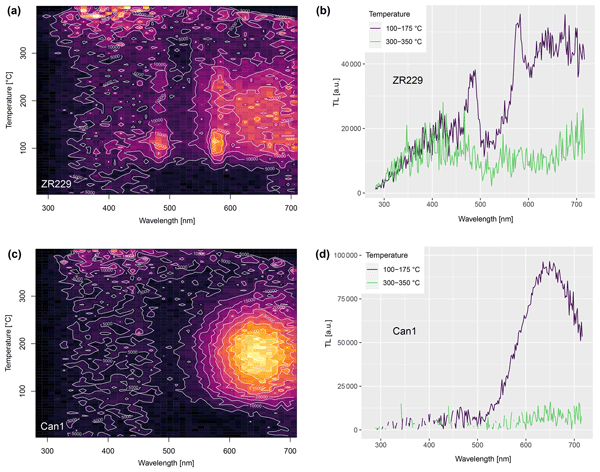
We study the use of zircons as dosimeters using modern techniques, highlighting their advantages such as time-invariant dose rates. We explore the correlation between zircon geochemistry and luminescence properties, observe fast zircon optically stimulated luminescence (OSL) bleaching rates, and assess the potential of auto-regeneration. Low OSL sensitivities require combining natural OSL and auto-regenerated thermoluminescence (TL), with the potential to enhance age accuracy and precision.

Melanie Bartz, Jasquelin Peña, Stéphanie Grand, and Georgina E. King
Geochronology, 5, 51–64, https://doi.org/10.5194/gchron-5-51-2023, https://doi.org/10.5194/gchron-5-51-2023, 2023
Short summary
Short summary
Chemical weathering alters the chemical composition of mineral grains, and it follows that luminescence dating signals may also be progressively modified. We artificially weathered feldspar samples under different chemical conditions to understand the effect of feldspar partial dissolution on their luminescence properties. Only minor changes were observed on luminescence dating properties, implying that chemical alteration of feldspar surfaces may not affect luminescence dating signals.
Natacha Gribenski, Marissa M. Tremblay, Pierre G. Valla, Greg Balco, Benny Guralnik, and David L. Shuster
Geochronology, 4, 641–663, https://doi.org/10.5194/gchron-4-641-2022, https://doi.org/10.5194/gchron-4-641-2022, 2022
Short summary
Short summary
We apply quartz 3He paleothermometry along two deglaciation profiles in the European Alps to reconstruct temperature evolution since the Last Glacial Maximum. We observe a 3He thermal signal clearly colder than today in all bedrock surface samples exposed prior the Holocene. Current uncertainties in 3He diffusion kinetics do not permit distinguishing if this signal results from Late Pleistocene ambient temperature changes or from recent ground temperature variation due to permafrost degradation.

Joanne Elkadi, Benjamin Lehmann, Georgina E. King, Olivia Steinemann, Susan Ivy-Ochs, Marcus Christl, and Frédéric Herman
Earth Surf. Dynam., 10, 909–928, https://doi.org/10.5194/esurf-10-909-2022, https://doi.org/10.5194/esurf-10-909-2022, 2022
Short summary
Short summary
Glacial and non-glacial processes have left a strong imprint on the landscape of the European Alps, but further research is needed to better understand their long-term effects. We apply a new technique combining two methods for bedrock surface dating to calculate post-glacier erosion rates next to a Swiss glacier. Interestingly, the results suggest non-glacial erosion rates are higher than previously thought, but glacial erosion remains the most influential on landscape evolution.
Cited articles
Aitken, M. J.: Thermoluminescence Dating. Academic Press, Orlando/London, 351 pp., ISBN 9780120463800, 1985.
Auclair, M., Lamothe, M., and Huot, S.: Measurement of anomalous fading for feldspar IRSL using SAR, Radiat. Meas., 37, 487–492, https://doi.org/10.1016/S1350-4487(03)00018-0, 2003.
Beck, J. V.: Sensitivity coefficients utilized in nonlinear estimation with small parameters in a heat transfer problem, J. Basic Eng., 92, 215–221, https://doi.org/10.1115/1.3424973, 1970.
Becquerel, E.: La lumière, ses causes et ses effets, Vol. I, Paris, p. 273, https://doi.org/10.3931/e-rara-142176, 1867.
Bureau International des Poids et Mesures (BIPM): Le Système international d'unités [The International System of Units], Brochure, 1st edn., https://doi.org/10.59161/CDXH2109, 1970.
Corless, R. M., Gonnet, G. H., Hare, D. E., Jeffrey, D. J., and Knuth, D. E.: On the Lambert W function, Adv. Comput. Math. 5, 329–359, https://doi.org/10.1007/BF02124750, 1996.
Dodson, M. H.: Closure temperature in cooling geochronological and petrological systems, Contrib. Mineral. Petr. 40, 259–274, https://doi.org/10.1007/BF00373790, 1973.
Guralnik, B. and Sohbati, R.: Fundamentals of luminescence photo-and thermochronometry, In Advances in physics and applications of optically and thermally stimulated luminescence, World Scientific, 399–437, https://doi.org/10.1142/9781786345790_0011, 2019.
Guralnik, B., Li, B., Jain, M., Chen, R., Paris, R. B., Murray, A. S., Li, S. H., Pagonis, V., Valla, P. G., and Herman, F.: Radiation-induced growth and isothermal decay of infrared-stimulated luminescence from feldspar, Radiat. Meas., 81, 224–231, https://doi.org/10.1016/j.radmeas.2015.02.011, 2015a.
Guralnik, B., Jain, M., Herman, F., Ankjærgaard, C., Murray, A. S., Valla, P. G., Preusser, F., King, G. E., Chen, R., Lowick, S. E., and Kook, M.: OSL-thermochronometry of feldspar from the KTB borehole, Germany, Earth Planet. Sc. Lett., 423, 232–243, https://doi.org/10.1016/j.epsl.2015.04.032, 2015b.
Hoogenstraaten, W.: Electron traps in ZnS phosphors, Philips Res. Rep., 13, 515–693, 1958.
Huntley, D. J.: An explanation of the power-law decay of luminescence, J. Phys. Condens. Matter, 18, 1359, https://doi.org/10.1088/0953-8984/18/4/020, 2006.
Huntley, D. J. and Lamothe, M.: Ubiquity of anomalous fading in K-feldspars and the measurement and correction for it in optical dating, Can. J. Earth Sci. 38, 1093–1106, https://doi.org/10.1139/e01-013, 2001.
Ito, H.: Simultaneous U–Pb and U–Th dating using LA-ICP-MS for young (< 0.4 Ma) minerals: A reappraisal of the double dating approach, Minerals, 14, 436, https://doi.org/10.3390/min14040436, 2024.
Jaiswal, M. K., Bhat, M. I., Bali, B. S., Ahmad, S., and Chen, Y. G.: Luminescence characteristics of quartz and feldspar from tectonically uplifted terraces in Kashmir Basin, Jammu and Kashmir, India, Radiat. Meas., 44, 523–528, https://doi.org/10.1016/j.radmeas.2009.04.008, 2009.
Kars, R. H. and Wallinga, J.: IRSL dating of K-feldspars: Modelling natural dose response curves to deal with anomalous fading and trap competition, Radiat. Meas. 44, 594–599, https://doi.org/10.1016/j.radmeas.2009.03.032, 2009.
Kars, R. H., Wallinga, J., and Cohen, K. M.: A new approach towards anomalous fading correction for feldspar IRSL dating–tests on samples in field saturation, Radiat. Meas., 43, 786–790, https://doi.org/10.1016/j.radmeas.2008.01.021, 2008.
King, G. E., Herman, F., Lambert, R., Valla, P. G., and Guralnik, B.: Multi-OSL-thermochronometry of feldspar, Quat. Geochronol., 33, 76–87, https://doi.org/10.1016/j.quageo.2016.01.004, 2016.
King, G. E., Burow, C., Roberts, H. M., and Pearce, N. J.: Age determination using feldspar: evaluating fading-correction model performance, Radiat. Meas., 119, 58–73, https://doi.org/10.1016/j.radmeas.2018.07.013, 2018.
Kreutzer, S.: calc_FadingCorr(): Apply a fading correction according to Huntley & Lamothe (2001) for a given g-value and a given tc, Function version 0.4.2, in: Luminescence: Comprehensive Luminescence Dating Data Analysis. R package version 0.7.5, CRAN [code], http://CRAN.R-project.org/package=Luminescence (last access: 17 August 2026), 2017.
Kreutzer, S. and Mercier, N.: calc_Lamothe2003(): Apply fading correction after Lamothe et al., 2003, in: Luminescence: Comprehensive Luminescence Dating Data Analysis, R package version 1.2.1, CRAN [code], http://CRAN.R-project.org/package=Luminescence (last access: 17 August 2026), 2026.
Lamothe, M., Auclair, M., Hamzaoui, C., and Huot, S.: Towards a prediction of long-term anomalous fading of feldspar IRSL, Radiat. Meas., 37, 493–498, https://doi.org/10.1016/S1350-4487(03)00016-7, 2003.
Li, B. and Li, S.-H.: Investigations of the dose-dependent anomalous fading rate of feldspar from sediments, J. Phys. D Appl. Phys., 41, 225502, https://doi.org/10.1088/0022-3727/41/22/225502, 2008.
Matsumoto, A.: K-Ar age determination for Quaternary volcanic rocks based on the Mass Fractionation Correction Method – methodology and its application to Ontake and Aso volcanoes, PhD Thesis, Univ. Tokyo, Japan, 153 pp., https://doi.org/10.11501/3087347, 1990.
Maxwell, J. C.: A Treatise on Electricity and Magnetism, Chap. X: Dimensions of Electric Units, Clarendon Press, Oxford, ISBN 9781108014038, 1873.
Medlin, W. L.: Decay of phosphorescence from a distribution of trapping levels, Phys. Rev., 123, 502, https://doi.org/10.1103/PhysRev.123.502, 1961.
Pagonis, V., Kitis, G., and Chen, R.: A new analytical equation for the dose response of dosimetric materials, based on the Lambert W function, J. Lumin., 225, 117333, https://doi.org/10.1016/j.jlumin.2020.117333, 2020.
Randall, J. T. and Wilkins, M. H. F.: Phosphorescence and electron traps II. The interpretation of long-period phosphorescence, P. R. Soc. Lond. A, 184, 390–407, https://doi.org/10.1098/rspa.1945.0025, 1945.
Renne, P. R.: Progress and challenges in K-Ar and 40Ar/39Ar geochronology, Paleontol. Soc. P., 12, 47–66, https://doi.org/10.1017/S1089332600001340, 2006.
Riehl, N.: Tunnel luminescence and infrared stimulation, J. Lumin., 1, 1–16, https://doi.org/10.1016/0022-2313(70)90019-0, 1970.
Rutherford, E.: XI. Radioactivity produced in substances by the action of thorium compounds, Phil. Mag., 49, 1–14, https://doi.org/10.1080/14786440009463832, 1900.
Slater, C., Preston, T., and Weaver, L. T.: Stable isotopes and the international system of units, Rapid Commun. Mass. Spectrom., 15, 1270–1273, https://doi.org/10.1002/rcm.328, 2001.
Smertenko, P. S.: Modeling of thermometric characteristics of thermodiode sensors by using the dimensionless sensitivity, Semicond. Phys. Quantum Electron. Optoelectron., 23, 437–441, https://doi.org/10.15407/spqeo23.04.437, 2020.
Smith, D. L.: Concept and significance of a dimensionless sensitivity matrix in applications of generalized least-squares analysis, Nucl. Instrum. Meth. A, 339, 626–629, https://doi.org/10.1016/0168-9002(94)90203-8, 1994.
Tachiya, M. and Mozumder, A.: Decay of trapped electrons by tunnelling to scavenger molecules in low-temperature glasses, Chem. Phys. Lett., 28, 87–89, https://doi.org/10.1016/0009-2614(74)80022-9, 1974.
Tanski, N. M., Pederson, J. L., Hidy, A. J., Rittenour, T. M., and Mauch, J. P.: The mystery of baselevel controls in the incision history of the central Colorado Plateau, AGU Advances, 6, e2024AV001359, https://doi.org/10.1029/2024AV001359, 2025.
Thiel, C., Tsukamoto, S., Tokuyasu, K., Buylaert, J. P., Murray, A. S., Tanaka, K., and Shirai, M.: Testing the application of quartz and feldspar luminescence dating to MIS 5 Japanese marine deposits, Quat. Geochronol., 29, 16–29, https://doi.org/10.1016/j.quageo.2015.05.008, 2015.
Thomas, D. G., Hopfield, J. J., and Augustyniak, W. M.: Kinetics of radiative recombination at randomly distributed donors and acceptors, Phys. Rev., 140, A202, https://doi.org/10.1103/PhysRev.140.A202, 1965.
Visocekas, R.: Miscellaneous aspects of artificial thermoluminescence of calcite: Emission spectra, athermal detrapping and anomalous fading, Eur. PACT J., 3, 258–265, 1976.
Visocekas, R.: Tunnelling radiative recombination in labradorite: its association with anomalous fading of thermoluminescence, Nucl. Tracks Rad. Meas., 10, 521–529, https://doi.org/10.1016/0735-245X(85)90053-5, 1985.
Virtanen, P., Gommers, R., Oliphant, T. E., Haberland, M., Reddy, T., Cournapeau, D., Burovski, E., Peterson, P., Weckesser, W., Bright, J., and Van Der Walt, S. J.: SciPy 1.0: fundamental algorithms for scientific computing in Python, Nat. Methods, 17, 261–272, https://doi.org/10.1038/s41592-019-0686-2, 2020.
Wallinga, J., Bos, A. J., Dorenbos, P., Murray, A. S., and Schokker, J.: A test case for anomalous fading correction in IRSL dating, Quat. Geochronol., 2, 216–221, https://doi.org/10.1016/j.quageo.2006.05.014, 2007.
Wintle, A. G.: Anomalous fading of thermo-luminescence in mineral samples, Nature, 245, 143–144, https://doi.org/10.1038/245143a0, 1973.
Short summary
Luminescence dating of feldspar minerals is widely applied in geology and archaeology. However, the luminescence of feldspar is prone to signal loss termed anomalous fading, which must be accounted for to avoid age underestimation. Here, we critically review the different mathematical approaches for anomalous fading correction, and present new, computationally efficient, analytical expressions for the two most ubiquitous fading correction schemes.
Luminescence dating of feldspar minerals is widely applied in geology and archaeology. However,...


