
Articles | Volume 8, issue 4
https://doi.org/10.5194/gchron-8-661-2026
© Author(s) 2026. This work is distributed under
the Creative Commons Attribution 4.0 License.
the Creative Commons Attribution 4.0 License.
https://doi.org/10.5194/gchron-8-661-2026
© Author(s) 2026. This work is distributed under
the Creative Commons Attribution 4.0 License.
the Creative Commons Attribution 4.0 License.
Research article
| 
22 Oct 2026
Research article |
| 22 Oct 2026
| 22 Oct 2026
Coupled K–Ca and Rb–Sr dating by LA-ICP-MS/MS – reaction gas optimisation and geological applications
Sarah E. Gilbert
CORRESPONDING AUTHOR

Adelaide Microscopy, Adelaide University, Adelaide, 5005, Australia
Stijn Glorie
Discipline of Earth Sciences, School of Physics, Chemistry and Earth Sciences, Adelaide University, Adelaide, 5005, Australia
Jarred C. Lloyd
Discipline of Earth Sciences, School of Physics, Chemistry and Earth Sciences, Adelaide University, Adelaide, 5005, Australia
Related authors
Jarred C. Lloyd, Carl Spandler, Sarah E. Gilbert, and Derrick Hasterok
Geochronology, 7, 265–287, https://doi.org/10.5194/gchron-7-265-2025, https://doi.org/10.5194/gchron-7-265-2025, 2025
Short summary
Short summary
Laser-based dating of rocks and minerals is invaluable in geoscience. This study significantly advances our ability to model and correct for a process called down-hole fractionation (DHF) that impacts the accuracy and uncertainty of dates. We develop an algorithm that quantitatively models DHF patterns but can be used on other geoscientific data. The implications are far-reaching: improved accuracy, reduced uncertainty, and easier comparisons between different samples and laboratories.
Alexander T. De Vries Van Leeuwen, Stijn Glorie, Martin Hand, Jacob Mulder, and Sarah E. Gilbert
Geochronology, 7, 199–211, https://doi.org/10.5194/gchron-7-199-2025, https://doi.org/10.5194/gchron-7-199-2025, 2025
Short summary
Short summary
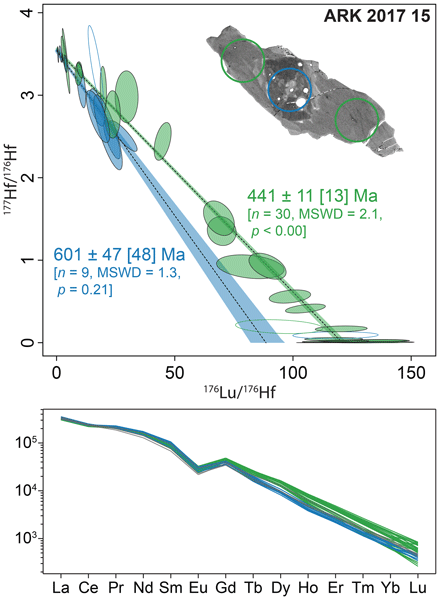
In this contribution, we demonstrate in situ monazite lutetium–hafnium dating and compare results with uranium–lead dating. We present data from monazite reference materials and complex samples to demonstrate the viability of this method. We show that in situ lutetium–hafnium dating of monazite can resolve multiple age populations and may find use in scenarios where the uranium–lead system has been compromised.

Stijn Glorie, Sarah E. Gilbert, Martin Hand, and Jarred C. Lloyd
Geochronology, 6, 21–36, https://doi.org/10.5194/gchron-6-21-2024, https://doi.org/10.5194/gchron-6-21-2024, 2024
Short summary
Short summary
Radiometric dating methods, involving laser ablation as the sample introduction, require robust calibrations to reference materials with similar ablation properties to the analysed samples. In the case of the rubidium–strontium dating method, calibrations are often conducted to nano powder with different ablation characteristics than the crystalline minerals. We describe the limitations of this approach and recommend an alternative calibration method involving natural minerals.

Darwinaji Subarkah, Angus L. Nixon, Monica Jimenez, Alan S. Collins, Morgan L. Blades, Juraj Farkaš, Sarah E. Gilbert, Simon Holford, and Amber Jarrett
Geochronology, 4, 577–600, https://doi.org/10.5194/gchron-4-577-2022, https://doi.org/10.5194/gchron-4-577-2022, 2022
Short summary
Short summary
Advancements in technology have introduced new techniques to more quickly and cheaply date rocks with little sample preparation. A unique use of this method is to date shales and constrain when these rocks were first deposited. This approach can also time when such sequences were subsequently affected by heat or fluids after they were deposited. This is useful, as the formation of precious-metal-bearing systems or petroleum source rocks is commonly associated with such processes.

Alexander Simpson, Stijn Glorie, Martin Hand, Carl Spandler, Sarah Gilbert, and Brad Cave
Geochronology, 4, 353–372, https://doi.org/10.5194/gchron-4-353-2022, https://doi.org/10.5194/gchron-4-353-2022, 2022
Short summary
Short summary
The article demonstrates a new technique that can be used to determine the age of calcite crystallisation using the decay of 176Lu to 176Hf. The technique is novel because (a) Lu–Hf radiometric dating is rarely applied to calcite and (b) this is the first instance where analysis has been conducted by ablating the sample with a laser beam rather than bulk dissolution. By using laser ablation the original context of the sample is preserved.
Jarred C. Lloyd, Carl Spandler, Sarah E. Gilbert, and Derrick Hasterok
Geochronology, 7, 265–287, https://doi.org/10.5194/gchron-7-265-2025, https://doi.org/10.5194/gchron-7-265-2025, 2025
Short summary
Short summary
Laser-based dating of rocks and minerals is invaluable in geoscience. This study significantly advances our ability to model and correct for a process called down-hole fractionation (DHF) that impacts the accuracy and uncertainty of dates. We develop an algorithm that quantitatively models DHF patterns but can be used on other geoscientific data. The implications are far-reaching: improved accuracy, reduced uncertainty, and easier comparisons between different samples and laboratories.
Alexander T. De Vries Van Leeuwen, Stijn Glorie, Martin Hand, Jacob Mulder, and Sarah E. Gilbert
Geochronology, 7, 199–211, https://doi.org/10.5194/gchron-7-199-2025, https://doi.org/10.5194/gchron-7-199-2025, 2025
Short summary
Short summary
In this contribution, we demonstrate in situ monazite lutetium–hafnium dating and compare results with uranium–lead dating. We present data from monazite reference materials and complex samples to demonstrate the viability of this method. We show that in situ lutetium–hafnium dating of monazite can resolve multiple age populations and may find use in scenarios where the uranium–lead system has been compromised.
Jon Engström, Kathryn Cutts, Stijn Glorie, Esa Heilimo, Ester M. Jolis, and Radoslaw M. Michallik
Solid Earth, 16, 97–117, https://doi.org/10.5194/se-16-97-2025, https://doi.org/10.5194/se-16-97-2025, 2025
Short summary
Short summary
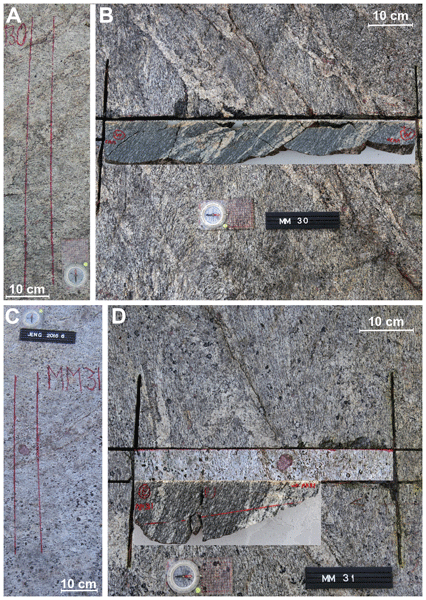
This paper describes migmatites and associated rocks in SW Finland that have been studied using the new in situ garnet and apatite Lu–Hf geochronology method. The metamorphic constraints and age presented in this paper enhance our understanding of the geological evolution in SW Finland. The results reveal detailed temporal constraints for the tectonic evolution that can be linked to major events in adjacent tectonic blocks in both Finland and Sweden during the Svecofennian orogeny.
Krisztián Szentpéteri, Kathryn Cutts, Stijn Glorie, Hugh O'Brien, Sari Lukkari, Radoslaw M. Michallik, and Alan Butcher
Eur. J. Mineral., 36, 433–448, https://doi.org/10.5194/ejm-36-433-2024, https://doi.org/10.5194/ejm-36-433-2024, 2024
Short summary
Short summary
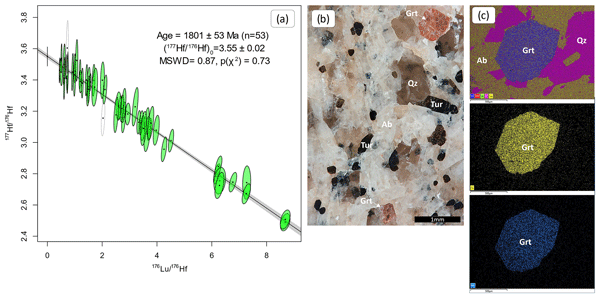
In situ Lu–Hf geochronology of garnet is applied to date a Finnish lithium–caesium–tantalum (LCT) pegmatite from the Somero–Tammela pegmatite region. The age obtained was 1801 ± 53 Ma, which is consistent with zircon ages of 1815–1740 Ma obtained from the same pegmatite. We show the in situ Lu–Hf method is a fast way of obtaining reliable age dates from LCT pegmatites.
Stijn Glorie, Sarah E. Gilbert, Martin Hand, and Jarred C. Lloyd
Geochronology, 6, 21–36, https://doi.org/10.5194/gchron-6-21-2024, https://doi.org/10.5194/gchron-6-21-2024, 2024
Short summary
Short summary
Radiometric dating methods, involving laser ablation as the sample introduction, require robust calibrations to reference materials with similar ablation properties to the analysed samples. In the case of the rubidium–strontium dating method, calibrations are often conducted to nano powder with different ablation characteristics than the crystalline minerals. We describe the limitations of this approach and recommend an alternative calibration method involving natural minerals.
Darwinaji Subarkah, Angus L. Nixon, Monica Jimenez, Alan S. Collins, Morgan L. Blades, Juraj Farkaš, Sarah E. Gilbert, Simon Holford, and Amber Jarrett
Geochronology, 4, 577–600, https://doi.org/10.5194/gchron-4-577-2022, https://doi.org/10.5194/gchron-4-577-2022, 2022
Short summary
Short summary
Advancements in technology have introduced new techniques to more quickly and cheaply date rocks with little sample preparation. A unique use of this method is to date shales and constrain when these rocks were first deposited. This approach can also time when such sequences were subsequently affected by heat or fluids after they were deposited. This is useful, as the formation of precious-metal-bearing systems or petroleum source rocks is commonly associated with such processes.
Alexander Simpson, Stijn Glorie, Martin Hand, Carl Spandler, Sarah Gilbert, and Brad Cave
Geochronology, 4, 353–372, https://doi.org/10.5194/gchron-4-353-2022, https://doi.org/10.5194/gchron-4-353-2022, 2022
Short summary
Short summary
The article demonstrates a new technique that can be used to determine the age of calcite crystallisation using the decay of 176Lu to 176Hf. The technique is novel because (a) Lu–Hf radiometric dating is rarely applied to calcite and (b) this is the first instance where analysis has been conducted by ablating the sample with a laser beam rather than bulk dissolution. By using laser ablation the original context of the sample is preserved.
Cited articles
Amal Dev, J. and Tomson, J. K.: U-Pb geochronology of rutiles from Southern granulite Terrane, India: Implications for the cooling and exhumation of East Gondwanan terranes, Precambrian Res., 407, https://doi.org/10.1016/j.precamres.2024.107408, 2024.
Amelin, Y. and Zaitsev, A. N.: Precise geochronology of phoscorites and carbonatites: The critical role of U-series disequilibrium in age interpretations, Geochim. Cosmochim. Ac., 66, 2399–2419, 2002.
Antonelli, M. A. and Simon, J. I.: Calcium isotopes in high-temperature terrestrial processes, Chem. Geol., 548, https://doi.org/10.1016/j.chemgeo.2020.119651, 2020.
Bayanova, T. B.: Baddeleyite: A Promising Geochronometer for Alkaline and Basic Magmatism, Petrology, 14, 187–200, 2006.
Brown, D. A., Simpson, A., Hand, M., Morrissey, L. J., Gilbert, S., Tamblyn, R., and Glorie, S.: Laser-ablation Lu-Hf dating reveals Laurentian garnet in subducted rocks from southern Australia, Geology, 50, 837–842, https://doi.org/10.1130/g49784.1, 2022.
Craig, G., Wehrs, H., Bevan, D. G., Pfeifer, M., Lewis, J., Coath, C. D., Elliott, T., Huang, C., Lloyd, N. S., and Schwieters, J. B.: Project Vienna: A Novel Precell Mass Filter for Collision/Reaction Cell MC-ICPMS/MS, Anal. Chem., 93, 10519–10527, https://doi.org/10.1021/acs.analchem.1c01475, 2021.
Dauphas, N., Hopp, T., Craig, G., Zhang, Z. J., Valdes, M. C., Heck, P. R., Charlier, B. L. A., Bell, E. A., Harrison, T. M., Davis, A. M., Dussubieux, L., Williams, P. R., Krawczynski, M. J., Bouman, C., Lloyd, N. S., Tollstrup, D., and Schwieters, J. B.: In situ 87Rb–87Sr analyses of terrestrial and extraterrestrial samples by LA-MC-ICP-MS/MS with double Wien filter and collision cell technologies, J. Anal. Atom. Spectrom., 37, 2420–2441, https://doi.org/10.1039/d2ja00135g, 2022.
DePaolo, D. J.: Calcium Isotopic Variations Produced by Biological, Kinetic, Radiogenic and Nucleosynthetic Processes, Rev. Mineral. Geochem., 55, 255–288, 2004.
Eiden, G. C., Barinaga, C. J., and Koppenaal, D. W.: Selective Removal of Plasma Matrix Ions in Plasma Source Mass Spectrometry, J. Anal. Atom. Spectrom., 11, 317–322, 1996.
Eliasson, T. and Schöberg, H.: U-Pb dating of the post-kinematic Sveconorwegian (Grenvillian) Bohus granite, SW Sweden: evidence of restitic zircon, Precambrian Res., 51, 337–350, 1991.
Farkaš, J.: Calcium Isotopes, in: Encyclopedia of Geochemistry, Encyclopedia of Earth Sciences Series, 1–6, https://doi.org/10.1007/978-3-319-39193-9_237-1, 2016.
Fletcher, I. R., McNaughton, N. J., Pidgeon, R. T., and Rosman, K. J. R.: Sequential closure of K–Ca and Rb–Sr isotopic systems in Archaean micas, Chem. Geol., 138, 289–301, 1997.
Gilbert, S. E., Danyushevsky, L. V., Rodemann, T., Shimizu, N., Gurenko, A., Meffre, S., Thomas, H., Large, R. R., and Death, D.: Optimisation of laser parameters for the analysis of sulphur isotopes in sulphide minerals by laser ablation ICP-MS, J. Anal. Atom. Spectrom., 29, 1042–1051, https://doi.org/10.1039/c4ja00011k, 2014.
Gilbert, S. E., Glorie, S., and Zack, T.: In situ beta decay dating by LA-ICP-MS/MS: applications, in: Methods and Applications of Geochronology, Elsevier, 243–295, ISBN 978-0-443-18803-9, https://doi.org/10.1016/B978-0-443-18803-9.00005-5, 2024.
Glorie, S., Mulder, J., Hand, M., Fabris, A., Simpson, A., and Gilbert, S.: Laser ablation (in situ) Lu-Hf dating of magmatic fluorite and hydrothermal fluorite-bearing veins, Geosci. Front., 14, 101629, https://doi.org/10.1016/j.gsf.2023.101629, 2023.
Glorie, S., Gilbert, S. E., Hand, M., and Lloyd, J. C.: Calibration methods for laser ablation Rb–Sr geochronology: comparisons and recommendation based on NIST glass and natural reference materials, Geochronology, 6, 21–36, https://doi.org/10.5194/gchron-6-21-2024, 2024a.
Glorie, S., Simpson, A., Gilbert, S. E., Hand, M., and Müller, A. B.: Testing the reproducibility of in situ LuHf dating using Lu-rich garnet from the Tørdal pegmatites, southern Norway, Chem. Geol., 653, 122038, https://doi.org/10.1016/j.chemgeo.2024.122038, 2024b.
Gopalan, K.: Conjunctive K–Ca and Rb–Sr dating of glauconites, Chem. Geol., 247, 119–123, https://doi.org/10.1016/j.chemgeo.2007.10.004, 2008.
Gorojovsky, L. and Alard, O.: Optimisation of laser and mass spectrometer parameters for the in-situ analysis of Rb/Sr ratios by LA-ICP-MS/MS, J. Anal. Atom. Spectrom., 35, 2322–2336, https://doi.org/10.1039/d0ja00308e, 2020.
Govindaraju, K.: Report (1968–1978) on Two Mica Reference Samples: Biotite Mica-Fe and Phlogopite Mica-Mg, Geostandard. Newslett., 3, 3–24, 1979.
Govindaraju, K.: Report (1973–1984) on Two ANRT Geochemical Reference Samples: Granite GS-N and Potash Feldspar FK-N, Geostandard. Newslett., 8, 173–206, 1984.
Govindaraju, K.: Working values with confidence limits for twenty-six CRPG, ANRT and IWG-GIT geostandards, Geostandard. Newslett., 19, 1–32, 1995.
Harrison, T. M. and Lovera, O. M.: The multi-diffusion domain model: Past, present and future, in: Advances in 40Ar/39Ar Dating: From Archaeology to Planetary Sciences, edited by: Jourdan, F., Mark, D. F., and Verati, C., Geological Society, London, 91–106, ISBN 978-1862393608, https://doi.org/10.1144/SP378, 2014.
Heuser, A., Eisenhauer, A., Gussone, N., Bock, B., Hansen, B. T., and Hagler, T. F.: Measurement of calcium isotopes (δ44Ca) using a multicollector TIMS technique, Int. J. Mass Spectrom., 220, 385–397, 2002.
Hogmalm, K. J., Zack, T., Karlsson, A. K. O., Sjöqvist, A. S. L., and Garbe-Schönberg, D.: In situ Rb–Sr and K–Ca dating by LA-ICP-MS/MS: an evaluation of N2O and SF6 as reaction gases, J. Anal. Atom. Spectrom., 32, 305–313, https://doi.org/10.1039/c6ja00362a, 2017.
Hogmalm, K. J., Dahlgren, I., Fridolfsson, I., and Zack, T.: First in situ Re-Os dating of molybdenite by LA-ICP-MS/MS, Miner. Deposita, 54, 821–828, https://doi.org/10.1007/s00126-019-00889-1, 2019.
Jackson, S. E.: Calibration strategies for elemental analysis by LA-ICP-MS, in: Mineralogical Association of Canada Short Course, Vancouver, 169–188, ISBN 9780921294498, 2008.
Jegal, Y., Zimmermann, C., Reisberg, L., Yeghicheyan, D., Cloquet, C., Peiffert, C., Gerardin, M., Deloule, E., and Mercadier, J.: Characterisation of Reference Materials for in-situ Rb‐Sr dating by LA‐ICP‐MS/MS, Geostand. Geoanal. Res., 645–671, https://doi.org/10.1111/ggr.12456, 2022.
Jenkin, G. R. T.: Do cooling paths derived from mica Rb-Sr data reflect true cooling paths?, Geology, 25, 907, https://doi.org/10.1130/0091-7613(1997)025<0907:dcpdfm>2.3.co;2, 1997.
Krasnova, N. Y.: The Kovdor phlogopite deposit, Kola Peninsula, Russia, Can. Mineral., 39, 33–44, 2001.
Kröner, A. and Stern, R. J.: Pan-African Orogeny, in: Encyclopaedia of Geology, edited by: Selley, R. C., Cocks, L. R. M., and Plimer, I. R., Elsevier, 1–12, https://doi.org/10.1016/B0-12-369396-9/00431-7, 2005.
Larson, K. P., Shrestha, S., Button, M., Cottle, J. M., and Barnes, C. J.: The Effect of Crystal Orientation on In Situ Rb‐Sr Mica Geochronology, Geostand. Geoanal. Res., 49, 705–713, https://doi.org/10.1111/ggr.70005, 2025.
Laureijs, C. T., Coogan, L. A., and Spence, J.: In-situ Rb-Sr dating of celadonite from altered upper oceanic crust using laser ablation ICP-MS/MS, Chem. Geol., 579, 120339, https://doi.org/10.1016/j.chemgeo.2021.120339, 2021a.
Laureijs, C. T., Coogan, L. A., and Spence, J.: Regionally variable timing and duration of celadonite formation in the Troodos lavas (Cyprus) from Rb-Sr age distributions, Chem. Geol., 560, 119995, https://doi.org/10.1016/j.chemgeo.2020.119995, 2021b.
Li, S.-S., Santosh, M., Farkaš, J., Redaa, A., Ganguly, S., Kim, S. W., Zhang, C., Gilbert, S., and Zack, T.: Coupled U-Pb and Rb-Sr laser ablation geochronology trace Archean to Proterozoic crustal evolution in the Dharwar Craton, India, Precambrian Res., 343, 105709, https://doi.org/10.1016/j.precamres.2020.105709, 2020.
Li, Y. and Vermeesch, P.: Short communication: Inverse isochron regression for Re–Os, K–Ca and other chronometers, Geochronology, 3, 415–420, 2021.
Liebmann, J., Kirkland, C. L., Kelsey, D. E., Korhonen, F. J., and Rankenburg, K.: Lithological fabric as a proxy for Rb–Sr isotopic complexity, Chem. Geol., 608, https://doi.org/10.1016/j.chemgeo.2022.121041, 2022.
Lloyd, J. C., Spandler, C., Gilbert, S. E., and Hasterok, D.: The quantification of down-hole fractionation for laser ablation mass spectrometry, Geochronology, 7, 265–287, https://doi.org/10.5194/gchron-7-265-2025, 2025.
Loyola, C., Farkaš, J., Collins, A. S., Gilbert, S. E., Verdel, C., Löhr, S. C., Brock, G. A., Shields, G. A., Baldermann, A., Redaa, A., Blades, M., Subarkah, D., Bishop, C., Giles, S. M., Christie-Blick, N., and Haines, P. W.: In situ Rb–Sr dating and REE analysis of glauconites and detrital feldspars from the Ediacaran/Cambrian strata: Centralian and Adelaide Superbasins, Australia, Precambrian Res., 427, https://doi.org/10.1016/j.precamres.2025.107851, 2025.
Marshall, B. D.: Potassium-calcium decay system, in: Geochemistry. Encyclopaedia of Earth Science, Springer, Dordrecht, https://doi.org/10.1007/1-4020-4496-8_260, 1998.
Morteani, G., Kostitsyn, Y. A., Gilg, H. A., Preinfalk, C., and Razakamanana, T.: Geochemistry of phlogopite, diopside, calcite, anhydrite and apatite pegmatites and syenites of southern Madagascar: evidence for crustal silicocarbonatitic (CSC) melt formation in a Panafrican collisional tectonic setting, Int. J. Earth Sci., 102, 627–645, https://doi.org/10.1007/s00531-012-0832-x, 2013.
Mortimer, G. E., Cooper, J. A., and James, P. R.: U-Pb and Rb-Sr geochronology and geological evolution of the Harts Range ruby mine area of the Arunta Inlier, Central Australia, Lithos, 20, 445–467, 1987.
Nägler, T. F. and Villa, I. M.: In pursuit of the 40K branching ratios: K-Ca and 39Ar-40Ar dating of gem silicates, Chem. Geol., 169, 5–16, https://doi.org/10.1016/S0009-2541(99)00194-1, 2000.
Nebel, O.: Rb–Sr Dating, Encyclopedia of Scientific Dating Methods, Springer, Dordrecht, 1–19, https://doi.org/10.1007/978-94-007-6326-5_116-1, 2014.
Norris, A. and Danyushevsky, L.: Towards Estimating the Complete Uncertainty Budget of Quantified Results Measured by LA-ICP-MS, Goldschmidt, Boston, https://goldschmidtabstracts.info/abstracts/abstractView?id=2018003403 (last access: 20 October 2026), 2018.
Olierook, H. K. H., Rankenburg, K., Ulrich, S., Kirkland, C. L., Evans, N. J., Brown, S., McInnes, B. I. A., Prent, A., Gillespie, J., McDonald, B., and Darragh, M.: Resolving multiple geological events using in situ Rb–Sr geochronology: implications for metallogenesis at Tropicana, Western Australia, Geochronology, 2, 283–303, https://doi.org/10.5194/gchron-2-283-2020, 2020.
Olierook, H. K. H., Ribeiro, B. V., Liebmann, J., Rankenburg, K., Jourdan, F., Redaa, A., Lloyd, J. C., Belgrano, T. M., Corella Santa Cruz, C. R., Jegal, Y., Mercadier, J., Yu, J., Zametzer, A., Kirkland, C. L., Rohrer, R., Storey, C., Doucet, L. S., Jones, I., Stokes, L., Zack, T., Rösel, D., Hébert, N., Fougerouse, D., Kaempf, J., Datta, P., Hameed, H., Evans, N. J., Roberts, M., Mayers, C., Frew, A., Al Odeh, S., Roche, C. E., Chiaradia, M., Cruz-Uribe, A. M., Collins, A. S., Gilbert, S. E., Farkaš, J., Glorie, S., Karlsson, A., and Kumara, A. S.: Appraisal of eight natural mica reference materials for in situ Rb-Sr geochronology, Geostand. Geoanal. Res., https://doi.org/10.1111/ggr.70061, 2026.
Pandey, B., Krishna, V., Sastry, D., Chabria, T., Mary, K., and Dhanaraju, R.: Pan-African whole rock Rb–Sr isochron ages for the granites and pegmatites of Kullampatti–Suriyamalai area, Salem District, Tamil Nadu, India, VI National Sym. Mass Spectrometry, Ind. Inst. of Petroleum, Dehradun, Abstract, 480–482, 1993.
Pedrosa-Soares, A. C., De Campos, C. P., Noce, C., Silva, L. C., Novo, T., Roncato, J., Medeiros, S., Castañeda, C., Queiroga, G., Dantas, E., Dussin, I., and Alkmim, F.: Late Neoproterozoic-Cambrian granitic magmatism in the Araçuaí orogen (Brazil), the Eastern Brazilian Pegmatite Province and related mineral resources, Geological Society, London, Special Publications, 350, 25–51, https://doi.org/10.1144/sp350.3, 2011.
Redaa, A., Farkaš, J., Gilbert, S., Collins, A. S., Wade, B., Löhr, S., Zack, T., and Garbe-Schönberg, D.: Assessment of elemental fractionation and matrix effects during in situ Rb–Sr dating of phlogopite by LA-ICP-MS/MS: implications for the accuracy and precision of mineral ages, J. Anal. Atom. Spectrom., 36, 322–344, https://doi.org/10.1039/d0ja00299b, 2021.
Redaa, A., Farkaš, J., Gilbert, S., Collins, A. S., Löhr, S., Vasegh, D., Forster, M., Blades, M., Zack, T., Giuliani, A., Maas, R., Baldermann, A., Dietzel, M., and Garbe‐Schönberg, D.: Testing Nano‐Powder and Fused‐Glass Mineral Reference Materials for In Situ Rb‐Sr Dating of Glauconite, Phlogopite, Biotite and Feldspar via LA‐ICP‐MS/MS, Geostand. Geoanal. Res., 47, 23–48, https://doi.org/10.1111/ggr.12467, 2022.
Renne, P. R., Balco, G., Ludwig, K. R., Mundil, R., and Min, K.: Response to the comment by W. H. Schwarz et al. on “Joint determination of 40K decay constants and 40Ar
Rieder, M., Cavazzini, G., D'yakonov, Y. S., Frank-Kamenetskii, V. A., Gottardi, G., Guggenheim, S., Koval, P. W., Müller, G. Neiva, A. M. R., Radoslovich, E. W., Robert, J.-L., Sassi, F. P., Takeda, H., Weiss, Z. and Wones, D. R.: Nomenclature of the Micas, Clay. Clay Miner., 46, 586–595, https://doi.org/10.1346/CCMN.1998.0460513, 1998
Romer, R. L. and Smeds, S.-A.: U-Pb columbite ages of pegmatites from Sveconorwegian terranes in southwestern Sweden, Precambrian Res., 76, 15–30, 1996.
Rösel, D. and Zack, T.: LA‐ICP‐MS/MS Single‐Spot Rb‐Sr Dating, Geostand. Geoanal. Res., https://doi.org/10.1111/ggr.12414, 2022.
Russell, W. A., Papanastassiou, D. A., and Tombrella, T. A.: Ca isotope fractionation on the Earth and other solar system materials, Geochim. Cosmochim. Ac., 42, 1075–1090, 1978.
Simpson, A., Gilbert, S., Tamblyn, R., Hand, M., Spandler, C., Gillespie, J., Nixon, A., and Glorie, S.: In-situ Lu Hf geochronology of garnet, apatite and xenotime by LA ICP MS/MS, Chem. Geol., 577, 120299, https://doi.org/10.1016/j.chemgeo.2021.120299, 2021.
Simpson, A., Glorie, S., Hand, M., Spandler, C., and Gilbert, S.: Garnet Lu-Hf speed dating: A novel method to rapidly resolve polymetamorphic histories, Gondwana Res., 121, 215–234, https://doi.org/10.1016/j.gr.2023.04.011, 2023.
Skiöld, T.: The interpretation of the Rb-Sr and K-Ar ages of late Precambrian rocks in south-western Sweden, Geol. Fören. Stock. För., 98, 3–29, https://doi.org/10.1080/11035897609454335, 2010.
Subarkah, D., Nixon, A. L., Jimenez, M., Collins, A. S., Blades, M. L., Farkaš, J., Gilbert, S. E., Holford, S., and Jarrett, A.: Constraining the geothermal parameters of in situ Rb–Sr dating on Proterozoic shales and their subsequent applications, Geochronology, 4, 577–600, https://doi.org/10.5194/gchron-4-577-2022, 2022.
Tamblyn, R., Hand, M., Simpson, A., Gilbert, S., Wade, B., and Glorie, S.: In situ laser ablation Lu–Hf geochronology of garnet across the Western Gneiss Region: campaign-style dating of metamorphism, J. Geol. Soc., 179, https://doi.org/10.1144/jgs2021-094, 2022.
Tamblyn, R., Gilbert, S., Glorie, S., Spandler, C., Simpson, A., Hand, M., Hasterok, D., Ware, B., and Tessalina, S.: Molybdenite Reference Materials for In Situ LA‐ICP‐MS/MS Re‐Os Geochronology, Geostand. Geoanal. Res., 48, 393–410, 2024.
Tillberg, M., Drake, H., Zack, T., Kooijman, E., Whitehouse, M. J., and Astrom, M. E.: In situ Rb-Sr dating of slickenfibres in deep crystalline basement faults, Sci. Rep., 10, 562, https://doi.org/10.1038/s41598-019-57262-5, 2020.
Tillberg, M., Drake, H., Zack, T., Hogmalm, J., Kooijman, E., and Åström, M.: Reconstructing craton‐scale tectonic events via in situ Rb-Sr geochronology of poly-phased vein mineralization, Terra Nova, 33, 502–510, https://doi.org/10.1111/ter.12542, 2021.
Tischendorf, G., Förster, H.-J., Gottesmann, B., and Rieder, M.: True and brittle micas: composition and solid-solution series, Mineral. Mag., 71, 285–320, 2007.
Vermeesch, P.: IsoplotR: a free and open toolbox for geochronology, Geosci. Front., 9, 1479–1493, https://doi.org/10.1016/j.gsf.2018.04.001, 2018.
Villa, I. M., De Bièvre, P., Holden, N. E., and Renne, P. R.: IUPAC-IUGS recommendation on the half-life of 87Rb, Geochim. Cosmochim. Ac., 164, 382–385, https://doi.org/10.1016/j.gca.2015.05.025, 2015.
Wang, C., Alard, O., Lai, Y.-J., Foley, S. F., Liu, Y., Munnikhuis, J., and Wang, Y.: Advances in in-situ Rb-Sr dating using LA-ICP-MS/MS: applications to igneous rocks of all ages and to the identification of unrecognized metamorphic events, Chem. Geol., 610, https://doi.org/10.1016/j.chemgeo.2022.121073, 2022.
Zack, T. and Gilbert, S. E.: In situ beta decay dating by LA-ICP-MS/MS: Fundamentals and methodology, in: Methods and Applications of Geochronology, Elsevier, 211–241, ISBN 978-0-443-18803-9, https://doi.org/10.1016/B978-0-443-18803-9.00014-6, 2024.
Zack, T. and Hogmalm, K. J.: Laser ablation Rb/Sr dating by online chemical separation of Rb and Sr in an oxygen-filled reaction cell, Chem. Geol., 437, 120–133, https://doi.org/10.1016/j.chemgeo.2016.05.027, 2016.
Zhao, J., Chen, H., Xiao, B., Zhu, Y., and Wang, H.: Substitution mechanism controls on compositional variations and spectral responses of white micas in major hydrothermal systems, Appl. Clay Sci., 269, 107762, https://doi.org/10.1016/j.clay.2025.107762, 2025.
Short summary
This study presents new methodology for combined in-situ analysis of Rb-Sr and K-Ca in K-rich micas and feldspars. Simultaneous analysis is especially beneficial for small grains and/or detrital minerals where sample material is limited. This technique has the potential for identifying decoupling between the isotope systems, to further understanding of cooling and alteration processes in micas and feldspars, and increase knowledge of element diffusivity in these minerals.
This study presents new methodology for combined in-situ analysis of Rb-Sr and K-Ca in K-rich...


