
the Creative Commons Attribution 4.0 License.
the Creative Commons Attribution 4.0 License.
 | 22 Oct 2026
Coupled K–Ca and Rb–Sr dating by LA-ICP-MS/MS – reaction gas optimisation and geological applications
Sarah E. Gilbert

Stijn Glorie
Jarred C. Lloyd
Both the Rb–Sr and K–Ca β-decay isotopic systems can be used to date a range of mica- and feldspar-group minerals and have the potential to unravel cooling and alteration processes across a wide range of geological settings. The development of LA-ICP-MS/MS has enabled direct in-situ analysis of these β-decay geochronometers via chemical separation with reactive gases within the mass-spectrometer. In addition to rapid analysis, a main advantage of in-situ K–Ca dating is the ability to avoid Ca- and Sr-bearing inclusions, which are a limiting factor for conventional bulk mineral dating via TIMS. Both Sr and Ca are highly reactive with both SF6 and N2O to form M-F, M-O or M-OH reaction products. In contrast, K and Rb are non-reactive with either gas enabling efficient separation of the parent-daughter isotope pairs, 40K–40Ca and 87Rb–87Sr. Additionally, mixing a small amount of H2 with SF6 or N2O efficiently eliminates 40Ar based interferences and reduces the background generated by the high ion load in the reaction cell when measuring mass to charge ratio () 40. This study compares the accuracy, precision, and product ion sensitivity of four reaction gas combinations: SF6 only, SF6 plus 2 mL min−1 H2, N2O plus 7 mL min−1 H2, and N2O plus 10 mL min−1 H2, by analysing a range of micas and feldspars with previously constrained dates: MDC and Kola phlogopites, Högsbo and Robins Folly muscovites, G71560 polylithionite, and F-KN and Bohus K-feldspars. Using these gas mixtures, coupled Rb–Sr and K–Ca dates were obtained from a single ablation spot in low Ca-bearing (5–300 ppm) micas and feldspars, with age uncertainties of 2 % and 5 %, respectively. The direct coupling of Rb–Sr and K–Ca dates within the same ablation volume allows assessment of isotopic disturbances at high spatial resolution. The gas combination of SF6 plus 2 mL min−1 H2 was found to be the most effective for coupled K–Ca and Rb–Sr dating, producing the highest sensitivity for reacted species while minimising the background on reacted 40Ca. Analysis of the FK-N feldspar from Madras, India shows the potential for the two isotopic systems to reveal decoupled dates, with the 515±22 Ma Rb–Sr date representing the crystallisation of the granite and the 437±38 Ma K–Ca date indicating late-stage hydrothermal activity.
- Article
(2130 KB) - Full-text XML
-
Supplement
(10748 KB) - BibTeX
- EndNote


Laser ablation inductively coupled mass spectrometry (LA-ICP-MS) is a widely used technique for element and isotopic analyses in the earth sciences and has been used for U–Pb geochronology for over 30 years. Recent technological advancements have led to the development of ICP-MS/MS systems that utilise a reaction cell between two mass selecting devices. This enables selective reactions and chemical separation of atomic and polyatomic interferences using a range of reactive gasses. Coupling this with in-situ sampling by laser ablation has led to an expansion of applications, especially in geochronology (e.g. Gilbert et al., 2024; Gorojovsky and Alard, 2020; Olierook et al., 2020; Tillberg et al., 2020; Laureijs et al., 2021a; Rösel and Zack, 2022; Simpson et al., 2023; Glorie et al., 2023; Tamblyn et al., 2022; Brown et al., 2022). Over the past decade, this technology has been applied to the analysis of β-decay geochronometers such as Rb–Sr, K–Ca, Lu–Hf and Re–Os (Redaa et al., 2021; Simpson et al., 2021; Tamblyn et al., 2024; Hogmalm et al., 2017, 2019; Zack and Hogmalm, 2016). In these systems, the parent and daughter isotopes have the same isotopic mass, creating an isobaric interference. These can be effectively separated using a range of reaction gases: N2O, SF6, HN3 or CH4.
Radioactive 40K decays via branched pathways to 40Ca (β−decay, ∼89 %) and 40Ar (electron capture, ∼11 %), enabling both K–Ca and K–Ar (39Ar–40Ar) dating (Nägler and Villa, 2000). These decay systems can be used to date high K, low common Ca minerals such as biotite, muscovite and K-felspars. Due to similar chemical behaviour and ionic radii, Rb readily substitutes for K in these minerals; hence, minerals that are suitable for K–Ca dating are also suitable for Rb–Sr dating. Micas are readily susceptible to deformation and alteration with reactive fluids. Thus, both isotopic systems can be reset at low temperatures through element diffusion, crystal deformation, and dissolution/recrystallisation and have the potential to be used to determine cooling dates or to improve the understanding of low temperature diagenetic processes (Fletcher et al., 1997; Gopalan, 2008). Although closure temperatures in micas are poorly constrained, an apparent closure temperature for 40Ca has been calculated at 300 °C (Harrison and Lovera, 2014), compared to 350–550 °C for the Rb–Sr system in micas (Jenkin, 1997; Nebel, 2014).
Analysis of highly precise Ca isotopes is routine via chemical dissolution and TIMS or MC-ICP-MS analysis for K-Ca dating of minerals (Farkaš, 2016; DePaolo, 2004; Antonelli and Simon, 2020; Gopalan, 2008; Heuser et al., 2002). These techniques can provide the highest level of analytical precision. However, the technique has some limitations: chemical dissolution and column chemistry can be time consuming and can easily incorporate common Ca-bearing inclusions within the target mineral; Ca has low ionisation efficiency by TIMS; and the precision of the Ca ratios is compromised in high K/Ca minerals due to the low sensitivity of 44Ca. Analysis by LA-ICP-MS/MS can overcome some of these limitations via rapid analysis at high spatial resolution and is ideally suited to highly radiogenic, low Ca-bearing minerals.
In-situ Rb–Sr and K–Ca dating via LA-ICP-MS/MS was first demonstrated using N2O and SF6 as reaction gasses (Hogmalm et al., 2017; Zack and Hogmalm, 2016). Uptake of in-situ Rb–Sr dating via LA-ICP-MS/MS has been rapid since then (Loyola et al., 2025; Wang et al., 2022; Subarkah et al., 2022; Liebmann et al., 2022; Jegal et al., 2022; Dauphas et al., 2022; Tillberg et al., 2021; Laureijs et al., 2021b; Olierook et al., 2020; Li et al., 2020). This is primarily due to the highly efficient and “simple” reaction chemistry of Sr with both N2O and SF6. However, the K–Ca analytical technique is currently underdeveloped and there are several isotopic and analytical challenges to be overcome for in-situ K–Ca dating.
The parent 40K is a minor isotope of K (0.012 %), whereas the radiogenic daughter 40Ca is also the most abundant common Ca isotope (96.9 %). The decay constant for 40K ( a−1; Renne et al., 2011) is larger than 87Rb ( a−1; Villa et al., 2015), resulting in a shorter half-life and faster production of the daughter 40Ca than 87Sr: 1.25×10³ Ma (Marshall, 1998) versus 49.61×10³ Ma (Villa et al., 2015). Despite the faster radiogenic ingrowth of K–Ca, the low 40K parent isotopic abundance requires ∼98 000 µg g−1 of K to produce ∼4 µg g−1 of 40Ca, compared to ∼1000 µg g−1 of Rb to produce the same amount of 87Sr over 1 Ga (Zack and Gilbert, 2024). Therefore, the radiogenic ingrowth of 40Ca can easily be overshadowed by the presence of common Ca in the mineral of interest or as inclusions. This study aims to provide a guide for the limitations of K–Ca dating in terms of the resolvable age versus the common Ca content.
In addition, 40Ar (99.6 % abundance) is also present at exceedingly high concentrations from the Ar burning ICP. It has been shown that the daughter 40Ca can be efficiently separated from the non-reactive 40K and 40Ar using N2O or SF6 reaction gases (Hogmalm et al., 2017). However, the high ion load from 40Ar+ passing through the first quadrupole into the reaction cell has the potential to compromise the analysis and reaction mechanisms. In this study, we investigate the effects of adding H2 as a second reaction gas to mitigate the Ar+ via charge transfer reaction (Ar H H; Eiden et al., 1996; Craig et al., 2021).
The ease of measuring multiple isotopes across the mass range is a distinct advantage for quadrupole LA-ICP-MS/MS analysis. This enables simultaneous measurement of two, or more, isotope systems from the same ablation volume. This study investigates the accuracy of simultaneous Rb–Sr and K–Ca isotopic measurements by LA-ICP-MS/MS in a range of micas and feldspars, and optimises the analytical procedure through comparison of N2O, SF6 and H2 reaction gases.
2.1 Mica group minerals
The MDC phlogopite was cut from a cm crystal, sourced from the Bekily region, Madagascar (Redaa et al., 2021). It is taken to be the equivalent in geological source and age as the Mica-Mg powdered reference material distributed by the Centre de Recherches Petrographiques et Geochimiques (CRPG; Govindaraju, 1979, 1995). The expected age of 519.4±6.5 Ma used in this study, is the average reported Rb–Sr, K–Ar and U–Pb age of the region (Hogmalm et al., 2017; and references therein). The initial Sr ratio of 0.72607±0.00070 was measured from two diopside analyses from the Mica-Mg sample (Morteani et al., 2013). More recent ID-MC-ICP-MS results from the Mica-Mg powdered samples give a relatively imprecise date of 521±24 from 12 aliquots (Jegal et al., 2022) and 524.9±3.6 from 1 aliquot (Redaa et al., 2022), indicating some uncertainty in the batch-to-batch reproducibility of the Rb–Sr age from the Mica-Mg powdered sample.
The Kola phlogopite was sourced from the Kovdor Massif, located on the Kola Penisnsula, Kovdorsky District, Russia. The cm-scale phlogopite book was purchased from a mineral dealer and the exact location is unknown. Similar sized phlogopites characteristic of the deposit are formed from high temperature ultrabasic pegmatites within a carbonatite-bearing alkaline-ultrabasic complex (Amelin and Zaitsev, 2002; Krasnova, 2001). A narrow range of TIMS U-Th-Pb dates have been reported from the Kovdor Massif by Amelin and Zaitsev (2002): ca. 378 Ma (baddeleyite, Pb lower intercept), 377.52±0.94 Ma (zircon Th), 377.5±3.5 Ma (apatite, Pb lower intercept) and 380.6±2.6 Ma (apatite and calcite, Pb lower intercept). Baddeleyite dates of 377±4 and 383±3 have also been reported (Bayanova, 2006). Phlogopites have been dated by conventional Rb–Sr, giving a date of 378.3±1.5 Ma (Amelin and Zaitsev, 2002), recalculated using the decay constant of Villa et al. (2015) and initial Sr of 0.70368±0.00055. A weighted mean date based on U–Pb and Rb–Sr analyses of 378.1±1.2 was used as the reference age in this study (Table 1).
Table 1Reference ages for minerals used in this study, with additional details in text.
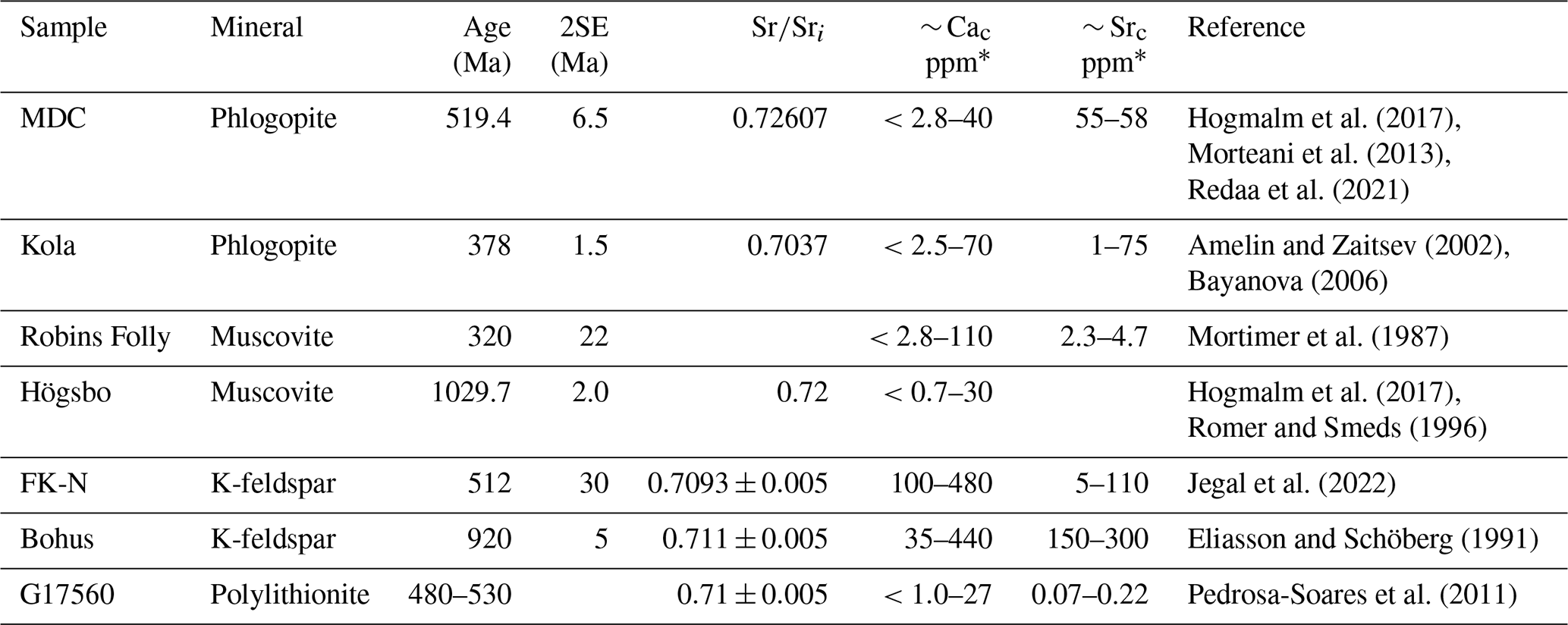
* Approximate common (c) Ca and Sr concentrations, measured on 43Ca and 88Sr, respectively (Table S10 in the Supplement). Ca initial assumed to be 47.15±0.02 (Russell et al., 1978).
The Robins Folly muscovite was sourced form undeformed pegmatites in the Hartz Range metaigneous province, Northern Territory, Australia, emplaced during the late stages of the Alice Springs Orogeny (450–300 Ma). The sample was collected near the Ruby Mines from the same location as described in Mortimer et al. (1987). This study reported a whole rock Rb–Sr date of 320±22 Ma (recalculated using the decay constant of Villa et al., 2015) with an initial Sr ratio of 0.7445±0.0028. Additional model muscovite and biotite dates from the same area are reported as 327–337 Ma and 329±2 Ma respectively (Mortimer et al., 1987), suggesting up to 5 % age variability between samples.
The Högsbo muscovite was sampled from the Högsbo pegmatite quarry in Gothenburg, Sweden. The crystallisation age of the pegmatite, constrained by a columbite Pb TIMS date of 1029.7±2.0 Ma (Romer and Smeds, 1996), was used as the reference in this study, along with an initial Sr ratio of 0.72000±0.00010 (Hogmalm et al., 2017). In-situ Rb–Sr dates have been reported as 1037±11 Ma from the Högsbo nano-powder pellet (Hogmalm et al., 2017), and 1035±7 and 1039±7 Ma from muscovite crystals (Rösel and Zack, 2022). More recently, an 40Ar–39Ar muscovite date of 1025.2±2.2 Ma, and in-situ Rb–Sr dates between 1023.0±2.4 and 1024±7 Ma, have been reported in Olierook et al. (2026). Significantly younger in situ Rb–Sr dates have also been reported within the same muscovite crystals: 1003±6 (Rösel and Zack, 2022) and 981±8 Ma (Olierook et al., 2026), suggesting some alteration of the pegmatites is recorded in the muscovite.
The G17560 polylithionite was sourced from the South Australian Museum collection from a non-specific location near Itinga, Minas Gerais, Brazil. This would place it within the Araçuaí District in the Eastern Brazilian Pegmatite Province. Similar gem-quality polylithonite specimens have been found in an artisanal mine within the Taquaral pegmatite field. Two different pegmatite suites have been identified in this region with zircon U–Pb dates of nearby granite bodies ranging from 520–480 and 530–500 Ma (G5 and G4 supersuites; Pedrosa-Soares et al., 2011). There are no published Rb–Sr dates for these pegmatites, nor measured Sr initial ratios. For this study, the initial was assumed to be 0.710±0.015 (assumed for enriched magmatic rocks; Rösel and Zack, 2022). The polylithionite contains very high Rb (∼1.4 wt %) and negligible common Sr, making the Sr component highly radiogenic. Hence, the choice of initial Sr ratio has no significant effect on the calculated Rb–Sr date.
All micas were sub-sampled from large mica crystals and mounted in epoxy blocks perpendicular to cleavage. Mounting in this orientation produces the most consistent spot-to-spot ablation compared to mounting parallel to cleavage (Larson et al., 2025).
2.2 K-feldspars
The FK-N K-feldspar is used as an international trace element reference material, distributed by CRPG (Govindaraju, 1984), sourced from Tamil Nadu Province, India. Feldspar chips from the original source were obtained and mounted for analysis. The FK-N powdered sample has been dated by Jegal et al. (2022), giving an Rb–Sr date of 512±30 Ma. Co-genetic pegmatites and leucogranites from the region have also been dated giving a Rb–Sr date of 521±9 Ma and initial Sr ratio of 0.7093 (Pandey et al., 1993).
The Bohus K-feldspars were separated from the Bohus granite, located in south-west Sweden. The granite massif compromises of several granitic intrusions, and has been commercially quarried since the 1840's. The granite intrudes into the Dal Group (1100 to 1050 Ma) at the end of the Sveconorwegian orogeny. It has a Rb–Sr date of 910±35 Ma and an initial Sr ratio of 0.711, and K–Ar model-ages range from 861 to 680 Ma (Skiöld, 2010). A higher precision zircon U–Pb date of 920±5 Ma is regarded as the crystallisation age of the Bohus granite (Eliasson and Schöberg, 1991).
3.1 Instrumentation
Analyses were conducted at Adelaide Microscopy, Adelaide University, using a RESOlution-LR 193 nm excimer laser system coupled to an Agilent 8900x ICP-MS/MS. The interface tubing between the laser sample chamber and the ICP torch was cleaned prior to each analytical session and was not used for the ablation of high Ca materials (e.g. NIST glasses, 8.15 wt % Ca) to minimise the potential for Ca-contamination. A pure SiO2 glass was also ablated at the start of each session to mobilise any residual, previously ablated aerosol particles in the tubing (Gilbert et al., 2014). A Teflon bulb (∼20 mL) was used as the signal smoothing device rather than a squid, given the latter is difficult to clean and remain Ca free. Carrier gas flow rates were 350 mL min−1 He, mixed with 890 mL min−1 Ar, and the addition of 6 mL min−1 N2 to enhance sensitivity. The laser parameters for all sessions were: 3.5 J cm−2 fluence, 5 Hz repetition rate, and 100 µm spot size. All instrument parameters, including ICP-MS/MS lens tuning, are provided in Table S1.
A range of reaction gas mixtures and flow rates were tested based on the previously published reaction products of Sr and Ca (Hogmalm et al., 2017; Redaa et al., 2021). The aim was to determine the optimal gas flow rates in terms of reaction product ion sensitivity and the signal to background ratio for 40+XCa (where X represents the mass shift of the product ions, see reaction gas optimisation section below). The four gas combinations selected for detailed testing were: SF6 only (0.77 mL min−1), SF6 and H2 mix (0.57 mL min−1 and 2 mL min−1, respectively), and N2O and H2 mixed in two different proportions: 0.16 mL min−1 N2O and 7 mL min−1 H2; and 0.16 mL min−1 N2O and 10 mL min−1 H2. These setting are referred to as SF6 only, SF6 + H2, N2O + low H2 and N2O + high H2, from here on. Using N2O as the reaction gas without H2 was not tested in detail due to the significant production of 40Ar16O which causes an interference with the target 40Ca16O reaction product. When H2 is added, Ar is neutralised via a charge transfer reaction (Eiden et al., 1996). In our experiments, no Ar reaction products were detected (measured as 36+XAr), indicating the charge transfer reaction is thermodynamically favourable in the reaction cell. Both SF6 and N2O gases were introduced into the reaction cell using the third mass flow controller (MFC3), N2O as 99.999 % purity, and SF6 as a mixture of 10 % SF6 in He (referred to as SF6 throughout). The 99.999 % purity H2 was introduced via a dedicated MFC.
3.2 Reaction products
To determine the most abundant rection products for Ca and Sr, product ion scans (PIS) were conducted. The first quadrupole (Q1) was set to a mass-to-charge ratio () of 44 or 88, respectively, and Q2 scanned across the mass range with mass shifts of 0 to 150 amu. When using SF6, both with and without the addition of H2, the predominant reaction products were CaF and SrF (+19 amu mass shift; Fig. 1a). For reactions with N2O plus H2, hydroxide (OH) product ions were most abundant (+17 amu mass shift; Fig. 1b). Thus, based on the PIS results, the highest abundant reaction products of Ca19F, Sr19F, Ca17OH and Sr17OH were used in further analysis. For both Ca and Sr, measurable amounts of hydrides and oxides were also present. For Ca, heavier Ca(H2O)OH and Ca(H2O)F were also detected. These H2O bearing reaction products may have been caused by a contaminant (e.g. air or moisture) in the H2 gas lines, as these occurred without the deliberate addition of oxygen i.e. with SF6. Additional gas line flushing is recommended to reduce the production of these molecules.
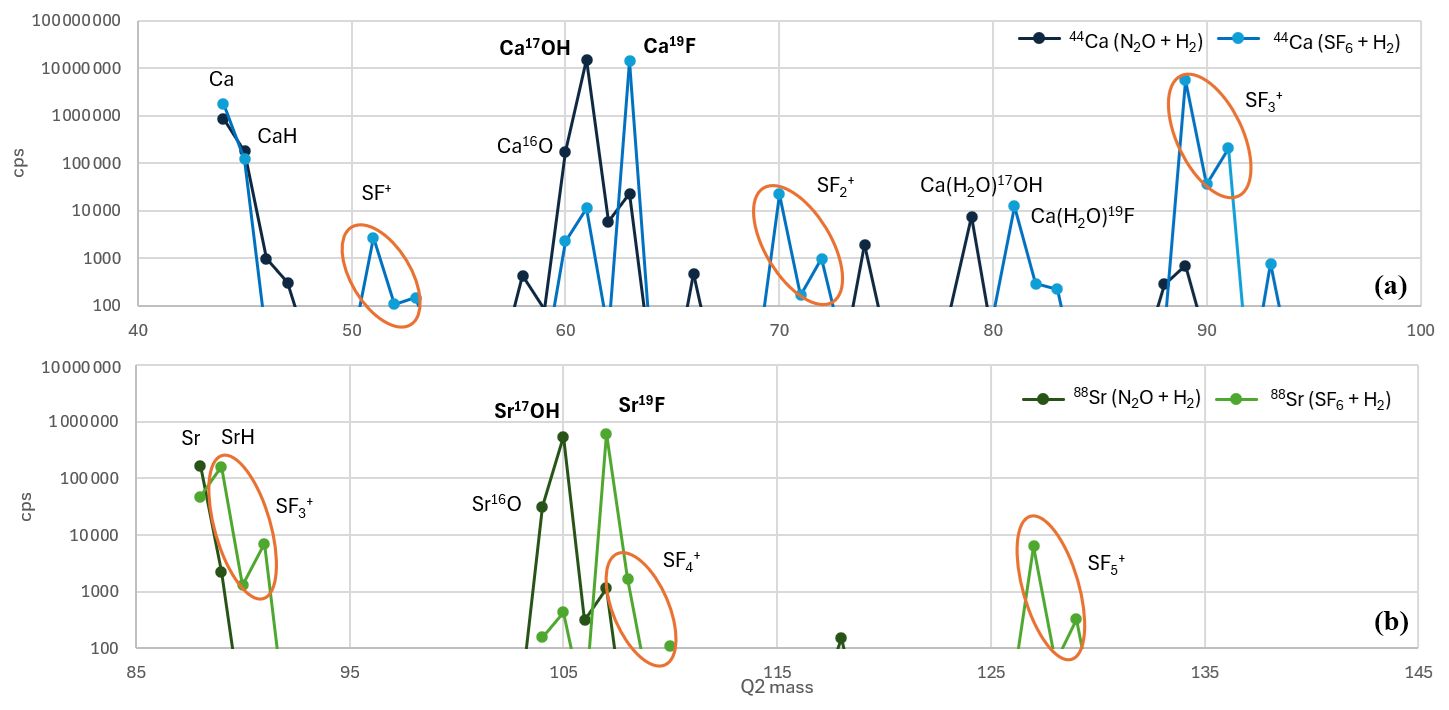
Figure 1Product ion scans for 44Ca (a) and 88Sr (b) using SF6 + H2 and N2O + H2 reaction gases, measured on NIST SRM 610 glass and plotted to show reaction products greater than 100 cps only. Major reaction product ions that were chosen for Sr and Ca analysis in further experiments are highlighted in bold. Circled in orange are the SF6 gas breakdown products (SFx).
For SF6, the PIS also showed the SFx breakdown products at masses 51, 70, 89, 108 and 127 amu (Fig. 1). These reaction products occur across 3 masses in each experiment, reflecting the isotopic proportions of S. As these product ions are created within the reaction cell from the breakdown of the SF6 reaction gas itself, their occurrence is independent of the ions that passes through Q1 into the reaction cell. For example, the SF6 reaction products were also measurable at the same rates when Q1 was set to 3 amu, meaning that no ions were entering the reaction cell. For K-Ca and Rb-Sr isotopic analysis, these products do not affect the measurements; however, they can have implications for the range of trace elements monitored in the same analysis; e.g. 51V, 53Cr, 89Y, and 90Zr will all have elevated backgrounds when SF6 is used as the reaction gas.
The isotopes measured with dwell times (ms) in brackets, were: 27Al (5), 36+XAr (20), 39K (10), 39+XK (20), 40+XCa (50), 42+XCa (50), 43+XCa (50),44+XCa (100), 85Rb (20), 86+XSr (50), and 87+XSr (50). For the reacted isotopes X represents a mass shift of either 19 (e.g. 40Ca19F) when using SF6 reaction gas or 17 (e.g. 40Ca17OH) when using the N2O and H2 mixture. The presence of unreacted 40Ca and 87Sr prevents the direct measurement of the parent isotopes, so 39K and 85Rb were measured as proxies for 40K and 87Rb respectively and calculated assuming natural isotopic abundance (Hogmalm et al., 2017; Redaa et al., 2021).
3.3 Analysis of mass 40 and reaction gas optimisation
Measurement of 40Ca, the major Ca isotope (96.9 % abundance), is complicated by the presence of the major isotope of Ar (99.6 % abundance), as well as the parent 40K. Since 40Ar+ is the most abundant ion produced in the Ar burning ICP, the total number of ions passing through Q1 (set at 40 amu) and entering the reaction cell is very large, greater than the maximum detectable 8×10¹⁰ cps. The total ion load is thus likely to significantly exceed the maximum capacity of the reaction cell in terms of ensuring efficient and controlled reactions.
Product ion scans were recorded at 40, both in the gas background (40Ar) and while ablating NIST SRM 610 glass (40Ar and 40Ca). Figure 2 illustrates the additional complexity of measuring 40Ca compared to the measurement of 44Ca. There are four major observations of note. Firstly, the enhancement of the reaction gas breakdown product ions e.g. 106 cps for SF+ when Q1 = 40 (Fig. 2), compared to 2000 cps at Q1 = 44 (Fig. 1a).
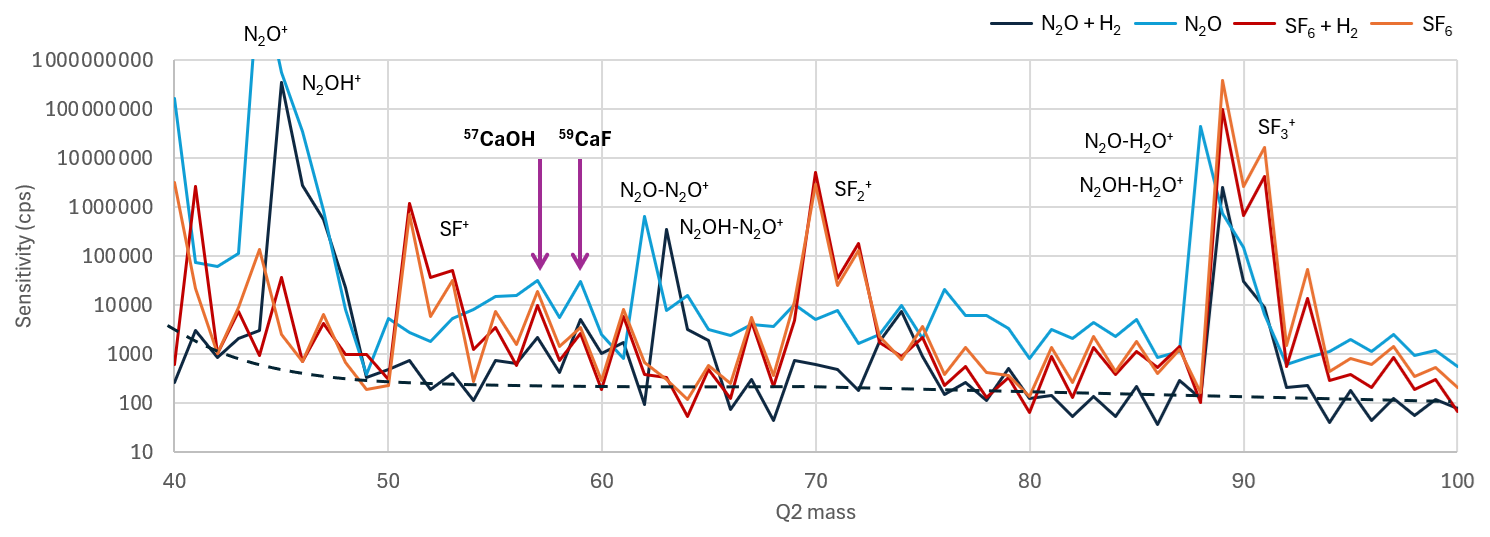
Figure 2Gas background product ion scans (no sample ablation) with Q1 = 40 amu using four different reaction gas mixtures: N2O only (light blue), N2O + H2 (dark blue), SF6 only (orange) and SF6 + H2 (red). The labelled high cps peaks represent the breakdown of the reaction gases themselves, and where Ca reaction products of interest would be measured at 57 and 59.
Secondly, N2O product ions, such as N2O-N2O+ and N2OH-N2O+, were detected on 62 and 63 but were not detected at other Q1 masses (Fig. 1). This is likely due to the high density of Ar+, reacting with and breaking down the reaction gasses. Thirdly, N2O and SF6 can attenuate Ar+ ions via charge transfer reactions, although less effectively than H2. The on-mass 40 amu measurement remains significant for reactions without H2 (c. 106 cps with SF6 and c. 108 cps with N2O; Fig. 2); however, this is lower compared to when no reaction gasses are used (above the maximum 8×10¹⁰ cps). As predicted, the addition of H2 to both SF6 and N2O reduced the detectable 40 amu to <1000 cps. Fourthly, a high gas background was observed on all Q2 masses when Q1 was set to 40 amu, indicated with the dashed line in Fig. 2. The addition of H2 to SF6 had little effect on this background (red and orange lines, Fig. 2), whereas its addition to N2O significantly reduced the background (light and dark blue lines, Fig. 2). Therefore, the high background is likely to be caused by the presence of Ar+ ions, as opposed to the reactive H+ ions generated from the Ar-H2 charge transfer reaction. This background can be significant at the CaF and CaOH reaction product masses, 57 and 59 amu (highest values > 104 cps in the example below), and subsequent testing detailed below aimed to optimise the reaction gas flow rates to minimise this background. Ultimately, sensitivity is a function of signal to background ratio, thus background signals need to be carefully monitored prior to analysis.
The reaction gas flow rates and proportions between the gases (SF6, N2O and H2) were systematically varied to determine their effect on 40+XCa reaction products. Count rates on (Q1 = 40, Q2 = 57) and 59 (Q1 = 40, Q2 = 59) were measured in the gas background and when ablating NIST610 to produce CaOH and CaF reaction products. The signal to background ratios were compared to determine the optimal flow rates for each reaction gas (Fig. 3).
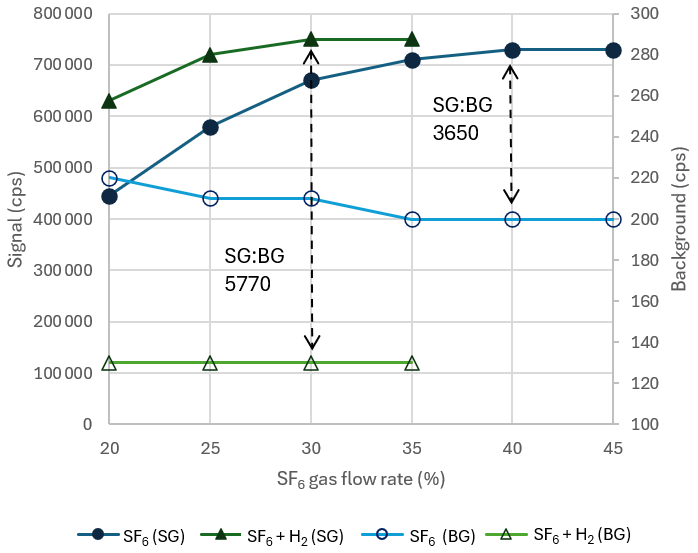
Figure 3Signal (SG) and background (BG) cps at 59 (CaF) for the optimisation of SF6 gas flow rate. Units in % of total flow of the mass flow controller, where 30 % is a flow of 0.57 mL min−1 and 40 % is 0.77 mL min−1. Experiment 1 (blue symbols) is SF6 gas only and experiment 2 (green symbols) is SF6 with 2 mL min−1 H2.
As the SF6 flow rate was increased from an initial rate of 20 % (0.38 mL min−1), the sensitivity of CaF increased to a plateau at 30 % for SF6 + H2 (0.57 mL min−1 SF6, 2 mL min−1 H2) and 40 % for SF6 only (0.77 mL min−1), while the background decreased slightly or was stable (Fig. 3). These sensitivity plateaus occur at the flow rates that give the maximum reaction efficiency. Higher gas flow rates eventually attenuate the signal due to increased collisions in the cell. While the addition of SF6 only can resolve the Ar interference on 40Ca (no 40ArF reaction), the SF6 + H2 mixture results in slightly higher sensitivity for 40Ca19F and, more importantly, a significantly lower background (signal to background ratio increases from 3650 to 5770, Fig. 3).
Signal and background data was collected for a range of N2O flow rates, from 0.16 to 0.32 mL min−1 (15 %–30 %) using 7 mL min−1 H2 (Fig. 4a). The sensitivity dropped with increasing N2O flow rate, resulting in a lower signal to background ratio. The same relationship was observed when using higher H2 flow rates (e.g. 10 mL min−1). Figure 4b presents cps data using 0.16 mL min−1 N2O (15 %) and varying the H2 flow from 5–10 mL min−1 (with 10 mL min−1 being the highest flow rate achievable on the mass-flow controller). Signal sensitivity and background both decreased with increasing H2 gas flow, however, the highest signal to background ratio was achieved using a maximum of 10 mL min−1 H2. The higher H2 gas flow rates not only effect 40Ca sensitivity, but they also effect the sensitivity of the minor 44Ca, where higher sensitivity is beneficial to improve overall uncertainty of the measured ratios. The two conditions of 0.16 mL min−1 N2O and 7 mL min−1 H2 (N2O + low H2), and 0.16 mL min−1 N2O and 10 mL min−1 H2 (N2O + high H2), were used for further testing of mineral samples. The 7 mL min−1 H2 flow rate is a compromise in signal to background ratios, while maintaining higher signal sensitivity.
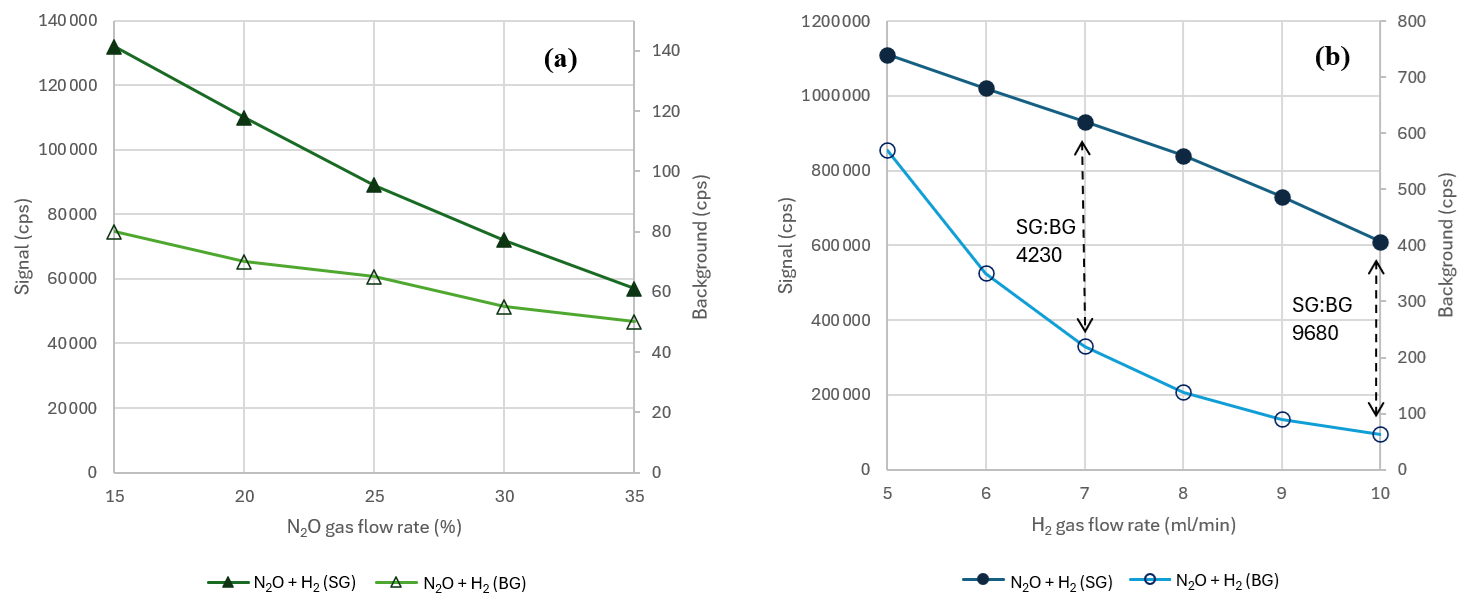
Figure 4Signal (SG) and background (BG) cps at 57 (CaOH) for the optimisation of N2O and H2 gas flow rates. (a) Using 7 mL min−1 H2 and varying the N2O flow from 15 % to 30 % (0.16 to 0.32 mL min−1). (b) Using 15 % N2O (0.16 mL min−1) and varying the H2 flow from 5–10 mL min−1.
3.4 Calibration strategies
Isotopic ratios were calibrated using a glass reference material, manufactured at the Institute for Photonics and Advanced Sensing, Adelaide University. The glasses were made from SiO2-Na2O-(BaO)-MgO matrix doped with known quantities of K, Ca, Sr and Rb (referred to as SNBM-1 and SNM-1). The raw materials were ball-milled for 1 h to achieve thorough mixing and then loaded into a platinum crucible. The batch materials were melted at 1500 °C for 2 h and cast into a brass mould. On the following day, the sample was annealed at 520 °C for 2 h to relieve internal stress. To improve the homogeneity of the glass, the initial glass was powdered and re-melted at 1500 °C for 2 h, followed by the same casting and annealing steps as before.
The synthetic glasses were used in preference to the more commonly used high-Ca glasses: NIST SRM 610 (8.15 wt % Ca) and BCR-2G (5.05 wt % Ca), to avoid Ca contamination from remobilisation of previously ablated material in the interface tubing (i.e. false signal). The manufactured glasses also enabled customisation of the K, Rb, Sr and Ca concentrations to match the electron multiplier detector modes (pulse or analog counting) between reference materials and samples.
Initial testing used the SNBM-1 glass with a SiO2-Na2O-BaO-MgO matrix doped with 2000 ppm K and Rb, and 500 ppm Ca and Sr (data Tables S3, S4, S6 and S8). However, ablating this glass with 100 µm spot size and 5 Hz repetition rate resulted in 40+XCa being measured in analog mode, while the samples were all in pulse mode. Note that 44+XCa was always measured in pulse mode because the natural abundance ratio between 44Ca and 40Ca is c.47:1. Reducing the laser beam size or repetition rate to lower the 40+XCa signal into pulse mode caused an unfavourable reduction in precision of the ratios for the mineral samples due to lower sensitivity of the minor 44+XCa isotope. The MDC phlogopite (519±6.5 Ma, Sri 0.72607; Hogmalm et al., 2017; Morteani et al., 2013; Redaa et al., 2021) was used as the mineral-matched reference material to correct for matrix-dependent mass bias on Sr and Ca (Glorie et al., 2024a) via Eqs. (1) and (2), respectively.
Where subscript S denoted the measured isotopic ratio of the sample corrected to SNBM-1 glass, TR is the reference age of MDC and TM is the raw measured date (Ma) calculated from the inverse isochron of the ratios corrected to SNBM-1 glass. Decay constants (λ) of and were used for the Rb-Sr and K-Ca systems, respectively (Renne et al., 2011; Villa et al., 2015). The correction to the matrix matched age reference material (MDC) was calculated in Excel.
The 40+XCa signal was collected in pulse mode in MDC, compared to analog in the SNBM-1 glass. As the 40+XCa in all other samples were measured in pulse mode, correcting the Ca ratios to MDC also incorporated a pulse-analog component to the correction. The pulse and analog detector modes have been observed to drift relative to each other in some Rb-Sr sessions (Glorie et al., 2024a). To assess this, the SNBM-1 glass (analog) and MDC phlogopite (pulse) were both measured every 20–30 analyses throughout each analytical session. After correction to the SNBM-1 glass, no residual time-dependent drift was apparent in the MDC isochrons (see data tables in the Supplement).
The Kola phlogopite was used to calculate a pulse-analog correction for Ca using the offset between the calculated, unanchored Ca intercept and the expected ratio of 47.15±0.02 (Russell et al., 1978). Kola was used in preference to MDC for the pulse-analog correction for Ca as it gave higher variability in measured Ca ratios between analyses, leading to more robust isochron regression and calculated initial Ca ratio. For the initial method validation, the pulse-analog correction was robust enough for comparative testing to optimise the reaction gas flows; however, it is not recommended as a routine protocol due to differences in mass-bias drift between pulse and analog modes (Glorie et al., 2024b).
A second glass, SNM-1, was made to address the pulse-analog issues identified in the initial testing. It had a SiO2-Na2O-MgO matrix doped with 2000 ppm K, 1000 ppm Rb, 100 ppm Ca and 500 ppm Sr. These concentrations were chosen such that 39K and 85Rb were measured in analog detector mode and 40+XCa and 87+XSr were measured in pulse mode at 100 µm spot size. This second glass better matched the detector mode in the samples to avoid the need for additional pulse-analog correction and is recommended for all future analyses. Analyses of the micas were repeated with the two most promising reaction gas mixtures (SF6 + H2 and N2O + low H2, data Tables S5 and S7) using the SNM-1 glass to validate the initial data sets without requiring an additional pulse-analog correction.
The synthetic glasses were used to correct for instrument drift, down-hole fractionation and matrix independent mass-bias using the LADR data processing software (Norris and Danyushevsky, 2018). The reference values used for normalisation of the measured isotopic ratios for both glasses were calculated from the nominal concentrations, assuming natural isotopic abundances and molar proportions.
All uncertainties are reported at the 95 % confidence interval. The individual measurement uncertainties include the excess scatter of the ratios measured in the glass reference material as calculated in LADR. The MDC age correction factor was applied to the measured Sr and Ca ratios, and the calculated MDC age uncertainty (typically ∼2 % for K–Ca and ∼1 % for Rb–Sr) was propagated onto the uncertainty of the sample isochron dates. The long-term reproducibility of Rb–Sr dates at the Adelaide Microscopy isotope facility is ∼1.5 %, which is similar to 1.6 % reported in Olierook et al. (2026), and 1.4 % in Rösel and Zack (2022). This additional systematic uncertainty was propagated onto the final dates: 1.5 % for Rb-Sr and a more conservative 2 % for K–Ca as a realistic estimate, in the absence of long-term data.
Either the SNBM-1 or SNB-1 glass was used as the primary refence material for Sr ratios without further correction, as isotopic ratios of the same element are not subject to matrix-dependent fractionation (Redaa et al., 2021; Gorojovsky and Alard, 2020) and all Sr isotope measurements were in pulse detector mode.
3.5 Data treatment
The low-Ca glasses (SNBM-1 and SNM-1) were used in preference to high-Ca NIST610, to minimise the potential for carry over of Ca between reference glasses and samples. However, contamination was still seen in some ablation signals either from the remobilisation of previously ablated material (predominantly affecting the lower sensitivity isotope 44Ca) or surface contamination on the samples (predominantly affecting 40Ca, the most abundant common Ca isotope). This was especially apparent in low-Ca micas and for the initial data sets. To remove surface contamination, the samples were repolished and cleaned using distilled water, and 5–10 pre-ablation shots were used to clean the surface prior to sample ablation. During data processing signals were cropped where possible to avoid Ca spikes and surface contamination. Outlier analyses with high 44Ca giving a young age bias, were excluded from the isochrons. These contamination issues were most prevalent in the initial data sets (Tables S4 and S6) and minimised in the later after sample cleaning (Tables S5 and S7). Example ablation signals are provided in Supplement Figures.
A relatively long counting time was used for the low abundance 44Ca, to reduce the impact of high uncertainty at low count rates (cps): 100 ms, where the minimum detectable 1 count equates to 10 cps. The signals were also cropped during data processing to avoid any zeros in the 44Ca signals to ensure accurate uncertainty calculations. Average background subtracted signal sensitivities (cps) are provided in Supplement Data tables.
All data were plotted as inverse isochrons (plotting parent/daughter versus stable/daughter isotope ratios) to minimise uncertainty correlations and improve data visualisation (Li and Vermeesch, 2021), using isoplotR (Vermeesch, 2018). The Sr initial ratios used for plotting sample isochrons were either obtained from the literature when known (Table 1) or an assumed value based on the recommendations by Rösel and Zack (2022). A Ca initial value of 47.15±0.02 was used for plotting all K-Ca isochrons, as the range of naturally occurring Ca isotopic ratios can be considered invariant within the uncertainty of the LA-ICP-MS/MS measurements (Russell et al., 1978). This is a significant benefit of the K–Ca method because it allows direct calculation of dates for every analysis without a need to assume initial ratios.
4.1 Down Hole Fractionation
Both and isotope ratio pairs have contrasting element volatilities with Rb and K being the more volatile (Jackson, 2008). Hence, down-hole fractionation (DHF) between the elements during ablation is likely and has been described elsewhere for (Gorojovsky and Alard, 2020; Redaa et al., 2021; Glorie et al., 2024a). The DHF effects were minimised in this study by using a relatively large laser spot size (100 µm) and 5 Hz repetition rate to reduce the depth to diameter ratio of the crater. Nevertheless, DHF was still observed for both isotope pairs (Fig. 5).
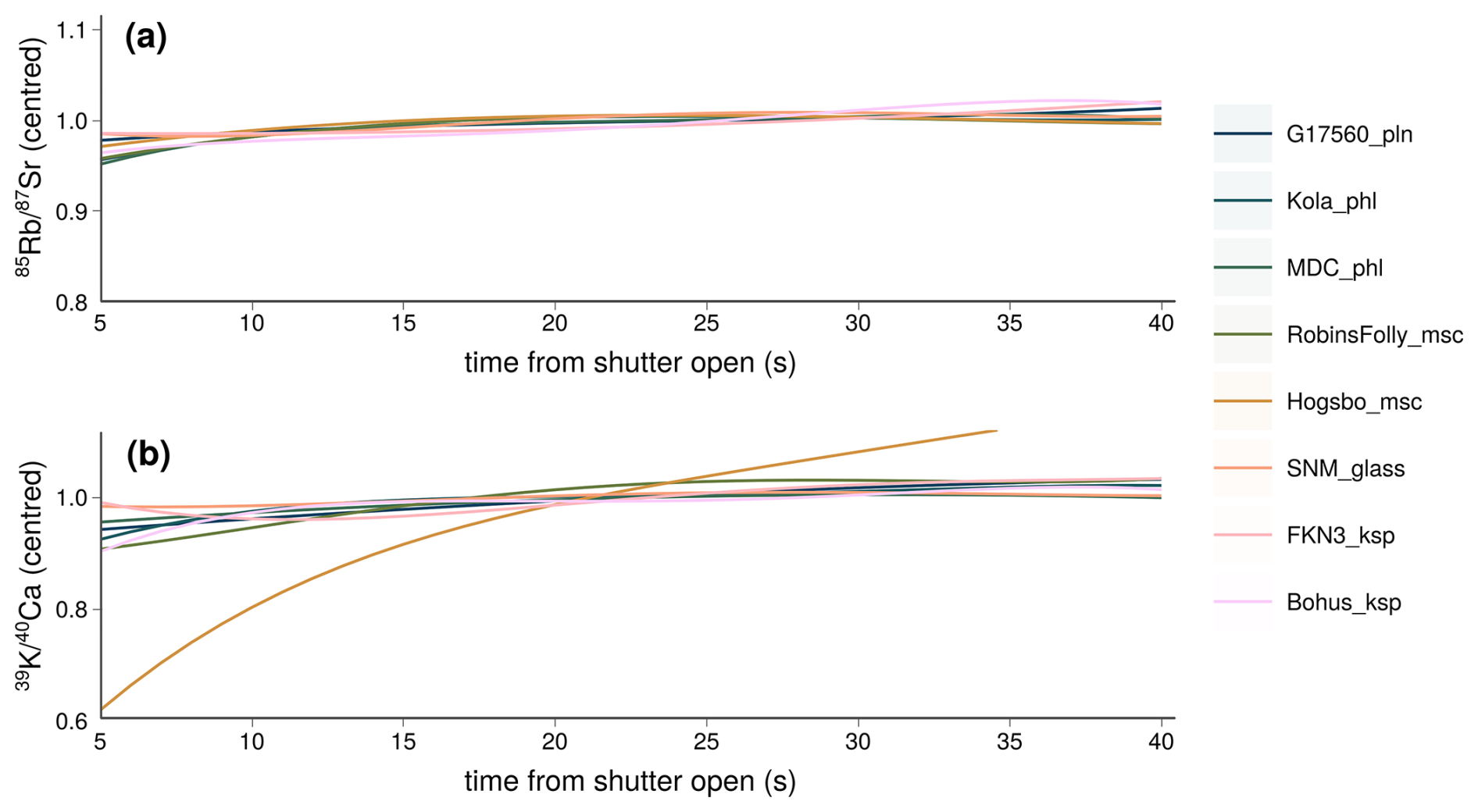
Figure 5Down hole fractionation curves for (a) Sr and (b) Ca ratios in the SNM-1 glass, micas and feldspars, starting 5 s after the start of ablation (signal has stabilised by this time). Each line represents an average of between 10–30 individual signals, excluding those displaying the most variable common Ca signals. Contributing individual signals are centred to a value of 1.0 so that the effects of mass bias and drift are removed as per Lloyd et al. (2025). Shaded regions are the model uncertainties at 95 % confidence intervals; however, they are typically less than the width of the plotted lines at this scale. Note the y-axis scales in (a) and (b) are different to exaggerate the curves and aid visual interpretation. Polylithionite (pln), phlogopite (phl), muscovite (msc), K-feldspar (ksp).
For there is very little difference in DHF between the materials after the first 10 s of ablation, with the exception of Bohus feldspar which shows a more variable average signal curve during the ablation (Fig. 5a, Table S9; Lloyd et al., 2025). The relative differences between materials are more pronounced for ratios, especially during the first 10 s of ablation (Fig. 5b), with up to 10 % DHF, compared to 5 % for . The SNM glass, MDC, G17560 and Kola micas all have relatively flat ratios which is likely to be representative of laser induced DHF. The more variable profiles primarily reflect variations in common Ca rather than differences in ablation behaviour. This was most pronounced for feldspar, where the fewest number of signals were averaged due to naturally heterogeneous common Ca within the ablation volume of the feldspars, producing more variable average . The main outlier is Högsbo, for which the steeper curve is attributed to minor common Ca contamination on the surface, which potentially penetrated along cleaves into the subsurface. Despite 7 pre-ablation shots, the common Ca signal was highest at the start of each ablation before decaying to a stable level. When pre-ablation shots were recorded, the Ca signal was significantly higher than during the main ablation, compared to major elements which had similar sensitivity, indicating surface contamination of Ca. For both causes of variable common Ca, the most stable part of the signal was selected to calculate dates, although the whole signals are used to generate the ratio curves in Fig. 5. Typically, the first 10 s of ablation was not included in the signal selection to avoid common Ca contamination and to minimise DHF differences between matrices (see Supplement Figures).
The SNM-01 glass was used to correct for DHF in the other materials. The average curve for SNM-01 is slightly flatter compared to the micas (Fig. 5), which is likely to under-correct the minerals. However, no residual slope was observed on individual analysis ratios for the minerals within the noise of the signals, and any residual bias is assumed to be corrected as a component of the matrix-match mineral age correction (to MDC phlogopite). In the current absence of data processing software which can use isochronous mineral-matched reference materials to correct DHF directly, the suitability of SNM-01 as a DHF correction material is evaluated in this study. Differences in ablation characteristics between minerals (especially between the MDC mineral-matched reference material and K-feldspars) are likely to become more apparent at smaller spot sizes due to increased differences in DHF curves between matrices.
4.2 K–Ca and Rb–Sr dates of micas and feldspar
4.2.1 Reaction gas optimisation – micas
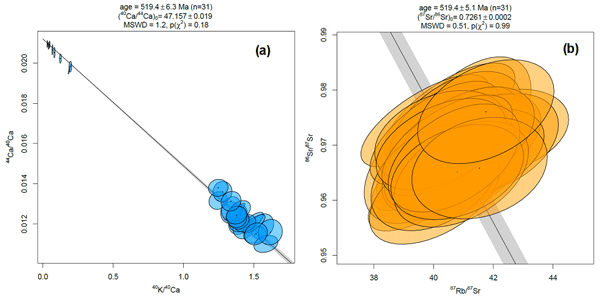
The MDC phlogopite was used as the matrix-matched reference material for all other samples analysed. Typical isochrons are shown in Fig. 6 for K–Ca and Rb–Sr (see Supplement Tables S3–8 for isochrons for all gas mixtures). There was a much larger spread in Ca ratios compared to Sr, despite the data points being collected from the same ablation volumes. The bimodal distribution of the Ca ratios correlates with location on the MDC crystal. It reflects common-Ca heterogeneity within the mica, while the common-Sr is relatively homogeneous (Table 1). Therefore, the natural variation in minor common 44Ca and 86Sr is poorly correlated in this phlogopite which suggests that they can substitute differently into the mica structure in contrast to Rb which readily substitutes for K in the I-site in the general mineral formula for micas IMT4O10A2 (Rieder et al., 1998). The Ca will also substitute into the high coordination (often 12-fold) interlayer I-site along with K, Na and Rb. However, Sr has a preference for the 8-fold M-site (with Mg, Fe, Mn, Li etc.) but due to its large ionic radius will often be forced in the I-site (Harrison and Lovera, 2014; Tischendorf et al., 2007; Zhao et al., 2025). The MDC signals with the highest Ca ratios had stable signals throughout the ablation, indicating 44Ca is most likely incorporated within the mineral structure, rather than being a product from Ca-bearing mineral micro-inclusions. If Ca and Sr can be hosted differently in the mineral structure, this supports the theory that Ca and Sr can diffuse and be reset under different conditions, leading to potential de-coupling between the Rb–Sr and K–Ca apparent dates (Fletcher et al., 1997).
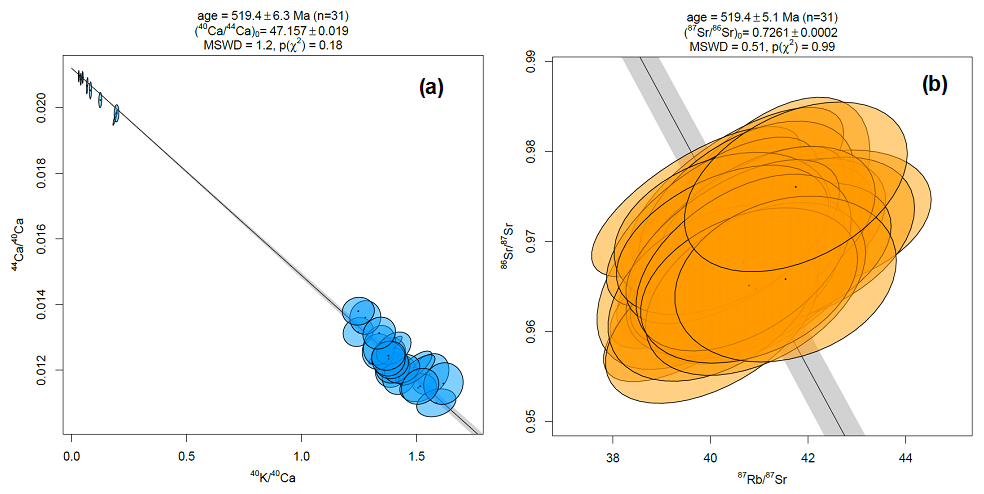
Figure 6Representative K–Ca (a) and Rb–Sr (b) isochrons for MDC using SF6 + H2 reaction gasses. Dates are matrix-offset corrected to MDC itself; thus, they are equivalent to the reference age. Date uncertainties are analytical only, and this was propagated onto the date uncertainties of the other samples.
Robins Folly biotite and Högsbo muscovite give accurate dates within uncertainty for both Rb–Sr and K–Ca using three different reaction gas mixtures (Fig. 7, Table S2). The exception is N2O + high H2, which gave a K–Ca date for Robins Folly that is >5 % too old. The agreement between the K–Ca and Rb–Sr dates for these micas demonstrates that phlogopite (MDC) is a suitable matrix matched reference material for muscovite, within the uncertainty of the technique. It further demonstrates that the choice of reaction gas, SF6 or N2O, has little effect on the accuracy. The least consistency between isotope systems was obtained when using a N2O + high H2 flow. The highest sensitivity and highest signal to background ratio was achieved for reacted 40Ca with SF6 + H2 (Figs. 3, 8). The highest Sr sensitivity was achieved using either SF6 + H2 and N2O + low H2. Using SF6 only, or too high H2 flow rate with N2O, results in significantly lower sensitivity. The enhanced sensitivity with SF6 + H2 is considered advantageous for producing the best theoretical precision of individual isotope ratio measurements due to improved counting statistics on the lowest abundance isotope 44Ca.
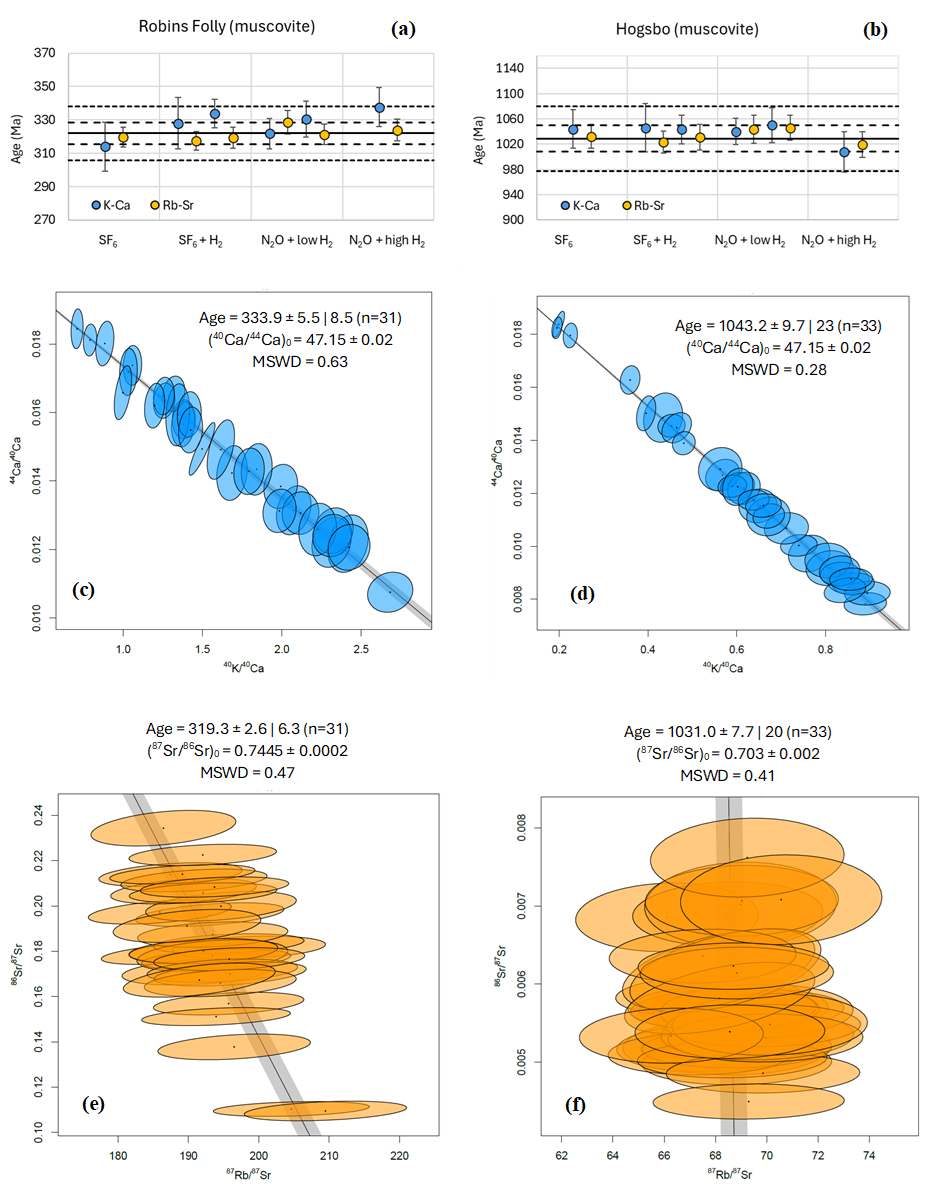
Figure 7(a, b) Comparison in calculated K–Ca and Rb–Sr dates between the four reaction gas experiments for Robins Folly and Högsbo muscovites. Uncertainty bars represent 2SE propagated uncertainties. The solid horizontal line represents expected age, long and short dashed horizontal lines are ±2 % and 5 % uncertainty of the expected age, respectively. Indicative K–Ca (c, d) and Rb–Sr (e, f) isochrons using SF6 + H2 reaction gas, with matrix matched age correction to MDC phlogopite. Analytical and total systematic age uncertainties are both reported with the isochrons (x|y).
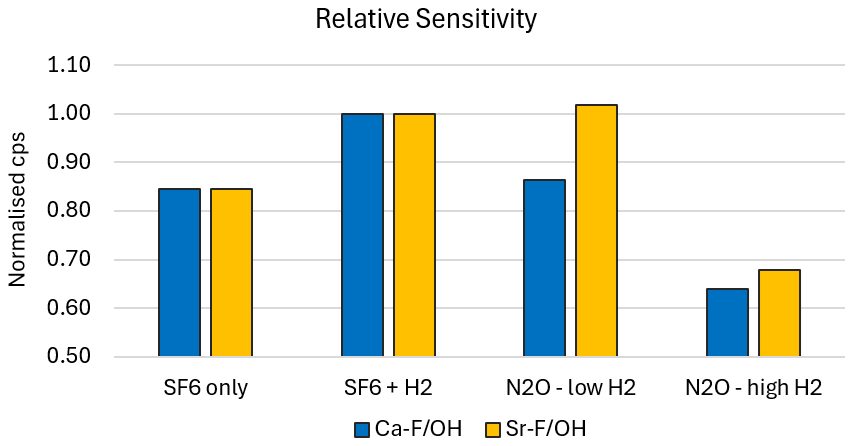
Figure 8Sensitivity of 40Ca19F or 40Ca17OH, and 88Sr19F or 88Sr17OH, measured on SNMB-1 glass, plotted relative to the SF6 + H2 reaction gas mixture.
The Rb–Sr dates for Kola are slightly older than expected, but within 3 % when using SF6 with or without H2 (Fig. 9a). However, the K-Ca ages for Kola, corrected to MDC, are highly variable with poor reproducibility between repeat sessions with both SF6 and N2O reaction gases, and apparent dates tending up to ca. 6 % older than Rb–Sr dates (Fig. 9a). Likewise, G17560 K–Ca dates also show poor reproducibility (Fig. 10a), but with almost identical relative offsets as Kola. When G17560 is corrected against Kola, rather than MDC (Fig. 10b), the measured K–Ca dates are consistent within uncertainty for all reaction gas combinations tested, and K–Ca dates are slightly younger than the Rb–Sr dates. These two micas have the lowest common Ca of the micas analysed (<5 ppm), suggesting a potential bias or interference effecting the low abundance 44Ca. Increasing the dwell time further for 44Ca for future analyses may help to improve counting statistics and bias at low levels. This suggests that matching the Ca concentration between the matrix-matched correction material and the samples is important for low Ca micas.
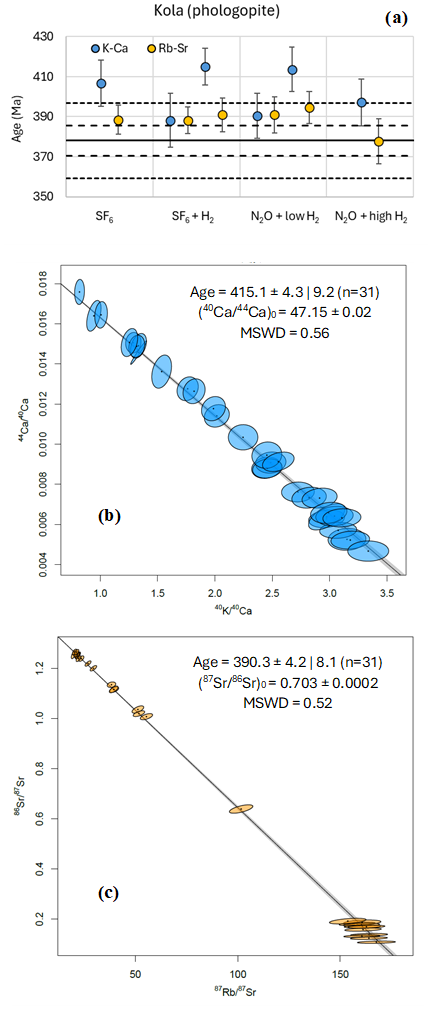
Figure 9(a) Comparison in calculated K–Ca and Rb–Sr dates between the four reaction gas experiments for Kola phlogopite. Uncertainty bars represent 2SE propagated uncertainties. Solid horizontal line represents expected age, long and short dashed horizontal lines are ±2 % and 5 % uncertainty of the expected age, respectively. Indicative K–Ca (b) and Rb–Sr (c) isochrons using SF6 + H2 reaction gas, with matrix matched age correction to MDC phlogopite. Analytical and total systematic age uncertainties are reported with the isochrons (x|y).
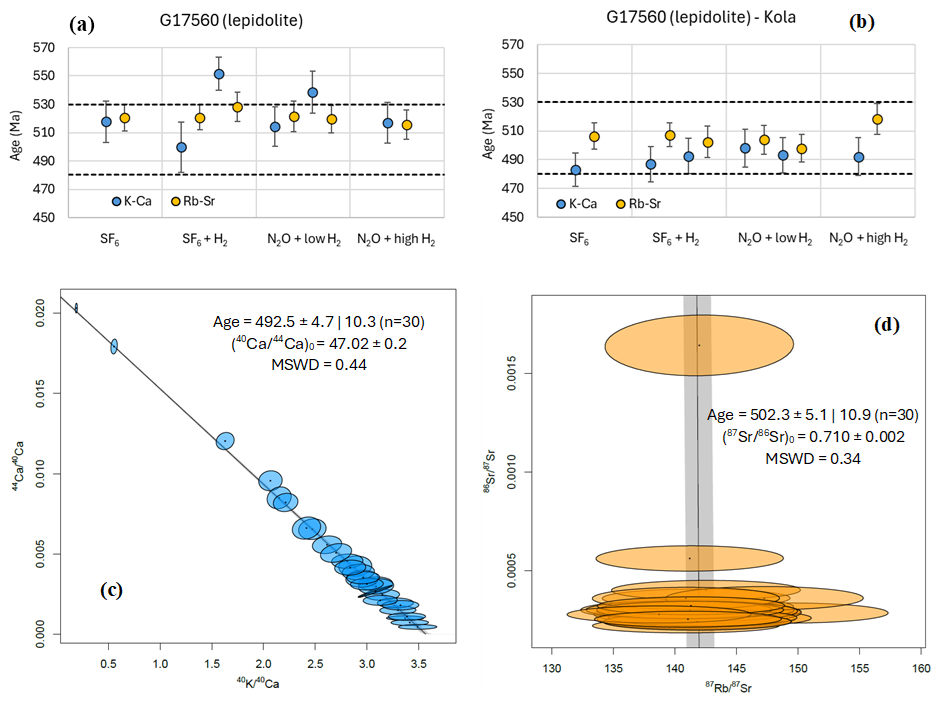
Figure 10(a, b) Comparison in calculated K–Ca and Rb–Sr dates between the four reaction gas experiments for G17560 polylithionite normalised to MDC (a) and Kola (b). Uncertainty bars represent 2SE propagated uncertainties. Dashed horizontal lines indicate the expected age range from the region. Indicative K–Ca (c) and Rb–Sr (d) isochrons using SF6 + H2 reaction gas, with matrix matched age correction to Kola phlogopite. Analytical and total systematic age uncertainties are reported with the isochrons (x|y).
4.2.2 Feldspars
The Bohus and FK-N feldspars were analysed using SF6 + H2 and N2O + low H2 reaction gas mixtures (Fig. 11). The MDC-corrected Rb–Sr and K–Ca dates are accurate within uncertainty for Bohus feldspar (921±35 Ma and 924±66 Ma, respectively using SF6 + H2), indicating no significant matrix bias between mica and felspars under the laser conditions used. In contrast, the K–Ca dates for FK-N were systematically younger than the Rb–Sr dates despite the large uncertainties (437±38 Ma and 515±22 Ma, respectively using SF6 + H2), indicating decoupling between the isotope systems. This younger K–Ca date could represent hydrothermal events recorded in the region (458–422 Ma, rutile U-Pb ages; Amal Dev and Tomson, 2024) while the Rb–Sr date can be interpreted as a cooling age after the original emplacement of the granites during the late stages of the Pan African Orogeny (870–550 Ma; Kröner and Stern, 2005).
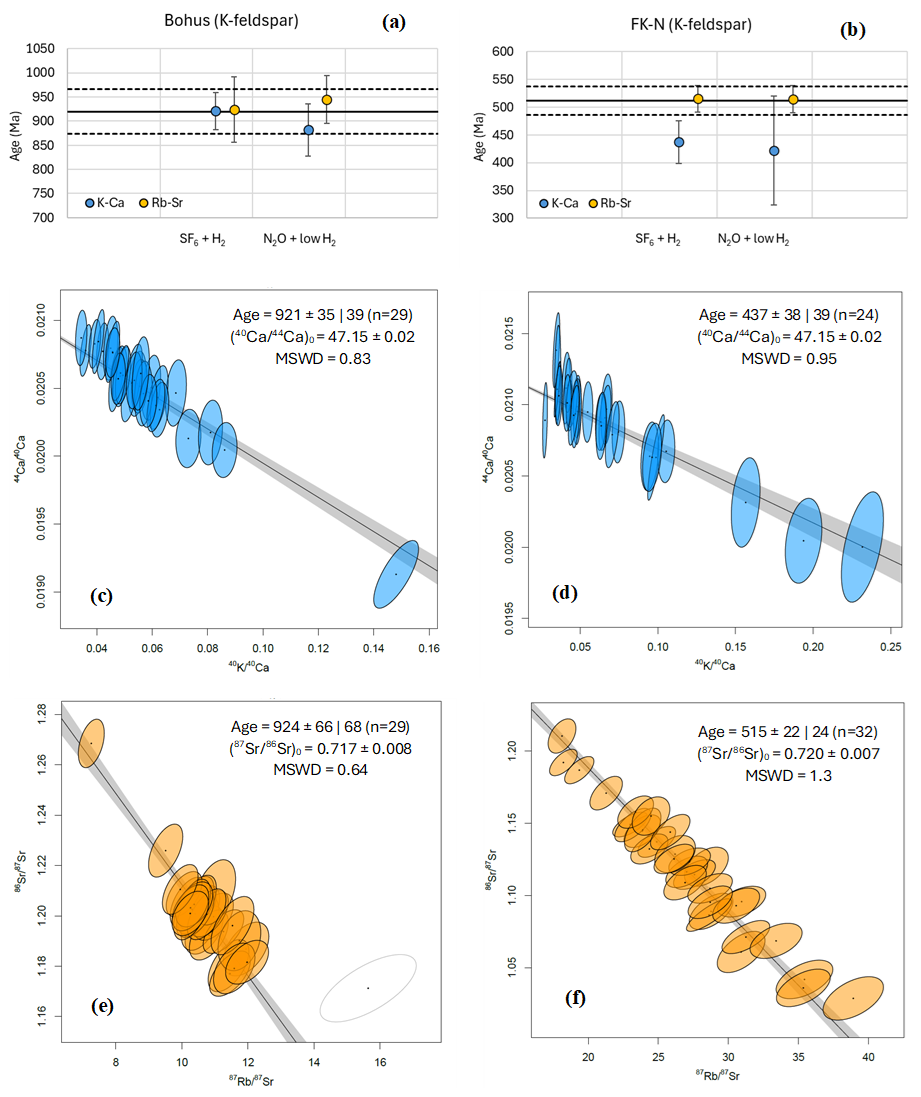
Figure 11(a, b) Comparison in calculated K–Ca and Rb–Sr dates between the SF6 + H2 and N2O + low H2 reaction gas experiments for Bohus and FK-N feldspars. Uncertainty bars represent 2SE propagated uncertainties. Solid horizontal line represents expected age, dashed horizontal lines are ±5 % of expected age. Indicative K–Ca (c, d) and Rb–Sr (e, f) isochrons using SF6 + H2 reaction gas, with matrix matched age correction to MDC phlogopite. Analytical and total systematic age uncertainties are reported with the isochrons (x|y).
For both feldspars, the K–Ca date uncertainties are generally larger than the corresponding Rb–Sr date, due to the K–Ca system being less radiogenic (Fig. 11). Compared to the micas analysed, the feldspars are also significantly less radiogenic for both K–Ca and Rb–Sr. Multiple grains of FK-N and Bohus were mounted and tested for Ca concentration prior to analysis, and the lowest Ca grain was used for K-Ca measurements. These feldspars were selected due to their relatively low common Ca content (∼300 ppm). Feldspars with higher Ca would be more challenging to analyse within 5 % analytical precision on a quadrupole ICP-MS/MS, and a MC-ICP-MS/MS may be advantageous for more precise Ca measurements.
4.3 Current Limitations and Future Direction
The accuracy of the current technique is limited by the reference K–Ca age of the matrix matched reference material. In this study, we assume MDC has the same K–Ca age as reported for Rb–Sr. This proves to be valid in accurately reproducing the ages of Robins Folly and Högsbo muscovites within 2 %–3 % uncertainty. However, independent validation of the K–Ca age would be required for the technique to develop further and to assess accuracy within 1 %–2 % uncertainty, comparable to the in-situ Rb–Sr method. Recent work by Olierook et al. (2026) has provided new Ar–Ar and Rb–Sr dates for a range of commonly used mica reference materials, and further characterisation of these micas for K–Ca would also be beneficial to the analytical community.
The low concentrations of common Ca, typical in micas, mean the analyses can be easily compromised by Ca contamination. This can occur via remobilisation of previously ablated particulates in the interface tubing, especially after ablation of high Ca glasses such as NIST SRM 610 and BCR-2G, or from surface contamination during sample preparation and polishing. The impact of contamination was minimised by using 5–10 pre-ablation shots prior to the main analysis, and by cleaning the samples with distilled water in an ultra-sonic bath to remove particulates inside past ablation craters and/or crystal defects. The effects of contamination can be seen as spiky signals, especially for the minor 44Ca, which leads to a young age bias in contaminated data points (higher Ca ratios). It may also, in part, explain the poor reproducibility of K–Ca dates between sessions (using the same reaction gas) for the highly radiogenic micas Kola and G17560 (<5 ppm common Ca). Hence, sample cleaning and pre-ablation are paramount for accurate K–Ca dates.
There is also an upper limit of allowable Ca concentrations to resolve the amount of radiogenic 40Ca ingrowth from the common Ca. For FK-N feldspar, which is approximately 500 Ma and contains ∼300 ppm total K, the measured 40Ca was only 1–5 % radiogenic (Ca = 0.02015–0.02099). Analysis using MC-ICP-MS/MS would improve the uncertainty on the Ca ratio, enabling improved age precision and/or the ability to date younger Ca-bearing minerals such as feldspars. However, analysing both Rb–Sr and K–Ca simultaneously is currently only possible on a quadrupole ICP-MS/MS. An additional consideration is the pulse-analog transition of the electron multiplier detectors, which in this study was ∼2.7 Mcps, equivalent to ∼300 ppm total Ca.
One of the major advantages of quadrupole ICP-MS/MS is the ability to measure a wide range of isotopic masses in one analysis, enabling simultaneous Rb–Sr, K–Ca and trace element analyses. However, when using SF6 as the reaction gas, there are some limitations as to the additional trace element isotopes than can be measured due to isobaric interferences from reaction gas breakdown products. Specifically causing high backgrounds of: SF on 51V, 52Cr and 53Cr, and SF3 on 89Y, 90Zr and 91Zr. As these interferences are created within the reaction cell, they cannot be avoided. Thus, care is needed for isotope selection and interpretation of trace element data when using SF6as reaction gas.
This study compared SF6 and N2O combined with H2 as reaction gasses for simultaneous Rb–Sr and K–Ca analysis in micas and feldspars. Both Sr and Ca react efficiently to form either F or OH reaction products, enabling analysis free from parent isotope isobaric interference (40K and 87Rb). The addition of H2 is highly efficient in minimising the contribution from 40Ar and reducing the backgrounds created from the high ion load in the reaction cell when targeting 40. The gas combinations of SF6 only, SF6 plus H2 or N2O plus 7 mL min−1 H2 were found to produce accurate data for micas within 2 % and K-feldspars to within 5 %. However, the combination of SF6 plus H2 gave the highest sensitivity and best signal to noise ratio. This is advantageous for achieving the best precision, especially for young micas or those with low common-Ca concentration.
We show that the simultaneous dating using both K–Ca and Rb–Sr isotope systems is achievable from the same ablation volume for both mica and feldspars. This can be especially beneficial for small grains and/or detrital minerals where sample material is limited. Furthermore, in contrast to the initial Sr ratio, the initial Ca ratio is observed to be invariable over geological timescales. Thus, single spot K–Ca dates can be determined from anchored 2-point isochrons (similar to the Lu–Hf system), opening opportunities for detrital geochronology. Mineral dating via quadrupole LA-ICP-MS/MS is not only advantageous for simultaneous measurement of both isotope systems, but it is also best suited for low Ca-bearing phases (5–300 ppm). Analysing this concentration range compliments TIMS and MC-ICP-MS/MS techniques, which achieve higher precision for high Sr and Ca bearing, low radiogenic phases.
The potential for decoupling between the isotope systems has been demonstrated with the FK-N feldspar from the Madras region, where the younger K–Ca date is likely to represent regional hydrothermal alteration, compared to the Rb–Sr date which has retained the crystallisation age of the granite. This newly developed technique, where isotope decoupling can be identified, will have wide usage for understanding cooling and alteration processes in micas and feldspars, and increase knowledge of element diffusivity in these minerals.
All datasets from this study are included in the Supplement.
The supplement related to this article is available online at https://doi.org/10.5194/gchron-8-661-2026-supplement.
S. E. Gilbert: Conceptualisation, data curation, methodology, formal analysis, investigation, validation, visualisation, writing – original, writing – review and editing.
S. Glorie: Conceptualisation, methodology, formal analysis, investigation, writing – review and editing.
J. Lloyd: Conceptualisation, methodology, visualisation, writing – review and editing.
The contact author has declared that none of the authors has any competing interests.
Publisher's note: Copernicus Publications remains neutral with regard to jurisdictional claims made in the text, published maps, institutional affiliations, or any other geographical representation in this paper. The authors bear the ultimate responsibility for providing appropriate place names. Views expressed in the text are those of the authors and do not necessarily reflect the views of the publisher.
We acknowledge and pay respects to the Kaurna People, the traditional custodians whose ancestral lands Adelaide University is built on and where the research was conducted. The authors would like to acknowledge the technical expertise of the fibre optics manufacturing team at the Institute for Photonics and Advanced Sensing, Adelaide University, especially to Dr. Mingze Yang for producing the reference material glasses. Thank you to Thomas Zack and Delia Rösel for providing the Bohus and FK-N feldspar materials, and to both anonymous reviewers for their constructive feedback to improve the manuscript. Adelaide Microscopy, Adelaide University is a Microscopy Australia (ROR: 042mm0k03) facility enabled by NCRIS.
This project was funded by an Australian Research Council Discovery Project (grant no. DP260104272).
This paper was edited by Daniela Rubatto and reviewed by two anonymous referees.
Amal Dev, J. and Tomson, J. K.: U-Pb geochronology of rutiles from Southern granulite Terrane, India: Implications for the cooling and exhumation of East Gondwanan terranes, Precambrian Res., 407, https://doi.org/10.1016/j.precamres.2024.107408, 2024.
Amelin, Y. and Zaitsev, A. N.: Precise geochronology of phoscorites and carbonatites: The critical role of U-series disequilibrium in age interpretations, Geochim. Cosmochim. Ac., 66, 2399–2419, 2002.
Antonelli, M. A. and Simon, J. I.: Calcium isotopes in high-temperature terrestrial processes, Chem. Geol., 548, https://doi.org/10.1016/j.chemgeo.2020.119651, 2020.
Bayanova, T. B.: Baddeleyite: A Promising Geochronometer for Alkaline and Basic Magmatism, Petrology, 14, 187–200, 2006.
Brown, D. A., Simpson, A., Hand, M., Morrissey, L. J., Gilbert, S., Tamblyn, R., and Glorie, S.: Laser-ablation Lu-Hf dating reveals Laurentian garnet in subducted rocks from southern Australia, Geology, 50, 837–842, https://doi.org/10.1130/g49784.1, 2022.
Craig, G., Wehrs, H., Bevan, D. G., Pfeifer, M., Lewis, J., Coath, C. D., Elliott, T., Huang, C., Lloyd, N. S., and Schwieters, J. B.: Project Vienna: A Novel Precell Mass Filter for Collision/Reaction Cell MC-ICPMS/MS, Anal. Chem., 93, 10519–10527, https://doi.org/10.1021/acs.analchem.1c01475, 2021.
Dauphas, N., Hopp, T., Craig, G., Zhang, Z. J., Valdes, M. C., Heck, P. R., Charlier, B. L. A., Bell, E. A., Harrison, T. M., Davis, A. M., Dussubieux, L., Williams, P. R., Krawczynski, M. J., Bouman, C., Lloyd, N. S., Tollstrup, D., and Schwieters, J. B.: In situ 87Rb–87Sr analyses of terrestrial and extraterrestrial samples by LA-MC-ICP-MS/MS with double Wien filter and collision cell technologies, J. Anal. Atom. Spectrom., 37, 2420–2441, https://doi.org/10.1039/d2ja00135g, 2022.
DePaolo, D. J.: Calcium Isotopic Variations Produced by Biological, Kinetic, Radiogenic and Nucleosynthetic Processes, Rev. Mineral. Geochem., 55, 255–288, 2004.
Eiden, G. C., Barinaga, C. J., and Koppenaal, D. W.: Selective Removal of Plasma Matrix Ions in Plasma Source Mass Spectrometry, J. Anal. Atom. Spectrom., 11, 317–322, 1996.
Eliasson, T. and Schöberg, H.: U-Pb dating of the post-kinematic Sveconorwegian (Grenvillian) Bohus granite, SW Sweden: evidence of restitic zircon, Precambrian Res., 51, 337–350, 1991.
Farkaš, J.: Calcium Isotopes, in: Encyclopedia of Geochemistry, Encyclopedia of Earth Sciences Series, 1–6, https://doi.org/10.1007/978-3-319-39193-9_237-1, 2016.
Fletcher, I. R., McNaughton, N. J., Pidgeon, R. T., and Rosman, K. J. R.: Sequential closure of K–Ca and Rb–Sr isotopic systems in Archaean micas, Chem. Geol., 138, 289–301, 1997.
Gilbert, S. E., Danyushevsky, L. V., Rodemann, T., Shimizu, N., Gurenko, A., Meffre, S., Thomas, H., Large, R. R., and Death, D.: Optimisation of laser parameters for the analysis of sulphur isotopes in sulphide minerals by laser ablation ICP-MS, J. Anal. Atom. Spectrom., 29, 1042–1051, https://doi.org/10.1039/c4ja00011k, 2014.
Gilbert, S. E., Glorie, S., and Zack, T.: In situ beta decay dating by LA-ICP-MS/MS: applications, in: Methods and Applications of Geochronology, Elsevier, 243–295, ISBN 978-0-443-18803-9, https://doi.org/10.1016/B978-0-443-18803-9.00005-5, 2024.
Glorie, S., Mulder, J., Hand, M., Fabris, A., Simpson, A., and Gilbert, S.: Laser ablation (in situ) Lu-Hf dating of magmatic fluorite and hydrothermal fluorite-bearing veins, Geosci. Front., 14, 101629, https://doi.org/10.1016/j.gsf.2023.101629, 2023.
Glorie, S., Gilbert, S. E., Hand, M., and Lloyd, J. C.: Calibration methods for laser ablation Rb–Sr geochronology: comparisons and recommendation based on NIST glass and natural reference materials, Geochronology, 6, 21–36, https://doi.org/10.5194/gchron-6-21-2024, 2024a.
Glorie, S., Simpson, A., Gilbert, S. E., Hand, M., and Müller, A. B.: Testing the reproducibility of in situ LuHf dating using Lu-rich garnet from the Tørdal pegmatites, southern Norway, Chem. Geol., 653, 122038, https://doi.org/10.1016/j.chemgeo.2024.122038, 2024b.
Gopalan, K.: Conjunctive K–Ca and Rb–Sr dating of glauconites, Chem. Geol., 247, 119–123, https://doi.org/10.1016/j.chemgeo.2007.10.004, 2008.
Gorojovsky, L. and Alard, O.: Optimisation of laser and mass spectrometer parameters for the in-situ analysis of Rb/Sr ratios by LA-ICP-MS/MS, J. Anal. Atom. Spectrom., 35, 2322–2336, https://doi.org/10.1039/d0ja00308e, 2020.
Govindaraju, K.: Report (1968–1978) on Two Mica Reference Samples: Biotite Mica-Fe and Phlogopite Mica-Mg, Geostandard. Newslett., 3, 3–24, 1979.
Govindaraju, K.: Report (1973–1984) on Two ANRT Geochemical Reference Samples: Granite GS-N and Potash Feldspar FK-N, Geostandard. Newslett., 8, 173–206, 1984.
Govindaraju, K.: Working values with confidence limits for twenty-six CRPG, ANRT and IWG-GIT geostandards, Geostandard. Newslett., 19, 1–32, 1995.
Harrison, T. M. and Lovera, O. M.: The multi-diffusion domain model: Past, present and future, in: Advances in 40Ar/39Ar Dating: From Archaeology to Planetary Sciences, edited by: Jourdan, F., Mark, D. F., and Verati, C., Geological Society, London, 91–106, ISBN 978-1862393608, https://doi.org/10.1144/SP378, 2014.
Heuser, A., Eisenhauer, A., Gussone, N., Bock, B., Hansen, B. T., and Hagler, T. F.: Measurement of calcium isotopes (δ44Ca) using a multicollector TIMS technique, Int. J. Mass Spectrom., 220, 385–397, 2002.
Hogmalm, K. J., Zack, T., Karlsson, A. K. O., Sjöqvist, A. S. L., and Garbe-Schönberg, D.: In situ Rb–Sr and K–Ca dating by LA-ICP-MS/MS: an evaluation of N2O and SF6 as reaction gases, J. Anal. Atom. Spectrom., 32, 305–313, https://doi.org/10.1039/c6ja00362a, 2017.
Hogmalm, K. J., Dahlgren, I., Fridolfsson, I., and Zack, T.: First in situ Re-Os dating of molybdenite by LA-ICP-MS/MS, Miner. Deposita, 54, 821–828, https://doi.org/10.1007/s00126-019-00889-1, 2019.
Jackson, S. E.: Calibration strategies for elemental analysis by LA-ICP-MS, in: Mineralogical Association of Canada Short Course, Vancouver, 169–188, ISBN 9780921294498, 2008.
Jegal, Y., Zimmermann, C., Reisberg, L., Yeghicheyan, D., Cloquet, C., Peiffert, C., Gerardin, M., Deloule, E., and Mercadier, J.: Characterisation of Reference Materials for in-situ Rb‐Sr dating by LA‐ICP‐MS/MS, Geostand. Geoanal. Res., 645–671, https://doi.org/10.1111/ggr.12456, 2022.
Jenkin, G. R. T.: Do cooling paths derived from mica Rb-Sr data reflect true cooling paths?, Geology, 25, 907, https://doi.org/10.1130/0091-7613(1997)025<0907:dcpdfm>2.3.co;2, 1997.
Krasnova, N. Y.: The Kovdor phlogopite deposit, Kola Peninsula, Russia, Can. Mineral., 39, 33–44, 2001.
Kröner, A. and Stern, R. J.: Pan-African Orogeny, in: Encyclopaedia of Geology, edited by: Selley, R. C., Cocks, L. R. M., and Plimer, I. R., Elsevier, 1–12, https://doi.org/10.1016/B0-12-369396-9/00431-7, 2005.
Larson, K. P., Shrestha, S., Button, M., Cottle, J. M., and Barnes, C. J.: The Effect of Crystal Orientation on In Situ Rb‐Sr Mica Geochronology, Geostand. Geoanal. Res., 49, 705–713, https://doi.org/10.1111/ggr.70005, 2025.
Laureijs, C. T., Coogan, L. A., and Spence, J.: In-situ Rb-Sr dating of celadonite from altered upper oceanic crust using laser ablation ICP-MS/MS, Chem. Geol., 579, 120339, https://doi.org/10.1016/j.chemgeo.2021.120339, 2021a.
Laureijs, C. T., Coogan, L. A., and Spence, J.: Regionally variable timing and duration of celadonite formation in the Troodos lavas (Cyprus) from Rb-Sr age distributions, Chem. Geol., 560, 119995, https://doi.org/10.1016/j.chemgeo.2020.119995, 2021b.
Li, S.-S., Santosh, M., Farkaš, J., Redaa, A., Ganguly, S., Kim, S. W., Zhang, C., Gilbert, S., and Zack, T.: Coupled U-Pb and Rb-Sr laser ablation geochronology trace Archean to Proterozoic crustal evolution in the Dharwar Craton, India, Precambrian Res., 343, 105709, https://doi.org/10.1016/j.precamres.2020.105709, 2020.
Li, Y. and Vermeesch, P.: Short communication: Inverse isochron regression for Re–Os, K–Ca and other chronometers, Geochronology, 3, 415–420, 2021.
Liebmann, J., Kirkland, C. L., Kelsey, D. E., Korhonen, F. J., and Rankenburg, K.: Lithological fabric as a proxy for Rb–Sr isotopic complexity, Chem. Geol., 608, https://doi.org/10.1016/j.chemgeo.2022.121041, 2022.
Lloyd, J. C., Spandler, C., Gilbert, S. E., and Hasterok, D.: The quantification of down-hole fractionation for laser ablation mass spectrometry, Geochronology, 7, 265–287, https://doi.org/10.5194/gchron-7-265-2025, 2025.
Loyola, C., Farkaš, J., Collins, A. S., Gilbert, S. E., Verdel, C., Löhr, S. C., Brock, G. A., Shields, G. A., Baldermann, A., Redaa, A., Blades, M., Subarkah, D., Bishop, C., Giles, S. M., Christie-Blick, N., and Haines, P. W.: In situ Rb–Sr dating and REE analysis of glauconites and detrital feldspars from the Ediacaran/Cambrian strata: Centralian and Adelaide Superbasins, Australia, Precambrian Res., 427, https://doi.org/10.1016/j.precamres.2025.107851, 2025.
Marshall, B. D.: Potassium-calcium decay system, in: Geochemistry. Encyclopaedia of Earth Science, Springer, Dordrecht, https://doi.org/10.1007/1-4020-4496-8_260, 1998.
Morteani, G., Kostitsyn, Y. A., Gilg, H. A., Preinfalk, C., and Razakamanana, T.: Geochemistry of phlogopite, diopside, calcite, anhydrite and apatite pegmatites and syenites of southern Madagascar: evidence for crustal silicocarbonatitic (CSC) melt formation in a Panafrican collisional tectonic setting, Int. J. Earth Sci., 102, 627–645, https://doi.org/10.1007/s00531-012-0832-x, 2013.
Mortimer, G. E., Cooper, J. A., and James, P. R.: U-Pb and Rb-Sr geochronology and geological evolution of the Harts Range ruby mine area of the Arunta Inlier, Central Australia, Lithos, 20, 445–467, 1987.
Nägler, T. F. and Villa, I. M.: In pursuit of the 40K branching ratios: K-Ca and 39Ar-40Ar dating of gem silicates, Chem. Geol., 169, 5–16, https://doi.org/10.1016/S0009-2541(99)00194-1, 2000.
Nebel, O.: Rb–Sr Dating, Encyclopedia of Scientific Dating Methods, Springer, Dordrecht, 1–19, https://doi.org/10.1007/978-94-007-6326-5_116-1, 2014.
Norris, A. and Danyushevsky, L.: Towards Estimating the Complete Uncertainty Budget of Quantified Results Measured by LA-ICP-MS, Goldschmidt, Boston, https://goldschmidtabstracts.info/abstracts/abstractView?id=2018003403 (last access: 20 October 2026), 2018.
Olierook, H. K. H., Rankenburg, K., Ulrich, S., Kirkland, C. L., Evans, N. J., Brown, S., McInnes, B. I. A., Prent, A., Gillespie, J., McDonald, B., and Darragh, M.: Resolving multiple geological events using in situ Rb–Sr geochronology: implications for metallogenesis at Tropicana, Western Australia, Geochronology, 2, 283–303, https://doi.org/10.5194/gchron-2-283-2020, 2020.
Olierook, H. K. H., Ribeiro, B. V., Liebmann, J., Rankenburg, K., Jourdan, F., Redaa, A., Lloyd, J. C., Belgrano, T. M., Corella Santa Cruz, C. R., Jegal, Y., Mercadier, J., Yu, J., Zametzer, A., Kirkland, C. L., Rohrer, R., Storey, C., Doucet, L. S., Jones, I., Stokes, L., Zack, T., Rösel, D., Hébert, N., Fougerouse, D., Kaempf, J., Datta, P., Hameed, H., Evans, N. J., Roberts, M., Mayers, C., Frew, A., Al Odeh, S., Roche, C. E., Chiaradia, M., Cruz-Uribe, A. M., Collins, A. S., Gilbert, S. E., Farkaš, J., Glorie, S., Karlsson, A., and Kumara, A. S.: Appraisal of eight natural mica reference materials for in situ Rb-Sr geochronology, Geostand. Geoanal. Res., https://doi.org/10.1111/ggr.70061, 2026.
Pandey, B., Krishna, V., Sastry, D., Chabria, T., Mary, K., and Dhanaraju, R.: Pan-African whole rock Rb–Sr isochron ages for the granites and pegmatites of Kullampatti–Suriyamalai area, Salem District, Tamil Nadu, India, VI National Sym. Mass Spectrometry, Ind. Inst. of Petroleum, Dehradun, Abstract, 480–482, 1993.
Pedrosa-Soares, A. C., De Campos, C. P., Noce, C., Silva, L. C., Novo, T., Roncato, J., Medeiros, S., Castañeda, C., Queiroga, G., Dantas, E., Dussin, I., and Alkmim, F.: Late Neoproterozoic-Cambrian granitic magmatism in the Araçuaí orogen (Brazil), the Eastern Brazilian Pegmatite Province and related mineral resources, Geological Society, London, Special Publications, 350, 25–51, https://doi.org/10.1144/sp350.3, 2011.
Redaa, A., Farkaš, J., Gilbert, S., Collins, A. S., Wade, B., Löhr, S., Zack, T., and Garbe-Schönberg, D.: Assessment of elemental fractionation and matrix effects during in situ Rb–Sr dating of phlogopite by LA-ICP-MS/MS: implications for the accuracy and precision of mineral ages, J. Anal. Atom. Spectrom., 36, 322–344, https://doi.org/10.1039/d0ja00299b, 2021.
Redaa, A., Farkaš, J., Gilbert, S., Collins, A. S., Löhr, S., Vasegh, D., Forster, M., Blades, M., Zack, T., Giuliani, A., Maas, R., Baldermann, A., Dietzel, M., and Garbe‐Schönberg, D.: Testing Nano‐Powder and Fused‐Glass Mineral Reference Materials for In Situ Rb‐Sr Dating of Glauconite, Phlogopite, Biotite and Feldspar via LA‐ICP‐MS/MS, Geostand. Geoanal. Res., 47, 23–48, https://doi.org/10.1111/ggr.12467, 2022.
Renne, P. R., Balco, G., Ludwig, K. R., Mundil, R., and Min, K.: Response to the comment by W. H. Schwarz et al. on “Joint determination of 40K decay constants and 40ArK for the Fish Canyon sanidine standard, and improved accuracy for 40Ar 39Ar geochronology” by P.R. Renne et al. (2010), Geochim. Cosmochim. Ac., 75, 5097–5100, 2011.
Rieder, M., Cavazzini, G., D'yakonov, Y. S., Frank-Kamenetskii, V. A., Gottardi, G., Guggenheim, S., Koval, P. W., Müller, G. Neiva, A. M. R., Radoslovich, E. W., Robert, J.-L., Sassi, F. P., Takeda, H., Weiss, Z. and Wones, D. R.: Nomenclature of the Micas, Clay. Clay Miner., 46, 586–595, https://doi.org/10.1346/CCMN.1998.0460513, 1998
Romer, R. L. and Smeds, S.-A.: U-Pb columbite ages of pegmatites from Sveconorwegian terranes in southwestern Sweden, Precambrian Res., 76, 15–30, 1996.
Rösel, D. and Zack, T.: LA‐ICP‐MS/MS Single‐Spot Rb‐Sr Dating, Geostand. Geoanal. Res., https://doi.org/10.1111/ggr.12414, 2022.
Russell, W. A., Papanastassiou, D. A., and Tombrella, T. A.: Ca isotope fractionation on the Earth and other solar system materials, Geochim. Cosmochim. Ac., 42, 1075–1090, 1978.
Simpson, A., Gilbert, S., Tamblyn, R., Hand, M., Spandler, C., Gillespie, J., Nixon, A., and Glorie, S.: In-situ Lu Hf geochronology of garnet, apatite and xenotime by LA ICP MS/MS, Chem. Geol., 577, 120299, https://doi.org/10.1016/j.chemgeo.2021.120299, 2021.
Simpson, A., Glorie, S., Hand, M., Spandler, C., and Gilbert, S.: Garnet Lu-Hf speed dating: A novel method to rapidly resolve polymetamorphic histories, Gondwana Res., 121, 215–234, https://doi.org/10.1016/j.gr.2023.04.011, 2023.
Skiöld, T.: The interpretation of the Rb-Sr and K-Ar ages of late Precambrian rocks in south-western Sweden, Geol. Fören. Stock. För., 98, 3–29, https://doi.org/10.1080/11035897609454335, 2010.
Subarkah, D., Nixon, A. L., Jimenez, M., Collins, A. S., Blades, M. L., Farkaš, J., Gilbert, S. E., Holford, S., and Jarrett, A.: Constraining the geothermal parameters of in situ Rb–Sr dating on Proterozoic shales and their subsequent applications, Geochronology, 4, 577–600, https://doi.org/10.5194/gchron-4-577-2022, 2022.
Tamblyn, R., Hand, M., Simpson, A., Gilbert, S., Wade, B., and Glorie, S.: In situ laser ablation Lu–Hf geochronology of garnet across the Western Gneiss Region: campaign-style dating of metamorphism, J. Geol. Soc., 179, https://doi.org/10.1144/jgs2021-094, 2022.
Tamblyn, R., Gilbert, S., Glorie, S., Spandler, C., Simpson, A., Hand, M., Hasterok, D., Ware, B., and Tessalina, S.: Molybdenite Reference Materials for In Situ LA‐ICP‐MS/MS Re‐Os Geochronology, Geostand. Geoanal. Res., 48, 393–410, 2024.
Tillberg, M., Drake, H., Zack, T., Kooijman, E., Whitehouse, M. J., and Astrom, M. E.: In situ Rb-Sr dating of slickenfibres in deep crystalline basement faults, Sci. Rep., 10, 562, https://doi.org/10.1038/s41598-019-57262-5, 2020.
Tillberg, M., Drake, H., Zack, T., Hogmalm, J., Kooijman, E., and Åström, M.: Reconstructing craton‐scale tectonic events via in situ Rb-Sr geochronology of poly-phased vein mineralization, Terra Nova, 33, 502–510, https://doi.org/10.1111/ter.12542, 2021.
Tischendorf, G., Förster, H.-J., Gottesmann, B., and Rieder, M.: True and brittle micas: composition and solid-solution series, Mineral. Mag., 71, 285–320, 2007.
Vermeesch, P.: IsoplotR: a free and open toolbox for geochronology, Geosci. Front., 9, 1479–1493, https://doi.org/10.1016/j.gsf.2018.04.001, 2018.
Villa, I. M., De Bièvre, P., Holden, N. E., and Renne, P. R.: IUPAC-IUGS recommendation on the half-life of 87Rb, Geochim. Cosmochim. Ac., 164, 382–385, https://doi.org/10.1016/j.gca.2015.05.025, 2015.
Wang, C., Alard, O., Lai, Y.-J., Foley, S. F., Liu, Y., Munnikhuis, J., and Wang, Y.: Advances in in-situ Rb-Sr dating using LA-ICP-MS/MS: applications to igneous rocks of all ages and to the identification of unrecognized metamorphic events, Chem. Geol., 610, https://doi.org/10.1016/j.chemgeo.2022.121073, 2022.
Zack, T. and Gilbert, S. E.: In situ beta decay dating by LA-ICP-MS/MS: Fundamentals and methodology, in: Methods and Applications of Geochronology, Elsevier, 211–241, ISBN 978-0-443-18803-9, https://doi.org/10.1016/B978-0-443-18803-9.00014-6, 2024.
Zack, T. and Hogmalm, K. J.: Laser ablation Rb/Sr dating by online chemical separation of Rb and Sr in an oxygen-filled reaction cell, Chem. Geol., 437, 120–133, https://doi.org/10.1016/j.chemgeo.2016.05.027, 2016.
Zhao, J., Chen, H., Xiao, B., Zhu, Y., and Wang, H.: Substitution mechanism controls on compositional variations and spectral responses of white micas in major hydrothermal systems, Appl. Clay Sci., 269, 107762, https://doi.org/10.1016/j.clay.2025.107762, 2025.