Articles | Volume 8, issue 1
https://doi.org/10.5194/gchron-8-109-2026
© Author(s) 2026. This work is distributed under
the Creative Commons Attribution 4.0 License.
Special issue:
https://doi.org/10.5194/gchron-8-109-2026
© Author(s) 2026. This work is distributed under
the Creative Commons Attribution 4.0 License.
FAIR fission track analysis with geochron@home

University College London, London WC1E 6BT, United Kingdom
Tim Band
University College London, London WC1E 6BT, United Kingdom
Jiangping He
King's College London, London SE1 8WA, United Kingdom
Rex Galbraith
University College London, London WC1E 6BT, United Kingdom
Andrew Carter
Birkbeck, University of London, London WC1E 7HX, United Kingdom
Related authors
Pieter Vermeesch, Noah McLean, Anton Vaks, Tzahi Golan, Sebastian F. M. Breitenbach, and Randall Parrish
Geochronology, 7, 459–473, https://doi.org/10.5194/gchron-7-459-2025, https://doi.org/10.5194/gchron-7-459-2025, 2025
Short summary
Short summary
U–Pb dating of cave sediments has provided important new time constraints on the evolution of cave-dwelling organisms (including early humans) and of Earth's climate during the past 5 Myr. This paper shows that the most common type of U–Pb dating, which uses 238U and 206Pb, can be inaccurate beyond ca. 2 Myr ago. It proposes an alternative type of U–Pb dating, using 235U and 207Pb, as a more accurate alternative.
Pieter Vermeesch
Geochronology, 6, 397–407, https://doi.org/10.5194/gchron-6-397-2024, https://doi.org/10.5194/gchron-6-397-2024, 2024
Short summary
Short summary
The age of some geological materials can be estimated from the ratio of certain radiogenic "daughter" isotopes to their radioactive "parent". However, in many cases, the age estimation process is complicated by the presence of an inherited component of non-radiogenic daughter isotopes. This paper presents an improved algorithm to estimate the radiogenic and non-radiogenic components, either separately or jointly.
Pieter Vermeesch, Yuntao Tian, Jae Schwanethal, and Yannick Buret
Geochronology, 5, 323–332, https://doi.org/10.5194/gchron-5-323-2023, https://doi.org/10.5194/gchron-5-323-2023, 2023
Short summary
Short summary
The U–Th–He method is a technique to determine the cooling history of minerals. Traditional approaches to U–Th–He dating are time-consuming and require handling strong acids and radioactive solutions. This paper presents an alternative approach in which samples are irradiated with protons and subsequently analysed by laser ablation mass spectrometry. Unlike previous in situ U–Th–He dating attempts, the new method does not require any absolute concentration measurements of U, Th, or He.
Alex Lipp and Pieter Vermeesch
Geochronology, 5, 263–270, https://doi.org/10.5194/gchron-5-263-2023, https://doi.org/10.5194/gchron-5-263-2023, 2023
Short summary
Short summary
We propose using the Wasserstein-2 distance (W2) as an alternative to the widely used Kolmogorov–Smirnov (KS) statistic for analysing distributional data in geochronology. W2 measures the horizontal distance between observations, while KS measures vertical differences in cumulative distributions. Using case studies, we find that W2 is preferable in scenarios where the absolute age differences in observations provide important geological information. W2 has been added to the R package IsoplotR.
Matthew Fox, Adam G. G. Smith, Pieter Vermeesch, Kerry Gallagher, and Andrew Carter
Geochronology Discuss., https://doi.org/10.5194/gchron-2022-23, https://doi.org/10.5194/gchron-2022-23, 2022
Preprint under review for GChron
Short summary
Short summary
The Great Unconformity represents an enormous amount of time lost from the sedimentary record. Its origin is debated, in part, due to different approaches used to interpret zircon (U–Th)/He ages. This thermochronometric system is ideal for this problem because the temperature sensitivity varies according to radiation damage. Here we explore the uncertainty associated with the radiation damage model and show how this limits our ability to resolve the origin of the Great Unconformity.
Pieter Vermeesch
Geochronology, 4, 561–576, https://doi.org/10.5194/gchron-4-561-2022, https://doi.org/10.5194/gchron-4-561-2022, 2022
Short summary
Short summary
Secondary ion mass spectrometry (SIMS) is the oldest and most sensitive analytical technique for in situ U–Pb geochronology. This paper introduces a new algorithm for SIMS data reduction that treats data as
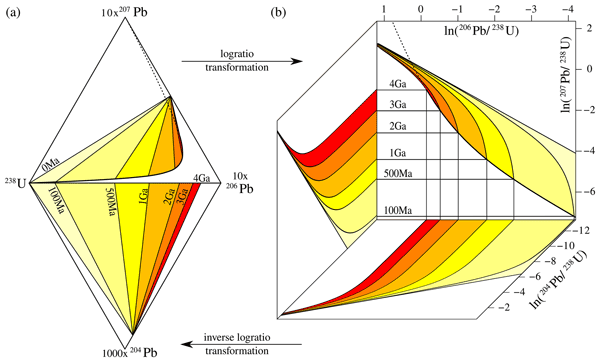
compositional data, which means that the relative abundances of 204Pb, 206Pb, 207Pb, and 238Pb are processed within a tetrahedral data space or
simplex. The new method is implemented in an eponymous computer programme that is compatible with the two dominant types of SIMS instruments.
Yang Li and Pieter Vermeesch
Geochronology, 3, 415–420, https://doi.org/10.5194/gchron-3-415-2021, https://doi.org/10.5194/gchron-3-415-2021, 2021
Short summary
Short summary
A conventional isochron is a straight-line fit to two sets of isotopic ratios, D/d and P/d, where P is the radioactive parent, D is the radiogenic daughter, and d is a second isotope of the daughter element. The slope of this line is proportional to the age of the system. An inverse isochron is a linear fit through d/D and P/D. The horizontal intercept of this line is inversely proportional to the age. The latter approach is preferred when d<D, which is the case in Re–Os and K–Ca geochronology.
Pieter Vermeesch
Geochronology, 3, 247–257, https://doi.org/10.5194/gchron-3-247-2021, https://doi.org/10.5194/gchron-3-247-2021, 2021
Short summary
Short summary
This paper shows that the current practice of filtering discordant U–Pb data based on the relative difference between the 206Pb/238U and 207Pb/206Pb ages is just one of several possible approaches to the problem and demonstrably not the best one. An alternative approach is to define discordance in terms of isotopic composition, as a log ratio distance between the measurement and the concordia line. Application to real data indicates that this reduces the positive bias of filtered age spectra.
William Michael Maslanka, Martin John Wooster, Zixia Liu, and Jiangping He
EGUsphere, https://doi.org/10.5194/egusphere-2025-4486, https://doi.org/10.5194/egusphere-2025-4486, 2025
This preprint is open for discussion and under review for Biogeosciences (BG).
Short summary
Short summary
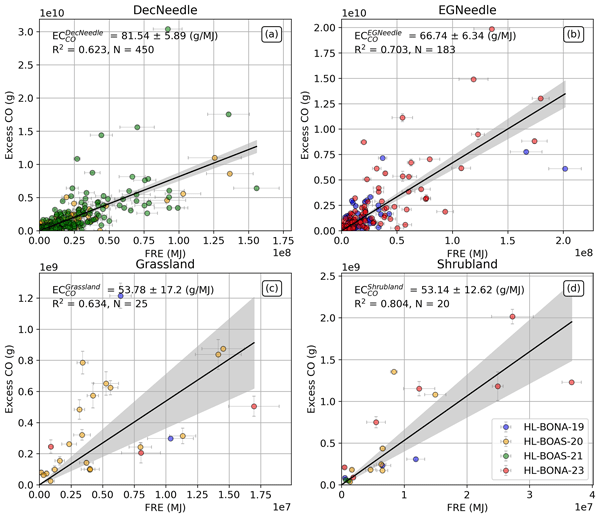
We created a new independent method that uses only near real time satellite data to estimate how much carbon is emitted from landscape fires in the high latitudes. Our estimates are similar, but smaller, than estimates using modelled data, based on laboratory experiments and observations of burned area. This provides the first clear picture of fire emissions across high-latitude regions and will help us better understand the role of wildfires in climate change now and in the future.
Pieter Vermeesch, Noah McLean, Anton Vaks, Tzahi Golan, Sebastian F. M. Breitenbach, and Randall Parrish
Geochronology, 7, 459–473, https://doi.org/10.5194/gchron-7-459-2025, https://doi.org/10.5194/gchron-7-459-2025, 2025
Short summary
Short summary
U–Pb dating of cave sediments has provided important new time constraints on the evolution of cave-dwelling organisms (including early humans) and of Earth's climate during the past 5 Myr. This paper shows that the most common type of U–Pb dating, which uses 238U and 206Pb, can be inaccurate beyond ca. 2 Myr ago. It proposes an alternative type of U–Pb dating, using 235U and 207Pb, as a more accurate alternative.
Pieter Vermeesch
Geochronology, 6, 397–407, https://doi.org/10.5194/gchron-6-397-2024, https://doi.org/10.5194/gchron-6-397-2024, 2024
Short summary
Short summary
The age of some geological materials can be estimated from the ratio of certain radiogenic "daughter" isotopes to their radioactive "parent". However, in many cases, the age estimation process is complicated by the presence of an inherited component of non-radiogenic daughter isotopes. This paper presents an improved algorithm to estimate the radiogenic and non-radiogenic components, either separately or jointly.
Pieter Vermeesch, Yuntao Tian, Jae Schwanethal, and Yannick Buret
Geochronology, 5, 323–332, https://doi.org/10.5194/gchron-5-323-2023, https://doi.org/10.5194/gchron-5-323-2023, 2023
Short summary
Short summary
The U–Th–He method is a technique to determine the cooling history of minerals. Traditional approaches to U–Th–He dating are time-consuming and require handling strong acids and radioactive solutions. This paper presents an alternative approach in which samples are irradiated with protons and subsequently analysed by laser ablation mass spectrometry. Unlike previous in situ U–Th–He dating attempts, the new method does not require any absolute concentration measurements of U, Th, or He.
Alex Lipp and Pieter Vermeesch
Geochronology, 5, 263–270, https://doi.org/10.5194/gchron-5-263-2023, https://doi.org/10.5194/gchron-5-263-2023, 2023
Short summary
Short summary
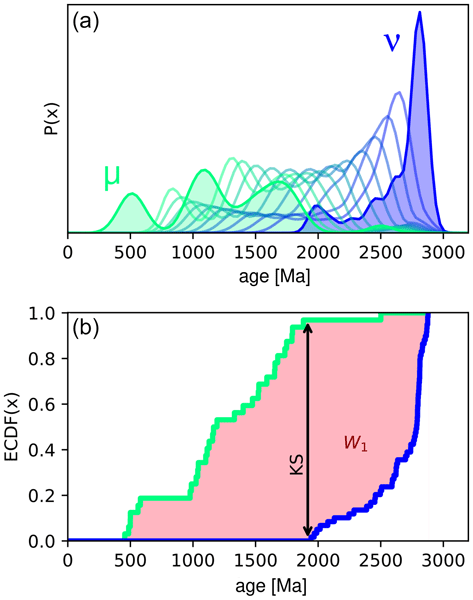
We propose using the Wasserstein-2 distance (W2) as an alternative to the widely used Kolmogorov–Smirnov (KS) statistic for analysing distributional data in geochronology. W2 measures the horizontal distance between observations, while KS measures vertical differences in cumulative distributions. Using case studies, we find that W2 is preferable in scenarios where the absolute age differences in observations provide important geological information. W2 has been added to the R package IsoplotR.
Hannah M. Nguyen, Jiangping He, and Martin J. Wooster
Atmos. Chem. Phys., 23, 2089–2118, https://doi.org/10.5194/acp-23-2089-2023, https://doi.org/10.5194/acp-23-2089-2023, 2023
Short summary
Short summary
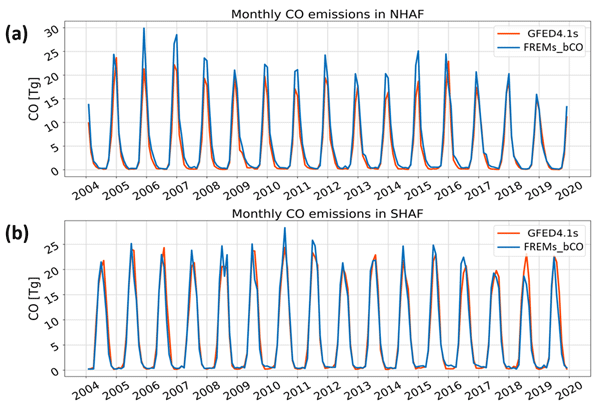
This work presents novel advances in the estimation of open biomass burning emissions via the first fully "top-down" approach to exploit satellite-derived observations of fire radiative power and carbon monoxide over Africa. We produce a 16-year record of fire-generated CO emissions and dry matter consumed per unit area for Africa and evaluate these emissions estimates through their use in an atmospheric model, whose simulation output is then compared to independent satellite observations of CO.
Matthew Fox, Adam G. G. Smith, Pieter Vermeesch, Kerry Gallagher, and Andrew Carter
Geochronology Discuss., https://doi.org/10.5194/gchron-2022-23, https://doi.org/10.5194/gchron-2022-23, 2022
Preprint under review for GChron
Short summary
Short summary
The Great Unconformity represents an enormous amount of time lost from the sedimentary record. Its origin is debated, in part, due to different approaches used to interpret zircon (U–Th)/He ages. This thermochronometric system is ideal for this problem because the temperature sensitivity varies according to radiation damage. Here we explore the uncertainty associated with the radiation damage model and show how this limits our ability to resolve the origin of the Great Unconformity.
Pieter Vermeesch
Geochronology, 4, 561–576, https://doi.org/10.5194/gchron-4-561-2022, https://doi.org/10.5194/gchron-4-561-2022, 2022
Short summary
Short summary
Secondary ion mass spectrometry (SIMS) is the oldest and most sensitive analytical technique for in situ U–Pb geochronology. This paper introduces a new algorithm for SIMS data reduction that treats data as
compositional data, which means that the relative abundances of 204Pb, 206Pb, 207Pb, and 238Pb are processed within a tetrahedral data space or
simplex. The new method is implemented in an eponymous computer programme that is compatible with the two dominant types of SIMS instruments.
Yang Li and Pieter Vermeesch
Geochronology, 3, 415–420, https://doi.org/10.5194/gchron-3-415-2021, https://doi.org/10.5194/gchron-3-415-2021, 2021
Short summary
Short summary
A conventional isochron is a straight-line fit to two sets of isotopic ratios, D/d and P/d, where P is the radioactive parent, D is the radiogenic daughter, and d is a second isotope of the daughter element. The slope of this line is proportional to the age of the system. An inverse isochron is a linear fit through d/D and P/D. The horizontal intercept of this line is inversely proportional to the age. The latter approach is preferred when d<D, which is the case in Re–Os and K–Ca geochronology.
Pieter Vermeesch
Geochronology, 3, 247–257, https://doi.org/10.5194/gchron-3-247-2021, https://doi.org/10.5194/gchron-3-247-2021, 2021
Short summary
Short summary
This paper shows that the current practice of filtering discordant U–Pb data based on the relative difference between the 206Pb/238U and 207Pb/206Pb ages is just one of several possible approaches to the problem and demonstrably not the best one. An alternative approach is to define discordance in terms of isotopic composition, as a log ratio distance between the measurement and the concordia line. Application to real data indicates that this reduces the positive bias of filtered age spectra.
Cited articles
Abbott, B. P., Abbott, R., Abbott, T. D., et al.: Observation of gravitational waves from a binary black hole merger, Physical Review Letters, 116, 061102, https://doi.org/10.1103/PhysRevLett.116.061102, 2016. a
Boone, S. C., Chung, L., Faux, N., Nattala, U., Church, T., Jiang, C., McMillan, M., Jones, S., Liu, D., Jiang, H., Ehinger, K., Drummond, T., Kohn, B., and Gleadow, A.: Raising the Bar: Deep Learning on Comprehensive Database Sets New Benchmark for Automated Fission-Track Detection, Computers & Geosciences, 208, 106096, https://doi.org/10.1016/j.cageo.2025.106096, 2025. a, b
Donelick, R. A.: Method of fission track analysis utilizing bulk chemical etching of apatite, US Patent 5,267,274, 1993. a
Galton, F.: Vox Populi, Nature, 75, 450–451, https://doi.org/10.1038/075450a0, 1907. a
Gleadow, A.: Future developments in fission track thermochronology, in: Fission track thermochronology and its application to geology, edited by: Malusà, Marco and Fitzgerald, P., chap. 4, Springer, https://doi.org/10.1007/978-3-319-89421-8_4, 2019. a, b
Gleadow, A. J., Gleadow, S. J., Belton, D. X., Kohn, B. P., Krochmal, M. S., and Brown, R. W.: Coincidence mapping – a key strategy for the automatic counting of fission tracks in natural minerals, Geological Society, London, Special Publications, 324, 25–36, https://doi.org/10.1144/SP324.2, 2009. a, b, c, d
Green, P.: Comparison of zeta calibration baselines for fission-track dating of apatite, zircon and sphene, Chemical Geology: Isotope Geoscience Section, 58, 1–22, https://doi.org/10.1016/0168-9622(85)90023-5, 1985. a
Guo, C., Zhang, Z., Lease, R., Malusà, M. G., Chew, D., Lu, H., Wu, L., Xiang, D., Wang, N., Grasemann, B., and Xiao, W.: Apatite geo-thermochronology and geochemistry constrain oligocene-miocene growth and geodynamics of the northeastern Tibetan Plateau, Geophysical Research Letters, 52, e2024GL113157, https://doi.org/10.1029/2024GL113157, 2025. a
Li, R., Xu, Z., Su, C., and Yang, R.: Automatic identification of semi-tracks on apatite and mica using a deep learning method, Computers & Geosciences, 162, 105081, https://doi.org/10.1016/j.cageo.2022.105081, 2022. a, b
Miller, D. S., Duddy, I. R., Green, P. F., Hurford, A. J., and Naeser, C. W.: Results of interlaboratory comparison of fission-track age standards: fission-track workshop – 1984, Nuclear Tracks and Radiation Measurements, 10, 383–391, https://doi.org/10.1016/0735-245X(85)90127-9, 1985. a, b
Miyakawa, T.: No raw data, no science: another possible source of the reproducibility crisis, Molecular Brain, 13, https://doi.org/10.1186/s13041-020-0552-2, 2020. a
Nachtergaele, S. and De Grave, J.: AI-Track-tive: open-source software for automated recognition and counting of surface semi-tracks using computer vision (artificial intelligence), Geochronology, 3, 383–394, https://doi.org/10.5194/gchron-3-383-2021, 2021. a, b
Ren, Z., Li, S., Xiao, P., Yang, X., and Wang, H.: Artificial intelligent identification of apatite fission tracks based on machine learning, Machine Learning: Science and Technology, 4, 045039, https://doi.org/10.1088/2632-2153/ad0e17, 2023. a
Still, M.: The Definitive Guide to ImageMagick, 1st edn., Springer, ISBN 978-1-59059-590-9, 2006. a
Tamer, M. T., Chung, L., Ketcham, R. A., and Gleadow, A. J. W.: The need for fission-track data transparency and sharing, Geochronology, 7, 45–58, https://doi.org/10.5194/gchron-7-45-2025, 2025. a, b, c, d
Van Ranst, G., Baert, P., Fernandes, A. C., and De Grave, J.: Technical note: Nikon–TRACKFlow, a new versatile microscope system for fission track analysis, Geochronology, 2, 93–99, https://doi.org/10.5194/gchron-2-93-2020, 2020. a, b
Vermeesch, P.:
IsoplotR: a free and open toolbox for geochronology, Geoscience Frontiers, 9, 1479–1493, https://doi.org/10.1016/j.gsf.2018.04.001, 2018a. a
Vermeesch, P.: Statistics for fission-track thermochronology, in: Fission track thermochronology and its application to geology, edited by: Malusá, M. and Fitzgerald, P., chap. 6, Springer, https://doi.org/10.1007/978-3-319-89421-8_6, 2018b. a
Vermeesch, P.: pvermees/GaHa: v.2, Zenodo [data set], https://doi.org/10.5281/zenodo.18672351, 2026a. a
Vermeesch, P.: pvermees/supplements/geochron@home, Zenodo [data set], https://doi.org/10.5281/zenodo.18672428, 2026b. a
Vermeesch, P., Band, T., and He, J.: pvermees/geochron-at-home: 1.0, Zenodo [software], https://doi.org/10.5281/zenodo.18166196, 2026. a
Wilkinson, M. D., Dumontier, M., Aalbersberg, I. J., et al.: The FAIR Guiding Principles for scientific data management and stewardship, Scientific data, 3, 1–9, https://doi.org/10.1038/sdata.2016.18, 2016. a
Editor
This paper promotes both data transparency and open science by presenting the first web-based fission track platform available to deposit images and conduct counting analyses.
This paper promotes both data transparency and open science by presenting the first web-based...
Short summary
geochron@home is a free and open-source platform that makes fission track dating more transparent and reliable. It combines a virtual microscope with an online database to share images and data openly, following FAIR principles. Researchers can analyse tracks privately, archive data for peer review, teach students, or involve citizen scientists. By improving data access and reproducibility, geochron@home helps build trust and supports future advances in Earth science.
geochron@home is a free and open-source platform that makes fission track dating more...
Special issue