
Articles | Volume 8, issue 3
https://doi.org/10.5194/gchron-8-463-2026
© Author(s) 2026. This work is distributed under
the Creative Commons Attribution 4.0 License.
the Creative Commons Attribution 4.0 License.
https://doi.org/10.5194/gchron-8-463-2026
© Author(s) 2026. This work is distributed under
the Creative Commons Attribution 4.0 License.
the Creative Commons Attribution 4.0 License.
Research article
| 
27 Aug 2026
Research article |
| 27 Aug 2026
| 27 Aug 2026
Uncertainty in helium diffusion in zircon limits thermochronologic resolution: application to the Great Unconformity
Matthew Fox
CORRESPONDING AUTHOR

London Geochronology Centre, Department of Earth Sciences, University College London, Gower St., London, WC16BT, UK
Adam G. G. Smith
London Geochronology Centre, Department of Earth Sciences, University College London, Gower St., London, WC16BT, UK
now at: School of Geographical and Earth Sciences, University of Glasgow, Glasgow, UK
Pieter Vermeesch
London Geochronology Centre, Department of Earth Sciences, University College London, Gower St., London, WC16BT, UK
Kerry Gallagher
Géosciences Rennes/OSEREN, University of Rennes, Rennes, France
Andrew Carter
London Geochronology Centre, Department of Earth Sciences, University College London, Gower St., London, WC16BT, UK
School of Natural Sciences, Birkbeck College, Malet St., London, WC1E 7HX, UK
Related authors
Elie René-Bazin, Michel Tsamados, Sabrina Sofea Binti Aliff Raziuddin, Joel Perez Ferrer, Tudor Suciu, Carmen Nab, Chamkaur Ghag, Harry Heorton, Rosemary Willatt, Jack Landy, Matthew Fox, and Thomas Bodin
The Cryosphere, 20, 3913–3932, https://doi.org/10.5194/tc-20-3913-2026, https://doi.org/10.5194/tc-20-3913-2026, 2026
Short summary
Short summary
This paper introduces a new statistical approach to retrieve ice and snow depth over the Arctic Ocean, using satellite altimeters measurements. We demonstrate the ability of this method to compute efficiently the sea ice thickness and the snow depth over the Arctic, without major assumptions on the snow. In addition to the ice and snow depth, this approach is efficient to study the penetration of radar and laser pulses, paving the way for further research in satellite altimetry.
Dawid Szymanowski, Marcel Guillong, Pieter Vermeesch, and Philip J. Hopley
EGUsphere, https://doi.org/10.5194/egusphere-2026-4403, https://doi.org/10.5194/egusphere-2026-4403, 2026
Short summary
Short summary
U–Pb geochronology of carbonates using 238U and 206Pb can be inaccurate beyond ca. 2 Ma. This paper explores analytical strategies to use the more accurate, alternative approach using 235U and 207Pb. Solution mode and laser ablation analyses of reference materials and of a South African speleothem demonstrate that this method is widely applicable, improving our ability to provide accurate carbonate chronologies, particularly in the freshwater realm.
Elie René-Bazin, Michel Tsamados, Sabrina Sofea Binti Aliff Raziuddin, Joel Perez Ferrer, Tudor Suciu, Carmen Nab, Chamkaur Ghag, Harry Heorton, Rosemary Willatt, Jack Landy, Matthew Fox, and Thomas Bodin
The Cryosphere, 20, 3913–3932, https://doi.org/10.5194/tc-20-3913-2026, https://doi.org/10.5194/tc-20-3913-2026, 2026
Short summary
Short summary
This paper introduces a new statistical approach to retrieve ice and snow depth over the Arctic Ocean, using satellite altimeters measurements. We demonstrate the ability of this method to compute efficiently the sea ice thickness and the snow depth over the Arctic, without major assumptions on the snow. In addition to the ice and snow depth, this approach is efficient to study the penetration of radar and laser pulses, paving the way for further research in satellite altimetry.
Pieter Vermeesch
EGUsphere, https://doi.org/10.5194/egusphere-2026-2783, https://doi.org/10.5194/egusphere-2026-2783, 2026
Short summary
Short summary
This paper warns that geochronological data can sometimes look "too good to be true". While scientists usually worry about data being too scattered, overly tidy results may come from over-zealous outlier rejection. A new diagnostic plot helps reveal this hidden problem in published datasets. A survey shows underdispersion is common and can give false confidence in precise ages, reducing accuracy and masking real geological complexity.
Alyssa L. Abbey and Kerry Gallagher
EGUsphere, https://doi.org/10.5194/egusphere-2026-2328, https://doi.org/10.5194/egusphere-2026-2328, 2026
Short summary
Short summary
We review updates that have been made to the thermal history modeling program QTQt. QTQt is used to model age and crystal composition data from rock samples used in thermochronology studies to understand the thermal history of a sample. We show that forcing increased complexity does not change how well the model fits the data, but does add complexity to areas of the model that are not controlled by the input data.
Maxime Bernard, Pieter van der Beek, Cody Colleps, Xavier Robert, Kerry Gallagher, William Guenthner, Julien Amalberti, and Georgina E. King
EGUsphere, https://doi.org/10.5194/egusphere-2026-2286, https://doi.org/10.5194/egusphere-2026-2286, 2026
Short summary
Short summary
Pecube, a 3D thermal-kinematic software that predicts thermochronometer data, has been widely used to constrain the past evolution of mountain belts, but its accessibility and application is still limited. This work overcomes this limitation by offering a graphical user interface to Pecube, PecubeGUI, and by broadening its application to a wider range of tectonic settings through the implementation thermochronometer prediction models in line with the most recent research developments.
Pieter Vermeesch, Tim Band, Jiangping He, Rex Galbraith, and Andrew Carter
Geochronology, 8, 109–118, https://doi.org/10.5194/gchron-8-109-2026, https://doi.org/10.5194/gchron-8-109-2026, 2026
Short summary
Short summary
geochron@home is a free and open-source platform that makes fission track dating more transparent and reliable. It combines a virtual microscope with an online database to share images and data openly, following FAIR principles. Researchers can analyse tracks privately, archive data for peer review, teach students, or involve citizen scientists. By improving data access and reproducibility, geochron@home helps build trust and supports future advances in Earth science.
Pieter Vermeesch, Noah McLean, Anton Vaks, Tzahi Golan, Sebastian F. M. Breitenbach, and Randall Parrish
Geochronology, 7, 459–473, https://doi.org/10.5194/gchron-7-459-2025, https://doi.org/10.5194/gchron-7-459-2025, 2025
Short summary
Short summary
U–Pb dating of cave sediments has provided important new time constraints on the evolution of cave-dwelling organisms (including early humans) and of Earth's climate during the past 5 Myr. This paper shows that the most common type of U–Pb dating, which uses 238U and 206Pb, can be inaccurate beyond ca. 2 Myr ago. It proposes an alternative type of U–Pb dating, using 235U and 207Pb, as a more accurate alternative.
Pieter Vermeesch
Geochronology, 6, 397–407, https://doi.org/10.5194/gchron-6-397-2024, https://doi.org/10.5194/gchron-6-397-2024, 2024
Short summary
Short summary
The age of some geological materials can be estimated from the ratio of certain radiogenic "daughter" isotopes to their radioactive "parent". However, in many cases, the age estimation process is complicated by the presence of an inherited component of non-radiogenic daughter isotopes. This paper presents an improved algorithm to estimate the radiogenic and non-radiogenic components, either separately or jointly.
Alexis Derycke, Nathan Cogné, Dominique Bavay, David Vilbert, Lionel Dutruch, Sebastien Ternois, Gilles Ruffet, Marc Jolivet, and Kerry Gallagher
Geochronology Discuss., https://doi.org/10.5194/gchron-2024-6, https://doi.org/10.5194/gchron-2024-6, 2024
Publication in GChron not foreseen
Short summary
Short summary
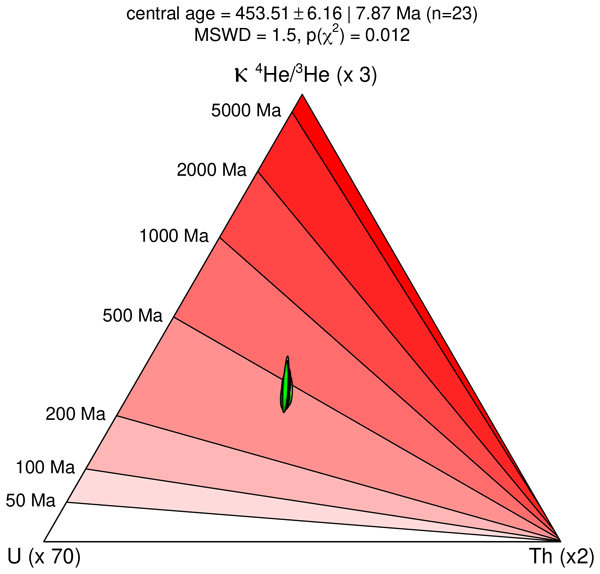
This note details a development of the (U-Th)/He method for dating apatite crystals in low-temperature thermochronology. Our innovation simplifies analysis protocols for gases (He) and crystals (U, Th, etc.), aiming to expedite data production and enhance study reliability.
Pieter Vermeesch, Yuntao Tian, Jae Schwanethal, and Yannick Buret
Geochronology, 5, 323–332, https://doi.org/10.5194/gchron-5-323-2023, https://doi.org/10.5194/gchron-5-323-2023, 2023
Short summary
Short summary
The U–Th–He method is a technique to determine the cooling history of minerals. Traditional approaches to U–Th–He dating are time-consuming and require handling strong acids and radioactive solutions. This paper presents an alternative approach in which samples are irradiated with protons and subsequently analysed by laser ablation mass spectrometry. Unlike previous in situ U–Th–He dating attempts, the new method does not require any absolute concentration measurements of U, Th, or He.
Alex Lipp and Pieter Vermeesch
Geochronology, 5, 263–270, https://doi.org/10.5194/gchron-5-263-2023, https://doi.org/10.5194/gchron-5-263-2023, 2023
Short summary
Short summary
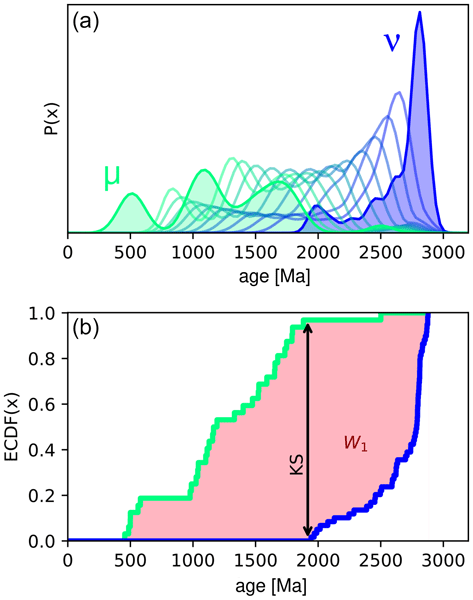
We propose using the Wasserstein-2 distance (W2) as an alternative to the widely used Kolmogorov–Smirnov (KS) statistic for analysing distributional data in geochronology. W2 measures the horizontal distance between observations, while KS measures vertical differences in cumulative distributions. Using case studies, we find that W2 is preferable in scenarios where the absolute age differences in observations provide important geological information. W2 has been added to the R package IsoplotR.
Pieter Vermeesch
Geochronology, 4, 561–576, https://doi.org/10.5194/gchron-4-561-2022, https://doi.org/10.5194/gchron-4-561-2022, 2022
Short summary
Short summary
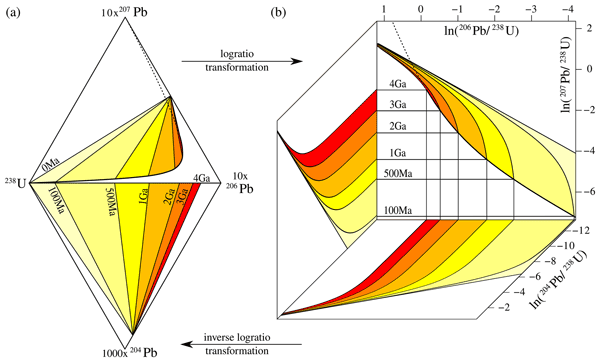
Secondary ion mass spectrometry (SIMS) is the oldest and most sensitive analytical technique for in situ U–Pb geochronology. This paper introduces a new algorithm for SIMS data reduction that treats data as
compositional data, which means that the relative abundances of 204Pb, 206Pb, 207Pb, and 238Pb are processed within a tetrahedral data space or
simplex. The new method is implemented in an eponymous computer programme that is compatible with the two dominant types of SIMS instruments.
Cited articles
Anderson, A. J., Hodges, K. V., and van Soest, M. C.: Empirical constraints on the effects of radiation damage on helium diffusion in zircon, Geochim. Cosmochim. Ac., 218, 308–322, https://doi.org/10.1016/j.gca.2017.09.006, 2017.
Anderson, A. J., Hodges, K. V., and van Soest, M. C.: Comment on 'Distinguishing slow cooling versus multiphase cooling and heating in zircon and apatite (U-Th)/He datasets. The case of the McClure Mountain syenite standard' by Weisberg, Metcalf, and Flowers, Chem. Geol., 498, 150–152, https://doi.org/10.1016/j.chemgeo.2018.07.006, 2018.
Ault, A. K., Guenthner, W. R., Moser, A. C., Miller, G. H., and Refsnider, K. A.: Zircon grain selection reveals (de) coupled metamictization, radiation damage, and He diffusivity, Chem. Geol., 490, 1–12, https://doi.org/10.1016/j.chemgeo.2018.04.023, 2018.
Barr, D. R. and Slezak, N. L.: A comparison of multivariate normal generators, Communications of the Association of Computing Machinery, 15, 1048–1049, https://doi.org/10.1145/361598.361620, 1972.
Cooperdock, E. H. G., Ketcham, R. A., and Stockli, D. F.: Resolving the effects of 2-D versus 3-D grain measurements on apatite (U–Th) ∕ He age data and reproducibility, Geochronology, 1, 17–41, https://doi.org/10.5194/gchron-1-17-2019, 2019.
DeLucia, M. S., Guenthner, W. R., Marshak, S., Thomson, S. N., and Ault, A. K.: Thermochronology links denudation of the Great Unconformity surface to the supercontinent cycle and snowball Earth, Geology, 46, 167–170, https://doi.org/10.1130/G39525.1, 2018.
Dodson, M. H.: Closure temperature in cooling geochronological and petrological systems, Contrib. Mineral. Petrol., 40, 259–274, https://doi.org/10.1007/BF00373790, 1973.
Fechtig, H. and Kalbitzer, S.: The diffusion of argon in potassium-bearing solids, in: Potassium argon dating, Springer Berlin Heidelberg, Berlin, Heidelberg, 68–107, https://doi.org/10.1007/978-3-642-87895-4_4, 1966.
Flowers, R. M., Macdonald, F. A., Siddoway, C. S., and Havranek, R.: Diachronous development of Great Unconformities before Neoproterozoic Snowball Earth, P. Natl. Acad. Sci. USA, 117, 10172–10180, https://doi.org/10.1073/pnas.1913131117, 2020.
Flowers, R. M., Ketcham, R. A., Macdonald, F. A., Siddoway, C. S., and Havranek, R. E.: Existing thermochronologic data do not constrain Snowball glacial erosion below the Great Unconformities, P. Natl. Acad. Sci. USA, 119, e2208451119, https://doi.org/10.1073/pnas.2208451119, 2022.
Fox, M. and Carter, A.: Heated topics in thermochronology and paths towards resolution, Geosciences, 10, 375, https://doi.org/10.3390/geosciences10090375, 2020.
Fox, M. and Shuster, D. L.: The influence of burial heating on the (U–Th)/He system in apatite: Grand Canyon case study, Earth Planet. Sc. Lett., 397, 174–183, https://doi.org/10.1016/j.epsl.2014.04.041, 2014.
Fox, M., McKeon, R. E., and Shuster, D. L.: Incorporating 3-D parent nuclide zonation for apatite 4He/3He thermochronometry: An example from the Appalachian Mountains, Geochem. Geophy. Geosy., 15, 4217–4229, 2014.
Fox, M., Dai, J., and Carter, A.: Badly Behaved Detrital (U-Th)/He Ages: Problems With He Diffusion Models or Geological Models?, Geochem. Geophy. Geosy., 2018GC008102, https://doi.org/10.1029/2018GC008102, 2019.
Flowers, R. M. and Peak, B. A.: Context matters: Modeling thermochronologic data in geologic frameworks using the Great Unconformity as a case study, Earth Planet. Sc. Lett., 650, 119061, https://doi.org/10.1016/j.epsl.2024.119061, 2025.
Gallagher, K.: Transdimensional inverse thermal history modeling for quantitative thermochronology, J. Geophys. Res.-Sol. Ea., 117, https://doi.org/10.1029/2011JB008825, 2012.
Gautheron, C., Djimbi, D. M., Roques, J., Balout, H., Ketcham, R. A., Simoni, E., Pik, R., Seydoux-Guillaume, A. M., and Tassan-Got, L.: A multi-method, multi-scale theoretical study of He and Ne diffusion in zircon, Geochim. Cosmochim. Ac., 268, 348–367. https://doi.org/10.1016/j.gca.2019.10.007, 2020.
Gautheron, C., Hueck, M., Ternois, S., Heller, B., Schwartz, S., Sarda, P., and Tassan-Got, L.: Investigating the shallow to mid-depth (> 100–300 °C) continental crust evolution with (U-Th)/He thermochronology: a review, Minerals, 12, 563, https://doi.org/10.3390/min12050563, 2022.
Gelman, A., Gilks, W. R., and Roberts, G. O.: Weak convergence and optimal scaling of random walk Metropolis algorithms, Ann. Appl. Probab., 7, 110–120, 1997.
Ginster, U.: The Effects of Radiation Damage Accumulation and Annealing on Helium Diffusion in Zircon, PhD dissertation, Department of Geosciences, University of Arizona, Tucson, AZ, http://hdl.handle.net/10150/631475 (last access: 19 August 2026), 2018.
Gordon Gastil, R., DeLisle, M., and Morgan, J.: Some Effects of Progressive Metamorphism on Zircons, Geol. Soc. Am. Bull., 78, 879, https://doi.org/10.1130/0016-7606(1967)78[879:SEOPMO]2.0.CO;2, 1967.
Guenthner, W. R.: Implementation of an alpha damage annealing model for zircon (U-Th)/He thermochronology with comparison to a zircon fission track annealing model, Geochem. Geophy. Geosy., 22, e2019GC008757, https://doi.org/10.1029/2019GC008757, 2021.
Guenthner, W. R., Reiners, P. W., Ketcham, R. A., Nasdala, L., and Giester, G.: Helium diffusion in natural zircon: Radiation damage, anisotropy, and the interpretation of zircon (U-Th)/He thermochronology, Am. J. Sci., 313, 145–198, https://doi.org/10.2475/03.2013.01, 2013.
Guo, H., Zeitler, P. K., and Idleman, B. D.: Behavior of helium diffusion sinks in apatite: Evidence from continuous ramped heating analysis of borehole and well-characterized samples, Earth Planet. Sc. Lett., 641, 118828, https://doi.org/10.1016/j.chemgeo.2017.11.019, 2024.
Idleman, B. D., Zeitler, P. K., and McDannell, K. T.: Characterization of helium release from apatite by continuous ramped heating, Chem. Geol., 476, 223–232, 2018.
Keller, C. B., Husson, J. M., Mitchell, R. N., Bottke, W. F., Gernon, T. M., Boehnke, P., Bell, E. A., Swanson-Hysell, N. L., and Peters, S. E.: Neoproterozoic glacial origin of the Great Unconformity, P. Natl. Acad. Sci. USA, 116, 1136–1145, https://doi.org/10.1073/pnas.1804350116, 2019.
Ketcham, R. A., Guenthner, W. R., and Reiners, P. W.: Geometric analysis of radiation damage connectivity in zircon, and its implications for helium diffusion, Am. Mineral., 98, 350–360, https://doi.org/10.2138/am.2013.4249, 2013.
McDannell, K. T. and Flowers, R. M.: Vestiges of the ancient: Deep-time noble gas thermochronology, Elements, 16, 325–330, https://doi.org/10.2138/gselements.16.5.325, 2020.
McDannell, K. T., Zeitler, P. K., Janes, D. G., Idleman, B. D., and Fayon, A. K.: Screening apatites for (U-Th)/He thermochronometry via continuous ramped heating: He age components and implications for age dispersion, Geochim. Cosmochim. Ac., 223, 90–106, https://doi.org/10.1016/j.gca.2017.11.031, 2018.
McDannell, K. T., Keller, C. B., Guenthner, W. R., Zeitler, P. K., and Shuster, D. L.: Thermochronologic constraints on the origin of the Great Unconformity, P. Natl. Acad. Sci. USA, 119, e2118682119, https://doi.org/10.1073/pnas.2118682119, 2022.
McDannell, K. T., Gallagher, K., Guenthner, W. R., Keller, C. B., and Shuster, D. L.: A reset clock cannot keep time: Thermal overprinting obscures Great Unconformity origins in North China, P. Natl. Acad. Sci. USA, 123, e2616023123, https://doi.org/10.1073/pnas.2616023123, 2026.
Mialhe, P., Charles, J. P., and Khoury, A.: The thermodynamic compensation law, J. Phys. D Appl. Phys., 21, 383, https://doi.org/10.1088/0022-3727/21/3/001, 1988.
Miltich, L.: Low temperature cooling history of Archean Gneisses and Paleoproterozic Granites of southwestern Minnesota, BA thesis, Carleton College, Northfield, Minnesota, 58 pp., 2005.
Peak, B. A., Flowers, R. M., Macdonald, F. A., and Cottle, J. M.: Zircon (U-Th)/He thermochronology reveals pre-Great Unconformity paleotopography in the Grand Canyon region, USA, Geology, 49, 1462–1466, https://doi.org/10.1130/G49116.1, 2021.
Rahn, M. K., Brandon, M. T., Batt, G. E., and Garver, J. I.: A zero-damage model for fission-track annealing in zircon, Am. Mineral., 89, 473–484, https://doi.org/10.2138/am-2004-0401, 2004.
Reiners, P. W.: Zircon (U-Th)/He Thermochronometry, Rev. Mineral. Geochem., 58, 151–179, https://doi.org/10.2138/rmg.2005.58.6, 2005.
Reiners, P. W. and Brandon, M. T.: Using thermochronology to understand orogenic erosion, Annu. Rev. Earth Pl.. Sci., 34, 419–466, 2006.
Tagami, T.: Zircon Fission-Track Thermochronology and Applications to Fault Studies, Rev. Mineral. Geochem., 58, 95–122, https://doi.org/10.2138/rmg.2005.58.4, 2005.
Thurston, O. G., Guenthner, W. R., Karlstrom, K. E., Ricketts, J. W., Heizler, M. T., and Timmons, J. M.: Zircon (U-Th)/He thermochronology of Grand Canyon resolves 1250 Ma unroofing at the Great Unconformity and < 20 Ma canyon carving, Geology, 50, 222–226, https://doi.org/10.1130/G48699.1, 2022.
Tripathy-Lang, A., Fox, M., and Shuster, D. L.: Zircon 4He/3He thermochronometry, Geochim. Cosmochim. Ac., 166, 1–14, https://doi.org/10.1016/j.gca.2015.05.027, 2015.
Weisberg, W. R., Metcalf, J. R., and Flowers, R. M.: Distinguishing slow cooling versus multiphase cooling and heating in zircon and apatite (U-Th)/He datasets: the case of the McClure Mountain syenite standard, Chem. Geol., 485, 90–99, https://doi.org/10.1016/j.chemgeo.2018.03.038, 2018.
Whipp, D. M., Kellett, D. A., Coutand, I., and Ketcham, R. A.: Short communication: Modeling competing effects of cooling rate, grain size, and radiation damage in low-temperature thermochronometers, Geochronology, 4, 143–152, https://doi.org/10.5194/gchron-4-143-2022, 2022.
Yamada, R., Tagami, T., Nishimura, S., and Ito, H.: Annealing kinetics of fission tracks in zircon: an experimental study, Chem. Geol., 122, 249–258, https://doi.org/10.1016/0009-2541(95)00006-8, 1995.
Yamada, R., Murakami, M., and Tagami, T.: Statistical modelling of annealing kinetics of fission tracks in zircon; Reassessment of laboratory experiments, Chem. Geol., 236, 75–91, https://doi.org/10.1016/j.chemgeo.2006.09.002, 2007.
Zeitler, P. K., Herczeg, A. L., McDougall, I., and Honda, M.: U-Th-He dating of apatite: A potential thermochronometer, Geochim. Cosmochim. Ac., 51, 2865–2868, https://doi.org/10.1016/0016-7037(87)90164-5, 1987.
Zhan, R.-R., Duan, L., Zattin, M., Christie-Blick, N., Wan, B., Wei, R.-H., Yang, Z., Wang, J., Gou, L., Olivetti, V., Chen, K.-Y., and Zhang, X.: Tectonism rather than “snowball Earth” glaciation is responsible for the Great Unconformity, P. Natl. Acad. Sci. USA, 123, e2523891123, https://doi.org/10.1073/pnas.2523891123, 2026.
Short summary
The ability to reconstruct thermal histories from thermochronometric data is determined by kinetic parameters. The Great Unconformity represents an enormous amount of time lost from the sedimentary record and has been explored with zircon (U–Th)/He ages. Here we explore the uncertainty associated with the radiation damage model and show how this limits our ability to resolve the origin of the Great Unconformity.
The ability to reconstruct thermal histories from thermochronometric data is determined by...


