Articles | Volume 8, issue 2
https://doi.org/10.5194/gchron-8-297-2026
© Author(s) 2026. This work is distributed under
the Creative Commons Attribution 4.0 License.
https://doi.org/10.5194/gchron-8-297-2026
© Author(s) 2026. This work is distributed under
the Creative Commons Attribution 4.0 License.
Novel insights into the post-IR IRSL200 signal bleachability of single-grain K-feldspars in fluvial modern analogues from the Southern Central Andes, Chile
Institute of Geography, University of Cologne, 50674 Cologne, Germany
Geoscience Environment Toulouse, Université de Toulouse, Toulouse, 31400, France
Svenja Riedesel
Institute of Geography, University of Cologne, 50674 Cologne, Germany
Louise Karman-Besson
Institute of Geography, University of Cologne, 50674 Cologne, Germany
Geoscience Environment Toulouse, Université de Toulouse, Toulouse, 31400, France
Max Hellers
Institute of Geology and Mineralogy, University of Cologne, 50674 Cologne, Germany
Anne Guyez
Laboratorie d'Etudes en Géophysique et Océanographie Spatials, Université de Toulouse, Toulouse, 31400, France
Stéphane Bonnet
Geoscience Environment Toulouse, Université de Toulouse, Toulouse, 31400, France
Tony Reimann
Institute of Geography, University of Cologne, 50674 Cologne, Germany
Related authors
Saptarshi Dey, Rasmus C. Thiede, Arindam Biswas, Naveen Chauhan, Pritha Chakravarti, and Vikrant Jain
Earth Surf. Dynam., 9, 463–485, https://doi.org/10.5194/esurf-9-463-2021, https://doi.org/10.5194/esurf-9-463-2021, 2021
Short summary
Short summary
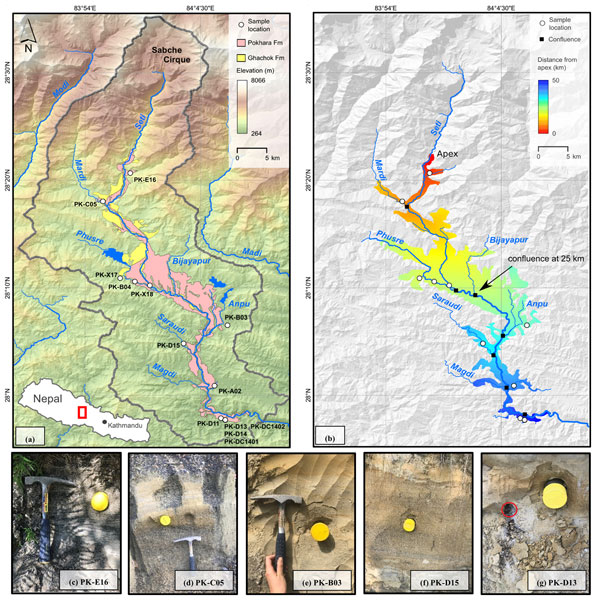
Ongoing deformation of the Himalaya is not constrained to its southern extremity. With morphometric analysis using a high-resolution digital elevation model, satellite image analysis, luminescence chronology of fluvial terraces and field observations, we identify a zone of rapid rock uplift in the interior of the Kashmir Himalaya. Our results suggest active tectonic and structural control on the growth of topography in the Himalayan interiors over multi-millennial timescales.
Dennis Handy, W. Marijn van der Meij, Mirijam Zickel, and Tony Reimann
Geosci. Instrum. Method. Data Syst., 15, 165–181, https://doi.org/10.5194/gi-15-165-2026, https://doi.org/10.5194/gi-15-165-2026, 2026
Short summary
Short summary
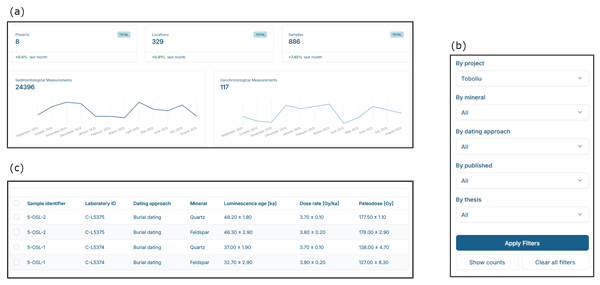
Geoscientific projects often struggle to manage complex data effectively, resulting in valuable information being lost due to poor findability and accessibility. To address this, we present a comprehensive research data framework for storing and processing data throughout a project, from fieldwork to data analysis. This ensures that datasets are clearly defined, reproducible and adhere to the FAIR principles (findability, accessibility, interoperability and reusability).
Linda Andrea Elisabeth Maßon, Simon Matthias May, Svenja Riedesel, Willem Marijn van der Meij, Stephan Opitz, Andreas Peffeköver, and Tony Reimann
EGUsphere, https://doi.org/10.5194/egusphere-2025-5895, https://doi.org/10.5194/egusphere-2025-5895, 2025
Short summary
Short summary
We investigated geomorphological activity and stability of surfaces and soils along a climatic transect in the Atacama Desert. Single grain luminescence data and sediment analyses reveal recent deposition and shallow post-depositional mixing. Two distinct phases of enhanced activity align with previously reported wetter intervals, demonstrating the sensitivity of arid landscape dynamics to climatic variability.
Linda A. E. Maßon, Svenja Riedesel, Stephan Opitz, Anja Zander, Anthony Bell, Hanna Cieszynski, and Tony Reimann
Geochronology, 7, 475–492, https://doi.org/10.5194/gchron-7-475-2025, https://doi.org/10.5194/gchron-7-475-2025, 2025
Short summary
Short summary
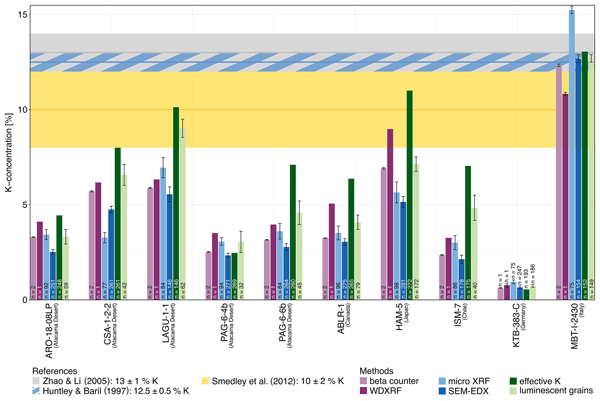
We evaluate different methods for the potassium (K) concentration determination in feldspars and the impact of the K concentrations on dose rate calculations for feldspar luminescence dating. Our results show discrepancies between published K concentrations and our measured K concentrations. Therefore, we emphasize measuring K concentrations via bulk measurements and single-grain techniques to obtain more accurate results.
Svenja Riedesel, Guillaume Guérin, Kristina J. Thomsen, Mariana Sontag-González, Matthias Blessing, Greg A. Botha, Max Hellers, Gunther Möller, Andreas Peffeköver, Christian Sommer, Anja Zander, and Manuel Will
Geochronology, 7, 59–81, https://doi.org/10.5194/gchron-7-59-2025, https://doi.org/10.5194/gchron-7-59-2025, 2025
Short summary
Short summary
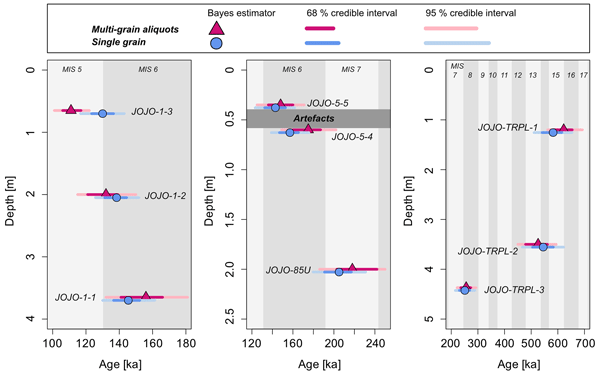
We apply luminescence dating of feldspars to establish a geochronological framework for the sequence of accretionary hillslope deposition at Jojosi, which contains important archaeological artefacts. We test and evaluate four different dose models and their applicability to single-grain and multi-grain data sets containing up to 67 % saturated grains. Our results constrain erosional and depositional processes from 100–700 ka and human occupation of the area in early MIS 5 and late MIS 6.
W. Marijn van der Meij, Svenja Riedesel, and Tony Reimann
SOIL, 11, 51–66, https://doi.org/10.5194/soil-11-51-2025, https://doi.org/10.5194/soil-11-51-2025, 2025
Short summary
Short summary
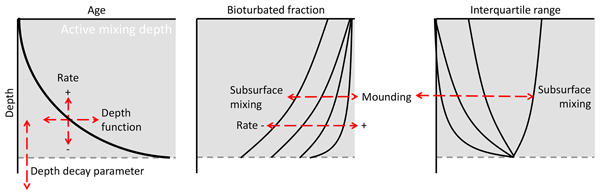
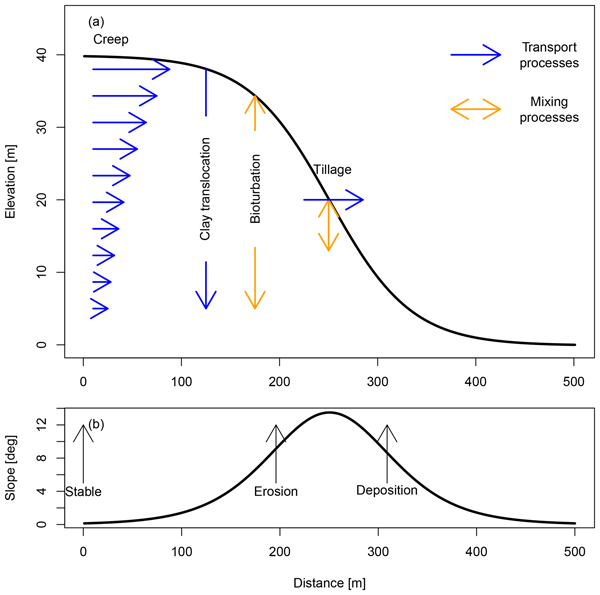
Soil mixing (bioturbation) plays a key role in soil functions, but the underlying processes are poorly understood and difficult to quantify. In this study, we use luminescence, a light-sensitive soil mineral property, and numerical models to better understand different types of bioturbation. We provide a conceptual model that helps to determine which types of bioturbation processes occur in a soil and a numerical model that can derive quantitative process rates from luminescence measurements.
Jungyu Choi, Roy van Beek, Elizabeth L. Chamberlain, Tony Reimann, Harm Smeenge, Annika van Oorschot, and Jakob Wallinga
SOIL, 10, 567–586, https://doi.org/10.5194/soil-10-567-2024, https://doi.org/10.5194/soil-10-567-2024, 2024
Short summary
Short summary
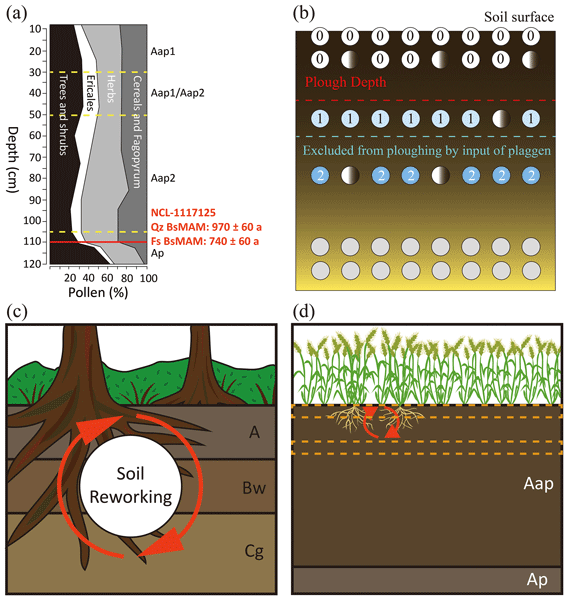
This research applies luminescence dating methods to a plaggic anthrosol in the eastern Netherlands to understand the formation history of the soil. To achieve this, we combined both quartz and feldspar luminescence dating methods. We developed a new method for feldspar to largely avoid the problem occurring from poorly bleached grains by examining two different signals from a single grain. Through our research, we were able to reconstruct the timing and processes of plaggic anthrosol formation.
Anna-Maartje de Boer, Wolfgang Schwanghart, Jürgen Mey, Basanta Raj Adhikari, and Tony Reimann
Geochronology, 6, 53–70, https://doi.org/10.5194/gchron-6-53-2024, https://doi.org/10.5194/gchron-6-53-2024, 2024
Short summary
Short summary
This study tested the application of single-grain feldspar luminescence for dating and reconstructing sediment dynamics of an extreme mass movement event in the Himalayan mountain range. Our analysis revealed that feldspar signals can be used to estimate the age range of the deposits if the youngest subpopulation from a sample is retrieved. The absence of clear spatial relationships with our bleaching proxies suggests that sediments were transported under extremely limited light exposure.
Jürgen Mey, Wolfgang Schwanghart, Anna-Maartje de Boer, and Tony Reimann
Geochronology, 5, 377–389, https://doi.org/10.5194/gchron-5-377-2023, https://doi.org/10.5194/gchron-5-377-2023, 2023
Short summary
Short summary
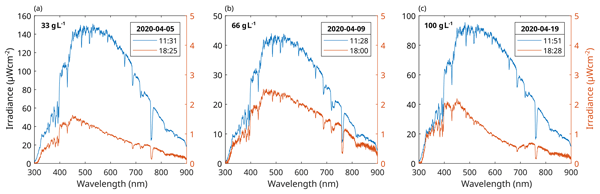
This study presents the results of an outdoor flume experiment to evaluate the effect of turbidity on the bleaching of fluvially transported sediment. Our main conclusions are that even small amounts of sediment lead to a substantial change in the intensity and frequency distribution of light within the suspension and that flow turbulence is an important prerequisite for bleaching grains during transport.
W. Marijn van der Meij, Arnaud J. A. M. Temme, Steven A. Binnie, and Tony Reimann
Geochronology, 5, 241–261, https://doi.org/10.5194/gchron-5-241-2023, https://doi.org/10.5194/gchron-5-241-2023, 2023
Short summary
Short summary
We present our model ChronoLorica. We coupled the original Lorica model, which simulates soil and landscape evolution, with a geochronological module that traces cosmogenic nuclide inventories and particle ages through simulations. These properties are often measured in the field to determine rates of landscape change. The coupling enables calibration of the model and the study of how soil, landscapes and geochronometers change under complex boundary conditions such as intensive land management.
Léopold de Lavaissière, Stéphane Bonnet, Anne Guyez, and Philippe Davy
Earth Surf. Dynam., 10, 229–246, https://doi.org/10.5194/esurf-10-229-2022, https://doi.org/10.5194/esurf-10-229-2022, 2022
Short summary
Short summary
Rivers are known to record changes in tectonic or climatic variation through long adjustment of their longitudinal profile slope. Here we describe such adjustments in experimental landscapes and show that they may result from the sole effect of intrinsic geomorphic processes. We propose a new model of river evolution that links long profile adjustment to cycles of river widening and narrowing. This result emphasizes the need to better understand control of lateral erosion on river width.
Saptarshi Dey, Rasmus C. Thiede, Arindam Biswas, Naveen Chauhan, Pritha Chakravarti, and Vikrant Jain
Earth Surf. Dynam., 9, 463–485, https://doi.org/10.5194/esurf-9-463-2021, https://doi.org/10.5194/esurf-9-463-2021, 2021
Short summary
Short summary
Ongoing deformation of the Himalaya is not constrained to its southern extremity. With morphometric analysis using a high-resolution digital elevation model, satellite image analysis, luminescence chronology of fluvial terraces and field observations, we identify a zone of rapid rock uplift in the interior of the Kashmir Himalaya. Our results suggest active tectonic and structural control on the growth of topography in the Himalayan interiors over multi-millennial timescales.
Cited articles
Aceituno, P., Boisier, J. P., Garreaud, R., Rondanelli, R., Rutllant, J. A.: Climate and Weather in Chile, in: Fernández, B., Gironás, J. (eds) Water Resources of Chile, World Water Resources, vol. 8, Springer, Cham. https://doi.org/10.1007/978-3-030-56901-3_2, 2021.
Alexanderson, H. and Murray, A. S.: Luminescence signals from modern sediments in a glaciated bay, NW Svalbard, Quat. Geochronol., 10, 250–256, https://doi.org/10.1016/j.quageo.2012.01.001, 2012.
Bateman, M. D.: Luminescence dating of periglacial sediments and structures, Boreas, 37, 574–588, https://doi.org/10.1111/j.1502-3885.2008.00050.x, 2008.
Biswas, A., Riedesel, S., Karman-Besson, L., Hellers, M., Guyez, A., Bonnet, S., and Reimann, T.: Novel insights into the post-IR IRSL200 signal bleachability of single-grain K-feldspars in fluvial modern analogues from the Southern Central Andes, Chile, Zenodo [data set], https://doi.org/10.5281/zenodo.19971385, 2026.
Bonnet, S., Reimann, T., Wallinga, J., Lague, D., Davy, P., and Lacoste, A.: Landscape dynamics revealed by luminescence signals of feldspars from fluvial terraces, Sci. Rep., 9, 8569, https://doi.org/10.1038/s41598-019-44533-4, 2019.
Bøtter-Jensen, L., Andersen, C. E., Duller, G. A., and Murray, A. S.: Developments in radiation, stimulation and observation facilities in luminescence measurements, Radiat. Meas., 37, 535–541, https://doi.org/10.1016/S1350-4487(03)00020-9, 2003.
Brill, D., Reimann, T., Wallinga, J., May, S. M., Engel, M., Riedesel, S., and Brückner, H.: Testing the accuracy of feldspar single grains to date late Holocene cyclone and tsunami deposits, Quat. Geochronol., 48, 91–103, https://doi.org/10.1016/j.quageo.2018.09.001, 2018.
Buylaert, J. P., Murray, A. S., Thomsen, K. J., and Jain, M.: Testing the potential of an elevated temperature IRSL signal from K-feldspar, Radiat. Meas., 44, 560–565, https://doi.org/10.1016/j.radmeas.2009.02.007, 2009.
Buylaert, J. P., Jain, M., Murray, A. S., Thomsen, K. J., Thiel, C., and Sohbati, R.: A robust feldspar luminescence dating method for Middle and Late Pleistocene sediments, Boreas, 41, 435–451, https://doi.org/10.1111/j.1502-3885.2012.00248.x, 2012.
Buylaert, J. P., Újvári, G., Murray, A. S., Smedley, R. K., and Kook, M.: On the relationship between K concentration, grain size and dose in feldspar, Radiat. Meas., 120, 181–187, https://doi.org/10.1016/j.radmeas.2018.06.003, 2018.
Chamberlain, E. L. and Wallinga, J.: Seeking enlightenment of fluvial sediment pathways by optically stimulated luminescence signal bleaching of river sediments and deltaic deposits, Earth Surf. Dynam., 7, 723–736, https://doi.org/10.5194/esurf-7-723-2019, 2019.
Chamberlain, E. L., Wallinga, J., Reimann, T., Goodbred Jr, S. L., Steckler, M. S., Shen, Z., and Sincavage, R.: Luminescence dating of delta sediments: Novel approaches explored for the Ganges-Brahmaputra-Meghna Delta, Quat. Geochronol., 41, 97–111, https://doi.org/10.1016/j.quageo.2017.06.006, 2017.
Choi, J., Chamberlain, E., and Wallinga, J.: Variance in pIRIR signal bleaching for single grains of feldspar, Quat. Geochronol., 83, 101577, https://doi.org/10.1016/j.quageo.2024.101577, 2024.
de Boer, A.-M., Schwanghart, W., Mey, J., Adhikari, B. R., and Reimann, T.: Insight into the dynamics of a long-runout mass movement using single-grain feldspar luminescence in the Pokhara Valley, Nepal, Geochronology, 6, 53–70, https://doi.org/10.5194/gchron-6-53-2024, 2024.
Duller, G. A.: Single-grain optical dating of Quaternary sediments: why aliquot size matters in luminescence dating, Boreas, 37, 589–612, https://doi.org/10.1111/j.1502-3885.2008.00051.x, 2008.
Fu, X. and Li, S. H.: A modified multi-elevated-temperature post-IR IRSL protocol for dating Holocene sediments using K-feldspar, Quat. Geochronol., 17, 44–54, https://doi.org/10.1016/j.quageo.2013.02.004, 2013.
Garreaud, R. D., Vuille, M., Compagnucci, R., and Marengo, J.: Present-day South American climate, Palaeogeogr. Palaeocl., 281, 180–195, https://doi.org/10.1016/j.palaeo.2007.10.032, 2009.
Gemmell, A. M. D.: Zeroing of the TL signal of sediment undergoing fluvial transportation: a laboratory experiment, Nucl. Tracks, 10, 695–702, https://doi.org/10.1016/0735-245X(85)90077-8, 1985.
Godfrey-Smith, D. I., Huntley, D. J., and Chen, W. H.: Optical dating studies of quartz and feldspar sediment extracts, Quaternary Sci. Rev., 7, 373–380, https://doi.org/10.1016/0277-3791(88)90032-7, 1988.
Gray, H. J., Tucker, G. E., and Mahan, S. A.: Application of a luminescence-based sediment transport model, Geophys. Res. Lett., 45, 6071–6080, https://doi.org/10.1029/2018GL078210, 2018.
Guralnik, B., Li, B., Jain, M., Chen, R., Paris, R. B., Murray, A. S., Li, S. H., Pagonis, V., Valla, P. G., and Herman, F.: Radiation-induced growth and isothermal decay of infrared-stimulated luminescence from feldspar, Radiat. Meas., 81, 224–231, https://doi.org/10.1016/j.radmeas.2015.02.011, 2015.
Guyez, A., Bonnet, S., Reimann, T., Carretier, S., and Wallinga, J.: Illuminating past river incision, sediment source and pathways using luminescence signals of individual feldspar grains (Rangitikei River, New Zealand), Earth Surf. Proc. Land., 47, 1952–1971, https://doi.org/10.1002/esp.5357, 2022.
Guyez, A., Bonnet, S., Reimann, T., Carretier, S., and Wallinga, J.: A novel approach to quantify sediment transfer and storage in rivers-testing feldspar single-grain pIRIR analysis and numerical simulations, J. Geophys. Res.-Earth, 128, e2022JF006727, https://doi.org/10.1029/2022JF006727, 2023.
Huffman, G. J., Stocker, E. F., Bolvin, D. T., Nelkin, E. J., and Tan, J.: GPM IMERG Final Precipitation L3 1 day 0.1 degree x 0.1 degree V07, edited by: Savtchenko, A., Greenbelt, MD, Goddard Earth Sciences Data and Information Services Center (GES DISC), (last access: 17 May 2023), https://doi.org/10.5067/GPM/IMERGDF/DAY/06, 2023
Jain, M., Murray, A. S., and Botter-Jensen, L.: Optically stimulated luminescence dating: how significant is incomplete light exposure in fluvial environments?, Quaternaire, 15, 143–157, https://doi.org/10.3406/quate.2004.1762, 2004.
Joordens, J. C., d'Errico, F., Wesselingh, F. P., Munro, S., De Vos, J., Wallinga, J., Ankjærgaard, C., Reimann, T., Wijbrans, J. R., Kuiper, K. F., Mücher, H. J., Coqueugniot, H., Lustenhouwer, W., Reijmer, J. J., and Roebroeks, W.: Homo erectus at Trinil on Java used shells for tool production and engraving, Nature, 518, 228–231, https://doi.org/10.1038/nature13962, 2015.
Kars, R. H., Reimann, T., Ankjærgaard, C., and Wallinga, J.: Bleaching of the post-IR IRSL signal: new insights for feldspar luminescence dating, Boreas, 43, 780–791, https://doi.org/10.1111/bor.12082, 2014.
King, G. E., Robinson, R. A. J., and Finch, A. A.: Apparent OSL ages of modern deposits from Fåbergstølsdalen, Norway: implications for sampling glacial sediments, J. Quaternary Sci., 28, 673–682, https://doi.org/10.1002/jqs.2666, 2013.
King, G. E., Sanderson, D. C., Robinson, R. A., and Finch, A. A.: Understanding processes of sediment bleaching in glacial settings using a portable OSL reader, Boreas, 43, 955–972, https://doi.org/10.1111/bor.12078, 2014.
Kreutzer, S., Burow, C., Dietze, M., Fuchs, M.C., Schmidt, C., Fischer, M., Friedrich, J., Mercier, N., Philippe, A., Riedesel, S., Autzen, M., Mittelstrass, D., Gray, H. J., and Galharret, J.: Luminescence: Comprehensive Luminescence Dating Data Analysis, R package version 0.9.23, CRAN, https://CRAN.R-project.org/package=Luminescence (last access: 30 August 2025), 2023.
Lowick, S. E., Trauerstein, M., and Preusser, F.: Testing the application of post IR-IRSL dating to fine grain waterlain sediments, Quat. Geochronol., 8, 33–40, https://doi.org/10.1016/j.quageo.2011.12.003, 2012.
Madsen, A. T., Buylaert, J. P., and Murray, A. S.: Luminescence dating of young coastal deposits from New Zealand using feldspar, Geochronometria, 38, 379–390, https://doi.org/10.2478/s13386-011-0042-5, 2011.
Maßon, L. A., Riedesel, S., Zander, A., Sontag-González, M., and Reimann, T.: Testing the applicability of standardised growth curves for chemically heterogeneous single-grain feldspars from the Atacama Desert, Chile, Quat. Geochronol., 83, 101585, https://doi.org/10.1016/j.quageo.2024.101585, 2024.
McGuire, C. and Rhodes, E. J.: Determining fluvial sediment virtual velocity on the Mojave River using K-feldspar IRSL: Initial assessment, Quaternary Int., 362, 124–131, https://doi.org/10.1016/j.quaint.2014.07.055, 2015.
Murray, A. S., Thomsen, K. J., Masuda, N., Buylaert, J. P., and Jain, M.: Identifying well-bleached quartz using the different bleaching rates of quartz and feldspar luminescence signals, Radiat. Meas., 47, 688–695, https://doi.org/10.1016/j.radmeas.2012.05.006, 2012.
Ollerhead, J., and Huntley, D. J.: Optical dating of young feldspars: the zeroing question, Ancient TL, 29, 59–63, https://doi.org/10.26034/la.atl.v29.i2, 2011.
Peng, J. and Li, B.: Single-aliquot regenerative-dose (SAR) and standardised growth curve (SGC) equivalent dose determination in a batch model using the R Package `numOSL', Ancient TL, 35, 32–53, https://doi.org/10.26034/la.atl.2017.516, 2017.
Peng, J., Dong, Z., Han, F., Long, H., and Liu, X.: R package numOSL: numeric routines for optically stimulated luminescence dating, Ancient TL, 31, 41–48, ttps://doi.org/10.26034/la.atl.2013.473, 2013.
Potts, P. J.: A handbook of silicate rock analysis, Springer Science & Business Media, https://doi.org/10.1007/978-1-4615-3270-5, 2012.
Preusser, F., Degering, D., Fuchs, M., Hilgers, A., Kadereit, A., Klasen, N., Krbetschek, M., Richter, D., and Spencer, J. Q. G.: Luminescence dating: basics, methods and applications, E&G Quaternary Sci. J., 57, 95–149, https://doi.org/10.3285/eg.57.1-2.5, 2008.
Reimann, T. and Tsukamoto, S.: Dating the recent past (< 500 years) by post-IR IRSL feldspar – Examples from the North Sea and Baltic Sea coast, Quat. Geochronol., 10, 180–187, https://doi.org/10.1016/j.quageo.2012.04.011, 2012.
Reimann, T., Tsukamoto, S., Naumann, M., and Frechen, M.: The potential of using K-rich feldspars for optical dating of young coastal sediments – a test case from Darss-Zingst peninsula (southern Baltic Sea coast), Quat. Geochronol, 6, 207–222, https://doi.org/10.1016/j.quageo.2010.10.001, 2011.
Reimann, T., Lindhorst, S., Thomsen, K. J., Murray, A. S., and Frechen, M.: OSL dating of mixed coastal sediment (Sylt, German Bight, North Sea), Quat. Geochronol., 11, 52–67, https://doi.org/10.1016/j.quageo.2012.04.006, 2012.
Reimann, T., Notenboom, P. D., De Schipper, M. A., and Wallinga, J.: Testing for sufficient signal resetting during sediment transport using a polymineral multiple-signal luminescence approach, Quat. Geochronol., 25, 26–36, https://doi.org/10.1016/j.quageo.2014.09.002, 2015.
Rhodes, E. J. and Leathard, J. A.: MET-IRSL used to track pre-depositional sediment transport history, Quat. Geochronol., 70, 101294, https://doi.org/10.1016/j.quageo.2022.101294, 2022.
Riedesel, S., Guérin, G., Thomsen, K. J., Sontag-González, M., Blessing, M., Botha, G. A., Hellers, M., Möller, G., Peffeköver, A., Sommer, C., Zander, A., and Will, M.: A direct comparison of single-grain and multi-grain aliquot luminescence dating of feldspars from colluvial deposits in KwaZulu-Natal, South Africa, Geochronology, 7, 59–81, https://doi.org/10.5194/gchron-7-59-2025, 2025.
Rittenour, T. M.: Luminescence dating of fluvial deposits: applications to geomorphic, palaeoseismic and archaeological research, Boreas, 37, 613–635, https://doi.org/10.1111/j.1502-3885.2008.00056.x, 2008.
Rodnight, H.: How many equivalent dose values are needed to obtain a reproducible distribution?, Ancient Tl, 26, 3–9, 2008.
Rodriguez Piceda, C., Scheck-Wenderoth, M., Gomez Dacal, M. L., Prezzi, C. and Strecker, M.: Lithospheric-scale 3D model of the Southern Central Andes, GFZ Data Services, https://doi.org/10.5880/GFZ.4.5.2020.001, 2020.
Sheather, S. J. and Jones, M. C.: A reliable data-based bandwidth selection method for kernel density estimation, J. R. Stat. Soc. B., 53, 683–690, https://doi.org/10.1111/j.2517-6161.1991.tb01857.x, 1991.
Silverman, B. W.: Density Estimation for Statistics and Data Analysis, 1st Edn., Routledge, https://doi.org/10.1201/9781315140919, 1998.
Sohbati, R., Murray, A. S., Buylaert, J. P., Ortuño, M., Cunha, P. P., and Masana, E.: Luminescence dating of Pleistocene alluvial sediments affected by the Alhama de Murcia fault (eastern Betics, Spain) – a comparison between OSL, IRSL and post-IR IRSL ages, Boreas, 41, 250–262, https://doi.org/10.1111/j.1502-3885.2011.00230.x, 2012.
Smedley, R. K., Duller, G. A. T., and Roberts, H. M.: Bleaching of the post-IR IRSL signal from individual grains of K-feldspar: Implications for single-grain dating, Radiat. Meas., 79, 33–42, https://doi.org/10.1016/j.radmeas.2015.06.003, 2015.
Smedley, R. K., Buylaert, J. P., and Újvári, G.: Comparing the accuracy and precision of luminescence ages for partially-bleached sediments using single grains of K-feldspar and quartz, Quat. Geochronol., 53, 101007, https://doi.org/10.1016/j.quageo.2019.101007, 2019.
Stevens, T., Marković, S. B., Zech, M., Hambach, U., and Sümegi, P.: Dust deposition and climate in the Carpathian Basin over an independently dated last glacial-interglacial cycle, Quaternary Sci. Rev., 30, 662–681, https://doi.org/10.1016/j.quascirev.2010.12.011, 2011.
Strecker, M. R., Alonso, R. N., Bookhagen, B., Carrapa, B., Hilley, G. E., Sobel, E. R., and Trauth, M. H.: Tectonics and climate of the southern central Andes, Annu. Rev. Earth Pl. Sc., 35, 747–787, https://doi.org/10.1146/annurev.earth.35.031306.140158, 2007.
Thiel, C., Buylaert, J. P., Murray, A., Terhorst, B., Hofer, I., Tsukamoto, S., and Frechen, M.: Luminescence dating of the Stratzing loess profile (Austria) – Testing the potential of an elevated temperature post-IR IRSL protocol, Quaternary Int., 234, 23–31, https://doi.org/10.1016/j.quaint.2010.05.018, 2011.
Thomsen, K. J., Murray, A. S., Jain, M., and Bøtter-Jensen, L.: Laboratory fading rates of various luminescence signals from feldspar-rich sediment extracts, Radiat. Meas., 43, 1474–1486, https://doi.org/10.1016/j.radmeas.2008.06.002, 2008.
Wallinga, J.: Optically stimulated luminescence dating of fluvial deposits: a review, Boreas, 31, 303–322, https://doi.org/10.1111/j.1502-3885.2002.tb01076.x, 2002.
Yi, S., Buylaert, J. P., Murray, A. S., Lu, H., Thiel, C., and Zeng, L.: A detailed post-IR IRSL dating study of the Niuyangzigou loess site in northeastern China, Boreas, 45, 644–657, https://doi.org/10.1111/bor.12185, 2016.
Zhang, J., Guralnik, B., Tsukamoto, S., Ankjærgaard, C., and Reimann, T.: The bleaching limits of IRSL signals at various stimulation temperatures and their potential inference of the pre-burial light exposure duration, Front. Earth Sci., 10, 933131, https://doi.org/10.3389/feart.2022.933131, 2023.
Zhao, H. and Li, S. H.: Internal dose rate to K-feldspar grains from radioactive elements other than potassium, Radiat. Meas., 40, 84–93, https://doi.org/10.1016/j.radmeas.2004.11.004, 2005.
Short summary
We evaluate luminescence signal resetting in single-grain K-feldspar from modern fluvial analogues in Chile. Our results show a uniform sample-average bleaching trend but strong grain-scale variability. Residual doses are independent of feldspar geochemistry and catchment lithology but scale with natural dose. Taken together, these findings refine palaeodose correction strategies and support defining sample‑specific bleaching thresholds for luminescence‑based sediment tracing.
We evaluate luminescence signal resetting in single-grain K-feldspar from modern fluvial...