Articles | Volume 5, issue 2
https://doi.org/10.5194/gchron-5-361-2023
© Author(s) 2023. This work is distributed under
the Creative Commons Attribution 4.0 License.
https://doi.org/10.5194/gchron-5-361-2023
© Author(s) 2023. This work is distributed under
the Creative Commons Attribution 4.0 License.
Technical note: Studying lithium metaborate fluxes and extraction protocols with a new, fully automated in situ cosmogenic 14C processing system at PRIME Lab
Department of Earth, Atmospheric, and Planetary Sciences, Purdue
University, 550 Stadium Mall Drive, West Lafayette, Indiana
47907, USA
Department of Physics and Astronomy and Purdue Rare Isotope
Measurement Laboratory (PRIME Lab), Purdue University, 525 Northwestern
Avenue, West Lafayette, Indiana 47907, USA
Jim Wilson
Aeon Laboratories, LLC, 5835 North Genematas Drive, Tucson, Arizona
85704, USA
Allie Koester
Department of Earth, Atmospheric, and Planetary Sciences, Purdue
University, 550 Stadium Mall Drive, West Lafayette, Indiana
47907, USA
Related authors
Arjen P. Stroeven, Gunhild C. Rosqvist, Allie J. Koester, Jane L. Andersen, Carl-Anton Wahlström, and Nathaniel A. Lifton
EGUsphere, https://doi.org/10.5194/egusphere-2026-447, https://doi.org/10.5194/egusphere-2026-447, 2026
This preprint is open for discussion and under review for Climate of the Past (CP).
Short summary
Short summary
Did Scandinavian glaciers survive the warmer conditions of the early Holocene? Ice thickness measurements, proglacial lake sediment, and cosmogenic nuclides in bedrock alongside Riukojietna, a small low-elevation ice cap in northern Sweden, all combine to constrain a glacier advance and retreat history since 9.8 thousand years ago. Riukojietna was small but persisted through the early Holocene, illustrating that other but higher-elevation valley glaciers in the region may also have done so.
Bradley W. Goodfellow, Arjen P. Stroeven, Nathaniel A. Lifton, Jakob Heyman, Alexander Lewerentz, Kristina Hippe, Jens-Ove Näslund, and Marc W. Caffee
Geochronology, 6, 291–302, https://doi.org/10.5194/gchron-6-291-2024, https://doi.org/10.5194/gchron-6-291-2024, 2024
Short summary
Short summary
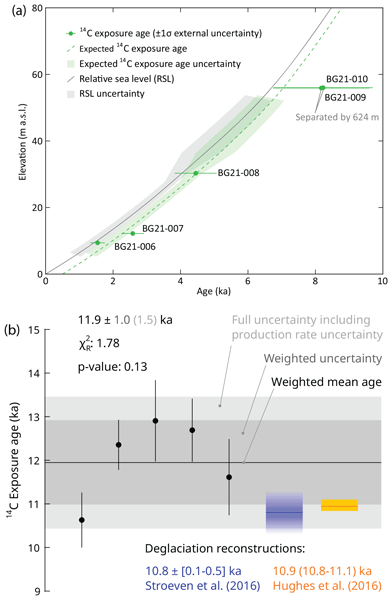
Carbon-14 produced in quartz (half-life of 5700 ± 30 years) provides a new tool to date exposure of bedrock surfaces. Samples from 10 exposed bedrock surfaces in east-central Sweden give dates consistent with the timing of both landscape emergence above sea level through postglacial rebound and retreat of the last ice sheet shown in previous reconstructions. Carbon-14 in quartz can therefore be used for dating in landscapes where isotopes with longer half-lives give complex exposure results.
Alexandria J. Koester and Nathaniel A. Lifton
Geochronology, 5, 21–33, https://doi.org/10.5194/gchron-5-21-2023, https://doi.org/10.5194/gchron-5-21-2023, 2023
Short summary
Short summary
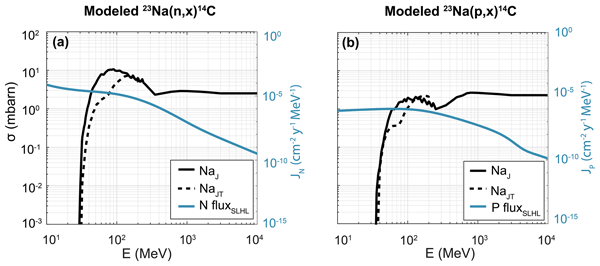
In situ 14C’s short half-life (5.7 kyr) is unique among cosmogenic nuclides, making it sensitive to complex exposure and burial histories since 25 ka. Current extraction methods focus on quartz, but the ability to extract it from other minerals would expand applications. We developed MATLAB® scripts to calculate in situ 14C production rates from a broad range of mineral compositions. Results confirm O, Si, Al, and Mg as key targets but also find significant production from Na for the first time.
Martim Mas e Braga, Richard Selwyn Jones, Jennifer C. H. Newall, Irina Rogozhina, Jane L. Andersen, Nathaniel A. Lifton, and Arjen P. Stroeven
The Cryosphere, 15, 4929–4947, https://doi.org/10.5194/tc-15-4929-2021, https://doi.org/10.5194/tc-15-4929-2021, 2021
Short summary
Short summary
Mountains higher than the ice surface are sampled to know when the ice reached the sampled elevation, which can be used to guide numerical models. This is important to understand how much ice will be lost by ice sheets in the future. We use a simple model to understand how ice flow around mountains affects the ice surface topography and show how much this influences results from field samples. We also show that models need a finer resolution over mountainous areas to better match field samples.
Arjen P. Stroeven, Gunhild C. Rosqvist, Allie J. Koester, Jane L. Andersen, Carl-Anton Wahlström, and Nathaniel A. Lifton
EGUsphere, https://doi.org/10.5194/egusphere-2026-447, https://doi.org/10.5194/egusphere-2026-447, 2026
This preprint is open for discussion and under review for Climate of the Past (CP).
Short summary
Short summary
Did Scandinavian glaciers survive the warmer conditions of the early Holocene? Ice thickness measurements, proglacial lake sediment, and cosmogenic nuclides in bedrock alongside Riukojietna, a small low-elevation ice cap in northern Sweden, all combine to constrain a glacier advance and retreat history since 9.8 thousand years ago. Riukojietna was small but persisted through the early Holocene, illustrating that other but higher-elevation valley glaciers in the region may also have done so.
Bradley W. Goodfellow, Arjen P. Stroeven, Nathaniel A. Lifton, Jakob Heyman, Alexander Lewerentz, Kristina Hippe, Jens-Ove Näslund, and Marc W. Caffee
Geochronology, 6, 291–302, https://doi.org/10.5194/gchron-6-291-2024, https://doi.org/10.5194/gchron-6-291-2024, 2024
Short summary
Short summary
Carbon-14 produced in quartz (half-life of 5700 ± 30 years) provides a new tool to date exposure of bedrock surfaces. Samples from 10 exposed bedrock surfaces in east-central Sweden give dates consistent with the timing of both landscape emergence above sea level through postglacial rebound and retreat of the last ice sheet shown in previous reconstructions. Carbon-14 in quartz can therefore be used for dating in landscapes where isotopes with longer half-lives give complex exposure results.
Alexandria J. Koester and Nathaniel A. Lifton
Geochronology, 5, 21–33, https://doi.org/10.5194/gchron-5-21-2023, https://doi.org/10.5194/gchron-5-21-2023, 2023
Short summary
Short summary
In situ 14C’s short half-life (5.7 kyr) is unique among cosmogenic nuclides, making it sensitive to complex exposure and burial histories since 25 ka. Current extraction methods focus on quartz, but the ability to extract it from other minerals would expand applications. We developed MATLAB® scripts to calculate in situ 14C production rates from a broad range of mineral compositions. Results confirm O, Si, Al, and Mg as key targets but also find significant production from Na for the first time.
Martim Mas e Braga, Richard Selwyn Jones, Jennifer C. H. Newall, Irina Rogozhina, Jane L. Andersen, Nathaniel A. Lifton, and Arjen P. Stroeven
The Cryosphere, 15, 4929–4947, https://doi.org/10.5194/tc-15-4929-2021, https://doi.org/10.5194/tc-15-4929-2021, 2021
Short summary
Short summary
Mountains higher than the ice surface are sampled to know when the ice reached the sampled elevation, which can be used to guide numerical models. This is important to understand how much ice will be lost by ice sheets in the future. We use a simple model to understand how ice flow around mountains affects the ice surface topography and show how much this influences results from field samples. We also show that models need a finer resolution over mountainous areas to better match field samples.
Cited articles
Binnie, S. A., Dewald, A., Heinze, S., Voronina, E., Hein, A., Wittmann, H.,
Blanckenburg, F. von, Hetzel, R., Christl, M., Schaller, M., Léanni, L.,
Team, A., Hippe, K., Vockenhuber, C., Ivy-Ochs, S., Maden, C.,
Fülöp, R.-H., Fink, D., Wilcken, K. M., Fujioka, T., Fabel, D.,
Freeman, S. P. H. T., Xu, S., Fifield, L. K., Akçar, N., Spiegel, C.,
and Dunai, T. J.: Preliminary results of CoQtz-N: A quartz reference
material for terrestrial in-situ cosmogenic 10Be and 26Al
measurements, Nucl. Instrum. Meth. B, 456, 203–212,
https://doi.org/10.1016/j.nimb.2019.04.073, 2019.
Donahue, D. J., Jull, A. J. T., and Toolin, L.: Radiocarbon measurements at
the University of Arizona AMS facility, Nucl. Instrum. Meth. B, 52, 224–228, 1990.
Donahue, D. J., Beck, J. W., Biddulph, D., Burr, G. S., Courtney, C., Damon,
P. E., Hatheway, A., Hewitt, L., Jull, A. J. T., Lange, T., Lifton, N.,
Maddock, R., McHargue, L., O'Malley, J. M., and Toolin, L.: Status of the
NSF-Arizona AMS laboratory, Nucl. Instrum. Meth. B, 123, 51–56, 1997.
Fülöp, R., Naysmith, P., Cook, G., and Fabel, D.: Update on the
performance of the SUERC in situ cosmogenic 14C extraction line, Radiocarbon,
52, 1288–1294, 2010.
Fülöp, R. H., Wacker, L., and Dunai, T. J.: Progress report on a
novel in situ 14C extraction scheme at the University of Cologne, Nucl. Instrum. Meth. B, 361, 20–24,
https://doi.org/10.1016/j.nimb.2015.02.023, 2015.
Fülöp, R.-H., Fink, D., Yang, B., Codilean, A. T., Smith, A.,
Wacker, L., Levchenko, V., and Dunai, T. J.: The ANSTO – University of
Wollongong in-situ 14C extraction laboratory, Nucl. Instrum. Meth. B, 438, 207–213,
https://doi.org/10.1016/j.nimb.2018.04.018, 2019.
Goehring, B. M., Wilson, J., and Nichols, K.: A fully automated system for
the extraction of in situ cosmogenic carbon-14 in the Tulane University cosmogenic
nuclide laboratory, Nucl. Instrum. Meth. B,
455, 284–292, https://doi.org/10.1016/j.nimb.2019.02.006, 2019.
Hippe, K. and Lifton, N. A.: Calculating Isotope Ratios and Nuclide
Concentrations for In Situ Cosmogenic 14C Analyses, Radiocarbon, 56,
1167–1174, https://doi.org/10.2458/56.17917, 2014.
Hippe, K., Kober, F., Baur, H., Ruff, M., Wacker, L., and Wieler, R.: The
current performance of the in situ 14C extraction line at ETH, Quat.
Geochronol., 4, 493–500, https://doi.org/10.1016/j.quageo.2009.06.001,
2009.
Hippe, K., Kober, F., Wacker, L., Fahrni, S. M., Ivy-Ochs, S., Akcar, N.,
Schluchter, C., and Wieler, R.: An update on in situ cosmogenic 14C analysis
at ETH Zürich, Nucl. Instrum. Meth. B, 294,
81–86, 2013.
Jull, A. J. T., Scott, E. M., and Bierman, P.: The CRONUS-Earth
inter-comparison for cosmogenic isotope analysis, Quat. Geochronol.,
26, 3–10, https://doi.org/10.1016/j.quageo.2013.09.003, 2015.
Lamp, J. L., Young, N. E., Koffman, T., Schimmelpfennig, I., Tuna, T., Bard,
E., and Schaefer, J. M.: Update on the cosmogenic in situ 14C laboratory at
the Lamont-Doherty Earth Observatory, Nucl. Instrum. Meth. B, 456, 157–162, https://doi.org/10.1016/j.nimb.2019.05.064,
2019.
Lifton, N., Jull, A., and Quade, J.: A new extraction technique and
production rate estimate for in situ cosmogenic 14C in quartz, Geochim.
Cosmochim. Ac., 65, 1953–1969, 2001.
Lifton, N., Goehring, B., Wilson, J., Kubley, T., and Caffee, M.: Progress
in automated extraction and purification of in situ 14C from quartz: Results
from the Purdue in situ 14C laboratory, Nucl. Instrum. Meth. B, 361, 381–386, https://doi.org/10.1016/j.nimb.2015.03.028,
2015.
Lupker, M., Hippe, K., Wacker, L., Steinemann, O., Tikhomirov, D., Maden,
C., Haghipour, N., and Synal, H.-A.: In-situ cosmogenic 14C analysis at
ETH Zürich: Characterization and performance of a new extraction system, Nucl. Instrum. Meth. B, 457, 30–36,
https://doi.org/10.1016/j.nimb.2019.07.028, 2019.
Nichols, K. A. and Goehring, B. M.: Isolation of quartz for cosmogenic in situ
14C analysis, Geochronology, 1, 43–52,
https://doi.org/10.5194/gchron-1-43-2019, 2019.
Pigati, J., Lifton, N., Jull, A. J. T., and Quade, J.: A simplified in situ
cosmogenic 14C extraction system, Radiocarbon, 52, 1236–1243, 2010.
Santos, G. M., Southon, J. R., Druffel-Rodriguez, K., Griffin, S., and
Mazon, M.: Magnesium Perchlorate as an Alternative Water Trap in AMS
Graphite Sample Preparation: A Report on Sample Preparation at KCCAMS at the
University of California, Irvine, Radiocarbon, 46, 165–174, 2004.
Schiffer, M., Stolz, A., López, D. A., Spanier, R., Herb, S.,
Müller-Gatermann, C., Heinze, S., Binnie, S., Melchert, J., Kivel, N.,
Schumann, D., Rethemeyer, J., Dunai, T., and Dewald, A.: Method developments
for accelerator mass spectrometry at CologneAMS, burial dating and
ultra-small 14CO2 samples, Glob. Planet. Change, 184,
103053, https://doi.org/10.1016/j.gloplacha.2019.103053, 2020.
Southon, J.: Graphite reactor memory – Where is it from and how to minimize
it?, Nucl. Instrum. Meth. B, 259, 288–292, 2007.
Short summary
We describe a new, fully automated extraction system for in situ 14C at PRIME Lab that incorporates more reliable components and designs than our original systems. We use a LiBO2 flux to dissolve a quartz sample in oxygen after removing contaminant 14C with a lower-temperature combustion step. Experiments with new Pt/Rh sample boats demonstrated reduced procedural blanks, and analyses of well-characterized intercomparison materials tested the effects of process variables on 14C yields.
We describe a new, fully automated extraction system for in situ 14C at PRIME Lab that...