Articles | Volume 6, issue 4
https://doi.org/10.5194/gchron-6-541-2024
© Author(s) 2024. This work is distributed under
the Creative Commons Attribution 4.0 License.
https://doi.org/10.5194/gchron-6-541-2024
© Author(s) 2024. This work is distributed under
the Creative Commons Attribution 4.0 License.
Technical note: Altitude scaling of 36Cl production from Fe

Angus K. Moore
CORRESPONDING AUTHOR
Department of Earth, Atmospheric, and Planetary Sciences, Purdue University, 550 Stadium Mall Drive, West Lafayette, IN 47907, USA
now at: Georges Lemaître Centre for Earth and Climate Research, Earth and Life Institute, UCLouvain, Place Louis Pasteur 3, 1348 Louvain-la-Neuve, Belgium
Darryl E. Granger
Department of Earth, Atmospheric, and Planetary Sciences, Purdue University, 550 Stadium Mall Drive, West Lafayette, IN 47907, USA
Related authors
Angus Moore, Maud Henrion, Yanfei Li, Eléonore du bois d'Aische, Philip Gautschi, Marcus Christl, François Jonard, Sébastien Lambot, Kristof Van Oost, Sophie Opfergelt, and Veerle Vanacker
EGUsphere, https://doi.org/10.5194/egusphere-2026-36, https://doi.org/10.5194/egusphere-2026-36, 2026
This preprint is open for discussion and under review for Earth Surface Dynamics (ESurf).
Short summary
Short summary
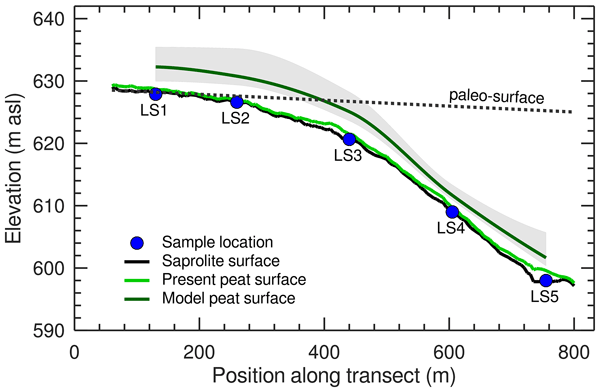
Studying peatlands dynamics over long timescales requires a proxy for past peat cover. In this paper, we explore the use of cosmogenic nuclides to infer peat thicknesses averaged over 100 kyr timescales. We find that long-term peat thicknesses inferred from cosmogenic nuclides at an upland peatland site in the Belgian Ardennes are consistent with independent constraints, but exceed modern peat thicknesses. We attribute this discrepancy to peat degradation associated with historical land use.
Yanfei Li, Maud Henrion, Angus Moore, Sébastien Lambot, Sophie Opfergelt, Veerle Vanacker, François Jonard, and Kristof Van Oost
Biogeosciences, 22, 6369–6392, https://doi.org/10.5194/bg-22-6369-2025, https://doi.org/10.5194/bg-22-6369-2025, 2025
Short summary
Short summary
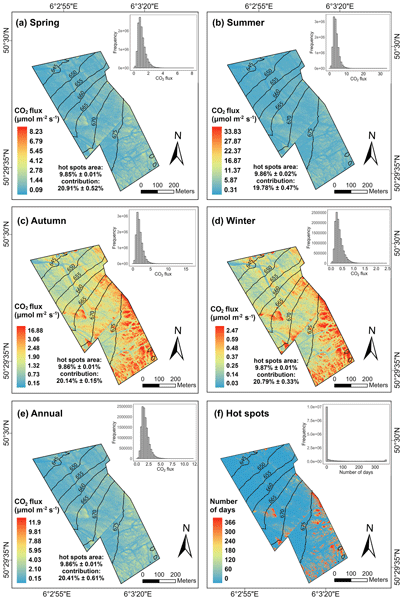
Combining Unmanned Aerial Vehicle (UAV) remote sensing with in-situ monitoring provides high spatial-temporal insights into CO2 fluxes from temperate peatlands. Dynamic factors (soil temperature and moisture) are the primary drivers contributing to 29 % of the spatial and 43 % of the seasonal variation. UAVs are effective tools for mapping daily soil respiration. CO2 fluxes from hot spots & moments contribute 20 % and 30 % of total CO2 fluxes, despite representing only 10 % of the area and time.
Angus Moore, Maud Henrion, Yanfei Li, Eléonore du bois d'Aische, Philip Gautschi, Marcus Christl, François Jonard, Sébastien Lambot, Kristof Van Oost, Sophie Opfergelt, and Veerle Vanacker
EGUsphere, https://doi.org/10.5194/egusphere-2026-36, https://doi.org/10.5194/egusphere-2026-36, 2026
This preprint is open for discussion and under review for Earth Surface Dynamics (ESurf).
Short summary
Short summary
Studying peatlands dynamics over long timescales requires a proxy for past peat cover. In this paper, we explore the use of cosmogenic nuclides to infer peat thicknesses averaged over 100 kyr timescales. We find that long-term peat thicknesses inferred from cosmogenic nuclides at an upland peatland site in the Belgian Ardennes are consistent with independent constraints, but exceed modern peat thicknesses. We attribute this discrepancy to peat degradation associated with historical land use.
Yanfei Li, Maud Henrion, Angus Moore, Sébastien Lambot, Sophie Opfergelt, Veerle Vanacker, François Jonard, and Kristof Van Oost
Biogeosciences, 22, 6369–6392, https://doi.org/10.5194/bg-22-6369-2025, https://doi.org/10.5194/bg-22-6369-2025, 2025
Short summary
Short summary
Combining Unmanned Aerial Vehicle (UAV) remote sensing with in-situ monitoring provides high spatial-temporal insights into CO2 fluxes from temperate peatlands. Dynamic factors (soil temperature and moisture) are the primary drivers contributing to 29 % of the spatial and 43 % of the seasonal variation. UAVs are effective tools for mapping daily soil respiration. CO2 fluxes from hot spots & moments contribute 20 % and 30 % of total CO2 fluxes, despite representing only 10 % of the area and time.
Richard F. Ott, Sean F. Gallen, and Darryl E. Granger
Geochronology, 4, 455–470, https://doi.org/10.5194/gchron-4-455-2022, https://doi.org/10.5194/gchron-4-455-2022, 2022
Short summary
Short summary
Cosmogenic nuclides are a tool to quantify denudation – the total removal of mass from near the Earth's surface. Chemical weathering can introduce biases to cosmogenic-nuclide-based denudation rates measurements. Here, we investigate the effects of weathering on cosmogenic nuclides and develop tools to correct for this influence. Our results highlight which additional measurements are required to determine accurate denudation rates in regions where weathering is not negligible.
Cited articles
Amidon, W. H., Farley, K. A., Burbank, D. W., and Pratt-Sitaula, B.: Anomalous cosmogenic 3He production and elevation scaling in the high Himalaya, Earth Planet. Sc. Lett., 265, 287–301, https://doi.org/10.1016/j.epsl.2007.10.022, 2008.
Argento, D. C., Reedy, R. C., and Stone, J. O.: Modeling the earth's cosmic radiation, Nucl. Instrum. Meth. B, 294, 464–469, https://doi.org/10.1016/j.nimb.2012.05.022, 2013.
Argento, D. C., Stone, J. O., Reedy, R. C., and O'Brien, K.: Physics-based modeling of cosmogenic nuclides part I – Radiation transport methods and new insights, The CRONUS-EARTH Volume: Part I, Quat. Geochronol., 26, 29–43. https://doi.org/10.1016/j.quageo.2014.09.004, 2015a.
Argento, D. C., Stone, J. O., Reedy, R. C., and O'Brien, K.: Physics-based modeling of cosmogenic nuclides part II – Key aspects of in-situ cosmogenic nuclide production, The CRONUS-EARTH Volume: Part I, Quat. Geochronol., 26, 44–55, https://doi.org/10.1016/j.quageo.2014.09.005, 2015b.
Balco, G.: Production rate calculations for cosmic-ray-muon-produced 10Be and 26Al benchmarked against geological calibration data, Quat. Geochronol., 39, 150–173, https://doi.org/10.1016/j.quageo.2017.02.001, 2017.
Bevington, P. R. and Robinson, D. K.: Data reduction and error analysis for the physical sciences, WCB McGraw-Hill, New York, ISBN 9780079112439/0079112439, 1992.
Blanckenburg, F. von and Willenbring, J. K.: Cosmogenic Nuclides: Dates and Rates of Earth-Surface Change, Elements, 10, 341–346, https://doi.org/10.2113/gselements.10.5.341, 2014.
Blard, P.-H., Braucher, R., Lavé, J., and Bourlès, D.: Cosmogenic 10Be production rate calibrated against 3He in the high Tropical Andes (3800–4900 m, 20–22° S), Earth Planet. Sc. Lett., 382, 140–149, https://doi.org/10.1016/j.epsl.2013.09.010, 2013.
Corbett, L. B., Bierman, P. R., Rood, D. H., Caffee, M. W., Lifton, N. A., and Woodruff, T. E.: Cosmogenic surface production ratio in Greenland, Geophys. Res. Lett., 44, 1350–1359, 2017.
Gayer, E., Pik, R., Lavé, J., France-Lanord, C., Bourlès, D., and Marty, B.: Cosmogenic 3He in Himalayan garnets indicating an altitude dependence of the production ratio, Earth Planet. Sc. Lett., 229, 91–104. https://doi.org/10.1016/j.epsl.2004.10.009, 2004.
Granger, D. E., Lifton, N. A., and Willenbring, J. K.: A cosmic trip: 25 years of cosmogenic nuclides in geology, Geol. Soc. Am. Bull., 125, 1379–1402, https://doi.org/10.1130/B30774.1, 2013.
Halsted, C. T., Bierman, P. R., and Balco, G.: Empirical Evidence for Latitude and Altitude Variation of the In Situ Cosmogenic Production Ratio, Geosciences, 11, 402, https://doi.org/10.3390/geosciences11100402, 2021.
Lal, D. and Peters, B.: Cosmic Ray Produced Radioactivity on the Earth, in: Kosmische Strahlung II/Cosmic Rays II, Handbuch der Physik/Encyclopedia of Physics, edited by; Sitte, K., Springer Berlin Heidelberg, https://doi.org/10.1007/978-3-642-46079-1_7, pp. 551–612, 1967.
Leontaritis, A. D., Pavlopoulos, K., Marrero, S. M., Ribolini, A., Hughes, P. D., and Spagnolo, M.: Glaciations on ophiolite terrain in the North Pindus Mountains, Greece: New geomorphological insights and preliminary 36Cl exposure dating, Geomorphology, 413, 108335, https://doi.org/10.1016/j.geomorph.2022.108335, 2022.
Lifton, N., Sato, T., and Dunai, T. J.: Scaling in situ cosmogenic nuclide production rates using analytical approximations to atmospheric cosmic-ray fluxes, Earth Planet. Sc. Lett., 386, 149–160, 2014.
Marrero, S. M., Phillips, F. M., Borchers, B., Lifton, N., Aumer, R., and Balco, G.: Cosmogenic nuclide systematics and the CRONUScalc program, Quat. Geochronol., 31, 160–187, 2016.
Masarik, J. and Beer, J.: An updated simulation of particle fluxes and cosmogenic nuclide production in the Earth's atmosphere, J. Geophys. Res., 114, D11103, https://doi.org/10.1029/2008JD010557, 2009.
Moore, A.: magnesiowustite/Altitude-scaling-of-Cl-36-production-from-Fe: Scaling Codes (1.0), Zenodo [code and data set], https://doi.org/10.5281/zenodo.13925210, 2024.
Moore, A. K. and Granger, D. E.: Calibration of the production rate of cosmogenic 36Cl from Fe, Quat. Geochronol., 51, 87–98, https://doi.org/10.1016/j.quageo.2019.02.002, 2019a.
Moore, A. K. and Granger, D. E.: Watershed-averaged denudation rates from cosmogenic 36Cl in detrital magnetite, Earth Planet. Sc. Lett., 527, 115761, https://doi.org/10.1016/j.epsl.2019.115761, 2019b.
Moore, A. K., Méndez Méndez, K., Hughes, K. S., and Granger, D. E.: Volcanic Arc Weathering Rates in the Humid Tropics Controlled by the Interplay Between Physical Erosion and Precipitation, AGU Advances, 5, e2023AV001066, https://doi.org/10.1029/2023AV001066, 2024.
Nishiizumi, K., Winterer, E. L., Kohl, C. P., Klein, J., Middleton, R., Lal, D., and Arnold, J. R.: Cosmic ray production rates of 10Be and 26Al in quartz from glacially polished rocks, J. Geophys. Res., 94, 17907–17915, https://doi.org/10.1029/JB094iB12p17907, 1989.
Nishiizumi, K., Imamura, M., Caffee, M. W., Southon, J. R., Finkel, R. C., and McAninch, J.: Absolute calibration of 10Be AMS standards, Nucl. Instrum. Meth. B, 258, 403–413, https://doi.org/10.1016/j.nimb.2007.01.297, 2007.
Phillips, F. M.: Cosmogenic nuclide data sets from the Sierra Nevada, California, for assessment of nuclide production models: I. Late Pleistocene glacial chronology, Quat. Geochronol., 35, 119–129, https://doi.org/10.1016/j.quageo.2015.12.003, 2016.
Phillips, F. M., Stone, W. D., and Fabryka-Martin, J. T.: An improved approach to calculating low-energy cosmic-ray neutron fluxes near the land/atmosphere interface, Chem. Geol., 175, 689–701, https://doi.org/10.1016/S0009-2541(00)00329-6, 2001.
Phillips, F. M., Zreda, M., Plummer, M. A., Elmore, D., and Clark, D. H.: Glacial geology and chronology of Bishop Creek and vicinity, eastern Sierra Nevada, California, Geol. Soc. Am. Bull., 121, 1013–1033, https://doi.org/10.1130/B26271.1, 2009.
Reedy, R. C.: Cosmogenic-nuclide production rates: Reaction cross section update, Proceedings of the Twelfth International Conference on Accelerator Mass Spectrometry, Wellington, New Zealand, 20–25 March 2011, Nucl. Instrum. Meth. B,, 294, 470–474, https://doi.org/10.1016/j.nimb.2011.08.034, 2013.
Sato, T., Yasuda, H., Niita, K., Endo, A., and Sihver, L.: Development of PARMA: PHITS-based Analytical Radiation Model in the Atmosphere, Radiat. Res., 170, 244–259, https://doi.org/10.1667/RR1094.1, 2008.
Schiekel, T., Sudbrock, F., Herpers, U., Gloris, M., Leya, I., Michel, R., Synal, H.-A., and Suter, M.: On the production of 36Cl by high energy protons in thin and thick targets, Nucl. Instrum. Meth. B, 113, 484–489, 1996.
Schimmelpfennig, I., Williams, A., Pik, R., Burnard, P., Niedermann, S., Finkel, R., Schneider, B., and Benedetti, L.: Inter-comparison of cosmogenic in-situ 3He, 21Ne and 36Cl at low latitude along an altitude transect on the SE slope of Kilimanjaro volcano (3° S, Tanzania), Quat. Geochronol., 6, 425–436, https://doi.org/10.1016/j.quageo.2011.05.002, 2011.
Sharma, P., Kubik, P. W., Fehn, U., Gove, H. E., Nishiizumi, K., and Elmore, D.: Development of 36Cl standards for AMS, Nucl. Instrum. Meth. B, 52, 410–415, https://doi.org/10.1016/0168-583X(90)90447-3, 1990.
Stone, J. O., Air pressure and cosmogenic isotope production, J. Geophys. Res., 105, 23753–23759, https://doi.org/10.1029/2000JB900181, 2000.
Uppala, S. M., KÅllberg, P. W., Simmons, A. J., Andrae, U., Bechtold, V. D. C., Fiorino, M., Gibson, J. K., Haseler, J., Hernandez, A., Kelly, G. A., Li, X., Onogi, K., Saarinen, S., Sokka, N., Allan, R. P., Andersson, E., Arpe, K., Balmaseda, M. A., Beljaars, A. C. M., Berg, L. V. D., Bidlot, J., Bormann, N., Caires, S., Chevallier, F., Dethof, A., Dragosavac, M., Fisher, M., Fuentes, M., Hagemann, S., Hólm, E., Hoskins, B.J., Isaksen, L., Janssen, P. A. E. M., Jenne, R., Mcnally, A. P., Mahfouf, J.-F., Morcrette, J.-J., Rayner, N. A., Saunders, R. W., Simon, P., Sterl, A., Trenberth, K. E., Untch, A., Vasiljevic, D., Viterbo, P., Woollen, J.: The ERA-40 re-analysis, Q. J. Roy. Meteor. Soc., 131, 2961–3012, https://doi.org/10.1256/qj.04.176, 2005.
Zweck, C., Zreda, M., and Desilets, D.: Snow shielding factors for cosmogenic nuclide dating inferred from Monte Carlo neutron transport simulation, Earth Planet. Sc. Lett., 379, 64–71, 2013.
Short summary
Cosmogenic nuclide geochronology requires accurately scaling production rates with altitude. The energy spectrum of cosmic radiation changes with altitude, and reactions that are sensitive to different energies may have different scaling behavior. Here, we model the altitude scaling of 36Cl production from Fe and evaluate this model against calibration data. The data are broadly consistent with the prediction of larger-altitude scaling factors for 36Cl from Fe than for other reactions.
Cosmogenic nuclide geochronology requires accurately scaling production rates with altitude. The...